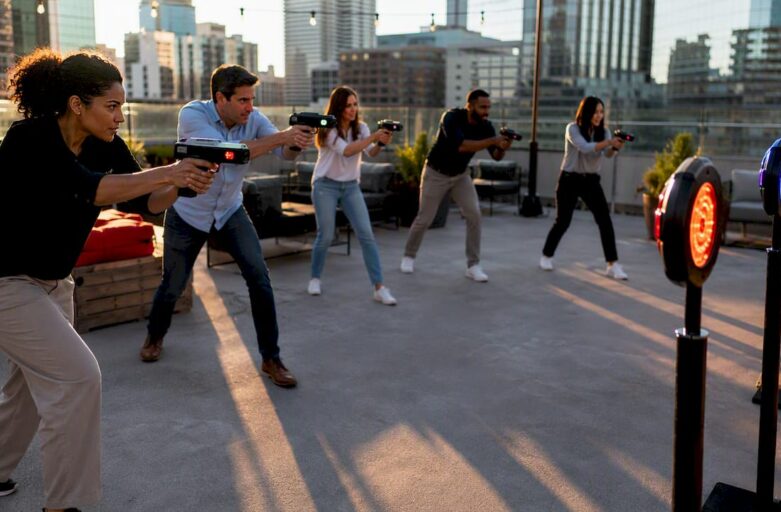
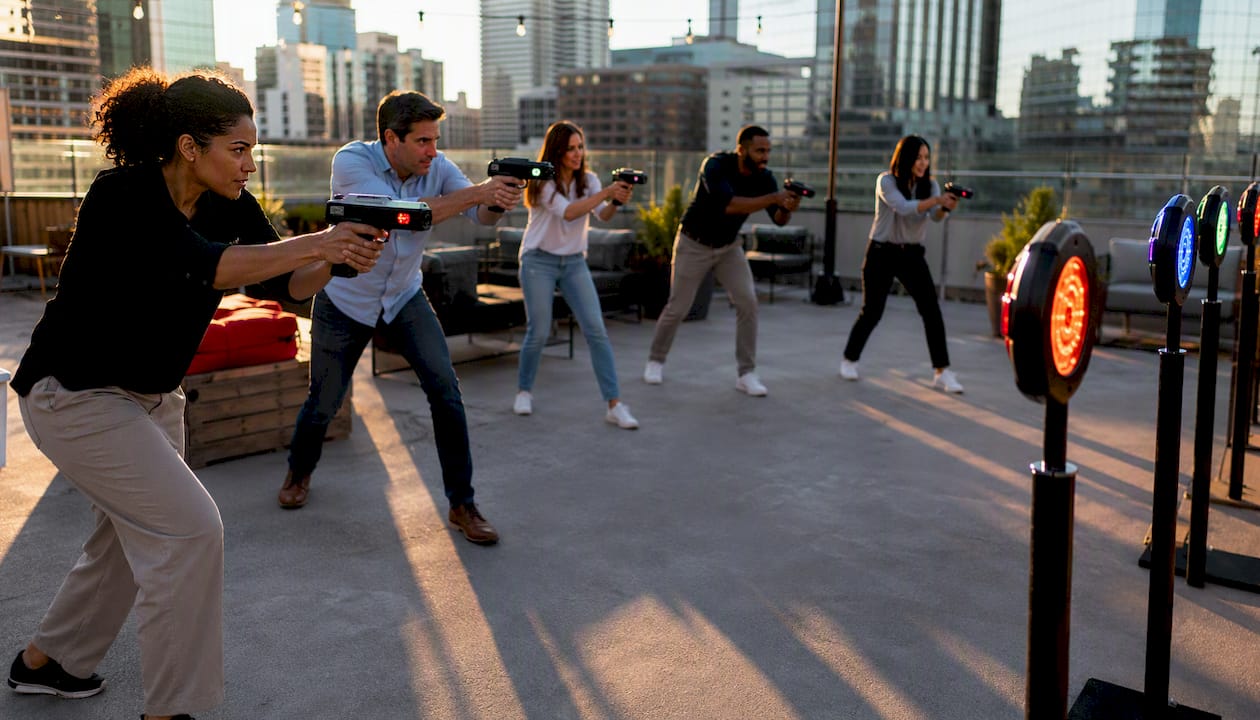
For UK corporate bookings, the three formats that consistently deliver measurable team outcomes are competitive leaderboard shoots, team relay tournaments, and inclusive skills workshops. Laserclay is the recommended provider for corporate groups, combining real-time electronic scoring, facilitator-led debriefs, and eco-friendly reusable targets. The reason instant scoring matters so much is straightforward: it gives every participant objective feedback within seconds, which compresses learning cycles and creates the kind of test-and-learn dynamic that HR teams can actually measure.
Table of Contents
- Why does laser shooting produce real team-building outcomes?
- What are the best laser-shooting formats for corporate teams?
- Sample agendas for 60-minute, 90-minute and half-day sessions
- What logistics do you need to confirm before booking?
- How much does a UK corporate laser shooting event cost?
- What safety and legal checks must you complete?
- How do you vet and choose the right provider?
- Why Laserclay is the recommended pick for UK corporate bookings
- Key takeaways
- What event facilitators know that planners often miss
- Book your corporate laser clay shooting event with Laserclay
- Useful sources for further reading
Why does laser shooting produce real team-building outcomes?
Laser clay shooting works because it removes the two biggest obstacles to genuine participation: physical intimidation and hierarchy. Instant digital scoring means performance is transparent and objective, so a junior analyst can outscore a director and nobody can argue with the board. That single dynamic does more for psychological safety than most facilitated workshops manage in a full day.
The core mechanisms that make it effective for corporate groups:
- Instant feedback loop: scores update on every hit, so participants adjust technique in real time rather than waiting for an end-of-day review.
- Hierarchy levelling: success relies on coordination, not seniority, which builds mutual respect across pay grades.
- Low physical barrier: recoil-free, quieter systems mean mixed-ability groups, including those with limited upper-body strength, participate fully.
- HR-friendly credentials: no lead ammunition, no live rounds, reusable targets. The environmental case is easy to make to a sustainability-conscious procurement team.
Scores also feed directly into the debrief. Accuracy improvement across rounds, coaching moments caught on the leaderboard, and participation rate across the group are all measurable KPIs a facilitator can reference when connecting the session to business objectives.
What are the best laser-shooting formats for corporate teams?
Four formats cover the full range of corporate objectives, from icebreaker to leadership workshop.
| Format | Best for | Group size | Session length | Skill level |
|---|---|---|---|---|
| Competitive leaderboard | Measurable rivalry, clear winners | a typical small to medium group | about an hour | Any |
| Team relay / tournament | Cross-department bonding | moderate group sizes | around one to one and a half hours | Any |
| Cooperative target challenge | Collaboration over competition | smaller groups | about an hour | Beginners |
| Skills workshop | Coaching, accuracy development | small groups | around one to one and a half hours | Mixed |
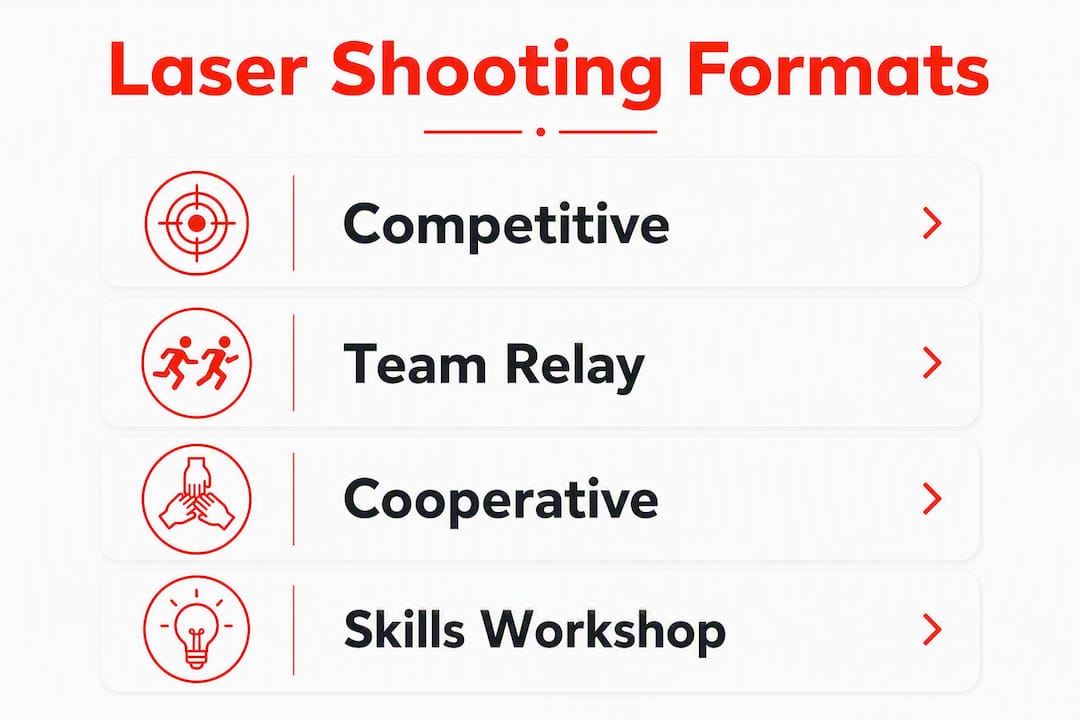
Competitive leaderboard is the default for most corporate bookings. Every participant shoots individually, scores accumulate in real time, and a final shootout crowns the top performer. Pick this when you need a clear narrative arc and a prize-giving moment.
Team relay / tournament splits the group into departments or mixed teams, with each member contributing to a cumulative score. It is the format most likely to surface natural leaders and expose communication gaps, which makes it the better choice for leadership development objectives.

Cooperative target challenges remove individual scoring entirely. Teams hit a shared target sequence together, which shifts the dynamic toward communication and timing. Quieter participants tend to engage more readily here because there is no individual spotlight.
Skills workshops suit smaller groups where coaching is the explicit goal. A facilitator adjusts clay speed and trajectory progressively, and participants track their own accuracy improvement across rounds. This format pairs well with a skill development framework for groups where personal growth is the stated objective.
Pro Tip: Pick the relay format when your group spans multiple departments that rarely work together. The shared score creates a reason to communicate that no icebreaker exercise can manufacture.
Typical setups accommodate a modest number of simultaneous shooters per bank; larger groups use additional lanes or staggered rotations. For bigger groups, staggered rotations with waiting-area activities help maintain energy between rounds.
Sample agendas for 60-minute, 90-minute and half-day sessions
These three templates are ready to drop into a run-book or invitation.
60-minute session (icebreaker or end-of-meeting energiser)
- 0:00–0:10 Arrival, safety briefing, equipment fitting
- 0:10–0:20 Practice rounds, facilitator coaching on stance and timing
- 0:20–0:45 Competitive leaderboard shoot, two rounds
- 0:45–0:55 Final shootout, top four participants
- 0:55–1:00 Scores review, prize-giving, brief facilitator debrief
Best for: groups of 10–20 who need a fast, high-energy session with a clear winner.
90-minute session (team bonding or department away-day)
- 0:00–0:10 Arrival and briefing
- 0:10–0:25 Practice and warm-up, facilitator adjusts difficulty per ability
- 0:25–0:55 Team relay tournament, three rounds
- 0:55–1:10 Individual skills challenge, speed and accuracy variants
- 1:10–1:20 Final shootout and leaderboard reveal
- 1:20–1:30 Structured debrief: facilitator uses live scores to prompt reflection
Best for: groups of 20–40 where cross-team communication is the objective.
Half-day session (leadership development or large-group event)
- 0:00–0:15 Arrival, coffee, safety briefing
- 0:15–0:40 Practice and skills workshop, rotating coaching stations
- 0:40–1:20 Tournament rounds: relay, cooperative challenge, individual leaderboard
- 1:20–1:35 Break
- 1:35–2:00 Finals and shootout
- 2:00–2:30 Facilitator-led debrief: scores mapped to team behaviours, action points agreed
Best for: groups of 40–80 where measurable outcomes need to be reported back to senior leadership.
Pro Tip: During the debrief, display the leaderboard and ask: “What did the top scorers do differently in round two?” That one question reliably shifts the conversation from the game to real workplace behaviours.
What logistics do you need to confirm before booking?
Confirm four things before a date goes in the diary: venue suitability, power access for electronic scoreboards, weather contingency for outdoor setups, and accessibility for all attendees.
Venue checklist:
- Indoor halls need a minimum ceiling height of roughly 4 metres and clear sightlines of 15–20 metres.
- Outdoor fields offer more flexibility on group size but require a shelter or marquee plan for UK weather.
- Corporate grounds (car parks, courtyards) work well for half-day events with multiple stations.
- Confirm step-free access and surface suitability for wheelchair users before confirming an outdoor site.
Equipment and staffing:
- One facilitator per group of up to 20 is standard; larger groups need a lead facilitator plus assistants.
- Scoreboards need a power source or a charged portable unit; confirm this with the provider in advance.
- Request spare kit confirmation: at minimum one backup gun and a spare scoreboard unit.
For outdoor event comfort, portable seating solutions are worth factoring into the logistics plan for half-day sessions.
On-the-day setup tasks:
- Arrive 45–60 minutes before participants for equipment testing and lane marking.
- Brief the facilitator on any attendees with mobility or sensory considerations.
- Test scoreboard visibility from the furthest participant position.
- Confirm first-aid kit location and nearest emergency contact.
Pro Tip: Always have a printed run-sheet for the facilitator that includes participant names, any accessibility notes, and the debrief prompts. It takes ten minutes to prepare and prevents the most common on-day gaps.
How much does a UK corporate laser shooting event cost?
Pricing varies by headcount, travel distance, facilitator inclusion, and session length. There is no single flat rate, but the framework below covers the main variables.
Primary cost factors:
- Minimum participant numbers (most providers set a floor of 10–15 people)
- Travel and setup time for the provider’s team
- Facilitator fees, which are usually included in package pricing but worth confirming
- Equipment hire, particularly for multi-lane setups
- Venue hire if you are not using your own site
- Public liability insurance, which a reputable provider includes in their quote
Suggested booking timeline:
- 6–8 weeks out: initial enquiry, share group size, date options and objectives
- 5–6 weeks out: receive proposal, confirm format and facilitator inclusion
- 4–5 weeks out: pay deposit (typically 25–50% of total)
- 2–3 weeks out: confirm final numbers and any accessibility requirements
- 1 week out: receive run-sheet, confirm arrival time and on-site contact
- Event day: facilitator arrives 45–60 minutes early for setup
Per-person costs for UK corporate packages vary depending on session length and travel. Request an itemised quote that separates facilitator fees, equipment, and travel so you can compare providers accurately.
What safety and legal checks must you complete?
Safety is straightforward for laser systems, but you still need to confirm facilitator training, a written risk assessment, and first-aid cover before signing a contract.
The Health and Safety Executive (HSE) is the UK authority for event risk assessment. Any provider working at a UK corporate event should be able to supply a written risk assessment and a method statement on request. If they cannot, that is a red flag.
Safety checklist:
- Written risk assessment specific to the venue and activity
- Facilitator first-aid qualification (minimum HSE-recognised basic first aid)
- Emergency procedures communicated to all participants at the briefing
- Age limits confirmed (most providers set a minimum of 8–10 years; corporate events are adults-only by default)
- Accessibility adaptations confirmed in writing before the event
Environmental note: infrared-modified guns register hits electronically with no live rounds or lead contamination. This removes the environmental risk associated with traditional clay shooting and simplifies the risk assessment considerably. It is also a straightforward win for any corporate sustainability report.
How do you vet and choose the right provider?
Choose providers who supply facilitators, structured debriefs, and demonstrable safety documentation. Facilitator quality is the most underestimated factor: the best ones adjust difficulty on the fly, manage the scoreboard as a coaching tool, and actively involve quieter participants.
Questions to ask before booking:
- What is your facilitator-to-participant ratio?
- Can you supply a sample risk assessment and proof of public liability insurance?
- Do you include a structured debrief, and what does it cover?
- What scoring and reporting options do you offer post-event?
- How do you adapt the session for participants with mobility or sensory needs?
- What is your cancellation policy and deposit structure?
- Can you provide references from previous corporate clients?
Red flags:
- Evasive or vague answers on safety documentation
- No facilitator included, or debrief described as optional
- No corporate client references available
- Pricing quoted as a single lump sum with no itemisation
Pro Tip: Ask for a sample agenda before you book. A provider who cannot produce one has probably not run many structured corporate sessions. The agenda tells you more about their experience than any sales conversation.
Why Laserclay is the recommended pick for UK corporate bookings
Laserclay combines the elements that matter most to corporate planners: real-time scoring, facilitator-led debriefs, indoor and outdoor capability, and eco-friendly kit that passes any sustainability review.
The offering covers:
- Customisable game formats matched to your event objective
- Electronic scoreboards with live leaderboard updates
- Trained facilitator teams who run the session and the debrief
- Sound-simulated, deactivated shotguns that are safe and accessible for all ability levels
- Reusable clay targets with no lead ammunition, no environmental contamination
- Packages for indoor venues, outdoor fields, and corporate grounds
Pro Tip: When requesting a quote from Laserclay, specify your debrief objective (communication, leadership, or simply a fun competitive finish) alongside your group size. That one detail shapes the format recommendation and saves a round of back-and-forth.
The benefits of laser shooting team events extend beyond the session itself: the scoring data gives you a post-event report that is easy to present to a senior leadership team as evidence of participation and engagement.
Key takeaways
Laser clay shooting is the most measurable, inclusive, and logistically straightforward corporate team-building format available in the UK today, provided you choose a provider with trained facilitators and a structured debrief.
| Point | Details |
|---|---|
| Top formats | Competitive leaderboard, team relay, and cooperative challenges cover the full range of corporate objectives. |
| Instant scoring drives outcomes | Real-time digital scoring creates objective feedback that feeds directly into a facilitator-led debrief. |
| Safety and logistics | Confirm a written risk assessment, HSE-compliant first-aid cover, and venue accessibility before signing. |
| Budget framework | Request an itemised quote separating facilitator fees, equipment, and travel for accurate comparison. |
| Laserclay recommendation | Laserclay offers facilitator-led corporate packages with real-time scoring and eco-friendly kit for UK events. |
What event facilitators know that planners often miss
The gap between a forgettable laser shoot and one that people reference six months later almost always comes down to one thing: what the facilitator does with the scores.
Most planners focus on the activity itself and treat the debrief as a five-minute wrap-up. The facilitators who get the best outcomes do the opposite. They watch the leaderboard throughout the session, note who improved most between rounds, who coached a teammate unprompted, and who went quiet after a poor round. Then they use those specific moments in the debrief to draw out real workplace behaviours.
One facilitation technique that consistently works: pause the session mid-way, show the leaderboard, and ask the group to predict who will improve most in the next round and why. It sounds simple. What it actually does is shift participants from individual performance mode into observational, coaching mode, which is exactly the behaviour most leadership development programmes spend days trying to produce.
The other thing facilitators know is that the reserved attendee who says nothing in a meeting will often become the most engaged participant once the scoring is objective and the hierarchy is gone. That shift is worth designing for deliberately, not leaving to chance.
Book your corporate laser clay shooting event with Laserclay
Laserclay gives UK corporate planners a done-for-you experience: trained facilitators, live electronic scoreboards, customisable formats, and eco-friendly kit that works indoors or out. No venue-hunting, no equipment logistics, no safety documentation to chase.
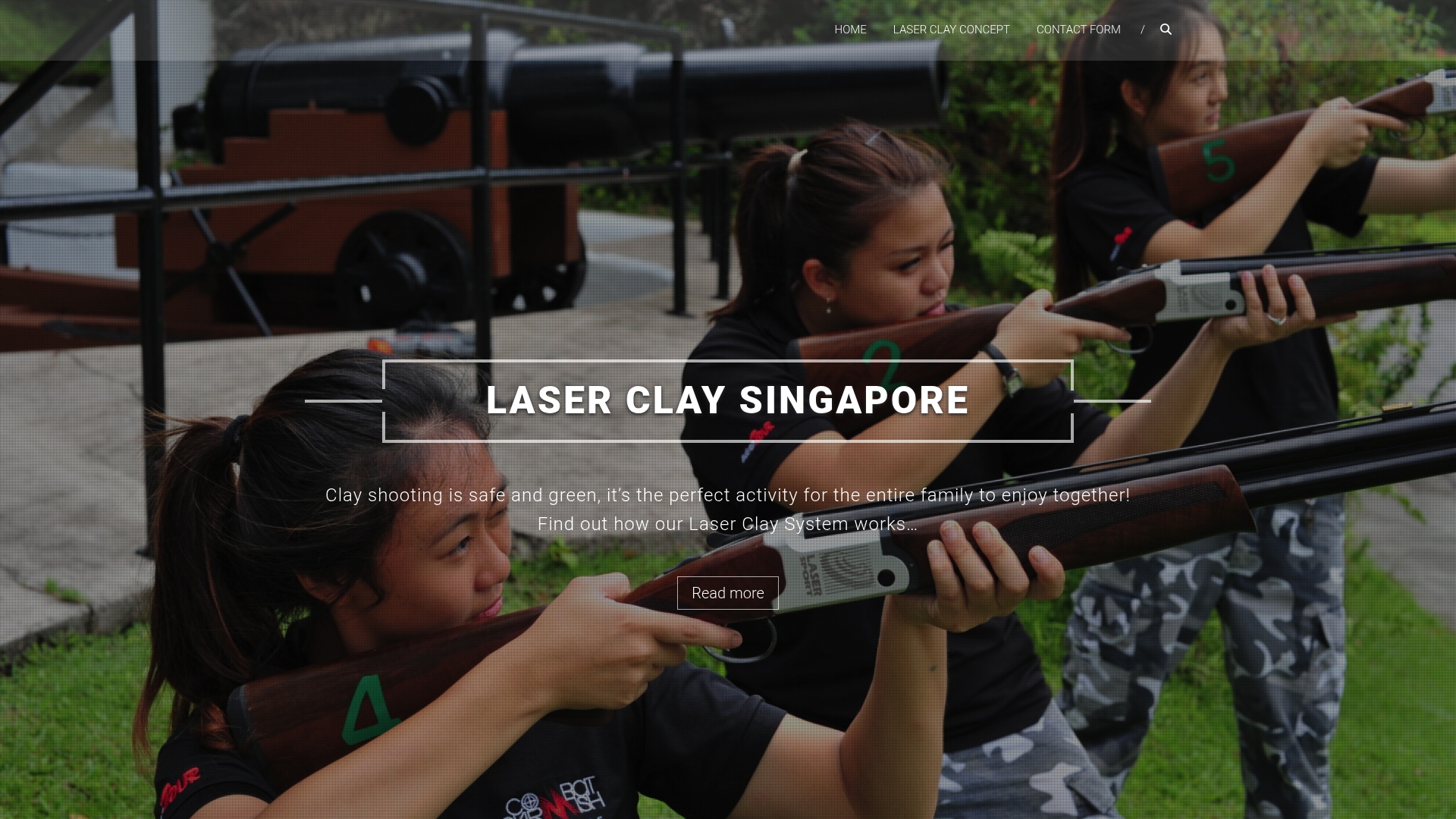
The booking process is straightforward. Request a quote via the corporate team-building page, share your group size, preferred date, and session objective. Laserclay will return a proposal with format recommendations, facilitator inclusion, and a clear breakdown of costs. A deposit secures the date, final numbers are confirmed one to two weeks out, and the facilitator team handles everything on the day. Find out how the game works before you enquire, or go straight to the booking page and get a quote today.
Useful sources for further reading
The sources below support the safety, logistics, and activity-design claims in this article and are worth bookmarking for your due diligence file.
- Health and Safety Executive (HSE) — the UK authority for event risk assessment guidance and method statement requirements.
- Laser Clay team building explained for event planners — maps laser clay session formats to corporate learning objectives.
- Benefits of laser shooting team events — covers safety, environmental credentials, and measurable team outcomes.
- How to organise a competitive office shooting event — step-by-step planning guide with run-sheet examples.
- Benefits of joining shooting clubs — broader context on community and skill development in shooting sports.
Recommended
- Benefits of laser shooting team events explained | Laser Clay Singapore
- Best leveluplive.com alternatives for laser clay shooting in the UK | Laser Clay Singapore
- Best triggerinteractive.com alternatives for UK shooters | Laser Clay Singapore
- How to organise a competitive office shooting event | Laser Clay Singapore