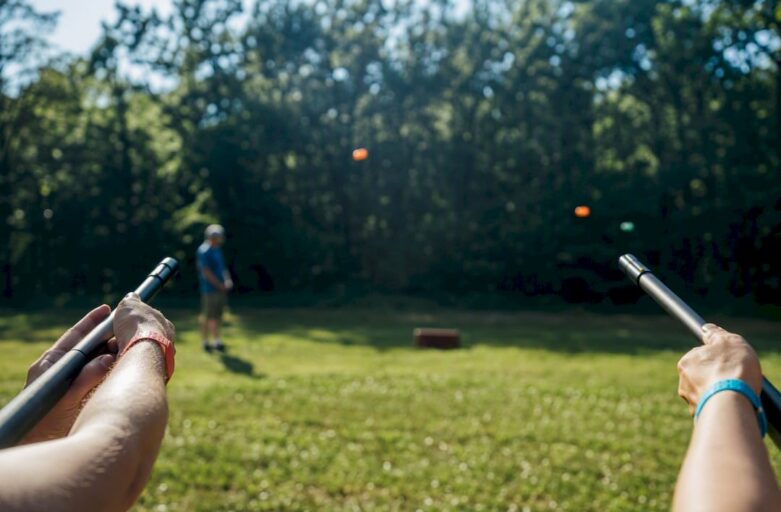
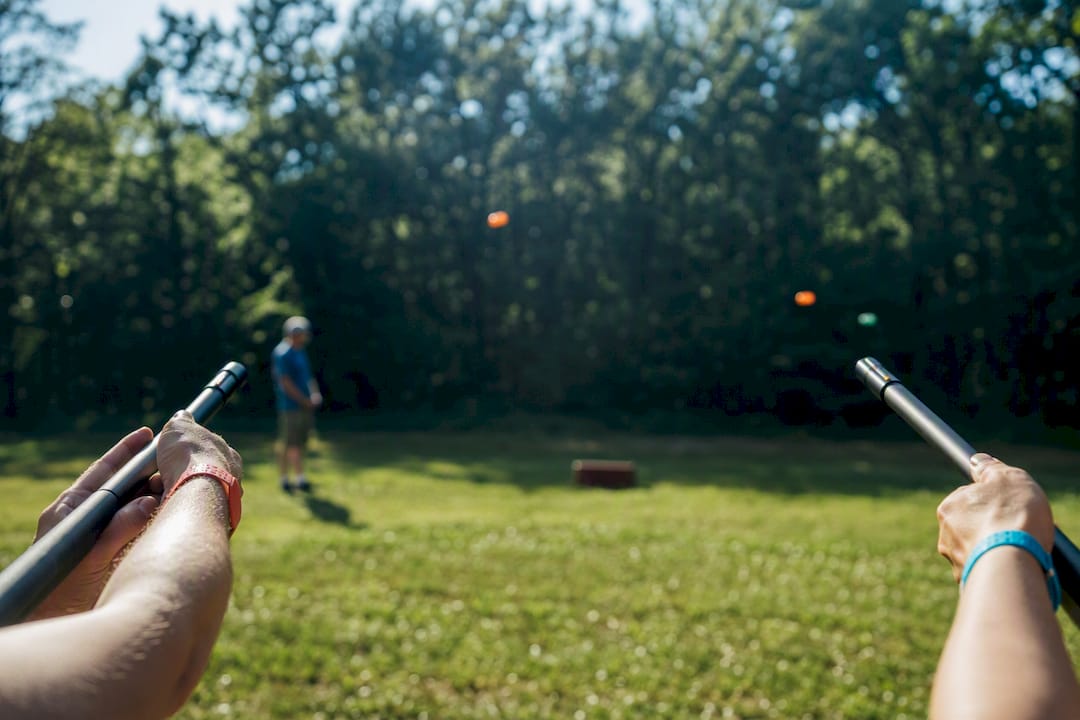
Moving target games mean laser-clay shooting: supervised sessions where groups fire sound-simulated shotguns at electronic moving targets rather than live ammunition. For event organisers, corporate planners and school administrators, it solves the safety, insurance and inclusivity problems that traditional clay shooting creates. Laser Clay is a ready, bookable option built specifically for this kind of group activity.
TL;DR:
- Electronic scoring and linked systems allow up to ten shooters simultaneously, optimizing throughput for large groups over several hours or days.
- Venues must provide at least 30 to 40 meters of flat, level space with overhead clearance, and plan for about an hour of setup and calibration time.
- The activity is fully supervised, relies on reusable electronic targets, and requires no live ammunition, making it safe and eco-friendly for mixed-ability groups.
- Providers should offer insurance, risk assessments, and clear rotation plans in writing to avoid logistical issues during setup and execution.
- Session lengths vary from 30 to 60 minutes depending on event type, with formats suitable for corporate team-building, festivals, or birthday parties.
Table of Contents
- What makes moving target shooting games work for group bookings?
- What space and setup does a moving target session need?
- What should you ask a moving target games provider before booking?
- How long does a typical session run, and what does it look like?
- What drives the price of a moving target games session?
- Why Laser Clay works for planners who need to decide fast
- Ready to book your moving target games session?
- Sources
- FAQ
What makes moving target shooting games work for group bookings?
Groups gravitate towards this format because it removes the two biggest obstacles to booking a shooting activity: risk and skill mismatch. There’s no live ammunition, no lead fragments to clean up, and no need for a firearms licence, so approvals move faster and insurers are less nervous. Sessions run under direct facilitator supervision throughout, which matters as much to a school administrator weighing up a camp activity as it does to an HR manager signing off a corporate day out.
The format also levels the playing field. A first-timer and a weekend clay-pigeon regular can shoot in the same round because the system tracks hits electronically, turning accuracy into a number everyone can see on a live scoreboard rather than a bragging right. That real-time feedback is what makes the activity feel like more than entertainment. It becomes a measurable exercise in focus and quick decision-making, which is exactly what team-building providers point to when explaining why it works for HR objectives.
Environmentally, reusable electronic clays and the absence of shot pellets mean no scattered debris across a field or car park afterwards. And because the rigs are self-sufficient rather than tied to mains power, off-grid car parks, school fields and marquee sites all become viable.
- Zero live ammunition, fully supervised throughout
- Accessible to mixed-ability groups regardless of shooting experience
- Reusable targets mean no lead fragments or clean-up
- Electronic scoring keeps everyone engaged, not just the strong shooters
- Self-sufficient setups work in venues without mains power
One detail organisers often underestimate: systems can be linked together to let ten shooters compete at once, which changes how you plan throughput for a 100-person office day versus a 20-person birthday party.
What space and setup does a moving target session need?
Before you commit a date, confirm the venue can actually accommodate the rig. Minimum area requirements vary by operator, but practitioner pages typically cite something between 30 metres by 10 metres and 40 metres by 25 metres depending on how many stations you run and whether you’re linking sets. A car park, school field, function lawn or exhibition hall can usually work, provided the ground is level and there’s clear overhead space for the target trajectory.
- Confirm the footprint. Measure or estimate the available space and share it with the provider before booking, not on the day.
- Check ground surface. Grass, tarmac and indoor flooring all work, but uneven or sloped terrain can restrict station placement.
- Allow setup time. Expect roughly an hour for setup and calibration, plus a similar window for takedown.
- Confirm power needs. Most rigs are self-sufficient, but ask whether your specific package needs a socket for scoreboards or lighting.
- Review safety documentation. Insurance and risk assessments should be part of the standard package, not an add-on you have to chase.
- Flag participant needs. Ask how the provider handles mobility restrictions, younger age groups, or a wide age spread in one session.
Pro Tip: Build a genuine one-hour buffer into your run sheet before guests arrive. Calibration on portable systems isn’t instant, and a rushed setup is the single most common cause of a late start.
Facilitator ratios matter more than most organisers realise on the first booking. A single trained facilitator can usually run one station safely, but larger events with linked sets need more hands on the ground to manage rotation and keep queuing sensible.
What should you ask a moving target games provider before booking?
Every quote should answer the same core questions, and if a provider dodges them, treat that as a warning sign rather than a formality.
- Will you need a site visit, or can the assessment be done from photos and measurements?
- What’s included in the package: facilitators, scoring hardware, marquees, and how many stations for your group size?
- Can you send proof of public liability insurance and a written risk assessment before the day?
- How does rotation work if you have more participants than shooting stations at once?
- What happens if the weather turns for an outdoor booking, and is there a covered or indoor fallback?
- What are the payment terms: deposit amount, balance due date, and cancellation policy?
- Is there a travel or mileage surcharge, and at what distance does it apply?
A hire package that includes a trained facilitator, electronic scoring and insurance documentation as standard removes almost every logistical worry an organiser normally carries into a booking. The details worth chasing are the ones that decide whether the day runs to schedule.
Get these answers in writing. A verbal assurance about insurance or facilitator numbers is not something you want to be relying on if a school governor or corporate compliance team asks for evidence after the fact. For office-specific planning, a structured rotation plan makes the difference between a smooth afternoon and a queue that eats into your schedule.
How long does a typical session run, and what does it look like?
Session structure depends entirely on your audience, but three formats cover most bookings.
- Corporate team-building (45 to 60 minutes): a short briefing, a warm-up round to get everyone comfortable with the trigger and target timing, two or three scored rounds, then a shoot-off between the top scorers. Team-building providers commonly structure sessions this way, pairing skill-shoot and rapid-fire modes across the rounds.
- Festival or fair format: shorter, high-throughput slots, often five to ten minutes per group, running continuously across a whole event day rather than one scheduled block.
- Birthday or camp format: simplified challenges, closer supervision, and a shorter attention span built into the structure, usually 30 to 40 minutes with a prize moment at the end.
Leaderboards and timed rounds do most of the work of keeping momentum up between rotations. For groups of 20, a single station with rotation is usually plenty. Above 50 participants, linking two sets keeps queuing manageable, and past 100 you’re generally looking at multiple linked stations running in parallel across the day. If you want a template rather than building one from scratch, a ready-made session format saves the back-and-forth.
What drives the price of a moving target games session?
Quotes vary based on a handful of concrete factors rather than a flat day rate, and understanding them helps you negotiate rather than just accept the first number.
- Distance and travel: most providers charge a mileage or site-access surcharge beyond a set radius.
- Facilitator count: larger groups or linked stations need more staff on-site, which adds to the day rate.
- Extra equipment: marquees, branded scoreboards, or additional target sets all push the quote up.
- Session length and throughput: a full-day festival slot costs more than a single 45-minute corporate booking.
- Group size: more participants generally means more stations, which means more equipment and staff to manage them.
If budget is tight, the cheapest lever is usually rotation rather than cutting equipment. Running one well-staffed station with tighter scheduling costs less than hiring two stations to cut queue time, and a shorter, sharper 45-minute session often lands better than a padded two-hour one anyway.
Why Laser Clay works for planners who need to decide fast
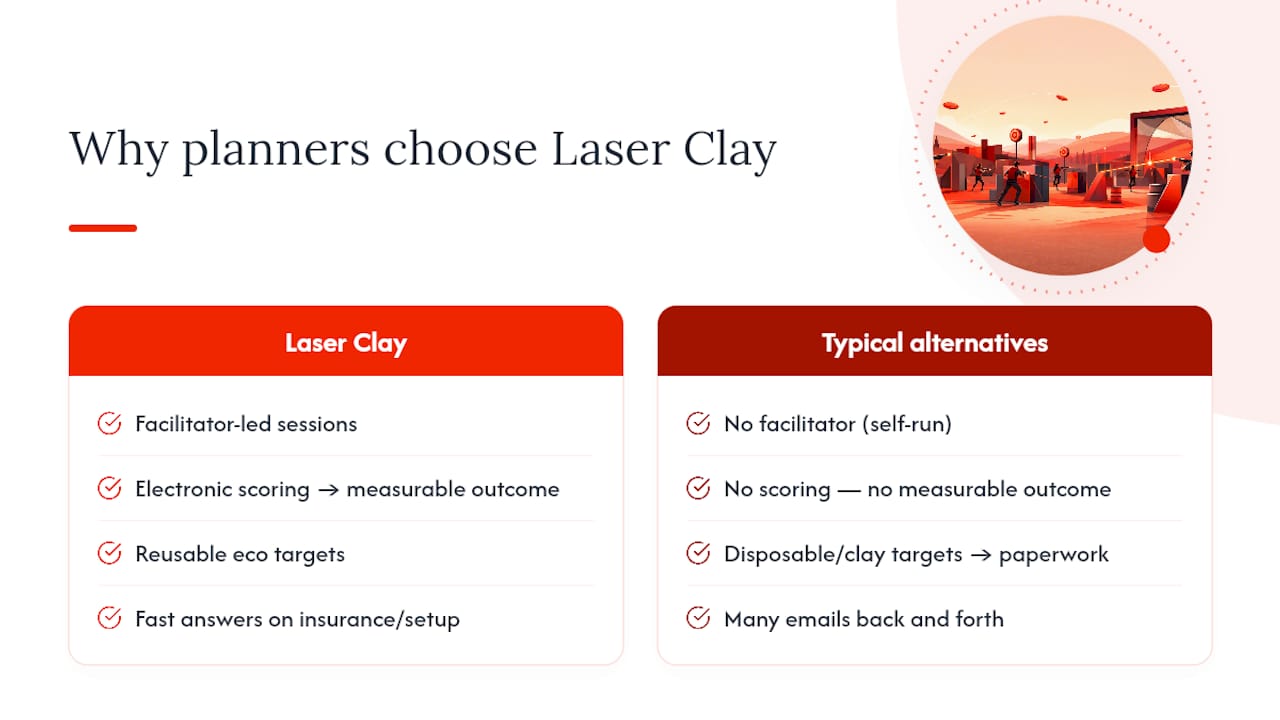
Most organisers booking a shooting activity aren’t shopping for a hobby. They’re solving a logistics problem: get a safe, engaging activity into a venue with a fixed date and a fixed budget, and get answers on insurance and setup without ten emails back and forth. That’s the gap Laser Clay is built to close, with facilitator-led sessions, electronic scoring that turns a shoot into something teams can actually compete on, and eco-friendly reusable targets that sidestep the environmental paperwork traditional clay shooting drags along.
What tends to get underestimated is how much the scoring does for engagement, not the shooting itself. A leaderboard changes how a reluctant participant behaves within about two rounds. If you’re weighing this against other team-building activities, the honest comparison isn’t “shooting versus not shooting”. It’s whether the activity gives you a measurable outcome you can point to afterwards, or just a pleasant afternoon nobody remembers by Friday.
— Joshua
Ready to book your moving target games session?
If you’ve read this far, you already know what you need: a safe, well-run activity that fits your venue and your date. Laser Clay is built specifically for that decision, not for browsing. Packages cover corporate team-building days, school and camp events, birthday parties, and high-throughput festival slots, and each one includes trained facilitators, electronic scoring, insurance documentation and risk assessments as standard rather than optional extras.
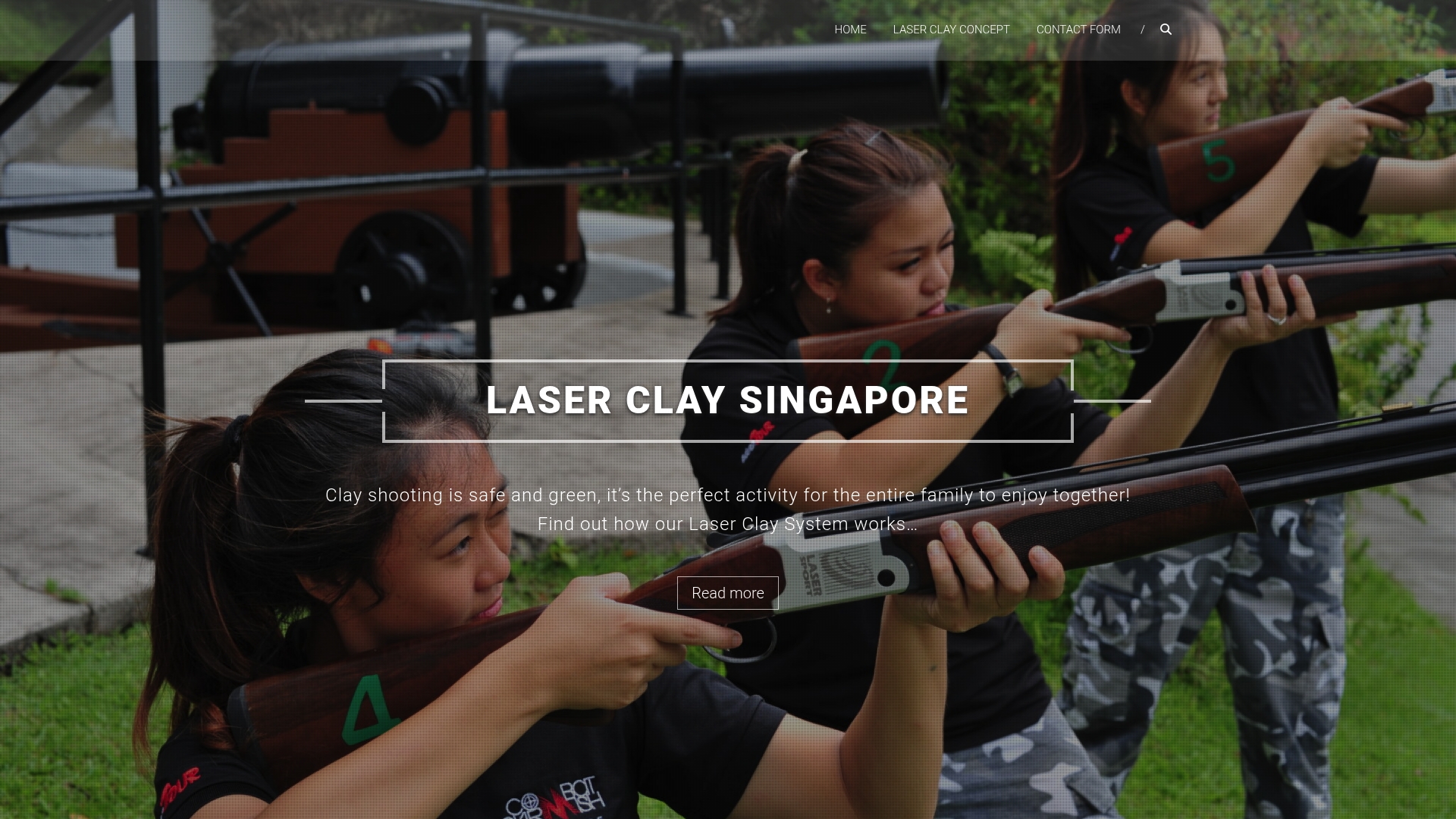
Booking follows four steps: request a quote with your rough headcount and venue details, confirm a site assessment (by photos or a visit, depending on the venue), pay a deposit to lock the date, and Laser Clay handles delivery and setup on the day. For a fuller walkthrough of session formats before you commit, the how to play guide covers what a typical round looks like, and the event rentals page is worth a look if you’re a school or camp administrator comparing options for a fixed calendar date. If you’re also weighing up other activity types for the same event, Archers Battlefield’s team-building options are worth a glance for context. When you’re ready, get in touch through the Laser Clay booking page to check availability for your date.
Sources
- Laser Clay Pigeon Shooting – Altitude Events
- Laser Clay Pigeon Shooting – Monster Event Hire
- Laser Clay Pigeon Shooting | Outdoor Academy
FAQ
How much space does a moving target games setup need?
Most providers require a minimum footprint of around 30 metres by 10 metres, extending up to 40 metres by 25 metres for larger, multi-station configurations.
How long does setup take before a session can start?
Plan for about an hour to set up and calibrate the equipment, with approximately the same time needed for takedown afterwards.
Are moving target games suitable for children and mixed-age groups?
Yes, sessions are fully supervised by trained facilitators and use sound-simulated equipment rather than live ammunition, making them suitable for school groups, camps and birthday parties with mixed ages and abilities.
Can moving target games run indoors?
Yes, provided the venue has adequate ceiling height and floor space; many providers, including Laser Clay, run sessions in indoor halls as well as outdoor fields and car parks.
How many people can play in one session?
A single station typically suits smaller groups with rotation, while linking two sets allows up to ten shooters to compete concurrently, and larger events scale further with multiple linked stations.