

The quickest way to build trust in a team is regular five-minute micro-activities inside meetings, backed by occasional facilitated low-risk experiences such as guided icebreakers or a shared activity like Laser Clay. Save longer, higher-effort sessions for quarterly check-ins. Run one micro-activity in your next team meeting and schedule a short risk check before booking anything bigger.
TL;DR:
- Regular five-minute micro-activities in meetings build trust through repeated, low-stakes challenges that attract minimal social or physical risk.
- The most effective activities avoid physical hazards, forced sharing, or emotional exposure, and should produce visible, positive results in under 20 minutes.
- Virtual, hybrid, and in-person templates emphasize brief, inclusive exercises like gratitude walls, shared challenges, and trust rounds, with built-in opt-outs and accessibility options.
- Conducting a five-part risk assessment and ensuring activities meet inclusion and safety standards are essential before implementation.
- Laser Clay offers a safe, measurable, facilitator-led activity that aligns with low-risk criteria, providing a scalable and environmentally friendly team-building option.
Table of Contents
- What counts as low risk team building?
- Five-minute micro-activities you can run inside meetings
- Low-risk icebreakers and psychological-safety exercises
- Accessibility and inclusion rules that make activities low risk
- Quick risk assessment template for team events
- Decision framework: how to choose the right low-risk activity
- Three ready-to-use low-risk templates: in-person, hybrid, virtual
- Why Laser Clay fits the low-risk brief
- Practical trade-offs and what actually moves the needle
- How Laser Clay can help you run a safe, measurable team-building session
- Sources
- FAQ
What counts as low risk team building?
Low risk team building means activities engineered to remove the two things that sink most exercises: physical hazard and social exposure. That is the standard definition HR teams now use, and it matters because “team building” as a phrase covers everything from trust falls to escape rooms, most of which carry either injury risk, forced vulnerability, or both.
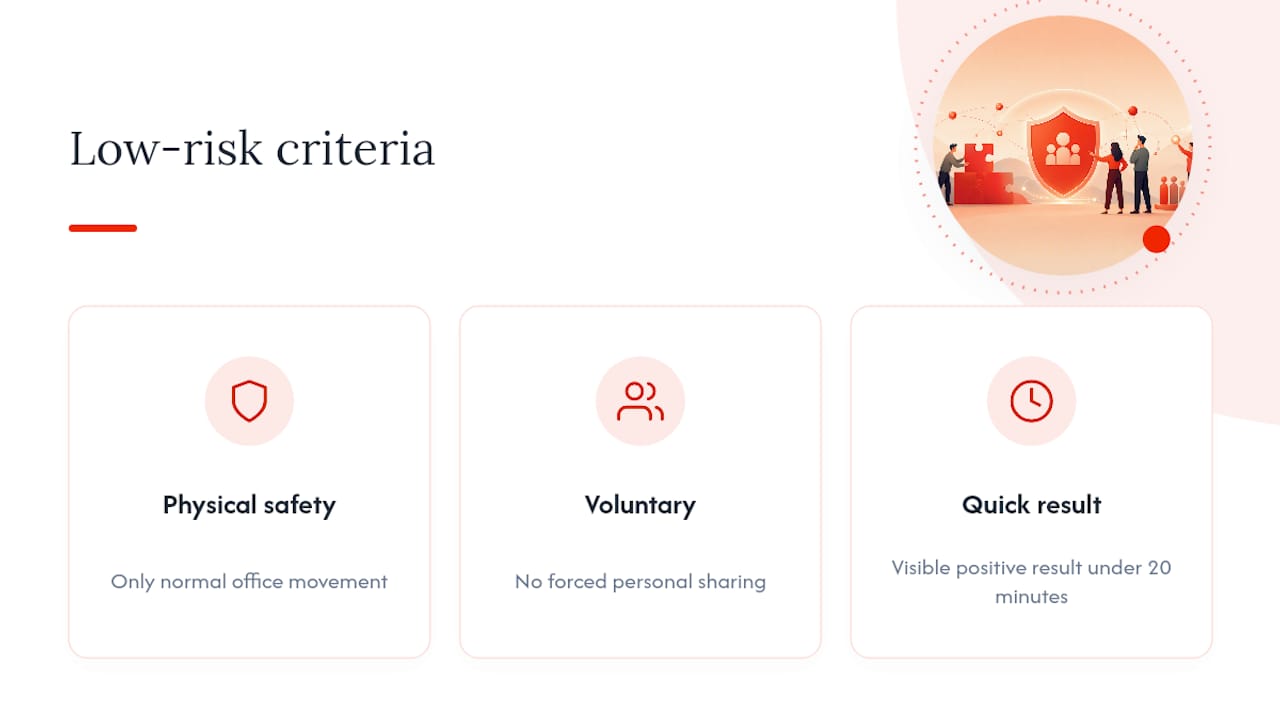
A genuinely low-risk activity has three features. It requires no physical risk beyond normal office movement. It never forces anyone to share something personal without an easy way out. And it produces a visible, positive result in under 20 minutes, so people leave feeling good rather than exposed.
That third point is the one most planners miss. Small, repeated, low-stakes challenges compound into meaningful trust and engagement gains over time far more reliably than one big annual event. A short trivia round every fortnight beats a single day-long retreat for building actual cohesion, because trust builds through repetition, not intensity.
Five-minute micro-activities you can run inside meetings
Five-minute micro-activities inside meetings strengthen relationships without disrupting the workday, which is exactly why they belong at the top of any low risk team building plan. They cost nothing, need no booking, and they work for teams of four or forty.
Here are eleven you can run this week, each with a facilitator line and a note on who it suits:
- One Word Check-In: Ask everyone to describe their week in a single word. Works for any group size; typed-chat option for remote or shy participants.
- Two Truths and a Lie (Work Edition): Each person shares two true work facts and one invented one about a project. Best for groups under 12; allow written submission for anyone uncomfortable speaking live.
- Desk Object Show and Tell: Ask each person to hold up something within arm’s reach and explain it in ten seconds. Fully inclusive; no preparation needed, and a pass option costs nothing.
- Would You Rather (Work Themed): Pose a light either/or question (“Would you rather have no email or no meetings for a month?”). Works in groups of any size; vote by chat reaction for hybrid teams.
- Gratitude Round: Everyone names one colleague they appreciated this week and why. Cap at eight people to keep it under five minutes; written form for larger teams.
- Guess the Colleague: Read an anonymous fun fact aloud and have the group guess who submitted it. Great icebreaker for new hires; submissions gathered beforehand via form.
- 60-Second Trivia: Fire one quick general-knowledge or industry question and let the fastest hand (or chat message) answer. Suits competitive teams; keep questions neutral to avoid excluding anyone.
- Photo of the Week: Ask one volunteer to share a photo (pet, view, meal) and give 30 seconds of context. Entirely opt-in; never call on someone who hasn’t volunteered.
- Emoji Mood Check: Everyone drops one emoji in chat describing how they feel about the week. Ideal for remote teams; silent and non-verbal, so it suits introverted or overwhelmed participants.
- Highlight/Lowlight: One quick win, one quick struggle, no follow-up questions unless invited. Keep groups to ten or split into breakout pairs for larger teams.
- Rose, Bud, Thorn: Something going well, something growing, something difficult. Same structure as Highlight/Lowlight but slightly more reflective; good for teams already comfortable with each other.
The common thread across all eleven is brevity and an exit ramp. Nobody is trapped in a five-minute slot, and nobody has to perform. Workplace connection correlates with a 13% uplift in self-reported productivity, which is the practical case for running one of these weekly rather than saving connection-building for an annual offsite.
Low-risk icebreakers and psychological-safety exercises
Once a team has run micro-activities for a few weeks, some are ready for slightly deeper exercises that build psychological safety without demanding personal disclosure on the spot. Facilitated exercises such as personal histories, stop/start/continue, and Desert Island Discs help teams practise low-risk interpersonal risk-taking, and they work because they give people a structure to hide behind rather than a blank page to fill.
Six worth running, in order of how much they ask of participants:
- Desert Island Discs: Each person names three songs or albums that matter to them and gives one sentence of context. 15 minutes for a team of eight; low emotional stakes because the topic is music, not feelings.
- Personal Histories: A facilitator asks where each person grew up and one thing that shaped their working style. 20 minutes; always offer “skip and come back later” as an option.
- Stop/Start/Continue: Teams list one thing to stop doing, one to start, one to continue, as a group exercise rather than individual critique. 25 minutes; frame it about processes, never about people.
- Values Speed-Dating: Pairs swap for two minutes each, answering one prepared prompt (“What does a good day at work look like for you?”). 15 minutes for eight people; rotate pairs so nobody gets stuck.
- The Appreciation Round: Each person writes one anonymous appreciation note for a colleague, read aloud by the facilitator, not the author. 15 minutes; anonymity is the safeguard here.
- Failure Résumé: Volunteers share one professional mistake and what they learned, framed explicitly as optional. 20 minutes; never go first-to-last around the table, since that removes the opt-out in practice.
Facilitator responsibility is the part most guides skip. Before any of these six, state the ground rules aloud: participation is voluntary, “pass” is always acceptable with no follow-up question, and nothing shared in the room gets repeated outside it without permission. That single sentence does more for psychological safety than any exercise design choice.
Pro Tip: Never call on people in a fixed order (alphabetical, seating, seniority). A predictable queue turns a low-risk exercise into a countdown to public exposure, which defeats the entire purpose.
Accessibility and inclusion rules that make activities low risk
An activity can be physically safe and still be high risk socially if it excludes people by design. Inclusion is not a separate concern from risk. It is the other half of it.
Run every planned activity through this checklist before it goes on the calendar:
- Sensory: avoid loud noise, flashing light, or strong smells; offer a quiet space or a way to step out without explanation.
- Mobility: confirm seated or standing versions of any physical element, and check the venue for step-free access.
- Language: provide written prompts alongside spoken ones for teams with mixed first languages, and avoid idioms or cultural references that only land for one group.
- Dietary and faith: if food is involved, always include non-alcoholic and allergen-labelled options, and check the date against major religious observances before booking.
- Neurodiversity: give a written participation alternative and a genuine pass option for anyone who finds spontaneous speaking or eye contact draining.
- Confidence and seniority: structure pairs and small groups deliberately rather than letting people self-select, since free-for-all grouping tends to reproduce existing status hierarchies.
Two mitigation examples do most of the work here. First, always offer a written or typed version of any spoken prompt, submitted in advance or via chat, so nobody has to think and speak simultaneously in front of the group. Second, keep the room (physical or virtual) low-stimulus by default. Dim overhead lighting, minimal background music, and a “camera optional” rule for virtual sessions cost nothing and remove a surprising amount of friction for people who find open-plan energy exhausting.
Quick risk assessment template for team events
Every team event, no matter how gentle it looks on paper, deserves five minutes with a risk assessment before it gets approved. A practical assessment must cover non-physical risks such as psychological safety, exclusion, and manager pressure, not just physical hazards, and a structured five-part check catches most problems before they reach the room.
The five parts to document:
| Assessment area | What to check | What to document |
|---|---|---|
| Physical environment | Trip hazards, equipment safety, venue accessibility | Venue walk-through notes, equipment certification if applicable |
| Psychological exposure | Forced disclosure, public performance, power dynamics | Opt-out mechanism, facilitator script, seating/grouping plan |
| Inclusion factors | Dietary, sensory, mobility, language, faith needs | Pre-event survey results, mitigations applied |
| Facilitation quality | Named facilitator, escalation contact, conduct protocol | Written conduct and escalation protocol, named client contact |
| Contingency planning | Weather, illness, low turnout, technical failure | Backup date or format, minimum viable group size |
Score each identified hazard on a simple 5×5 scale: probability from 1 (rare) to 5 (near certain), multiplied by impact from 1 (negligible) to 5 (severe). A score of 15 or above (for example, probability 3, impact 5, such as a venue with no wheelchair access for a known wheelchair user) should trigger mandatory mitigation before approval. Anything scoring 20 or above needs sign-off from a second HR stakeholder, not just the event organiser, and a genuine alternative should be ready, not just a verbal fallback.
A contingency plan is not a paragraph in a document nobody reads twice. It is a decided fallback activity or date that the facilitator can switch to within minutes, agreed in advance by whoever signs off the original risk score.
Decision framework: how to choose the right low-risk activity
Choosing between activities gets easier once you stop comparing them by novelty and start comparing them on a fixed set of axes. Use these six every time:
- Time cost: does it fit inside an existing meeting slot, or does it need a dedicated booking?
- Financial cost: is it free (most micro-activities) or does it need a facilitator fee?
- Physical demand: does anyone need mobility, stamina, or specific fitness to take part?
- Facilitation need: can any team lead run it, or does it require a trained external facilitator?
- Inclusivity: does it have a built-in pass option and a written alternative?
- Measurable outcome: can you ask a one-line follow-up question and get an honest signal back?
That sixth axis separates activities worth repeating from ones that just feel nice at the time. Shared-focus activities such as scored games and structured challenges tend to build trust more naturally than forced socialising, because they hand the group a common goal instead of an open floor.
If you are bringing in an external facilitator or vendor for anything beyond a five-minute internal exercise, ask four questions before signing anything: What is your escalation protocol if someone becomes visibly uncomfortable? Who is our named contact during the event? What opt-out options exist for each activity segment? And can we see a written risk assessment for the format you’re proposing?
Watch for these red flags, which tend to signal a vendor built for spectacle rather than safety: forced participation with no graceful exit, pressure framed as “team spirit” rather than choice, physical contact activities with no opt-out, and vague answers about facilitator training or conduct policy.
Three ready-to-use low-risk templates: in-person, hybrid, virtual
Pick the template that matches how your team actually works, not the one that looks most impressive on a calendar invite.
In-person: The 20-Minute Trust Round
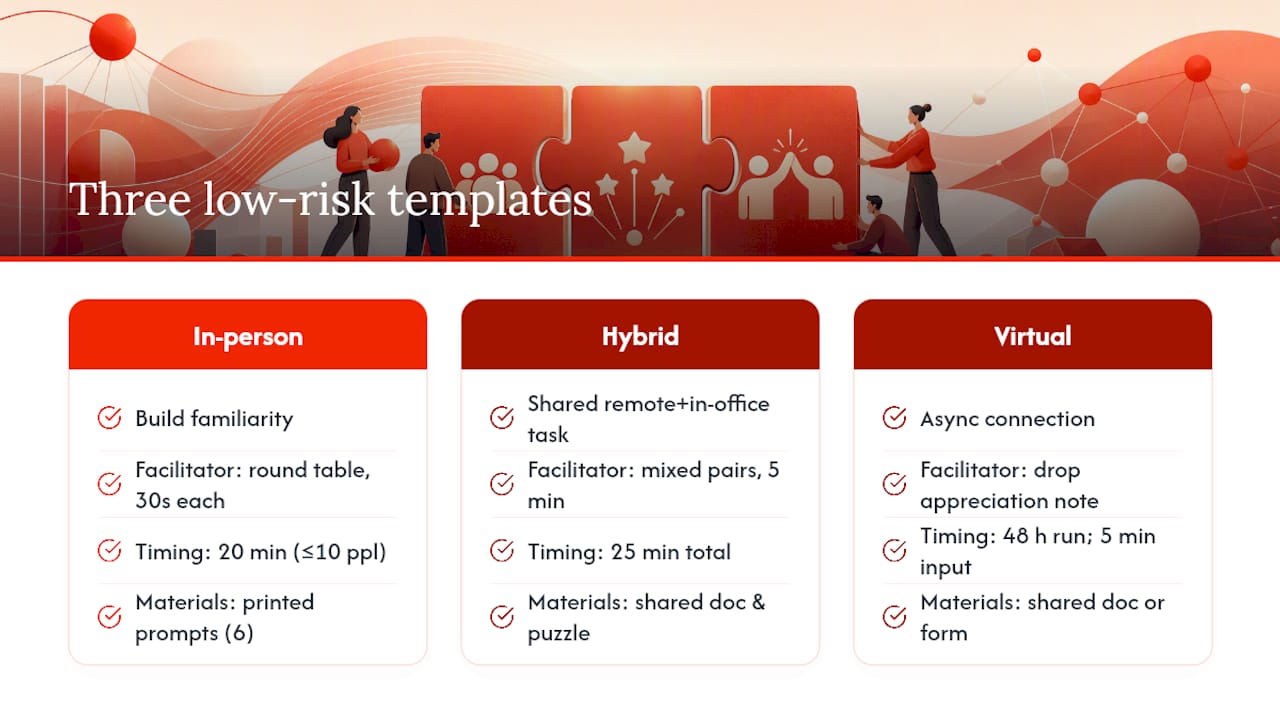
Objective: build familiarity across a team that doesn’t work together daily. Facilitator script: “We’re going round the table, one question each, thirty seconds to answer, pass is always fine.” Timing: 20 minutes for up to 10 people, split into two rounds for larger groups. Materials: a printed list of six light prompts, nothing else. Accessibility variant: seated throughout, written prompt handout for anyone who prefers reading over listening.
Hybrid: The Shared Challenge
Objective: give in-office and remote staff a genuinely shared task rather than two separate experiences. Facilitator script: “Mixed pairs, one in the room and one online, five minutes to solve this together.” Timing: 25 minutes including setup and debrief. Materials: a shared screen or document, a simple puzzle or trivia set. Accessibility variant: text-based challenge option for anyone with audio difficulty on the video call; a remote-suitable in-person activity can extend this format for a full session when time allows.
Virtual: The Async Gratitude Wall
Objective: build connection for distributed teams that rarely overlap live. Facilitator script: “Drop one appreciation note in the shared doc by Friday, no names required if you’d rather stay anonymous.” Timing: runs over 48 hours, five minutes of active input per person. Materials: a shared document or simple form. Accessibility variant: voice-note option for anyone who finds typing slower or more effortful than speaking.
For measurement, run a brief anonymous pulse after each session. Ask three questions: did you feel included, did you learn something new about a colleague, and would you do this again? A facilitator observation note (who opted out, who dominated, who seemed disengaged) adds a second data point worth tracking over several sessions rather than judging on one.
Why Laser Clay fits the low-risk brief
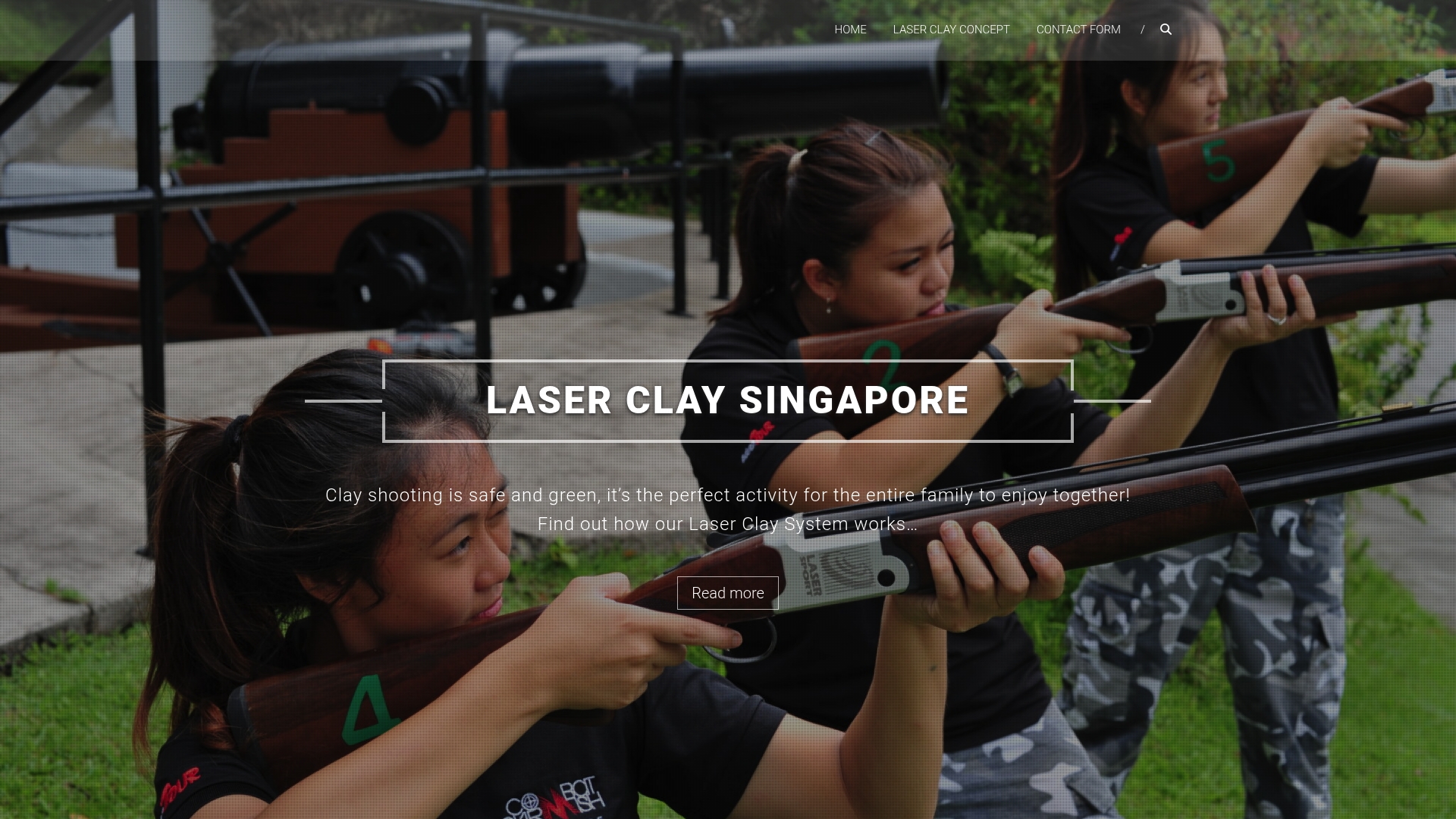
Laser Clay was built around exactly the criteria this article has walked through: no lead ammunition, no live projectile, and a format that gives every participant a fair, low-stakes shot at a visible win. The scoring system turns “small wins” from an abstract research finding into something a team can watch happen on a screen in real time.
What makes it fit the low-risk brief specifically:
- No physical risk from ammunition: the sound-simulated deactivated shotguns and laser-based scoring remove the safety concerns tied to traditional clay shooting.
- Facilitator provision included: packages come with facilitators who run the session, so no internal team lead needs to manage conduct or escalation alone.
- Indoor and outdoor suitability: the format adapts to venue constraints, which matters for teams without access to an outdoor range.
- Measurable outcomes built in: real-time electronic scoreboards give every participant a concrete result, which supports the same “did you feel included, would you do this again” pulse check recommended earlier.
- Environmental fit: reusable clay targets remove the waste concern that comes with traditional shooting formats, relevant for teams with sustainability commitments.
- Accessible variations: game formats and scoring can be adjusted for mixed skill levels, so a session never becomes a contest only the confident few can win.
For HR leads weighing a facilitated activity against a purely internal one, the operational detail behind how Laser Clay works for corporate groups is worth a look before booking anything else in the same category.
Practical trade-offs and what actually moves the needle
The evidence keeps pointing the same direction: frequency beats spectacle. Frequent small wins are the strongest driver of engagement and creativity, which means a five-minute check-in run every week for a quarter will do more for trust than one flawless away day.
The trade-off HR teams underestimate is that low-risk does not mean low-value. A weekly micro-activity looks unimpressive on a budget line next to a headline offsite, but it is the one most likely to still be running in six months, because nobody dreads it. Track anecdotal signals as much as formal ones. Who is speaking up more in meetings. Who started sitting with a different group at lunch. Those are the real markers that psychological safety is building, long before an engagement survey confirms it.
— Joshua
How Laser Clay can help you run a safe, measurable team-building session
Laser Clay was built to answer the exact checklist this article has walked through: no lead ammunition, no live projectile risk, facilitators included, and a scoring system that turns effort into a visible result within minutes. That combination is hard to get from a DIY office quiz or a rented escape room, where either the facilitation or the safety documentation is left to you.
If you’ve worked through the risk assessment template above and want a facilitated option that already ticks the physical-safety and inclusion boxes, see how Laser Clay works and what a session looks like before your next booking window closes. It’s a straightforward way to add one genuinely shared, low-risk experience to a calendar that’s otherwise full of five-minute check-ins, and it scales from a small departmental group to a full office event.
Sources
- How to improve employee satisfaction (Asana)
- 30 five‑minute team‑building activities (Bryant University)
- Low‑stakes team challenges that build high performance (Success)
- 10 psychological safety exercises for building a stronger team (Spill)
FAQ
What are some low-key team building activities?
One-word check-ins, gratitude rounds, and desk-object show and tell are reliable low-key options because they run in under five minutes and never force personal disclosure.
What are some good 10-minute virtual team building activities?
Emoji mood checks, async gratitude walls, and values speed-dating in breakout pairs all work well virtually, since each gives a clear structure and an easy opt-out for camera-shy participants.
What are some non-cringe team building activities?
Activities built around a shared task, such as a scored trivia round or a facilitated experience like Laser Clay, tend to feel less forced than icebreakers that demand spontaneous personal sharing.
What are the 5 C’s of a team?
Definitions vary across sources, but most versions centre on communication, collaboration, cohesion, commitment, and conflict resolution, all of which low-risk, repeated activities help build gradually.
How do I know if a team-building activity is genuinely low risk?
Check it against three criteria: no physical hazard beyond normal movement, a real opt-out with no follow-up pressure, and a documented risk score under 15 on a 5×5 probability and impact scale.