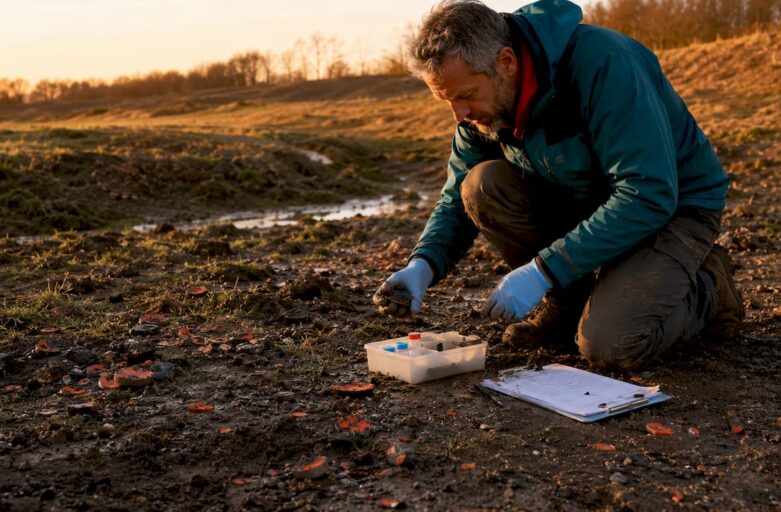
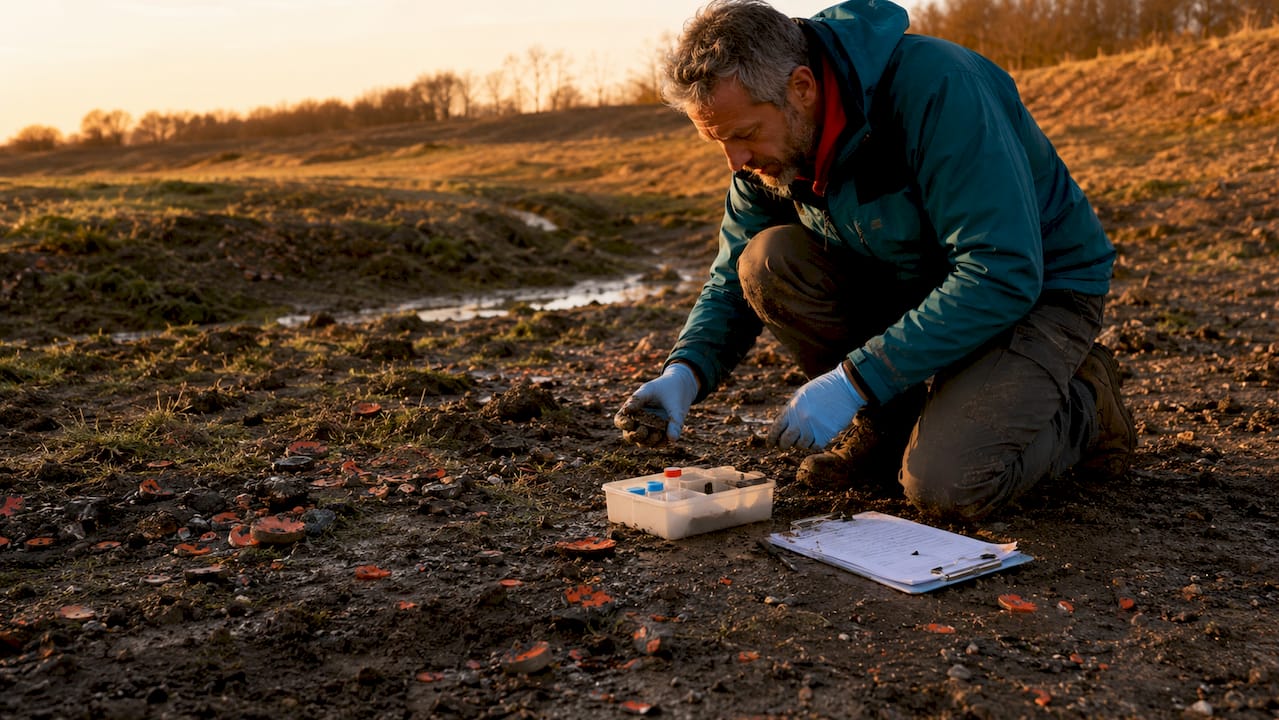
Clay shooting pollutes soil and water by depositing lead pellets and toxic clay target fragments across shooting grounds, where they accumulate and migrate through soil and water systems over time. The clay shooting environmental impact extends well beyond litter on a field. Lead, antimony, arsenic, and polycyclic aromatic hydrocarbons (PAHs) from target binders enter the soil, then travel via rainfall and runoff into groundwater and surface water. The Pennsylvania Blue Hole Creek case and the LGA Institut für Umweltgeologie und Altlasten soil study both confirm this is a documented, measurable problem. The UK’s 2026 REACH lead restriction now formally requires shooting ranges to address these pathways.
Why clay shooting pollutes soil and water
The two primary sources of contamination are shotgun pellets and shattered clay target fragments. Traditional shotgun pellets are composed largely of lead, with antimony and arsenic added to harden the alloy. When fired, these pellets scatter across the ground in a predictable fallout zone. A single shooting session at a busy range can deposit hundreds of pellets per square metre in backstop areas.
Clay targets are bound together using petroleum pitch, a material that contains PAHs. The PAHs in clay binders are classified as carcinogenic and harmful to vegetation and aquatic life. When targets shatter, these fragments spread across the ground and begin breaking down, releasing PAHs directly into the soil. Over time, both lead and PAH contamination build up in the upper soil layers.
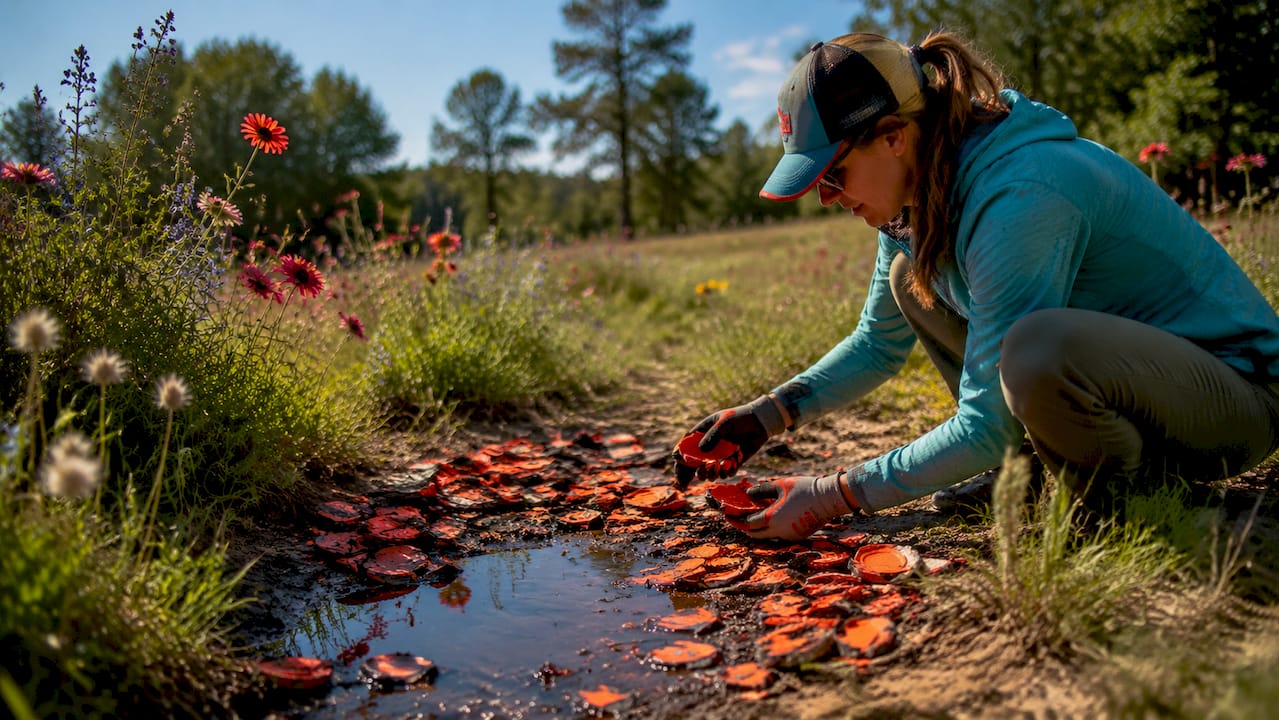
Contamination does not stay where it lands. Precipitation drives lead particles and PAH residues downward through the soil profile via percolation, or horizontally across the surface via runoff. Both pathways lead to adjacent water bodies. The UK REACH framework now formally classifies this as a soil and water migration risk, not simply a waste management issue.
What toxic substances does clay shooting release?
Understanding the specific pollutants helps explain why the effects of clay shooting on soil are so persistent. The table below summarises the main contaminants, their sources, and their environmental risks.
| Pollutant | Source | Environmental Risk |
|---|---|---|
| Lead (Pb) | Shotgun pellets | Toxic to soil biota, leaches into groundwater, accumulates in food chains |
| Antimony (Sb) | Pellet hardener | Moderately soluble, mobile in acidic soils, toxic to aquatic organisms |
| Arsenic (As) | Pellet alloy additive | Highly toxic, persistent in soil, carcinogenic to humans and wildlife |
| PAHs | Clay target binders (petroleum pitch) | Carcinogenic, harmful to vegetation and aquatic life, persistent in soil |
Each of these substances behaves differently in the environment. Lead is relatively immobile in neutral soils but becomes far more soluble under acidic conditions. Lead bioavailability and leaching depend on soil chemistry, pH, and the presence of organic matter. This means the same quantity of lead deposited at two different sites can produce very different contamination outcomes.
PAHs present a separate concern. Unlike lead, they do not dissolve readily in water, but they bind to soil particles and fine sediments. When those particles are transported by runoff, PAHs travel with them into streams and wetlands.
Pro Tip: If you manage or use a shooting ground, request a soil pH test. Acidic soils below pH 6 significantly increase lead mobility and the risk of groundwater contamination.
How do lead and debris migrate into soil and water?
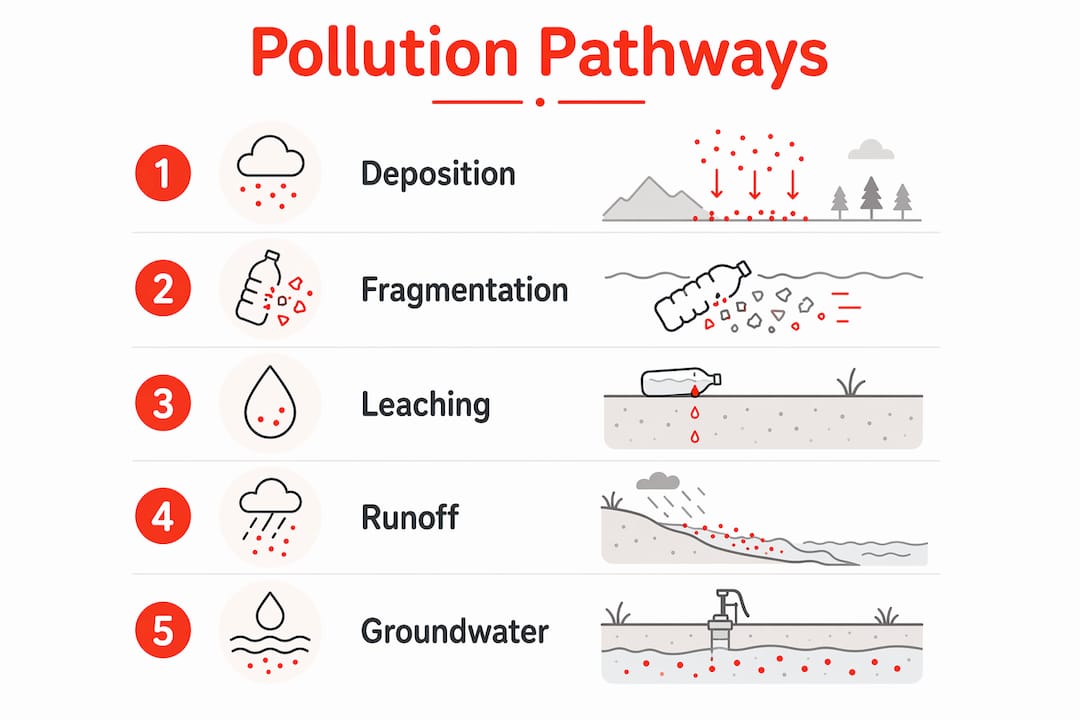
The contamination process follows a clear sequence. Understanding each stage helps explain why even well-managed ranges can cause off-site pollution.
- Pellet deposition. Lead shot falls to the ground in the shooting zone and backstop areas. At active ranges, this accumulation builds over years. Soil hotspots act as secondary contaminant sources if control measures fail.
- Weathering and fragmentation. Lead pellets oxidise on the surface, forming lead carbonate and lead sulphate compounds. These weathered forms are more soluble than metallic lead and more readily taken up by plant roots or dissolved in soil water.
- Percolation through soil. Rainfall carries dissolved lead and fine clay fragments downward through the soil profile. The rate depends on soil texture, organic matter content, and buffering capacity. Sandy soils with low organic matter offer little resistance. Lead pellets and clay fragments can migrate into groundwater via this percolation process.
- Surface runoff. Heavy rainfall events mobilise lead-rich surface particles and PAH-bound sediments horizontally across the ground. Storm and runoff dynamics are the primary drivers in transporting lead contamination from shooting range soils into adjacent waterways.
- Entry into water bodies. Runoff reaches streams, ponds, and wetlands, depositing lead and PAHs into sediments. From there, aquatic organisms absorb these contaminants, beginning the process of bioaccumulation up the food chain.
Site geography matters considerably. Ranges situated on slopes, near drainage channels, or above permeable geology face a higher risk of off-site contamination. Legacy contamination persists and can impact soil and groundwater long after a range ceases operations.
Pro Tip: When assessing a shooting site for environmental risk, map the drainage patterns first. A range that drains toward a watercourse or sits above a shallow aquifer requires far more rigorous containment than one on flat, clay-rich ground.
What evidence shows the real-world ecological impact?
The science on water contamination from clay shooting is no longer theoretical. Multiple case studies and peer-reviewed studies confirm measurable harm to ecosystems.
The Blue Hole Creek case in Pennsylvania is the most striking recent example. Lead contamination in Blue Hole Creek was found over 400 times above safe levels due to runoff from a nearby clay shooting range. The creek was removed from fish stocking programmes as a result of environmental harm confirmed through testing between 2023 and 2026. This is not a marginal exceedance. It represents a catastrophic failure of containment at a single site.
Soil studies from trap shooting ranges in Spain found lead concentrations exceeding USEPA safety thresholds. Soil samples exceeded 400 mg/kg lead in some areas, well above the USEPA residential soil screening level of 400 mg/kg and the industrial threshold of 800 mg/kg. These hotspots are capable of releasing lead into adjacent water bodies during rainfall events.
“Field investigations show that even managed grounds can produce off-site contamination via precipitation-driven mobilisation of lead and PAHs from accumulated debris.” — LGA Institut für Umweltgeologie und Altlasten
The ecological consequences extend beyond soil chemistry. Lead exposure in waterfowl occurs via ingestion of lead shot and contaminated sediments, causing mortality and sub-lethal health effects. A review of studies from 2015 to 2025 confirms persistent legacy contamination in wetlands adjacent to shooting ranges. Ducks and geese are particularly vulnerable because they feed in sediments where lead accumulates. This creates a direct pathway from a shooting range to wildlife mortality kilometres away.
How do regulations and best practice reduce this pollution?
Regulation of pollutants from shooting sports has tightened considerably in 2026. The UK REACH restriction on lead in ammunition now requires outdoor shooting ranges to document and implement specific risk reduction measures for soil and water protection.
The required and recommended measures include:
- Earth bunds and sand bays positioned to capture pellets and prevent their spread beyond the shooting zone.
- Rubber granulate backstops that trap pellets physically and allow periodic removal and recycling.
- Projectile removal programmes where accumulated lead is excavated from backstop soils on a scheduled basis.
- Surface water management including bunding and drainage controls to prevent runoff from reaching watercourses.
- Monitoring and reporting obligations requiring range operators to document contamination levels and demonstrate compliance.
UK REACH regulations require documentation of measures like earth bunds, sand bays, and projectile removal to protect soil and water. Regulators now treat lead contamination as a migration risk requiring active management, not simply a tidiness issue. This shift in regulatory framing is significant. It places legal responsibility on range operators to prevent off-site contamination.
The most effective long-term solution is substitution. Lead-free steel, bismuth, and tungsten-based shot eliminate the primary contamination source. Biodegradable clay targets made without petroleum pitch remove the PAH risk. For those seeking to train shooting sport sustainably, laser-based alternatives remove both ammunition and target debris entirely, leaving no residue in soil or water.
Key takeaways
Clay shooting pollutes soil and water through the accumulation and mobilisation of lead, antimony, arsenic, and PAHs, with storm runoff and soil percolation as the primary transport mechanisms.
| Point | Details |
|---|---|
| Lead is the primary pollutant | Shotgun pellets deposit lead across shooting grounds, where it oxidises and becomes more soluble over time. |
| PAHs compound the problem | Petroleum pitch binders in clay targets release carcinogenic PAHs into soil when targets shatter. |
| Runoff drives off-site harm | Storm events transport lead and PAHs from range soils into streams and groundwater, as confirmed by the Blue Hole Creek case. |
| Legacy contamination persists | Decommissioned ranges continue leaching lead and PAHs into soil and groundwater for decades after closure. |
| Regulation now mandates action | UK REACH 2026 requires documented soil and water protection measures at all outdoor shooting ranges. |
The part most shooting enthusiasts overlook
I have spent years watching the conversation about clay shooting and the environment focus almost entirely on lead shot in wetlands and the risk to wildfowl. That is a real problem, but it is only part of the picture. The contamination that concerns me most is the slow, invisible kind: the lead that sits in backstop soils for decades, quietly oxidising, waiting for a wet autumn to carry it into a stream nobody is monitoring.
The Blue Hole Creek situation did not happen overnight. It was the product of years of accumulation and inadequate containment at a single range. The fact that lead was found over 400 times above safe levels tells you this was not a borderline case. It was a failure that had been building for a long time before anyone measured it.
What I find genuinely underappreciated is the PAH problem. Most of the public debate focuses on lead, but the petroleum pitch in traditional clay targets introduces carcinogenic compounds that bind to soil particles and travel with sediment. Switching to steel shot but continuing to use traditional targets only solves half the problem. The environmental benefits of lead-free shooting are real, but they require addressing both the ammunition and the target material simultaneously.
The most honest conclusion I can draw is this: the sport as traditionally practised deposits a cocktail of toxic substances into the environment at every session. Regulation is catching up, but monitoring remains patchy and enforcement is inconsistent. Anyone who cares about the land they shoot on should be asking hard questions about what is accumulating in the soil beneath their feet.
— Joshua
A greener way to enjoy clay shooting
The ecological case against traditional clay shooting is well established. Lead, PAHs, and heavy metals accumulate in soil and migrate into water with every session at a conventional range. Laserclay offers a genuinely different approach.

Laserclay uses laser technology to replicate the clay shooting experience without any ammunition, pellets, or target debris. There is nothing deposited in the soil and no runoff risk to nearby water bodies. For outdoor enthusiasts and event organisers who want the thrill of clay shooting without the environmental cost, it is the only format that eliminates contamination at source. Explore clay shooting the greener way with Laserclay, or visit the main Laserclay site to find out how to bring a zero-pollution shooting experience to your next event.
FAQ
What makes clay shooting harmful to soil?
Clay shooting deposits lead pellets and PAH-containing clay fragments directly onto the ground. These substances accumulate in soil and become more mobile over time, particularly in acidic or sandy soils.
How does lead from shooting ranges reach groundwater?
Lead oxidises in soil and becomes soluble, then percolates downward through the soil profile with rainfall. Sandy soils with low organic matter offer the least resistance to this downward migration.
How contaminated can water near shooting ranges become?
Lead contamination in Pennsylvania’s Blue Hole Creek was found over 400 times above safe levels due to runoff from a nearby clay shooting range, resulting in the creek being removed from fish stocking programmes.
Does contamination persist after a range closes?
Yes. Legacy contamination from lead and PAHs can persist for decades after shooting activity ceases, slowly leaching through soil into groundwater.
What does UK law now require from shooting ranges?
The 2026 UK REACH restriction requires outdoor shooting ranges to document and implement soil and water protection measures, including earth bunds, sand bays, and scheduled projectile removal.