The three approaches worth building your event around are active sport tournaments, low-impact festival games, and virtual or hybrid rounds. Choose active sport when you have fit, willing participants and a pitch; choose festival games when inclusivity and mixed ability matter more than competition; choose virtual or hybrid when teams are scattered across sites. The sections below give you the rules, schedules and checklists to run any of the three.
TL;DR:
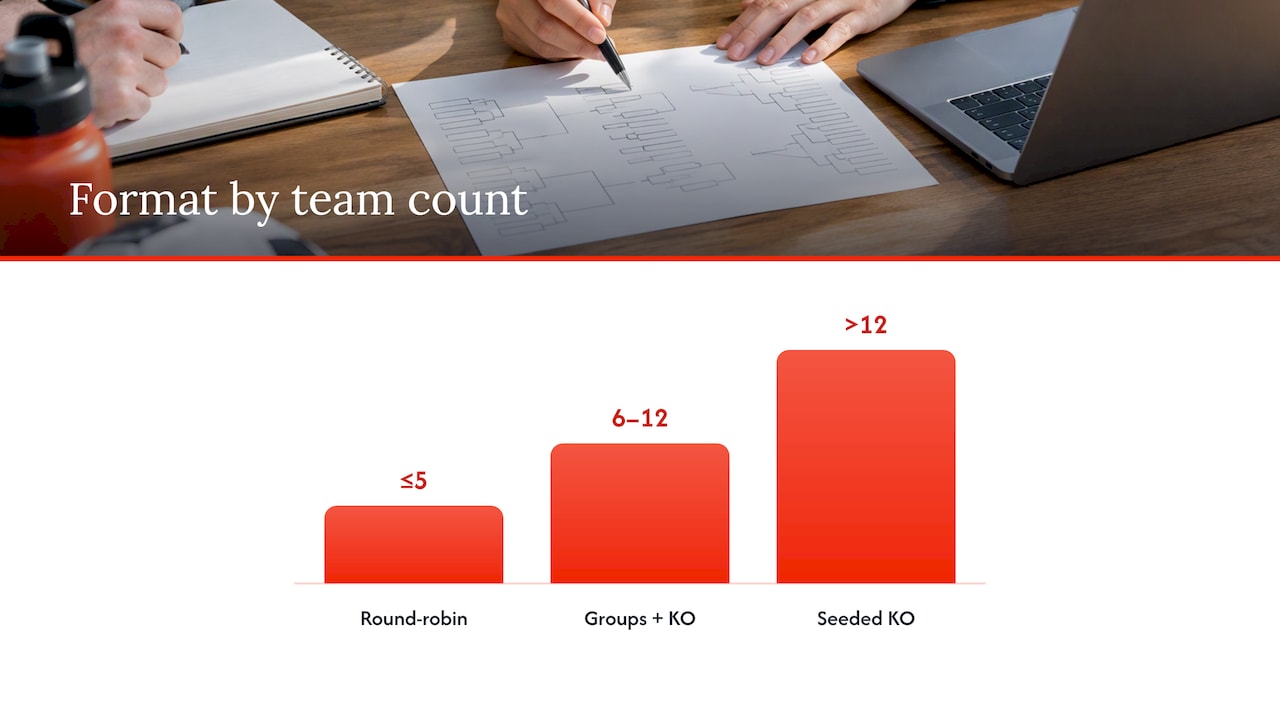
- Use a round robin for fewer than six teams, groups plus knockouts for six to twelve, and seeded knockouts or pools above twelve.
- Publish tie breakers before the draw, using goal difference, goals scored, head to head, then a penalty shootout if teams remain level.
- Assign one official per active court, keep a qualified first aider on site throughout, and allow five to ten minutes between fixtures for changeovers.
- For remote rounds, test video, screen sharing, latency, backup internet, and shared scoring the day before, with a dedicated moderator who is not playing.
- Build in low impact alternatives and mixed ability rules, and use a plate bracket so teams eliminated early keep playing instead of watching.
Table of Contents
- A catalogue of games for every tournament type
- Choosing a tournament format and setting the rules
- Planning and logistics: your pre-event checklist
- Running virtual and hybrid tournament rounds
- Copy-ready schedules and quick rules you can hand to officials
- Safety, accessibility and inclusivity checklist
- Laser Clay: a ready-made, safe and eco-friendly tournament activity
- Benefits of corporate tournament games for team building and employee engagement
- Tips for fostering sportsmanship and positive competition
- Customisation and theme ideas to match your company’s culture
- Measuring whether your tournament actually worked
- Three priorities every organiser should get right first
- How Laser Clay fits into your tournament day
- FAQ
- Sources
A catalogue of games for every tournament type
Most corporate tournaments mix categories rather than sticking to one, so it helps to know what each format demands before you commit a budget to it.
Active team sports suit groups with decent fitness and access to a pitch or court.
- Five-a-side football: 5 players per side, two halves of moderate length, works on grass, futsal courts or indoor sports halls.
- Futsal: identical team size to five-a-side but played on a hard court with a smaller, heavier ball, which rewards close control over long passing.
- Netball: 7 players per side, 4 x 10 minute quarters, needs a marked court and hoops, and tends to draw strong mixed-gender participation.
Low-impact festival games remove the fitness barrier almost entirely, which is why they turn up at carnival-style corporate days alongside the main matches.
- Softball-style toss games: minimal equipment, no running required, playable by almost anyone regardless of mobility.
- Relay challenges: short bursts of movement with props (batons, beanbags, buckets) rather than sustained running.
- Target throw contests: bean bags, darts-style boards or ring toss, scored individually or by team total.
Indoor tournament games work when weather, space or noise rules out anything outdoors.
- Table tennis knockouts: fast to run, needs only a table and bats, good filler between bigger matches.
- Badminton: singles or doubles brackets, needs a hall with decent ceiling height.
- Office Olympics stations: desk chair races, paper aeroplane distance contests, stapler flicking, rotated on a timer so every team cycles through each station.
Quick-challenge formats are built for festival days where you need short, repeatable bursts of competition between the main fixtures: penalty shoot-outs (five kicks per player, most goals wins), target accuracy contests, and timed relays that can run in under five minutes per heat.
Virtual and hybrid games are the right call when a meaningful share of your workforce is not in the same building. Team-building resources commonly recommend a mix of active, strategy and low-impact formats, and list platforms such as Kahoot and Jackbox as go-to tools for remote-friendly quizzes and party games because they are quick to set up and support live scoring.
Before picking any game, run it through a short checklist: how much space does it need, what kit does it require, how long does a typical match run, what skill or attribute does it actually test, and how accessible is it to someone with limited mobility or no sporting background. A game that fails the accessibility check for most of your workforce is rarely worth including, however popular it looks on paper.
Choosing a tournament format and setting the rules
The format you pick should follow the number of teams and the time you have, not the other way round.
- Under 6 teams: run a round-robin so everyone plays everyone, which maximises game time and avoids early knockouts that leave people watching for hours.
- 6 to 12 teams: use a group stage followed by a knockout bracket, splitting into two or three groups of three or four before the top finishers cross into semi-finals.
- Over 12 teams: go straight to a seeded knockout bracket, or split into pools that feed a shorter knockout, otherwise the day overruns badly.
Match duration needs to be fixed before the draw is published. A five-a-side corporate match typically runs two halves of moderate duration with a short half-time break, and unlimited rolling substitutions, which keeps the game moving and reduces injury risk among less-conditioned players. A points system awarding points for wins, draws, and losses is the standard corporate adaptation of league scoring; it rewards decisive results without overcomplicating the table.
Tie-breakers matter more than most organisers expect, because round-robin groups frequently finish level on points. The usual order is goal difference, then goals scored, then a head-to-head result, then a penalty shoot-out if the tie still stands. Published tournament pages, such as Singapore Pools’ Football with a Heart, set out exactly this kind of group-stage points allocation and tie-break order, which is a useful template to copy rather than inventing your own on the day.
A plate or bronze bracket for teams eliminated early keeps everyone playing rather than spectating, and tournament organisers increasingly build this in deliberately because it raises overall satisfaction for a medium-sized event. For corporate crowds specifically, simplify the adult rulebook: remove offside in five-a-side, cap sliding tackles, and allow a goalkeeper-free small-sided format if your participants are mixed-ability.
Planning and logistics: your pre-event checklist
A tournament lives or dies on the logistics decided weeks before kickoff, not on the day itself.
Venue: confirm pitch or hall availability, check whether the venue requires its own public liability insurance or event permit, and walk the space once before booking to check line-of-sight for officials and spectators. Our venue guidance for planners covers indoor and outdoor adaptability if you are weighing up options.
Staffing: aim for one umpire or match official per pitch or court, plus a dedicated registration desk and a first-aider on site for the full duration, not just during matches.
- Registration and check-in: 1 to 2 staff depending on team count.
- Match officiating: 1 per active pitch or court.
- First aid: at least 1 qualified first-aider present throughout.
- Equipment and scoring: 1 per activity station for festival-style games.
Equipment: balls, bibs or jerseys, cones, a scoreboard or scoring app, first-aid kit, and spare kit for breakages, itemised by game before the week starts rather than assembled the night before.
Scheduling: build buffer time between matches, typically 5 to 10 minutes per fixture for changeovers, and schedule at least one longer break for lunch or refreshments rather than running straight through.
Budget: line items to estimate include venue hire, equipment rental or purchase, staffing or facilitator fees, catering, prizes, and a contingency allowance of roughly 10% for any unbudgeted expenses on the day.
Pro Tip: Run your schedule past someone who was not involved in building it. A fresh eye catches overlaps and unrealistic changeover times every time.
Running virtual and hybrid tournament rounds
Remote rounds fail for one reason more than any other: nobody tested the platform before the event started.
A functional setup needs a few non-negotiables: a video platform that supports breakout rooms, a moderator whose only job is running the round (not also playing in it), and a live scoreboard feed that every participant can see without asking. Test latency and screen-sharing the day before, not the morning of.
Round formats translate well from in-person play. Trivia rounds score in the same 3-1-0 style as a league match, escape-room style challenges can be timed and ranked by completion speed, and quiz-show formats such as those built on Kahoot or Jackbox give you live scoring with almost no setup, which is why team-building guides return to them repeatedly for remote play.
To blend remote and on-site participants in one event, run simultaneous heats, a virtual team competing on screen while an in-person team plays the same challenge on a pitch, then combine scores on one shared leaderboard. A live video feed of the on-site action for remote viewers, with audience voting on a “best moment” award, keeps the two groups feeling like one event rather than two separate ones.
- Technical checklist: platform tested, moderator briefed, backup internet connection confirmed, scoreboard visible to all.
- Contingency: a phone-based backup call if video drops, and a paused-not-cancelled rule if technical issues hit mid-round.
Copy-ready schedules and quick rules you can hand to officials
These three templates are built to be adapted, not redesigned from scratch.
- Half-day carnival and mini-tournament run-sheet (4 hours): 09:00 registration and warm-up, 09:30 to 11:00 group-stage five-a-side matches on a rotating pitch, 11:00 to 12:00 festival games (target throws, relays) running alongside knockout matches on the main pitch, 12:00 to 12:30 lunch break, 12:30 to 13:00 semi-finals and finals, 13:00 presentation. Staffing: 2 match officials, 1 festival games coordinator, 1 first-aider.
- Single-pitch five-a-side tournament for 8 teams: group stage of two groups of four, each match 2 x 10 minutes to fit the day, 3 points for a win and 1 for a draw, top two from each group advance to semi-finals, tie-breaks follow goal difference then head-to-head then a 5-kick shoot-out. Total run time with changeovers: roughly 3.5 hours.
- Office-friendly indoor round-robin for 6 teams across table tennis, badminton and an office Olympics station: each team plays every other team once per activity, matches capped at 10 minutes to keep rotation tight, 2 points for a win and 0 for a loss (no draws in individual games), final ranking by total points across all three activities. Our competition ideas for planners has further formats if you want to mix in something less conventional.
Safety, accessibility and inclusivity checklist
Run through this before the first whistle, not after an incident.
- Confirm a first-aider is present throughout, not just during matches, and that an emergency contact process is briefed to every official.
- Check all equipment for wear or damage before play starts, especially nets, goals and anything shared between stations.
- Offer non-contact alternatives (futsal instead of full-contact football, underarm throws instead of overarm) for mixed-fitness groups.
- Build in opt-in intensity levels so participants can choose festival games over full-contact sport without feeling singled out.
- Favour mixed-gender team rules and accommodations for participants with disabilities over strictly competitive seeding.
- Choose reusable or low-impact equipment where possible to cut both cost and environmental footprint.
Laser Clay: a ready-made, safe and eco-friendly tournament activity
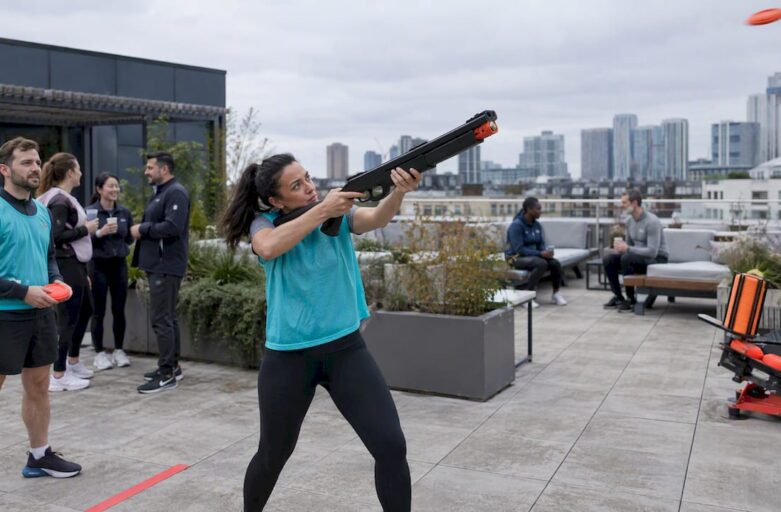
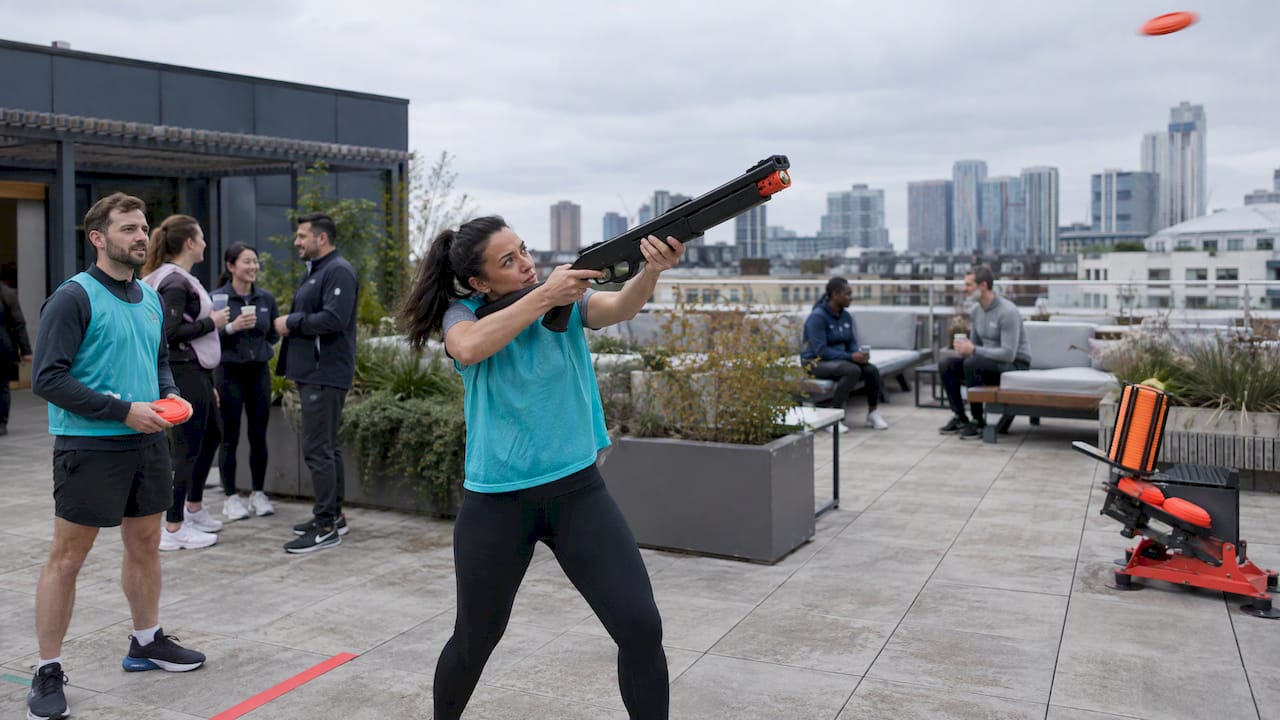
When a tournament day needs an activity that tests accuracy and nerve without physical contact or fitness demands, laser clay shooting can be a drop-in option. The use of laser technology instead of live ammunition removes safety risks and environmental concerns tied to lead shot, and reusable clay targets mean nothing is thrown away after a single round.
Facilitated corporate laser clay rounds typically fit a tournament day in under an hour. We supply the scoring systems, so results feed straight into a live leaderboard alongside your other matches.
- Equipment and facilitators: equipment includes sound-simulated deactivated shotguns, electronic scoreboards and on-site staff for the full session.
- Setup: sessions adapt to indoor or outdoor venues without changing the scoring format.
- Fit: the activity is suitable for participants from age 10 upwards, regardless of sporting background, which makes it a strong leveller between more and less athletic teams.
Benefits of corporate tournament games for team building and employee engagement
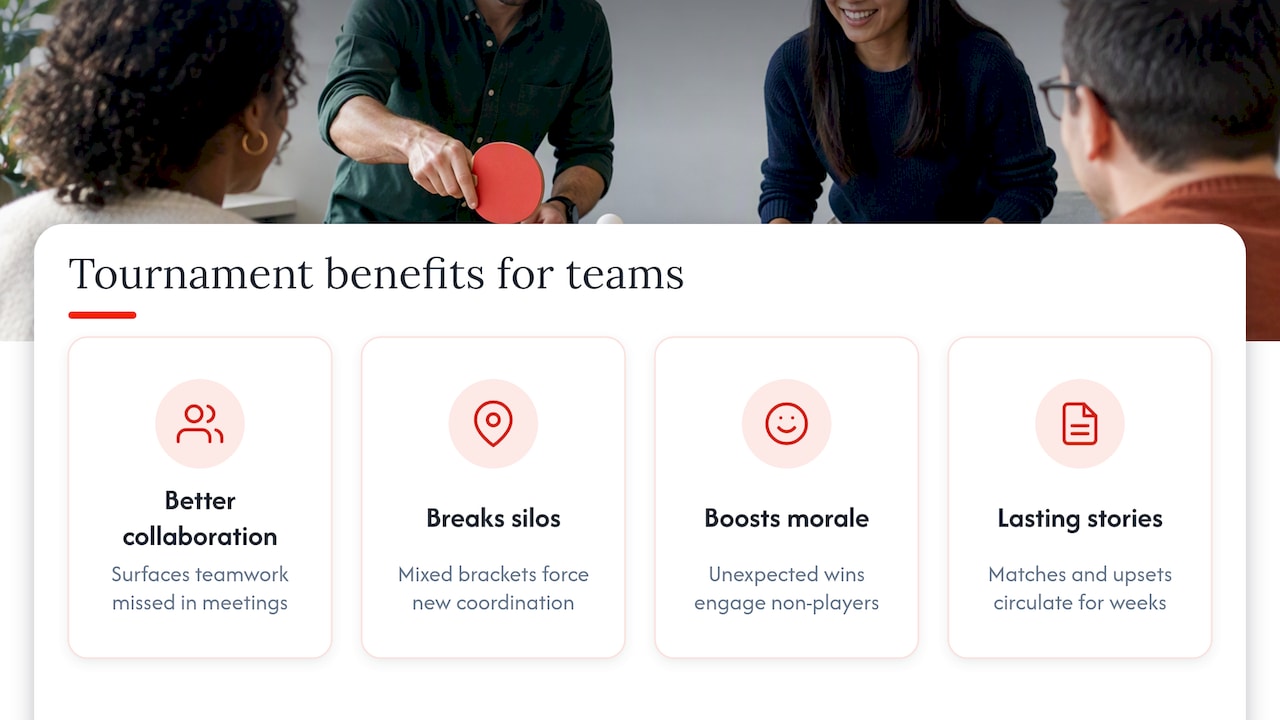
A tournament format does something a standard team-building session rarely achieves: it gives colleagues a shared, low-stakes goal with a clear result at the end. That structure tends to surface collaboration you do not see in a normal meeting room, people cover for each other’s weak spots, call out encouragement, and remember the result long after they have forgotten the agenda of a workshop.
Mixed team composition, deliberately breaking up departmental silos when you draw up the brackets, forces colleagues who rarely interact to coordinate under mild pressure. That tends to translate into easier working relationships once everyone is back at their desks, because a shared win or a narrow loss gives people something informal to talk about.
The festival and low-impact elements matter here as much as the competitive ones. Someone who never plays five-a-side can still win a target throw contest, and that kind of unexpected success does more for morale than watching from the sidelines. Rotating staff through officiating roles, scorekeeping, registration, running a station, also spreads a sense of ownership beyond just the players, which widens engagement past whoever happens to be sporty.
A well-run tournament day gives people a genuinely shared story: the dramatic penalty shoot-out, the underdog team that made the final, the office Olympics station that descended into chaos. Those stories circulate for weeks, which is a cheap and durable form of engagement compared with most one-off events.
Tips for fostering sportsmanship and positive competition
Set the tone before a single match starts. A short briefing that states the result matters less than how the day is played sounds obvious, but naming it explicitly changes behaviour more than most organisers expect.
Appoint neutral officials wherever possible, ideally not direct managers of the teams they are refereeing, so decisions do not carry any whiff of internal politics. Publish the rules and tie-break procedures in advance so nobody can argue a decision was made up on the spot.
Build recognition that is not purely about winning. A “spirit of the tournament” award voted on by participants, or a prize for the best-supported team, rewards the behaviour you actually want more than a trophy for first place alone.
Keep officials briefed to intervene early on anything approaching unsporting conduct, a hard tackle, a dismissive comment, before it escalates, rather than waiting for a flashpoint. Most issues at corporate tournaments come from overexcitement rather than genuine ill will, and a quiet word early in the day usually resolves it.
Finally, mix competitive matches with festival-style activities throughout the schedule rather than front-loading all the serious sport. That keeps the day lighter in tone and makes it harder for competitive intensity to build unchecked across several hours.
Customisation and theme ideas to match your company’s culture
A generic tournament works, but one themed around your own culture or objectives tends to land better and photographs better for internal comms afterwards.
Align the format with the result you actually want: a sales-heavy culture might lean into a leaderboard-driven, individually scored day, while a culture built on collaboration might favour team relay formats where no single person’s performance stands out. If sustainability is part of your company’s public positioning, choosing low-impact, reusable equipment over single-use kit reinforces that message rather than contradicting it.
Themed branding, team names tied to internal projects, jerseys in department colours, a company mascot presenting the trophy, costs little and makes the event feel bespoke rather than off-the-shelf. Tie prizes to things your workforce actually values: an extra day of leave, a charity donation in the winning team’s name, or a lunch with leadership, rather than defaulting to a generic voucher.
If the objective is cross-departmental mixing rather than competition for its own sake, build the draw deliberately so no team is drawn entirely from one department. That single decision does more for the “team building” half of the brief than any amount of theming.
Measuring whether your tournament actually worked
Deciding success criteria before the event, not after, is the difference between a useful debrief and a vague sense that “it went well”.
A short post-event survey, five questions, two minutes to complete, sent within 24 hours while the day is still fresh, gets you a genuine read on enjoyment, perceived inclusivity, and whether people would want it repeated. Attendance versus sign-up numbers is a blunt but honest measure: a large gap between who registered and who showed up usually signals a scheduling or communication problem worth fixing next time.
Watch participation patterns during the day itself: which stations had queues, which sat empty, which group had to be chivvied back from a long lunch. That kind of informal observation often tells you more than the survey does.
For a longer-term read, informal signals, whether cross-departmental teams keep talking afterwards, whether people reference the event in later meetings, are a reasonable proxy for whether it achieved anything beyond a pleasant afternoon. None of this needs to be elaborate. A short debrief with whoever staffed the day, held while memories are fresh, usually surfaces the one or two changes worth making before the next event.
Three priorities every organiser should get right first
If you take nothing else from this, prioritise three things: clear, simple rules published before the day so nobody argues a decision mid-match; enough staff and a visible first-aider so safety is never an afterthought; and buffer time built into every schedule, because every tournament overruns somewhere.
Everything else, themes, prizes, the exact choice of games, matters far less than those three. If you want a turnkey activity that handles scoring and facilitation for you, the next section covers where that fits.
— Joshua
How Laser Clay fits into your tournament day
If you are assembling a tournament day and want one activity that needs no pitch, no fitness test and almost no setup risk, our Corporate Laser Clay Package is built for exactly that slot. It costs 69 SGD per person, one-off, and covers facilitation, scoring and equipment so you are not managing another moving part on the day.
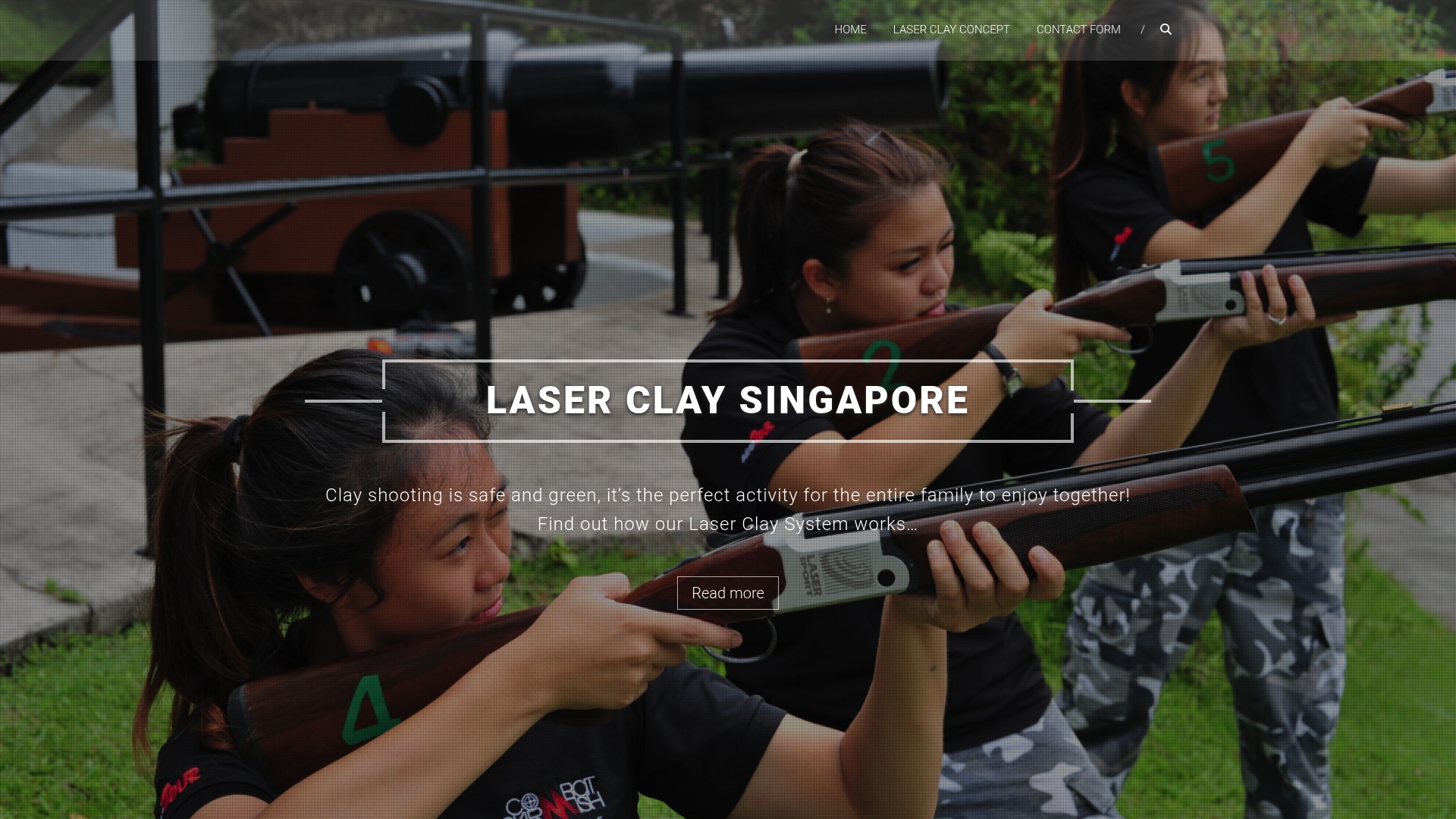
- We bring sound-simulated deactivated shotguns, electronic scoreboards and trained facilitators, so results plug straight into your tournament leaderboard.
- Sessions adapt to indoor or outdoor venues, which makes it a reliable filler activity between bigger matches or during a lunch break.
- If you only need the kit rather than full facilitation, our System Rental option runs 500 to 800 SGD per hour.
If this sounds like the missing piece for your schedule, get in touch through our contact page to request a quote or arrange a site visit before you lock in the rest of the day.
FAQ
What are some good games to play at a corporate event?
Five-a-side football, netball and futsal work well for active groups, while target throws, relays and bean bag toss suit mixed-fitness crowds. For remote colleagues, trivia and quiz-show platforms such as Kahoot or Jackbox-style formats are quick to set up and keep everyone involved.
What are some ideas for corporate games?
A mix of competitive sport, low-impact festival stations and a short virtual round covers most corporate audiences in one event. Office Olympics stations, penalty shoot-outs and timed relays are easy to run with minimal equipment and work well between bigger matches.
What are some fun activities for corporate team building?
Mixed-team tournaments that force colleagues from different departments to play together tend to build rapport faster than standard workshops. Low-impact activities such as laser clay shooting, which we run as a facilitated session suitable from age 10 upwards, give less athletic participants a genuine chance to compete.
What are corporate games?
Corporate games are structured competitive or team-based activities organised by a company, usually combining sport, festival-style challenges and sometimes virtual rounds, to build engagement among employees. They range from full five-a-side tournaments, such as Singapore’s Football Fiesta, through to low-impact office activities and remote-friendly quiz formats.
Sources
- 45 team building games to bring teams together at work
- SPH Media to host corporate 5-a-side tournament Football Fiesta in June
- Singapore Pools Football with a Heart 2026