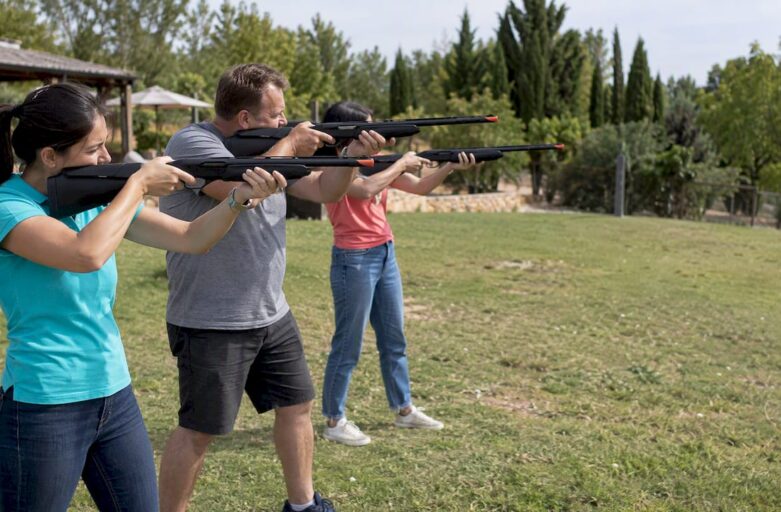
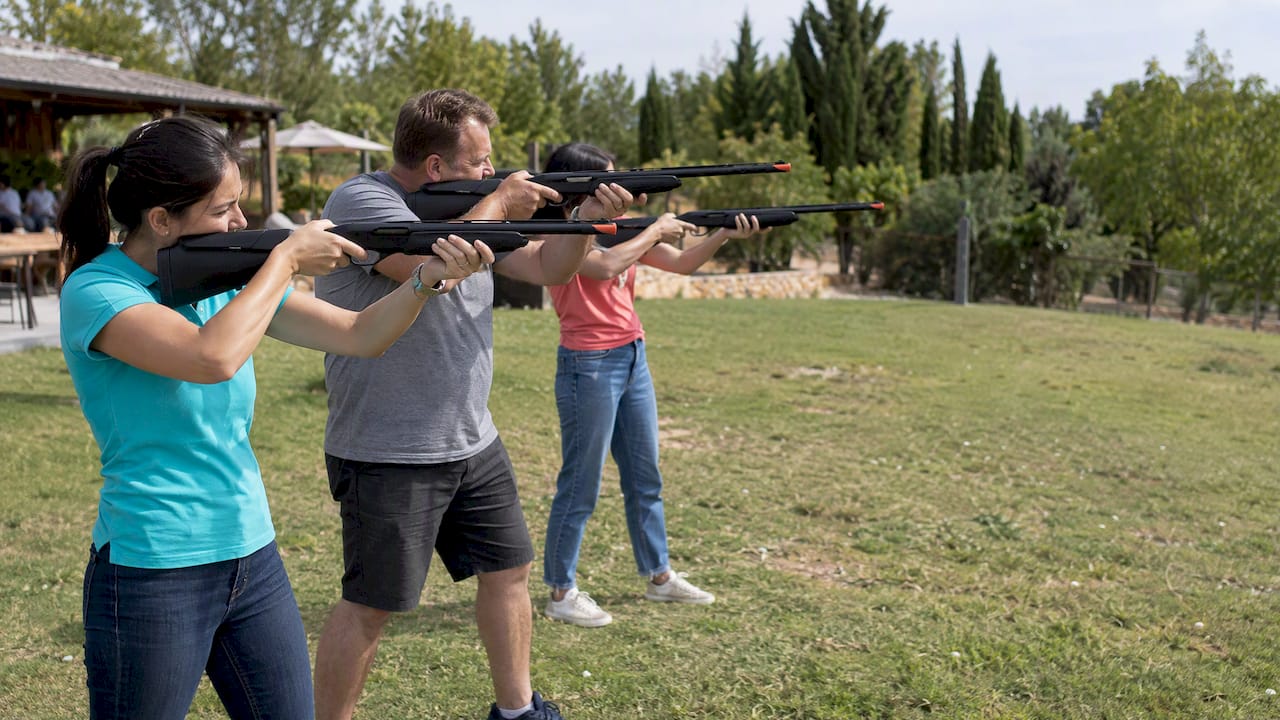
Most laser clay set-ups let 3 to 5 people shoot at once, with some configurations expandable to 8 to 10 shooters across extra lanes. A well-run session commonly serves anywhere from 5 participants at a small party to 80 or more at a corporate event, depending on format, rotation structure and how much time you book. The sections below cover staffing, timing and how we scale larger groups.
TL;DR:
- Groups above 30 to 40 should add duplicate systems to limit queues; groups over 80 are better served by combining Laser Clay with another activity.
- Most parties need 60 to 90 minutes; tournament formats require 90 to 120 minutes and suit corporate groups of at least 40.
- Budget one operator and one marshal per roughly 10 players, with a dedicated scorer recommended for larger events to keep the leaderboard current.
- Add 15 minutes beyond estimated run time for equipment setup, a safety briefing, and a prize round; spare batteries can prevent stalled heats.
Table of Contents
- Firing-line capacity and what it means for your event
- Overall group sizes and how we scale for bigger events
- Session length and how time scales with group size
- Staffing, equipment and venue set-up
- Keeping every guest engaged, not just the shooters
- A planner’s view on avoiding common booking mistakes
- Booking a session that fits your group
- FAQ
- Sources
Firing-line capacity and what it means for your event
The number of people who can shoot at the same moment is fixed by the hardware on the line, not by how many guests you invite. Most laser clay rigs run 3 to 5 shooters side by side on a single firing line. Operators can expand this to around 8 to 10 shooters by adding extra lanes or duplicating stations, though this needs more floor space and more staff to supervise safely.
That simultaneous count is the real throughput engine of the whole event. If each shooter fires a set number of rounds per heat, the total number of shots and the time needed to serve every guest both scale directly from that number. A tight group of 10 people sharing one 4-lane set-up moves through several heats in well under an hour. A group of 50 sharing the same single set-up needs either a much longer session or extra lanes to avoid long queues.
This is why planners should think in terms of heats and rotations rather than a single headline capacity figure.
- A single 3 to 5 shooter line suits small, intimate groups who want more airtime each.
- Adding a second parallel system roughly doubles throughput for the same session length.
- Duplicate systems make sense once attendance passes around 30 to 40 guests, so queue time stays reasonable.
Overall group sizes and how we scale for bigger events
Once you know the firing-line limit, the next question is how many total guests a session can comfortably handle. We think in three practical bands.
- Small groups (roughly 5 to 30 people) work well with one laser clay set-up and a straightforward rotation, suiting birthday parties and small team outings.
- Medium groups (roughly 30 to 80 people) usually need either a longer session, a second parallel station, or staggered start times so subgroups rotate through without long waits.
- Large groups (80 and above) are best served by running Laser Clay as one station within a wider multi-activity programme rather than funnelling every guest through a single line, an approach event suppliers use when they describe capacity ranges as wide as 5 to 400 guests for mixed-activity events.
These bands assume a casual, social format. Competitive formats with scoring and finals tend to push the ideal group size down, since fewer players per heat means more airtime per shooter and a fairer leaderboard. Social formats can stretch toward the upper end of each band because guests are happy to rotate through quickly and socialise between turns.
Session length and how time scales with group size
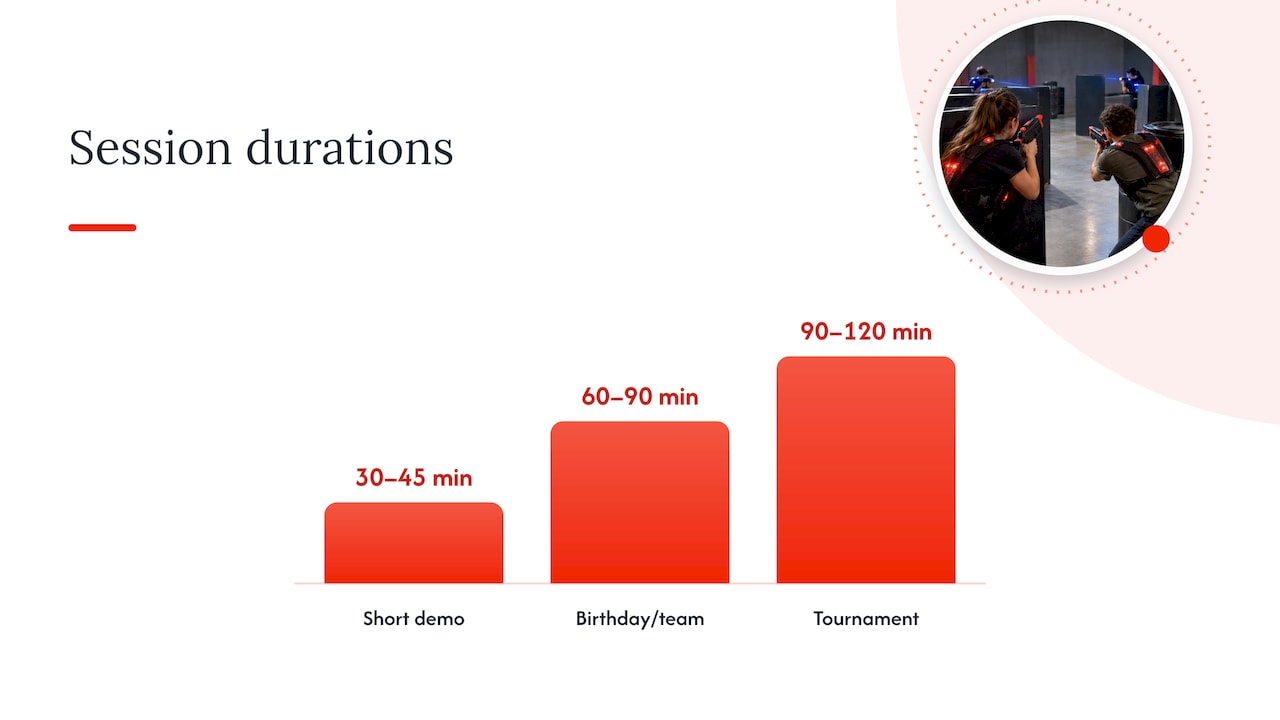
Session length is flexible and commonly runs between 30 and 120 minutes, with the right duration depending almost entirely on how many people you are serving and how competitive the format is.
- 30 to 45 minutes suits a short demo and a single scored round, ideal for a quick party activity or a taster slot at a larger event.
- 60 to 90 minutes allows multiple rounds plus a podium finish, the sweet spot for most birthday parties and team outings.
- 90 to 120 minutes supports a tournament-style structure with heats, semi-finals and a final, suited to corporate days with 40 or more guests.
A simple formula helps you estimate turns per person: shooters per heat multiplied by shots per round multiplied by number of heats gives total shots fired, which you then divide by headcount to see roughly how many turns each guest gets.
For a small party of 12 running a 60-minute session with 4 shooters per heat, three heats of 5 shots each gives 60 total shots, so each guest gets around 5 shots over the session. A corporate rotation of 48 people over 90 minutes with two parallel 4-shooter lines moving through 8 heats each gives every guest a similar handful of turns while keeping the whole group moving.
Pro Tip: Book 15 minutes more than your estimated run time to cover setup, a safety briefing and a prize round without rushing the last group.
Staffing, equipment and venue set-up
Adequate staffing is what actually keeps a session on schedule, regardless of group size. A useful planning reference is one operator plus one marshal per roughly 10 players, scaling up proportionally as your headcount grows. The operator manages the equipment and scoring system, the marshal oversees safety and queue flow at the firing line, and larger events benefit from a dedicated scorer to keep the leaderboard current.
- Keep spare deactivated shotguns on hand in case one unit needs swapping out mid-session.
- Carry spare batteries or a backup power solution so a flat battery never stalls a heat.
- Set up the scoreboard or display where every waiting guest can see it, not just the shooters.
- Plan a clear waiting area so queued guests are not standing in the sightline of the firing line.
Venue layout matters as much as staffing. The number of lanes you can fit, the distance between the firing line and the waiting area, and clear sightlines to the scoreboard all influence how smoothly a large group moves through.
Keeping every guest engaged, not just the shooters
The biggest risk with any group activity is downtime, guests standing around waiting for their turn. Relay-style rotations with rapid re-entry keep the line moving, and running parallel mini-challenges for waiting guests stops the session feeling like a queue.
Real-time electronic scoring helps here too. A live leaderboard gives waiting guests something to watch and react to, and assigning sideline roles such as scorekeeper or commentator turns spectators into participants.
- Use heats with quick re-entry rather than one long single-file queue.
- Run a side challenge or mini-game for guests waiting for their next turn.
- Assign a commentator or scorekeeper role to keep energy up between rounds.
Pro Tip: For groups over 80, pair Laser Clay with a second activity station so half the group is always active while the other half shoots.
A planner’s view on avoiding common booking mistakes
The most common error we see is underestimating setup and teardown time, then compressing the actual shooting window to fit. The second is booking the right headcount but the wrong staff ratio, which turns a smooth rotation into a slow one.
Before confirming a booking, run through this: confirmed session length, expected simultaneous shooters, staff ratio for your headcount, spare batteries on hand, a safety briefing scheduled, and a scoreboard position every guest can see.
— Joshua
Booking a session that fits your group
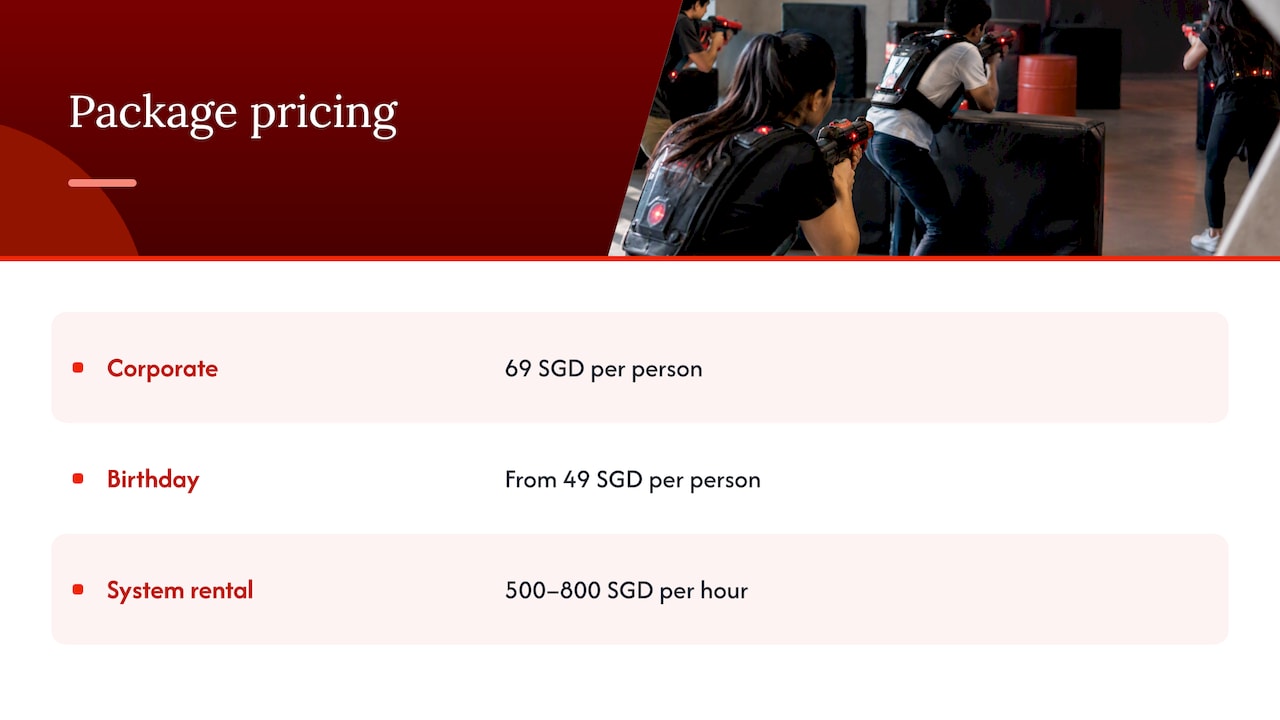
Whatever size group you are planning for, we build sessions around your exact headcount rather than forcing your guests into a fixed format. Our Corporate Laser Clay Package runs at 69 SGD per person and suits team-building days from small departments to full-company outings, while our Birthday party package starts from 49 SGD per person for celebrations of any size.
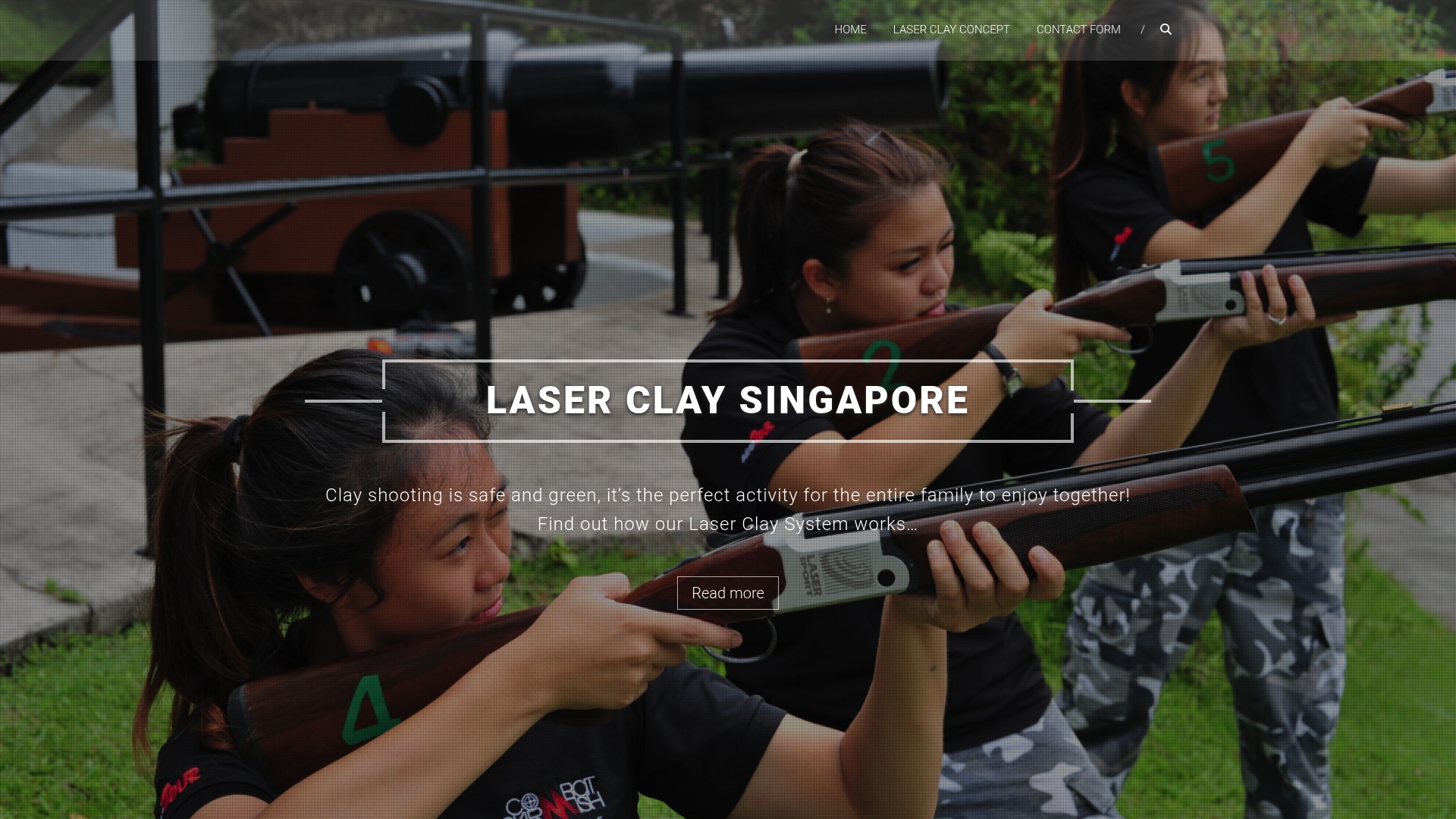
If you would rather run the activity at your own venue with your own schedule, our System Rental option at 500 to 800 SGD per hour gives you the same authentic, sound-simulated deactivated shotguns and reusable eco-friendly clays without needing to come to us. For catering alongside the activity, event planners often pair the session with gift favours such as handcrafted corporate event desserts for guests to take home.
Every package includes a facilitator, venue setup and full safety briefing, so there is no lead ammunition, no noise pollution and no experience required, suitable for ages 10 and up. Get in touch through our contact page for a bespoke quote matched to your exact group size.
FAQ
How many people can shoot at the same time in laser clay?
Most setups allow 3 to 5 people to shoot simultaneously on a single firing line. Some configurations expand to 8 to 10 shooters by adding extra lanes, though this requires more space and staff.
What is the ideal group size for a laser clay session?
Small groups of 5 to 30 people work well with a single set-up and simple rotation. Medium groups of 30 to 80 typically need a second parallel station or staggered starts, while groups above 80 are best served by combining Laser Clay with another activity station.
How long should we book a laser clay session for?
Sessions commonly run between 30 and 120 minutes, with the right length depending on headcount and format. A 60 to 90 minute slot suits most parties and team outings, while 90 to 120 minutes supports a full tournament structure for 40 or more guests.
How many staff do we need for a large group?
A useful planning reference is one operator plus one marshal per roughly 10 players, scaling up as your headcount grows. Larger events also benefit from a dedicated scorer to keep the leaderboard current and the queue moving.
Can laser clay handle very large events of over 100 people?
Yes, but a single set-up is not designed to serve a crowd that size on its own. The better approach is to run Laser Clay as one station within a rotation of multiple activities, an approach also used by event suppliers offering Laser Clay as part of a broader large-event programme.