The right team tournament format depends on three numbers: how many teams you have, how much time you have, and how many rounds each team must be guaranteed. Round robin is the fairest, knockout is the fastest, and a group stage feeding a short knockout final is what most company and community events end up using. This guide shows how to choose, with the match counts worked out for common team sizes.
It is written for people organising a team event in Singapore: HR and event planners, school staff, and anyone running a department competition.
TL;DR
- Round robin means every team plays every other team. It is the fairest format, but the number of matches climbs fast: 16 teams need 120 matches.
- Knockout needs only one match fewer than the number of teams, but half the field is out after round one.
- Group stage plus a knockout final guarantees every team several games and still ends with a decisive final. It suits most corporate and social events.
- Work backwards from your time slot: matches multiplied by minutes per match, divided by the number of stations running at once.
- Whatever you choose, tell teams the format, the tiebreakers and the prize rules before the first round.
Table of Contents
- Start with the constraint, not the format
- The four main formats
- Match counts at a glance
- Which format for how many teams
- Round robin or knockout: the trade-off in plain terms
- Seven decisions to settle before round one
- How we think about formats at Laser Clay
- Running it as a company event
- Book a laser clay tournament
- Common mistakes
- FAQ
- Sources
Start with the constraint, not the format
People usually ask which format is best. A better question is what will break your event. For most organisers it is one of three things:
- Time. A venue booked for two hours cannot host a 28-match schedule.
- Playing areas. If only one or two stations can run at once, every extra match is a queue.
- Participation. If 40 colleagues came for the afternoon, sending half of them home after ten minutes feels wrong.
Write down your team count, your total time and the number of matches that can run side by side. The rest of this page is arithmetic on those three figures.
The four main formats
Most team competitions use a variation of four structures: single elimination, double elimination, round robin and Swiss system. Here is what each means in practice.
Single elimination (knockout)
Teams are placed in a bracket. The winner of each match advances and the loser is out. Because every match removes exactly one team, a field of N teams needs N minus 1 matches. It is quick and easy to follow, and the final is a real event for spectators.
The weakness is fairness. One bad round, one nervous start, and a strong team is gone. If the number of teams is not a power of two (4, 8, 16, 32), some teams must receive a bye, a free pass into round two, which is normally given to the top seeds.
Double elimination
A team must lose twice to be out. This gives a second chance and reduces the damage of one off day, but it adds matches and makes the bracket harder to explain to a room of non-specialists. It works when you have a day, not an hour.
Round robin
Every contestant meets every other participant, usually once. Final rankings reflect performance across many games, so the result is hard to dispute. The price is volume. The number of matches follows N × (N − 1) ÷ 2, so adding teams makes the schedule grow much faster than the field.
Swiss system
Teams are paired each round against opponents with a similar record, and nobody is eliminated. After a handful of rounds the standings sort themselves out. It is efficient for large fields, but it needs someone to run the pairings between rounds and it is unfamiliar to most office participants. Use it when you have many teams, a scorer who knows what they are doing, and you do not want a bracket.
Match counts at a glance
The figures below are our own arithmetic from the formulas above: knockout is N − 1, round robin is N × (N − 1) ÷ 2. The 16-team comparison, 15 matches for knockout against 120 for a full round robin, matches the published guide.
| Teams | Knockout matches | Round robin matches | Games per team (round robin) |
|---|---|---|---|
| 4 | 3 | 6 | 3 |
| 5 | 4 | 10 | 4 |
| 6 | 5 | 15 | 5 |
| 8 | 7 | 28 | 7 |
| 12 | 11 | 66 | 11 |
| 16 | 15 | 120 | 15 |
The jump from 8 to 16 teams is the lesson. You double the teams and the round robin schedule grows more than fourfold. That is why a full round robin is generally discouraged at 16 teams unless the event runs over many days.
Which format for how many teams
4 to 6 teams: round robin
With few teams, a round robin is affordable and fair. Five teams, for example, means each team plays four games and the event totals ten matches. If you also want a final, split into two groups (one of two, one of three) and send the winners to a playoff. Either way, nobody travels across the island for a single game.
7 to 10 teams: groups, then knockout
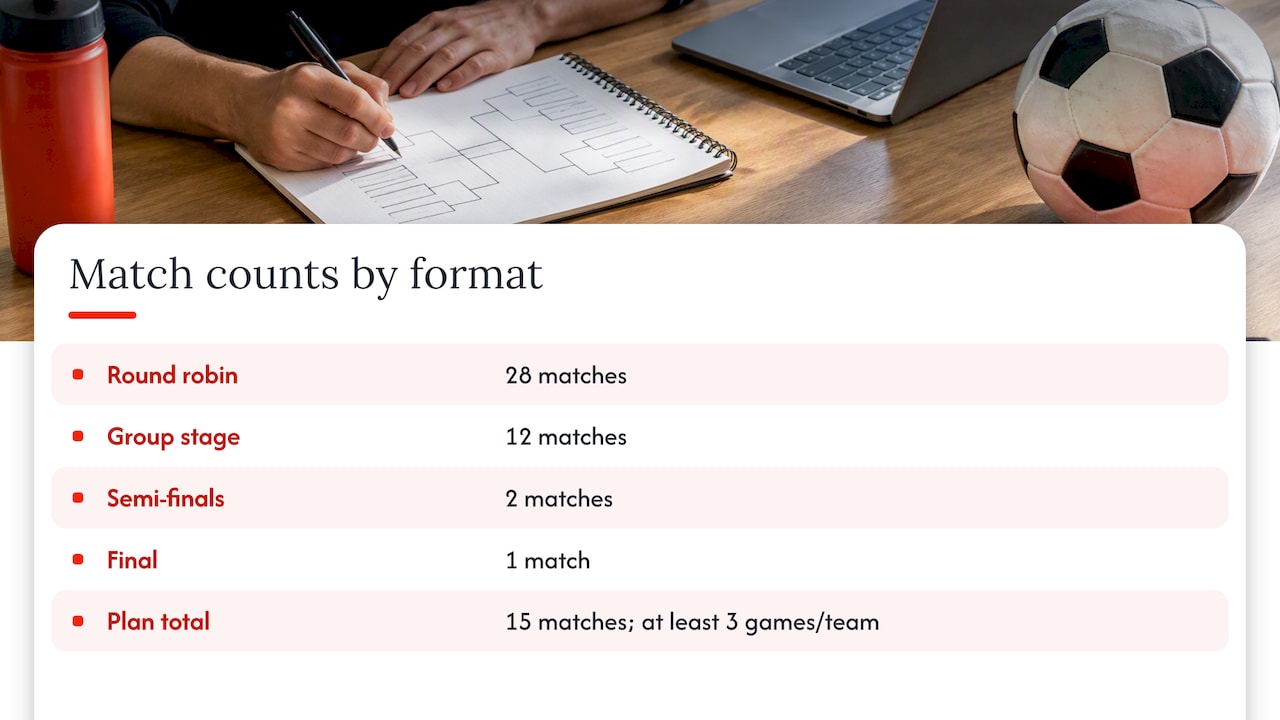
Eight teams in a round robin is 28 matches, which is rarely realistic. Two groups of four give you 6 matches per group, so 12 in total. Take the top two from each group into semi-finals (2 matches) and a final (1 match). That is 15 matches, and every team plays at least three games.
11 to 16 teams: multi-stage or Swiss
For larger fields, organisers commonly choose between Swiss, multi-stage or double elimination. For a company event with twelve teams, here is a clean multi-stage plan:
- Four groups of three teams. Each group plays 3 matches, so 12 in total.
- The top two from each group advance to an eight-team knockout: 4 quarter-finals, 2 semi-finals, 1 final, so 7 matches.
- Total: 19 matches. Every team plays at least two games, and half of them play four or more.
Compare that with 66 matches for a full round robin.
More than 16 teams
Use qualifying rounds. Let all teams complete a short, scored heat, then take the top 8 or 16 into a bracket. This is where individual scoring (each person’s score added into a team total) saves hours, because it needs no pairings at all.
Round robin or knockout: the trade-off in plain terms
| Question | Round robin | Knockout |
|---|---|---|
| Does every team get several games? | Yes | No, half the field plays once |
| Is the winner clearly deserved? | Very | Reasonably, but luck matters |
| How fast is it? | Slow | Fast |
| Is the finale dramatic? | Only if the table is close | Always |
| Is it easy to explain? | Yes | Yes |
Research on tournament design backs up a point organisers feel instinctively: comparing the same pair of players multiple times is wasteful when your aim is to find the true ranking. For a social event, that means you rarely need a double round robin, and you should not reach for one just to appear thorough.
Fairness is also often mistaken for round robin alone. Round robin is the fairest on paper and the most demanding on time, so for events where people came to enjoy themselves, a hybrid often gives guaranteed games plus a climactic final. Singapore’s recent community leagues, such as the franchise-style box cricket competition with ten teams announced in 2026, lean the same way.
Seven decisions to settle before round one
- Team size. Squads of four to six keep everyone involved. Larger teams mean spectators.
- Scoring. Decide whether a match is won on total points, or best of several rounds.
- Tiebreakers. Head-to-head result first, then points difference, then a sudden-death round. Announce this in advance.
- Seeding. If skill varies, seed by a warm-up score so the strongest teams do not meet in round one. For mixed-ability office groups, random draws feel friendlier.
- Byes. If the team count is not a power of two, give byes by seed or by draw, and say which.
- Spectator time. Plan snacks, a leaderboard and short breaks. Eliminated teams should have something to do.
- Prizes. Reward more than the winner: best score, best team name, most improved. Our tournament prize ideas guide breaks down categories, budgets and timelines.
How we think about formats at Laser Clay
We run laser clay events for companies, schools and families, and the same pattern repeats. The format that looks fairest on paper is rarely the one that makes people enjoy the afternoon.
Our view comes from how the activity works. Laser clay uses sound-simulated deactivated shotguns, reusable clay targets and a real-time electronic scoreboard, so scores are visible straight away and nobody argues about who hit what. That makes it easy to run a format that is scored by points rather than by head-to-head pairings. For many groups we suggest every participant shoots a round, individual scores are added to a team total, and the top teams go through to a final. Nobody sits out early, and the scoreboard does the admin.
Three rules we give planners:
- Give everyone at least two turns. One turn feels like a taster, two feels like a competition.
- Keep the final short and loud. A few minutes with the whole group watching is better than a long deciding match nobody can follow.
- Match the format to the mix. Mixed-ability groups, and ages from 10 upwards, do best with team totals rather than one-on-one duels. Competitive sales teams can handle the bracket.
If you are unsure how to balance team and individual scoring, our team versus individual modes guide walks through it for groups of around 40.
— Joshua
Running it as a company event
A company tournament in Singapore usually fits a 90 to 120 minute slot, often during a team-building afternoon. With that slot and two or three stations running together, a sensible shape looks like this:
- Briefing and practice so first-time participants are comfortable.
- Group stage, with every team scoring on each station.
- Semi-finals and final with the leaderboard visible to everyone.
- Prize-giving, kept to a few minutes.
If the event is part of a wider programme, see our notes on running a company Olympics, corporate tournament games and how to organise a competitive office shooting event. For other formats that fit the same afternoon, our competition ideas for Singapore planners is a useful companion.
A simple capacity check helps. Multiply matches by minutes per match, then divide by the number of stations. Twelve teams on the 19-match plan above, at ten minutes a match on two stations, needs roughly 95 minutes of play. That is before briefing and prizes, so trim the plan, for instance to a top-four knockout, if your slot is shorter.
Book a laser clay tournament
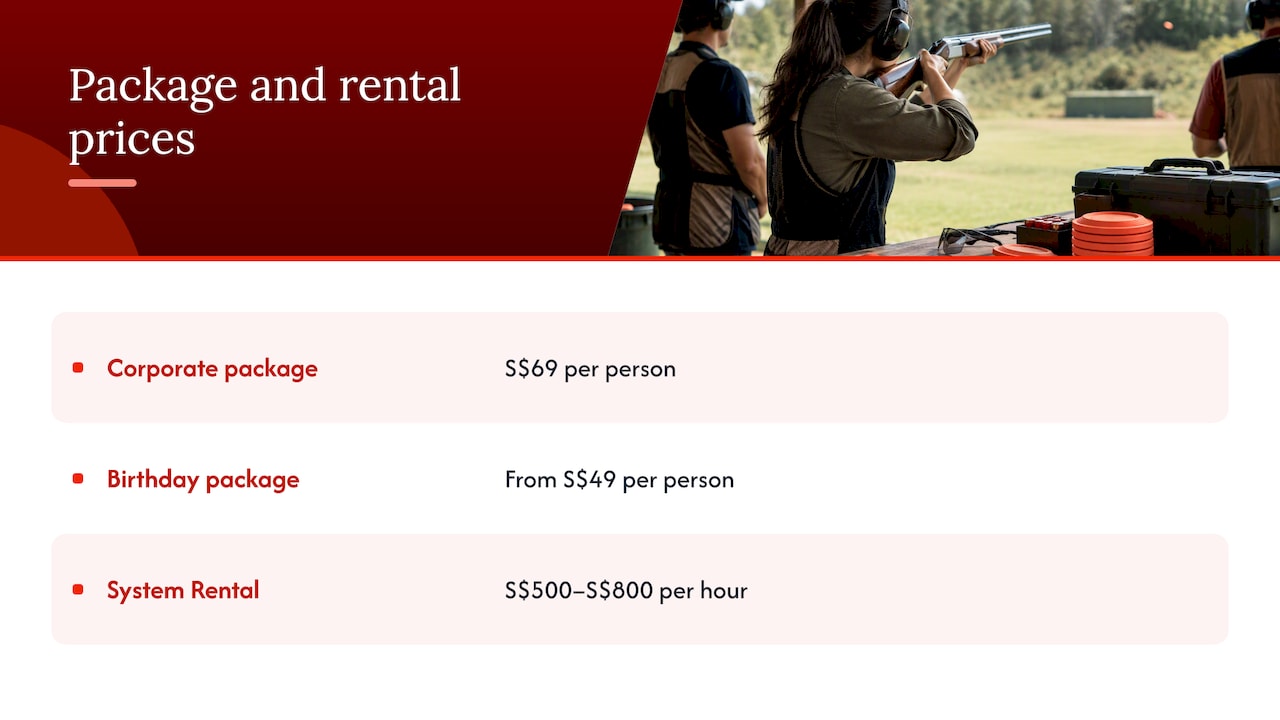
If you would like us to run the event, our Corporate Laser Clay Package is S$69 per person and includes facilitators, venue setup and event customisation, with game formats and scoring tailored to your group. Parents can look at the birthday party package, from S$49 per person. If you already have a venue and a facilitator, the System Rental is S$500 to S$800 per hour. To talk through your team count and time slot, contact us.
Common mistakes
- Choosing round robin for too many teams. Check the match count first.
- Not announcing tiebreakers. Disputes appear at exactly the wrong moment.
- Sending eliminated teams home. Add a plate competition, a consolation round or a social break.
- Overcomplicating the format. If you need a diagram to explain it, simplify it. A free tournament format planner can show games and rounds per format once you enter your team count.
- Ignoring the venue. Check how many stations can run at once before fixing the schedule. Our team building venues guide covers what to ask.
FAQ
What are the four main types of tournament?
Single elimination, double elimination, round robin and Swiss system are the four main structures. Elimination formats remove teams as they lose, round robin has everyone play everyone, and Swiss pairs teams of similar records without eliminating anyone. Many events combine two of them, such as groups followed by a knockout.
How is a 5-team tournament usually structured?
A single round robin is the usual choice. Each team plays four games and the event totals ten matches, which gives a fair table. If you want a final, split into groups of two and three and send the leaders into a playoff.
How do you run a tournament with 16 teams?
Avoid a full round robin, which needs 120 matches. Use four groups of four followed by a knockout of the top two from each group, or a Swiss system if you have a scorer who can run pairings. That keeps the number of matches manageable and still guarantees each team several games.
Is round robin better than knockout?
Round robin is fairer, because the result comes from many games rather than one. Knockout is faster and gives a clear final. For a social or corporate event, a group stage followed by a short knockout usually gives you both.
Sources
- Round-Robin vs Knockout vs Swiss: Which Tournament Format Should You Pick? (Score7)
- Tournament Structure: Games, Rounds and Hours by Format (Wheel of Teams)
- FIBA 3×3 workbook for organisers
- Number of Matches Tournament: Formulas for Every Format (Host A Tourney)
- Round-robin tournament (Wikipedia)
- The efficacy of tournament designs (ScienceDirect)
- Singapore to Launch First IPL-Style Box Cricket League (Tabla)