

Sustainable corporate events cut the footprint of travel, food, waste and venue energy, in that rough order of impact, so start with how people arrive and where they sleep, then menus, then certified venues. Anchor your plan to ISO 20121 and baseline Energy, Water and Waste early. Low-waste activities, such as our reusable laser clay sessions, keep the programme light on materials.
TL;DR:
- Set rail first for regional delegates, cluster hotels near the venue, use shuttles instead of individual taxis, and offer accessible travel alternatives.
- Shortlist venues with documented sustainability standards, efficient energy use, transit access, and visible waste systems, then require post event energy, water, and waste reports.
- Set a plant forward menu before negotiating prices, confirm attendance and dietary needs, control portions, and arrange food rescue and composting before event day.
- Prioritize reducing and reusing materials over recycling; set a diversion target, weigh each waste stream after the event, and compare results with a baseline.
- Require suppliers to document claims, agree on two or three measurable KPIs, and deliver post event data; score sustainability in the tender.
Table of Contents
- How do you choose a venue that supports sustainable corporate events?
- What does a menu-first approach to sustainable catering look like?
- Why do transport and accommodation matter most?
- How do you cut waste with reusable and circular materials?
- When do digital and hybrid formats cut the footprint?
- How do you measure and report the impact of an event?
- What should you put into supplier contracts?
- How can you engage attendees and leave a legacy?
- How do you make sustainable events inclusive and accessible?
- How can marketing and communications stay low-waste?
- How do you design and decorate with less waste?
- How do you cut energy use and source renewable power at event sites?
- Why choose low-waste activities for your team?
- Where do we fit in a sustainable corporate event programme?
- FAQ
- Sources
How do you choose a venue that supports sustainable corporate events?
Venue choice sets the ceiling for everything else, because building energy, transport access and waste systems are mostly fixed once you sign. The Carbon Trust’s Green Events guidance points planners to building energy efficiency, transport accessibility and a review of waste streams as early priorities. The GSTC MICE Criteria give you a shared yardstick for asking venues what they actually do.
What to look for in a shortlist:
- Alignment with ISO 20121 or the GSTC MICE Criteria, with documents you can read, not just a logo.
- Energy-efficient building operations, and a renewable electricity supply or on-site generation.
- Walking distance or a short transfer from rail and public transport.
- On-site recycling, composting or a food-donation process.
- EV charging for staff, suppliers and delegates who drive.
During the walk-through, ask to see the back-of-house waste area, the bin streams and the energy meter set-up. A venue that cannot show you any of these probably cannot report to you afterwards either.
For the RFP, paste in clauses that require the venue to supply energy, water and waste data after the event, to separate waste streams on request, and to accept your sustainability brief as part of the contract.
Pro Tip: Ask every shortlisted venue for last year’s waste diversion figure. The way they answer tells you more than the brochure.
What does a menu-first approach to sustainable catering look like?
Menu-first means you decide the food strategy before you negotiate prices, not after. Practitioners, including the team behind MCI’s ESG guide for corporate events, recommend plant-forward menus, seasonal and local sourcing and right-sized portions as a high-impact, low-barrier way to cut food waste and carbon while keeping quality high.
Food waste deserves particular attention. A pilot food rescue programme at a Las Vegas convention showed that diverting surplus food avoids a measurable amount of CO2e and that food is a major part of event waste streams.
Tactics that work in practice:
- Make plant-forward the default and offer meat as the opt-in choice.
- Chase accurate RSVPs and dietary data, then cater to the confirmed number rather than a padded guess.
- Choose plated service or staffed, replenished stations over large static buffets, which tend to produce surplus.
- Label dishes clearly so people take what they will eat.
- Line up a food rescue partner and a composting route before the day.
In the caterer’s contract, require a seasonal menu, reusable serveware, a portion-control plan and a post-event waste report. Swapping red meat for poultry, fish or vegetables, and disposable plates for reusable ones, is the simplest high-impact change you can make.
Pro Tip: Ask the caterer to show you the menu with the three highest-footprint dishes removed. You will often find nobody misses them.
Why do transport and accommodation matter most?
Carbon-accounting research on MICE events, including a case study from the University of Essex, shows mobility and accommodation as the dominant sources of emissions, with tools such as the Myclimate Event Calculator used to pinpoint where interventions pay off. Published research on carbon accounting reports that these two categories often make up a large share of an event’s footprint. That is why a rail-first travel policy and eco-certified hotels outperform almost any decorative gesture.
Interventions to build into your plan:
- A rail-first rule for regional delegates, with booking support so it is as easy as flying.
- Grouped airport transfers and shuttles in place of individual taxis.
- Incentives for low-carbon travel, such as a shorter travel-day allowance for those who take the train.
- One cluster of hotels within walking distance of the venue, preferably eco-certified.
- Carpool coordination for local attendees who would otherwise drive alone.
For international delegates, offer fewer, longer trips: stack meetings, site visits and workshops into one visit instead of several. Inside the event, keep activities in one place so nobody needs a coach between sessions.
How do you cut waste with reusable and circular materials?
Work down the hierarchy: reduce first, then reuse, then recycle. The UNDP’s sustainable events guideline stresses that sustainability belongs in the project’s governing principles from the start, which is when material choices are cheapest to change.
Practical steps:
- Use reusable cups, plates and cutlery with a clear return point, or rent them.
- Choose rented or modular staging and durable, dateless signage that survives into the next event.
- Run bin streams that match the venue’s actual disposal system, so sorted waste is not simply tipped together afterwards.
- Compost food scraps on site where possible, and send edible surplus to a food rescue partner.
- Replace throwaway giveaways with items people will use for years, or skip merchandise and donate the budget.
Set a diversion target before you start, record weights at the end, and compare them with your baseline next time.
Pro Tip: Staff the bin station for the first hour. Attendees sort correctly when someone is there to point.
When do digital and hybrid formats cut the footprint?
Hybrid and virtual elements save the most when they replace long-haul travel, because mobility is the biggest slice of the footprint. The ICLEI Sustainable Events Guide lists virtual and hybrid formats among the tools for mainstreaming sustainability, alongside procurement and waste management.
Design tips:
- Make keynotes and briefings remote-friendly, and keep hands-on workshops in person.
- Set up local satellite hubs so regional teams meet in their own city and stream into the main programme.
- Stream at moderate quality and switch cameras off for passive viewers.
- Pace the content so remote attendees are not forced into late-night sessions.
- Estimate the saving by taking the travel you avoid, in distance and mode, and running it through the same calculator you use for the in-person event.
Remote attendance also widens access for people who cannot travel, which is a benefit beyond carbon.
How do you measure and report the impact of an event?
You cannot manage what you do not measure, so baseline the event first. Singapore Tourism Board guidance on its MICE sustainability roadmap recommends tracking Energy, Water and Waste, aligned with the Net Zero Carbon Events Methodology. Its announcement of MICE sustainability initiatives describes a legacy toolkit and carbon and waste baselining to support planners.
A short data collection checklist:
- Venue energy and water use for event days, from meter readings or the venue’s report.
- Waste weights by stream: landfill, recycling, compost and food donation.
- Delegate travel by mode and distance, from the registration form.
- Hotel nights by property.
- Catering volumes and surplus.
Run the numbers through a recognised calculator such as Myclimate’s. Expect travel and accommodation to dominate, then set reduction targets you can actually reach, such as improving diversion on the last event rather than promising net zero. Report the results to sponsors and leadership in the same format each year, so progress is visible.
What should you put into supplier contracts?
Suppliers deliver what the contract measures. The Tourism Sustainability Programme frames tracked sustainability metrics, such as waste diversion rates and carbon emissions against a baseline, as a way to attract sponsors and support ESG reporting.
Paste-ready checklist items:
- State minimum sustainability requirements in the RFP, not as an afterthought.
- Ask for evidence: certifications, policies, last year’s data.
- Agree two or three supplier KPIs, such as waste diverted or share of local ingredients.
- Require post-event data within a fixed number of days.
- Reserve the right to review claims on site.
To spot greenwash, ask for numbers and documents. Vague claims with no data are a warning. A short supplier workshop before the event, with shared KPIs, usually does more than a long questionnaire.
Pro Tip: Score sustainability inside the tender, with a stated weighting, so it competes fairly with price.
How can you engage attendees and leave a legacy?
Tell delegates what you are doing before they arrive. A pre-event email can explain the rail-first policy, the plant-forward menu and the reusable cups, so nobody is surprised on the day.
Ideas for a legacy:
- Partner with a local community group and let delegates give time or skills during the event.
- Donate surplus food, furniture and materials to local charities.
- Tie a skills-transfer session to the event theme.
- Publish a short results note with real numbers.
- Feed outcomes into ESG reporting and sponsor communications.
The Singapore Tourism Board’s legacy toolkit, mentioned above, gives planners a structure for designing these outcomes.
How do you make sustainable events inclusive and accessible?
A sustainable event that excludes people is not sustainable in any useful sense. Accessibility and sustainability often pull in the same direction, and the social side is a stated part of ISO 20121, which covers environmental and social responsibility together.
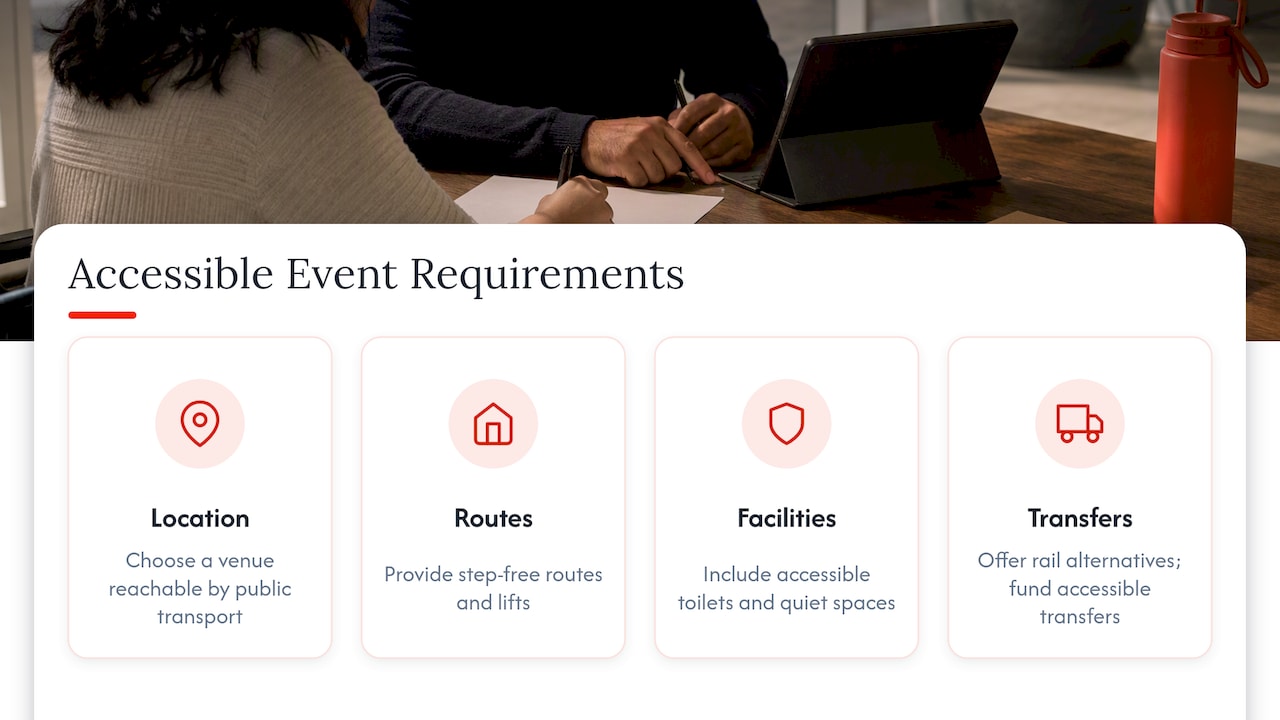
Start with the venue. Step-free routes, lifts, accessible toilets and quiet spaces matter, and so does a location reachable by public transport, which helps delegates who cannot drive and cuts emissions at once. Check that the rail-first policy does not strand anyone: offer an alternative for people with mobility needs, and cover the cost of accessible transfers.
Menus should respect dietary, religious and allergen needs without defaulting to the high-waste option. Plant-forward menus work well here because they suit a wide range of diets, and clear labelling helps everyone choose what they will actually eat.
For hybrid formats, add captions, transcripts and recordings, so deaf attendees, people in other time zones and those with caring responsibilities can take part on their own terms.
Think about who is in the room and on the stage. Diverse speakers and suppliers, including local and small businesses, spread the economic benefit of the event. Ask your accessibility questions at the same stage as your carbon questions, in the RFP, so they are priced in rather than bolted on.
Finally, ask attendees what got in their way. A single question on the feedback form about access and inclusion gives you something concrete to fix next time.
How can marketing and communications stay low-waste?
Event communications are an easy place to cut materials without touching the attendee experience. Digital invitations, a mobile agenda and a single event page replace most of what used to be printed, and they can be updated without reprinting anything.
Practical steps:
- Send digital invitations and reminders, and keep the mailing list clean so you are not sending to people who do not engage.
- Replace printed programmes with a mobile agenda or a QR code that leads to one page.
- Where print is unavoidable, choose recycled stock, print to the confirmed number and avoid dated information that makes leftovers useless.
- Use reusable or recyclable wayfinding signage instead of single-use boards.
- Keep file sizes and email attachments modest, since heavy digital assets also have a footprint.
Use your communications to carry the sustainability message itself. Tell delegates how to travel, what the menu looks like and where the recycling points are. People follow clear instructions much more readily than general appeals.
After the event, share your results honestly. A short note with real figures on waste diverted and travel choices is more persuasive than a generic claim, and it protects you from accusations of greenwash. If a target was missed, say so and explain what you will change.
Where sponsors are involved, agree early how they will brand the event without adding throwaway materials. Digital sponsor recognition, a shared reusable banner or a donation in their name often replaces a stack of printed collateral.
How do you design and decorate with less waste?
The greenest decoration is the one you reuse. Plan the look of the event around items that survive it, such as fabric backdrops, modular staging, potted plants that you can return or donate, and signage without dates, so the same pieces serve the next event.
Where you need disposable items, choose carefully:
- Prefer reusable first, then compostable only if the venue actually composts; biodegradable items sent to landfill do not solve anything.
- Rent furniture, lighting and staging instead of buying for a single use.
- Use living plants or locally sourced flowers that are donated afterwards, instead of foam-based arrangements.
- Keep branding generic enough to be reused, with the event name on a replaceable panel rather than printed across everything.
- Avoid glitter, balloons and confetti, which cannot be recovered.
Ask the production company how the build will be stored and reused, and put the answer in the contract. A supplier with a reuse process will give you a straight answer; one without will hesitate, which tells you what you need to know.
Activities are part of design too. Programme elements that need little in the way of consumables keep the event light. A reusable, tech-driven activity such as laser clay shooting can help reduce the materials used in a programme, so it adds energy and engagement without adding much to the bin. Our article on sustainable team building activities goes through how to weigh the waste of different formats for ESG reporting.
How do you cut energy use and source renewable power at event sites?
Energy is one of the three metrics worth baselining, and the venue controls most of it. Ask early what electricity the building runs on, how efficient the lighting and cooling are, and whether you can buy or specify renewable supply for the event days.
Options, from simplest to most ambitious:
- Pick a venue with efficient heating, cooling and lighting, and check how they are scheduled around your event hours.
- Ask whether the venue buys renewable electricity through a green energy contract, and request evidence.
- Where power must be brought in, prefer battery systems or grid connection over diesel generators.
- Switch off equipment overnight, and agree set-up and strip-out times that avoid running systems unnecessarily.
- Where a site allows it, use on-site solar or ask whether the venue has any.
For temporary or outdoor events, plan the load carefully. Oversized generators burn fuel for nothing, so size supply to the real demand and review it with the production team.
Treat energy data as part of your report. Ask the venue for meter readings for your days, compare them with the baseline from your last event and record the change. The Carbon Trust’s guidance is a good starting point for the questions to ask.
If you are comparing venues, make energy a scored criterion in the RFP, not a note in the margin. A building that is efficient and well run saves money as well as carbon, which helps the case for choosing it.
Why choose low-waste activities for your team?
I have a simple rule when choosing programme elements: favour activities that need no consumables and little travel. Team building is often where an otherwise careful event slips, with coaches to an off-site location, single-use materials and prizes nobody keeps.
Reusable, tech-driven formats avoid most of that. Laser clay shooting uses reusable clays, and a facilitated session brings its own staff and equipment to your venue, so delegates stay where they are. Our overview of the benefits of laser shooting team events explains how this suits planners with sustainability goals.
My advice: bring your activity supplier into the sustainability conversation early, as you would a caterer, and ask what they consume, what they transport and what they leave behind.
— Joshua
Where do we fit in a sustainable corporate event programme?
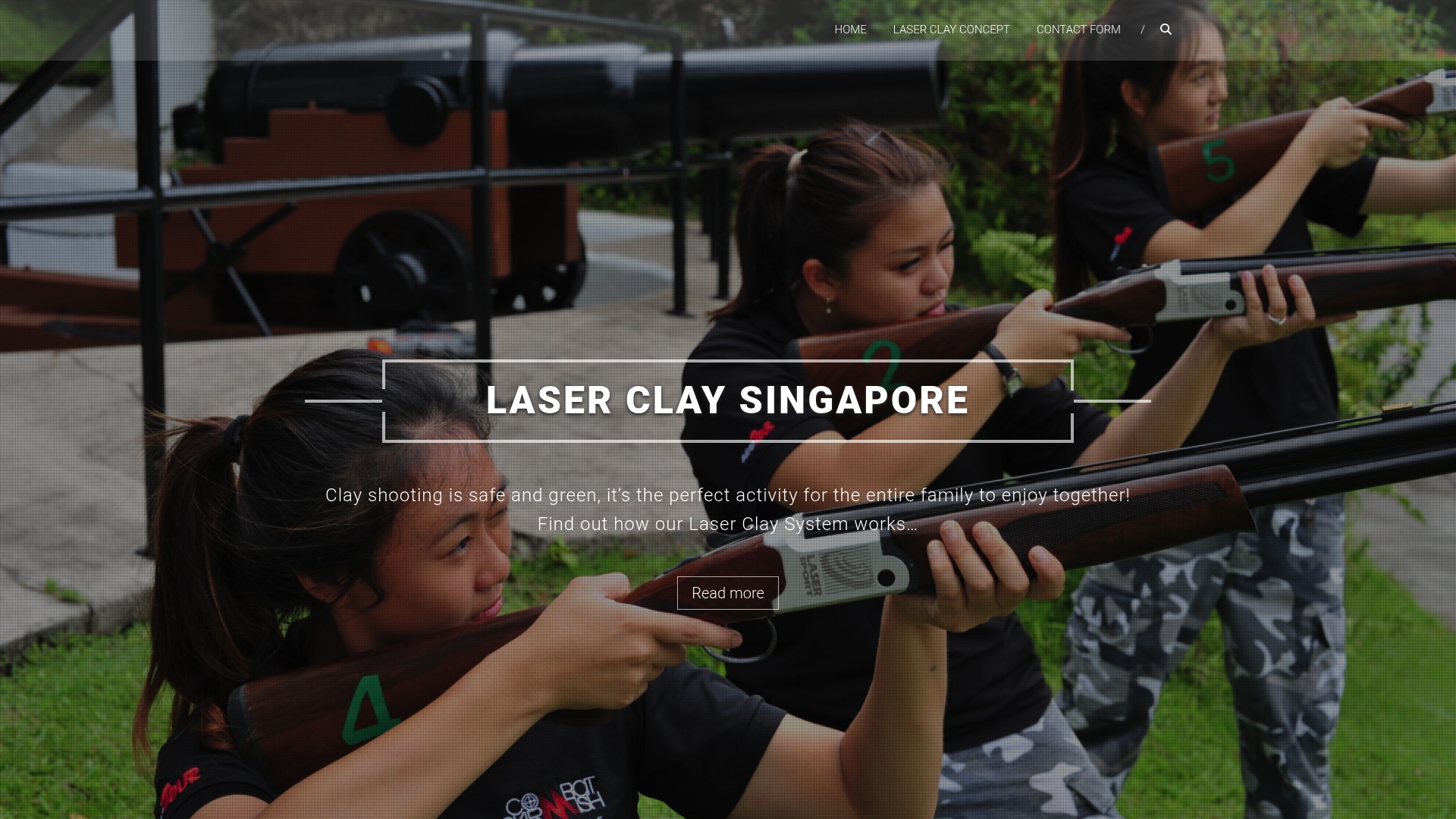
If your plan needs a team activity that adds energy without adding waste, our Corporate Laser Clay Package is built for it, at 69 SGD one-off per person.
What we bring to a low-waste programme:
- Reusable clays and no lead ammunition.
- No noise pollution from the sound-simulated deactivated shotguns.
- Facilitated sessions for your team.
- Indoor or outdoor delivery at your venue.
- Real-time electronic scoring, so results are measurable.
That covers the planner’s job of low-waste team building without adding logistics. If you would rather run the activity yourself, our system rental is available at 500-800 SGD per hour. Our planner-facing explainer covers set-up, and you can contact us to check availability for your date.
FAQ
What makes a corporate event sustainable?
A sustainable corporate event reduces environmental impact across travel, accommodation, food, waste and venue energy, and manages its social effects too. ISO 20121 is the recognised standard for managing this systematically.
What has the biggest effect on an event’s carbon footprint?
Travel and accommodation. Carbon-accounting case studies of MICE events show mobility and accommodation as the dominant emission sources, so cutting travel distance and choosing close, eco-certified hotels deliver the largest reduction.
How do you reduce food waste at a corporate event?
Confirm numbers accurately, choose plant-forward menus and portion sizes that match, and arrange food rescue and composting in advance. A convention food rescue pilot found that diverting surplus food avoided measurable CO2e.
What should you measure at a sustainable event?
Track Energy, Water and Waste, plus travel and accommodation. Singapore Tourism Board guidance recommends these metrics, aligned with the Net Zero Carbon Events Methodology.
Can team-building activities be low-waste?
Yes. Choose formats with reusable equipment and no consumables, delivered at your own venue. Laser clay shooting is one example, since it uses reusable clays and no lead.
Sources
- ISO 20121:2024 – Event sustainability management systems — Requirements with guidance for use
-
[Carbon Accounting for Sustainability Management: Case study of MICE events
Research Repository](https://repository.essex.ac.uk/40150/)
- The Global Sustainable Tourism Council (GSTC) Publishes New GSTC MICE Criteria | Singapore Tourism Board