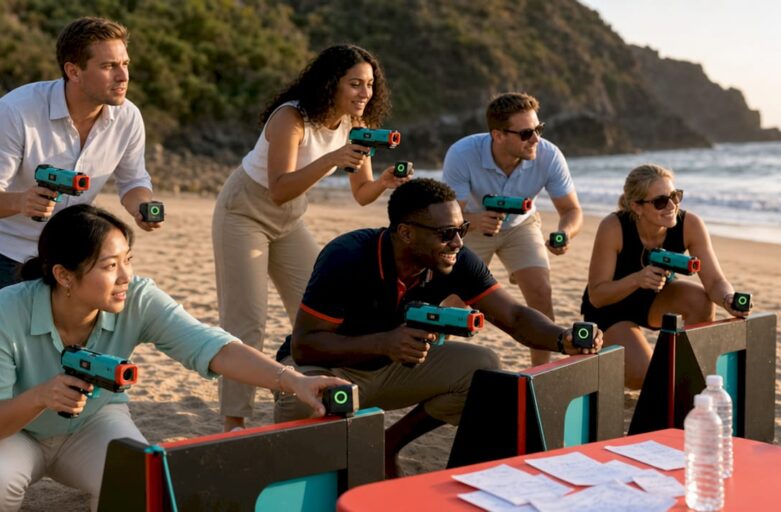
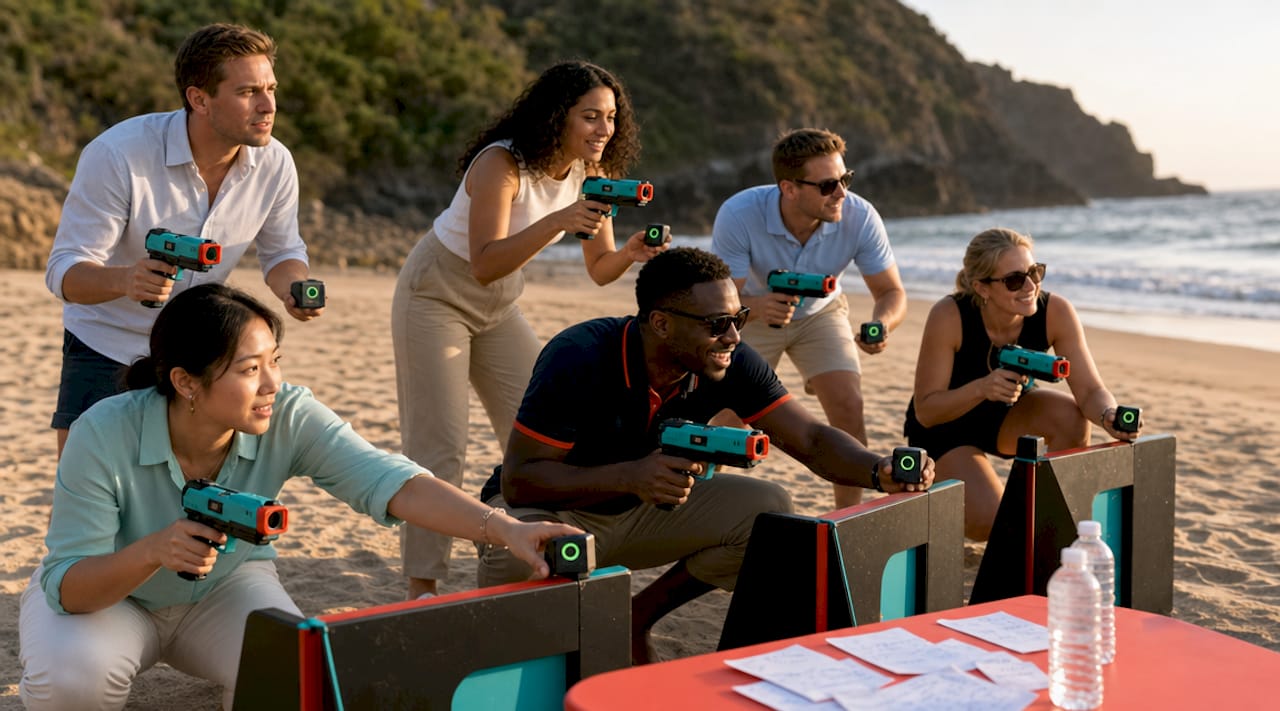
Laser shooting team events are defined as structured group activities using laser-based technology to simulate target shooting, delivering measurable benefits across communication, collaboration, and morale. The benefits of laser shooting team events extend well beyond entertainment. They create conditions where real teamwork is required, not just encouraged. Formats like laser clay pigeon shooting and laser tag arenas give event organisers flexible, eco-friendly options that work for groups of 25 to over 100 participants, with sessions typically running between 20 and 45 minutes per round. Whether you are planning a corporate away day or a group bonding experience, laser shooting delivers outcomes that traditional team-building activities rarely match.
1. How laser shooting events build communication and strategic collaboration
Corporate laser shooting creates a high-pressure environment that fosters real communication and trust under time constraints not easily replicated in an office setting. When a team is competing under a countdown, there is no room for vague instructions or passive listening. Players must communicate clearly, assign roles quickly, and adapt their strategy in real time.
100% of managed corporate laser shooting events report improvements in communication, strategic planning, and morale among participants. That figure reflects a consistent pattern: the game mechanics themselves force the kind of direct, purposeful communication that most workplace training sessions only attempt to simulate. When the pressure is real, even if the stakes are low, people communicate differently.

Strategic planning under timed, competitive conditions also strengthens team dynamics in ways that are difficult to manufacture artificially. Teams must assess the environment, allocate responsibilities, and adjust tactics mid-game. These are the same cognitive and interpersonal skills that determine performance in project teams, client pitches, and operational decisions.
Pro Tip: Assign a different team captain for each round. Rotating leadership during gameplay surfaces natural communication styles and reveals who steps up under pressure, giving you genuine insight into your team’s dynamics.
- Real-time communication is non-negotiable during gameplay, making it a natural training ground for clarity and brevity
- Strategic planning under time pressure mirrors the decision-making demands of real work scenarios
- Trust is built through shared risk and mutual reliance, not through classroom exercises
- Quick decision-making during play translates directly into faster, more confident choices at work
2. Inclusivity: why laser shooting levels the playing field
Laser shooting success depends on collective strategy rather than physical dominance, making it genuinely accessible to all fitness levels, ages, and experience backgrounds. This is the quality that separates laser shooting from most corporate sports days. You do not need to be fast, strong, or particularly fit to contribute meaningfully. You need to think, communicate, and coordinate.
Quiet, analytical team members often excel in laser shooting events precisely because the format rewards strategic depth over physical agility. The colleague who rarely speaks up in meetings may turn out to be the most effective tactician on the field. That kind of revelation changes how people perceive each other back in the workplace, and those shifts in perception are the foundation of stronger team dynamics.
Inclusivity also removes the peer pressure that often undermines traditional physical team activities. Nobody feels embarrassed about their pace or their coordination when the game is decided by positioning and communication rather than athleticism. This creates a psychologically safe environment where participation feels genuinely equal.
Pro Tip: Brief your teams before play by framing the activity as a strategy game, not a physical challenge. This single reframe increases engagement from participants who might otherwise hold back.
- No physical dominance required, welcoming participants of all fitness levels
- Analytical and quieter team members frequently outperform in strategy-led formats
- Shared experience without physical pressure builds trust across diverse team compositions
- Equal contribution opportunities strengthen cohesion between departments and seniority levels
3. Environmental and logistical advantages for sustainable team building
Laser shooting events remove the need for live ammunition, reducing environmental impact and offering flexible, eco-friendly event options that align with corporate sustainability commitments. For organisations with green credentials to maintain, this distinction matters. Traditional clay pigeon shooting involves lead shot, noise pollution, and significant land disturbance. Laser clay shooting eliminates all three.
The logistical advantages are equally significant. Mobile laser clay shooting setups require a minimum area of 60ft x 60ft and support five players simultaneously, while indoor laser tag arenas can host 40 or more players in sessions lasting 20 to 45 minutes. That flexibility means you are not locked into a specific venue type or a fixed group size.
| Feature | Laser shooting events | Traditional shooting events |
|---|---|---|
| Ammunition required | None | Live rounds or lead shot |
| Environmental impact | Minimal | Significant (lead, noise, land) |
| Venue flexibility | Indoor and outdoor | Primarily outdoor, specialist sites |
| Setup complexity | Low | High |
| Safety requirements | Standard event protocols | Specialist firearms oversight |
The practical result is that laser shooting events are easier to organise, cheaper to run, and far less disruptive to the surrounding environment. For event organisers managing tight timelines and sustainability reporting, those factors are not minor conveniences. They are genuine operational advantages.
4. Comparing laser shooting formats: which suits your team?
Choosing between laser tag arenas and laser clay pigeon shooting depends on your group size, venue access, and the specific team-building outcomes you want to prioritise. Both formats deliver the core benefits of laser tag, but they do so through different mechanics and atmospheres.
| Format | Ideal group size | Session length | Key team benefit | Venue type |
|---|---|---|---|---|
| Laser tag arena | 10 to 40+ players | 20 to 45 minutes | Agility, communication, rapid decision-making | Indoor |
| Laser clay pigeon shooting | 5 to 100+ players | Flexible, 2+ hours | Precision, patience, cross-team interaction | Outdoor or mobile |
| Corporate laser shooting packages | 25 to 100+ players | Half-day or full-day | Leadership, strategy, sustained collaboration | Indoor or outdoor |
Corporate packages cater to groups from 25 to over 100 participants, with options for two-hour private sessions and unlimited play for full-day bookings. That range makes laser shooting one of the most scalable team event ideas available to organisers working with large or mixed-size groups.
Laser tag arenas suit teams that benefit from fast-paced, high-energy interaction. The confined space and short rounds create intensity that accelerates communication and trust-building. Laser clay pigeon shooting, by contrast, suits teams where you want to encourage patience, precision, and cross-team conversation during breaks between rounds. Understanding what laser clay shooting involves helps organisers match the format to their specific team goals rather than defaulting to the most familiar option.
5. Tips for maximising team-building outcomes from laser shooting
Structuring your laser shooting event deliberately is what separates a fun afternoon from a genuinely developmental experience. The activity itself creates the conditions for growth. Your job as an organiser is to make sure those conditions are used well.
- Rotate teams between rounds. Rotating teams encourages cross-team bonding and prevents clique formation, which is the single most effective structural change you can make to a laser shooting event. Static teams default to existing relationships. Mixed teams build new ones.
- Set specific objectives for each round. Rather than playing for points alone, assign a communication challenge to each round. For example, one round might require all tactical decisions to be made verbally before any player moves. This makes the gameplay directly relevant to workplace behaviour.
- Run a structured debrief after play. Debrief sessions after play are critical for turning enjoyable gameplay into practical improvements in real-world team collaboration. Ask teams what communication worked, what failed, and how they would approach the same challenge at work.
- Tailor game modes to team goals. If your objective is leadership development, use formats that require one player to direct others without participating directly. If the goal is communication, use modes that penalise solo play.
- Capture observations during play. Assign one facilitator per team to observe and note specific moments of effective or ineffective communication. These observations become the raw material for a meaningful debrief.
Pro Tip: Send a short reflection prompt to participants within 24 hours of the event. Ask them to name one communication habit they noticed during play that they want to bring into their next team meeting. Written reflection dramatically increases retention of experiential learning.
Key takeaways
Laser shooting team events deliver their strongest results when strategy, inclusivity, and structured reflection are built into the programme from the start.
| Point | Details |
|---|---|
| Communication under pressure | Laser shooting creates real-time conditions that force clear, direct communication between team members. |
| Inclusivity across all abilities | Success depends on strategy, not physical fitness, making these events genuinely accessible to every participant. |
| Eco-friendly and logistically flexible | Ammunition-free technology reduces environmental impact and simplifies venue and setup requirements. |
| Format choice matters | Laser tag arenas suit fast-paced interaction; laser clay suits precision and cross-team dialogue. |
| Debrief converts fun into growth | Structured post-event reflection is what transforms gameplay into lasting improvements in team behaviour. |
Why laser shooting events work when other activities do not
I have observed dozens of corporate team-building formats over the years, and the pattern is consistent. Activities that rely on physical competition tend to reinforce existing hierarchies rather than disrupt them. The fastest runner still wins. The most confident voice still dominates. Laser shooting breaks that pattern in a way that very few other formats manage.
What makes it work is the combination of genuine adrenaline and low physical stakes. People are genuinely engaged because the game demands it, not because a facilitator is asking them to be. And because physical strength is irrelevant, the usual office dynamics do not simply transfer onto the field. I have watched senior managers get outmanoeuvred by junior analysts who had never touched a laser tag gun before. That moment of role reversal, when it happens in a safe and playful context, does more for team cohesion than a full day of workshop exercises.
The one non-negotiable, in my experience, is the debrief. Without it, the event is enjoyable but forgettable. With it, the gameplay becomes a shared reference point that teams return to for months. Joining a laser clay community extends that benefit beyond a single event, giving teams a recurring context for the kind of authentic interaction that builds real trust over time.
— Joshua
Plan your next team event with Laserclay
Laserclay designs corporate laser clay shooting experiences for groups of 25 to over 100 participants, with flexible scheduling, eco-friendly technology, and tailored event formats that match your team’s specific goals.
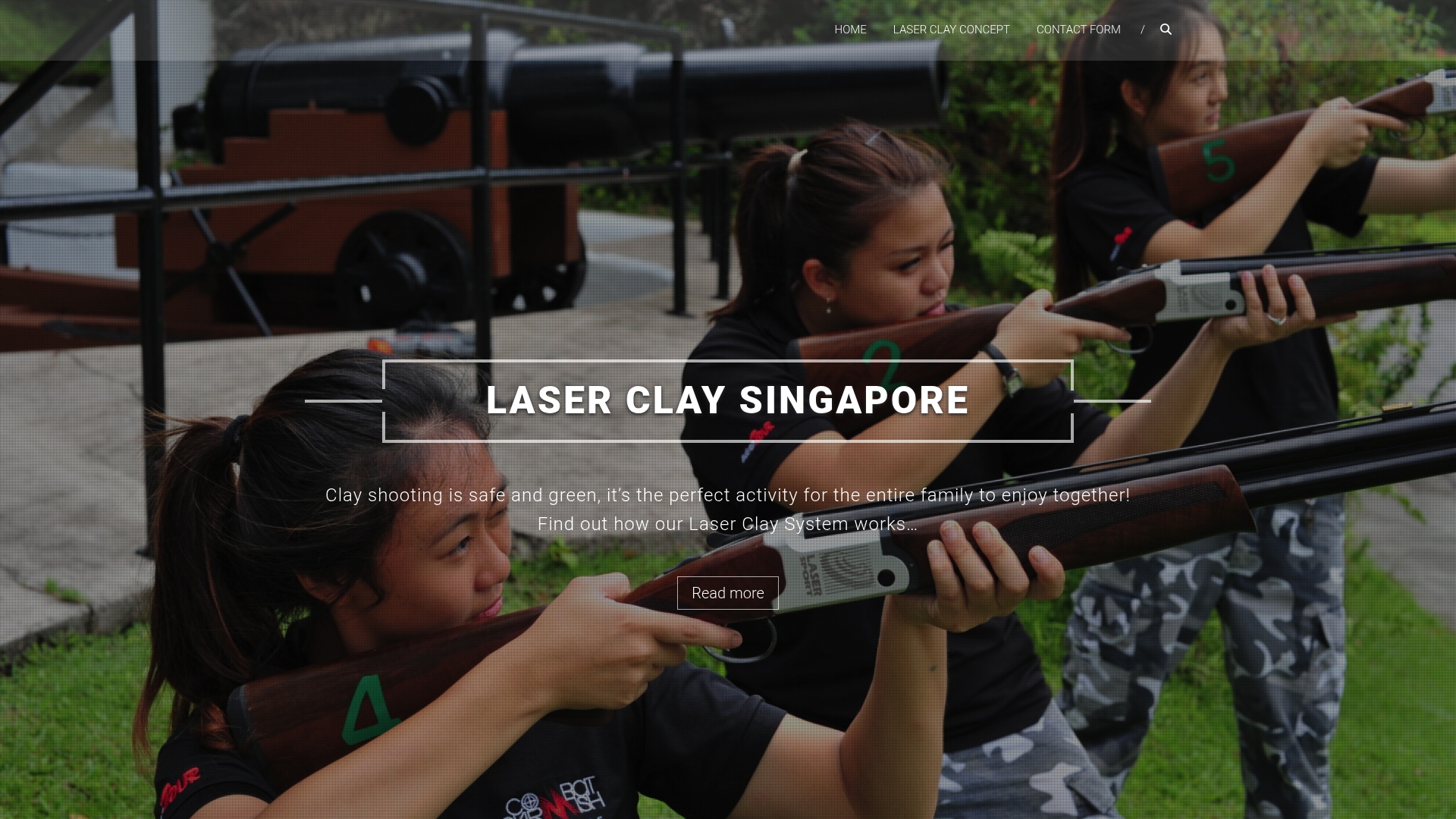
Whether you are organising a half-day session or a full-day corporate programme, Laserclay’s outdoor team building packages are built around the outcomes that matter: communication, collaboration, and genuine group cohesion. Every session uses ammunition-free laser technology, making it a responsible choice for organisations with sustainability commitments. Browse the full range of experiences at Laserclay and find the format that fits your team.
FAQ
What are the main benefits of laser shooting team events?
Laser shooting team events improve communication, strategic thinking, and morale by placing teams in high-pressure, collaborative gameplay scenarios. They are also inclusive, eco-friendly, and scalable for groups of 25 to over 100 participants.
How does laser clay shooting differ from laser tag for team building?
Laser clay pigeon shooting suits larger groups and focuses on precision and cross-team interaction, while laser tag arenas are better suited to fast-paced communication and rapid decision-making in smaller, more confined settings.
Is laser shooting suitable for all fitness levels?
Laser shooting success depends on collective strategy rather than physical dominance, making it accessible to participants of all ages, fitness levels, and experience backgrounds.
How long does a corporate laser shooting event typically last?
Sessions typically run between 20 and 45 minutes per round, with full corporate packages available as half-day or full-day programmes depending on group size and objectives.
Why is a debrief important after a laser shooting event?
Structured debrief sessions are critical for linking gameplay experiences to real workplace communication challenges, converting an enjoyable activity into measurable team development.