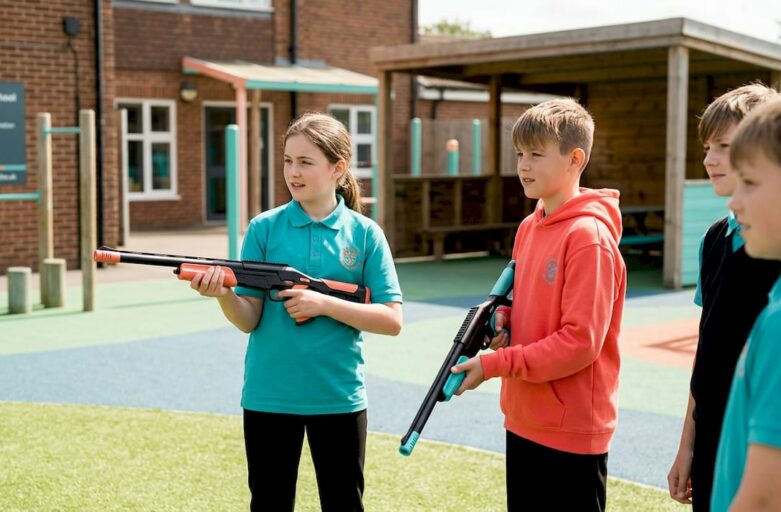
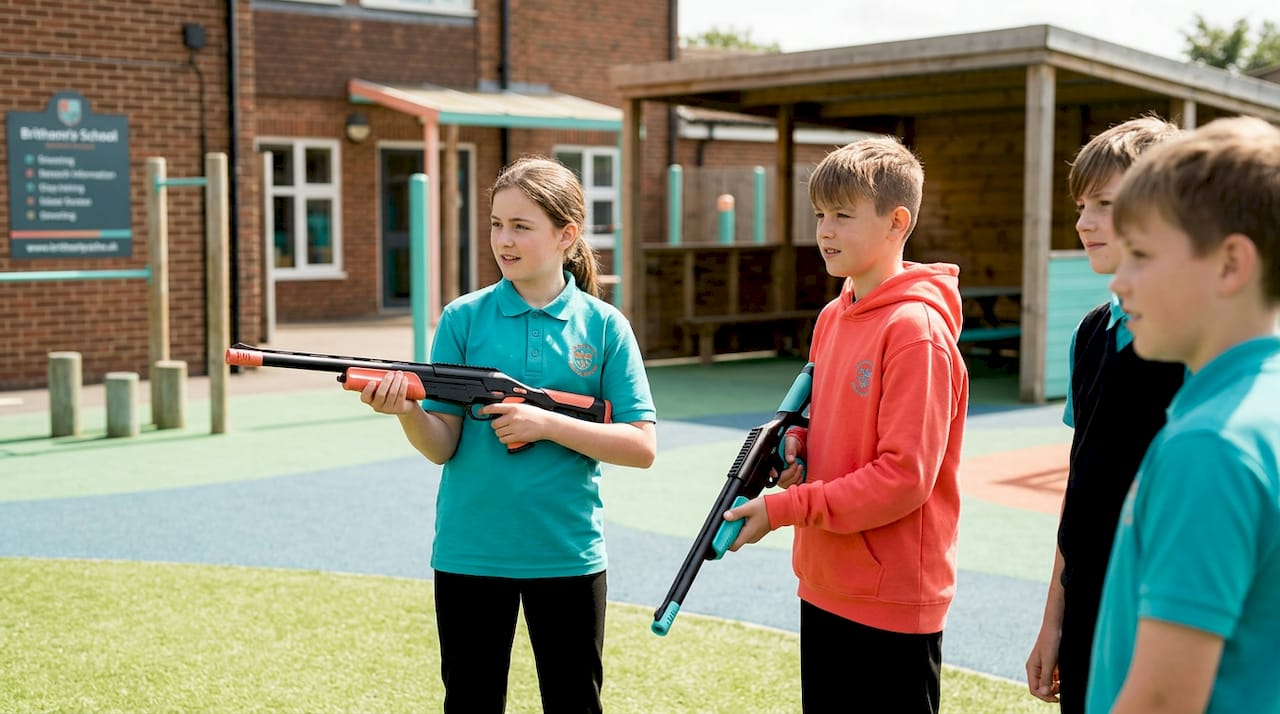
Every year, schools and event organisers wrestle with the same problem: a traditional sports day that leaves a third of participants standing on the sidelines, anxious, bored, or nursing a twisted ankle. Why laser clay beats traditional sports days comes down to three things. Safety without compromise, engagement that holds for every participant, and logistics that actually work. This article explores the technology behind laser clay shooting, the real advantages over conventional activities, and how to put it into practice at your next event.
Table of Contents
- Key takeaways
- Why laser clay beats traditional sports days
- Safety, inclusion, and engagement advantages
- Technology that keeps scoring honest
- Organising laser clay for school events
- Addressing common misconceptions
- My honest take after years in this space
- Get started with Laserclay for your next event
- FAQ
Key takeaways
| Point | Details |
|---|---|
| Safety without live ammo | Laser clay eliminates recoil and live ammunition, making it appropriate for all ages and environments. |
| Objective, dispute-free scoring | High-speed cameras and AI deliver millisecond-accurate results, removing the arguments common in traditional events. |
| Higher inclusion rates | Structured sessions and instant feedback encourage participants of every skill level, reducing anxiety and boosting confidence. |
| Flexible deployment | Equipment is portable and works indoors or outdoors, removing weather dependency from your planning. |
| Greener alternative | Lead-free shooting removes environmental concerns associated with conventional clay or ammunition-based activities. |
Why laser clay beats traditional sports days
Ask most educators to describe a traditional sports day and you will hear the same story. A relay race decided by a disputed photo finish, a student who cannot participate because of a prior injury, or a muddy field that forces a cancellation two hours in. Laser clay shooting addresses each of those problems at the root.
At its core, laser clay shooting replaces live ammunition with a laser-equipped replica firearm. When a clay disc is launched, the system detects whether the laser beam intersects its flight path within a precise window. There is no recoil and no live ammo, which means a fourteen-year-old with no prior experience and a teacher who has never held a sporting firearm can both participate safely on the same afternoon.
The gameplay itself is straightforward. A clay target is launched, the participant raises the replica, tracks the clay, and fires. Results appear immediately on a live display screen. That feedback loop, from action to visible outcome in under a second, is what separates laser clay from the passive experience of watching a race from the edge of a field.
Contrast that with traditional sports day staples. Tug of war carries a genuine injury risk, as rope friction burns and sudden falls are well documented. Long-distance running events expose participants with respiratory conditions or physical limitations to real discomfort. Neither activity has a built-in mechanism to make every single participant feel competent. Laser clay does.
- No physical contact required, removing collision and fall risks entirely
- Fully adjustable difficulty, so beginners and confident participants are challenged equally
- Instant visible results, meaning no participant waits twenty minutes to find out how they performed
- Scalable group sizes, from a small class of twenty to a full-school event of several hundred
Pro Tip: If you are introducing laser clay to a school group for the first time, schedule a short demonstration round before competition begins. Watching one clay get hit in real time removes most of the hesitation from less confident participants.
Safety, inclusion, and engagement advantages
Traditional sports days were designed for a different era. The assumption behind them is that every pupil is equally capable of running, jumping, or throwing, and that competition between unequal participants is somehow motivating. Schools have moved on from that assumption in almost every other area of education. Sports days are one of the last holdouts.
The safety case for laser clay is not just about removing ammunition. It is about removing the entire category of high-impact physical risk. Schools report that participants in laser clay sessions demonstrate higher confidence and lower anxiety than those in traditional competitive races. That matters for educators who are responsible for the wellbeing of every student, not just the athletic ones.
Inclusion that goes beyond physical ability
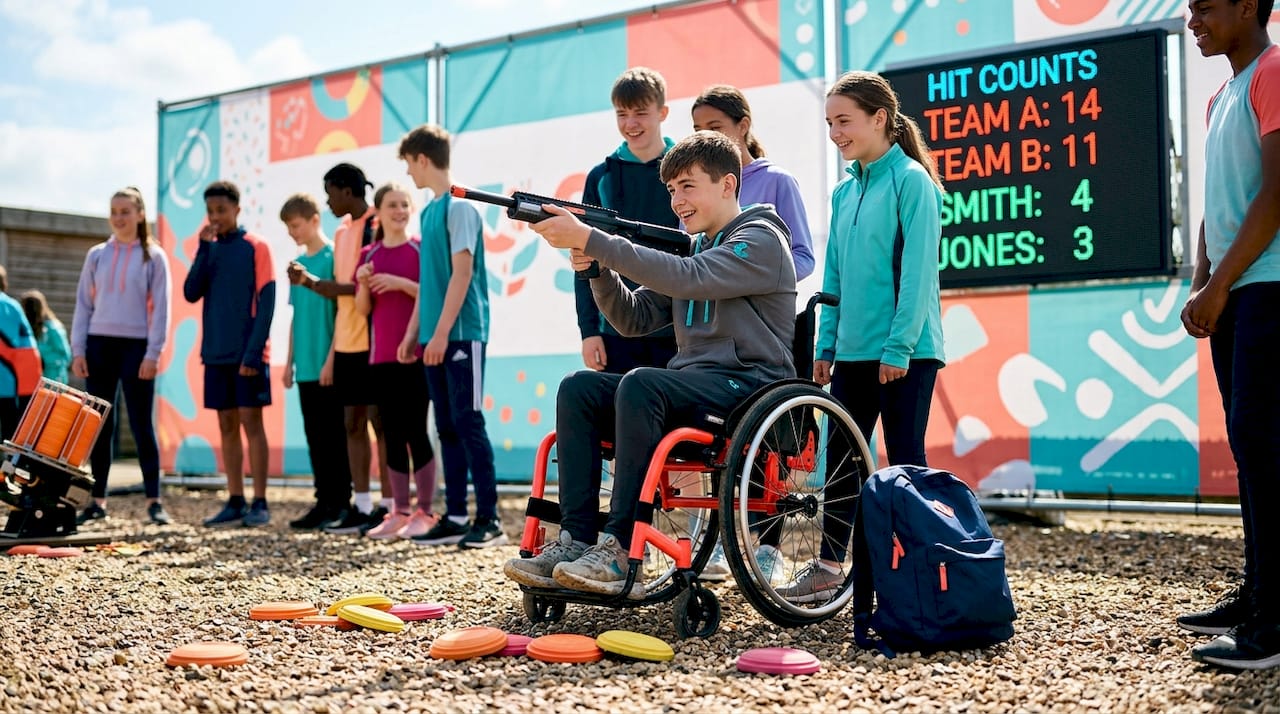
Laser clay works for participants who use wheelchairs, who have conditions affecting balance, or who simply have never excelled in team sports. The activity requires hand-eye coordination and focus rather than speed or strength. That shift opens participation to a far wider group without any modification to the activity itself.
| Feature | Laser clay | Traditional sports day activity |
|---|---|---|
| Physical contact risk | None | Moderate to high |
| Weather dependency | Low (indoor/outdoor flexible) | High |
| Skill threshold to enjoy | Very low | Variable, often high |
| Immediate feedback | Yes, digital and visual | Rarely |
| Suitable for all abilities | Yes | Often no |
| Environmental impact | Minimal | Lead waste, field damage |
Engagement through gamification
The live feedback screens and shooter portals that power modern laser clay systems do something traditional sports days cannot: they make every participant’s experience feel personal. Scores update in real time. Shooters can see their own improvement arc across multiple rounds. That sense of measurable personal progress is what keeps energy high for an entire session rather than peaking at the start gun and fading fast.
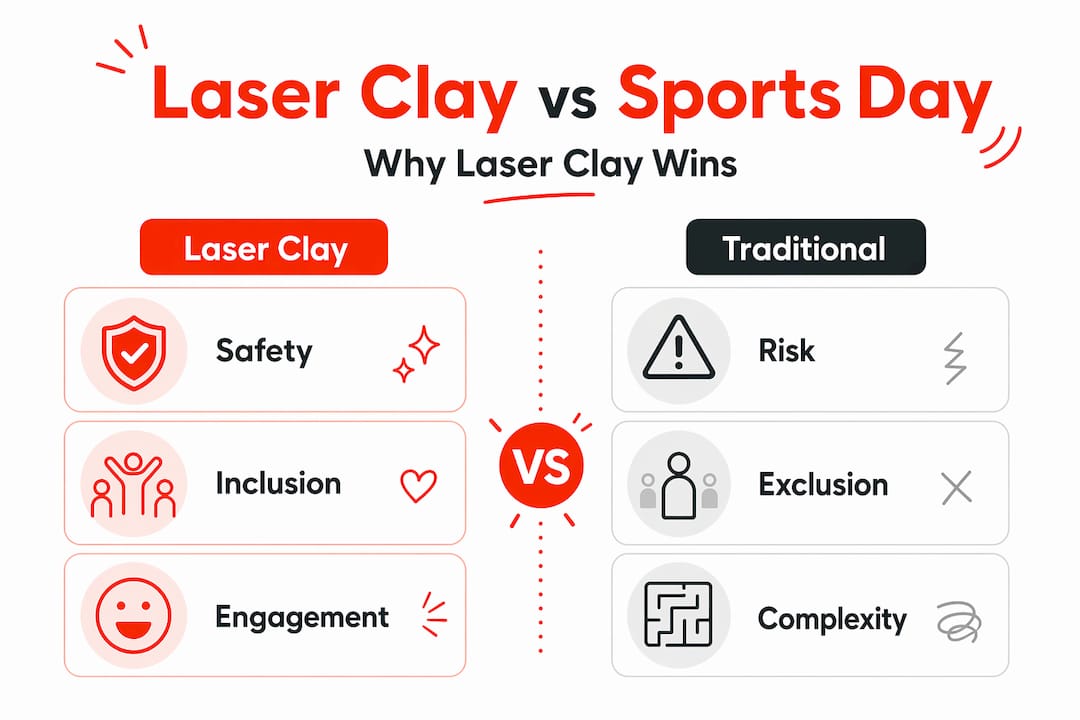
Reduced logistical complexity is another underrated benefit. Rain does not cancel laser clay. You do not need to line-mark a field at six in the morning. Equipment is portable and can be set up in a variety of outdoor and indoor venues with minimal preparation, which matters enormously to any organiser who has ever had to rearrange a full school schedule because of a weather forecast.
Technology that keeps scoring honest
One of the quiet frustrations of traditional sports days is the disputed result. A close finish in a sprint, a throw that may or may not have crossed a line, a judge who had to make a call under pressure. These moments erode confidence in the event and, for participants on the losing side of a wrong call, can genuinely spoil the day.
Laser clay systems resolve this at the hardware level. High-speed cameras capture clay flight at up to 4K resolution, and AI processes each frame to determine a hit or miss with millisecond accuracy. There is no human judgement involved in the decision.
Video playback and transparent verification
When a result is questioned, footage captured at up to 500fps allows any referee or organiser to review the exact moment of the shot and confirm the outcome. That level of transparency is genuinely new to school sports events. It removes arguments before they start and gives participants a reason to trust the process.
Pro Tip: Use the automated reporting feature at the end of each session to generate a printable results sheet. Handing participants their individual score breakdown as they leave creates a tangible memento and reinforces positive memories of the event.
The data generated during a session also has genuine value for organisers. Performance tracking across rounds shows which participants improved most, which can be used for recognition that sits outside the narrow category of “who scored highest.” Recognising improvement is often more motivating for school groups than recognising absolute performance, and laser clay gives you the data to do it properly.
Organising laser clay for school events
Getting laser clay onto a school sports day programme takes less preparation than most educators expect. The structured approach that BASC recommends for junior clay shooting translates directly to laser clay sessions: small groups, a clear safety briefing before any activity begins, and supervised rotation.
Here is a practical framework for a half-day laser clay excursion:
- Book a professional provider who supplies all equipment and facilitators. Laserclay, for example, handles setup, briefing, and facilitation, which removes the technical burden from school staff entirely.
- Divide participants into groups of four to six to keep wait times short and maintain energy. Larger groups can rotate through stations if multiple lanes are available.
- Deliver a five-minute safety briefing before each group shoots. Even without live ammunition, establishing a culture of safe handling is educationally valuable and builds seriousness and focus.
- Run at least three rounds per participant to allow for the learning curve. First-round scores are rarely representative. Three rounds let you see genuine improvement and give quieter participants time to find their confidence.
- Announce results live and celebrate improvement alongside outright winners. The scoring system makes this easy because individual progression data is captured automatically.
Pro Tip: If you are planning a full-school event, consider splitting the day so half the school participates in laser clay while the other half takes part in quieter activities. This keeps group sizes manageable and intensity high throughout.
Venue requirements are minimal. A flat outdoor area or a gymnasium is sufficient. No live ammunition means no exclusion zones, no specialist safety infrastructure, and no insurance complications that would arise with live shooting. Schools that have previously avoided clay shooting activities because of those concerns find laser clay straightforward to approve.
Addressing common misconceptions
Several concerns come up repeatedly when educators first consider replacing traditional sports day elements with laser clay. Most of them dissolve on closer inspection.
- “It is too expensive.” Professional laser clay packages are typically comparable in cost to hiring sports equipment and specialist coaches for a full-day athletics event. When you factor in that weather-related cancellations are far less likely, the cost-per-successful-event calculation shifts further in laser clay’s favour.
- “It is not a real sport.” Traditional clay shooting is an Olympic discipline. Laser clay uses the same technique, the same stance, and the same mental discipline. The only difference is the technology that confirms the hit.
- “The technology will fail.” Modern laser clay systems are purpose-built for event use. They are tested for reliability and come with on-site technical support when booked through a professional provider.
- “It is not environmentally responsible.” The reverse is true. Lead-free shooting eliminates the soil and water contamination associated with conventional clay shooting, making it a genuinely greener choice for schools with sustainability commitments.
- “Traditional sports feel more authentic.” Authenticity is not the same as familiarity. What most participants want is to feel capable and included. Laser clay delivers that more reliably than a sack race.
My honest take after years in this space
I have watched a lot of traditional sports days from the organisers’ side of the table. What strikes me every time is how the energy in the crowd is never evenly distributed. A quarter of the participants are visibly enjoying themselves. The rest are waiting, watching, or quietly wishing they were somewhere else.
When I first saw laser clay deployed in a school setting, I expected the usual reaction: a few excited students at the front, the rest observing politely. What actually happened was that the quietest students in the group, the ones who had spent the previous hour hovering at the edge of the field, were the ones most absorbed by the activity. The immediate, objective feedback gave them something no relay race ever had. A result that was clearly theirs.
My view is that educators who hesitate over laser clay are not really worried about the technology. They are worried about the conversation with parents or governors who equate familiarity with quality. The answer to that conversation is not defensive. It is to point to the evidence: better engagement data, fewer injuries, and participants who leave feeling genuinely positive about physical activity rather than privately relieved it is over.
The schools I have seen adopt Laserclay excursions return to them. That tells you more than any comparison table.
— Joshua
Get started with Laserclay for your next event
If you are ready to move past the limitations of the standard sports day format, Laserclay makes it straightforward. Their team specialises in school and group events, supplying all equipment, trained facilitators, and on-site technical support so your staff can focus on the students rather than the setup.
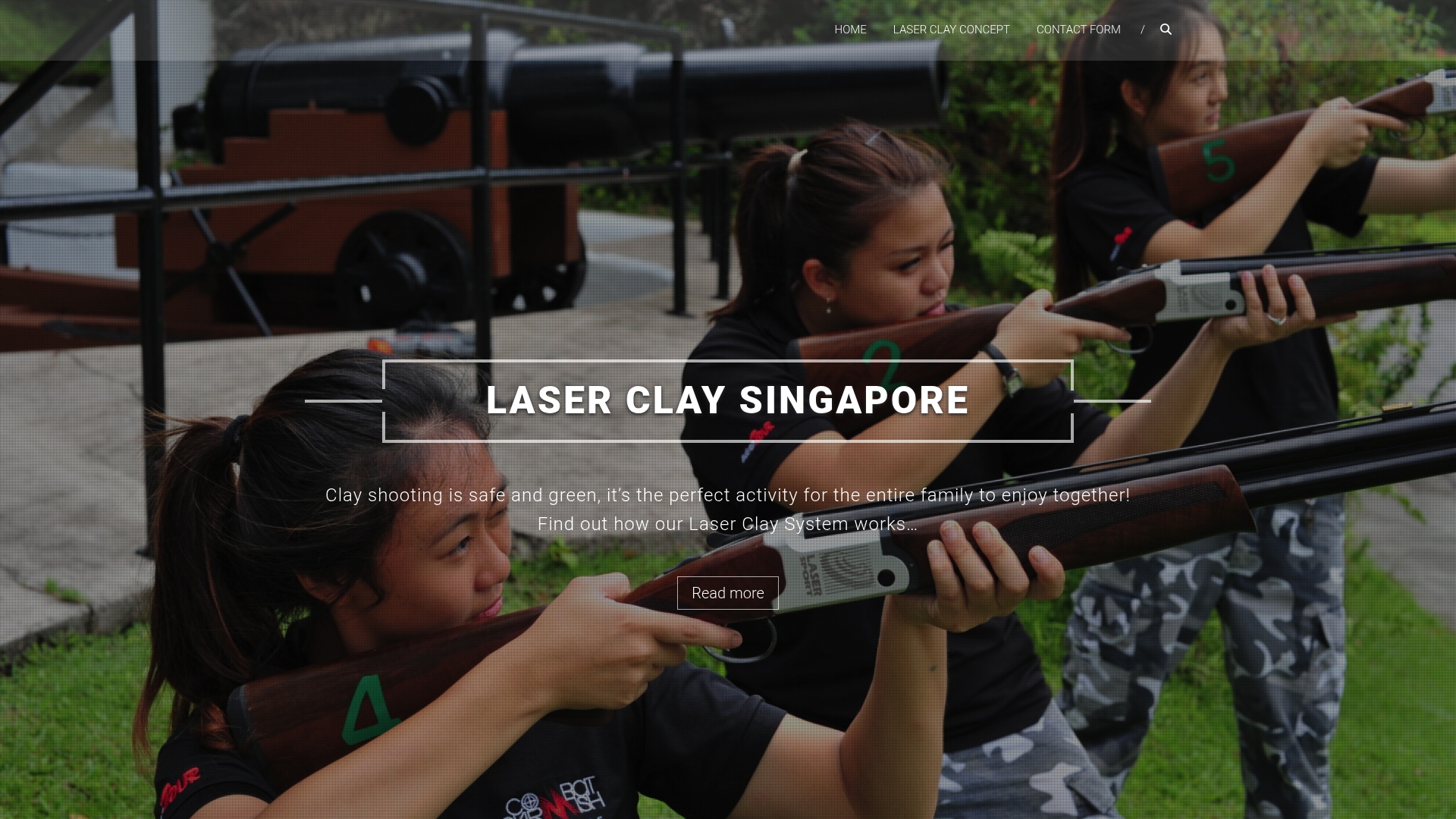
Whether you are organising a single-year-group afternoon or a full-school activity day, Laserclay offers packages that scale to your numbers and fit your venue. Explore how to play and see exactly what a session looks like before you commit. For schools that want the flexibility of hiring equipment directly, event rental options are also available. Contact the team to discuss your requirements and get a tailored quote for your programme.
FAQ
What is laser clay shooting?
Laser clay shooting uses replica firearms fitted with laser emitters to detect hits on clay targets, with no live ammunition or recoil involved. It delivers the full clay shooting experience safely and is suitable for all ages and skill levels.
Is laser clay safe for school-age participants?
Yes. No live ammunition is used, eliminating the primary safety risks associated with conventional shooting sports. Sessions follow structured safety briefings and small group formats in line with established guidelines for junior shooting activities.
How does laser clay scoring work?
The system uses high-speed AI cameras to track each clay and confirm hits or misses with millisecond accuracy. Results appear instantly on live display screens, with video footage available for verification if needed.
Can laser clay work indoors as well as outdoors?
Yes. Because there is no live ammunition, laser clay can be deployed in gyms, sports halls, and outdoor spaces with minimal setup requirements, removing weather dependency from event planning.
How does laser clay compare to traditional sports for inclusion?
Laser clay requires focus and coordination rather than speed or strength, which makes it accessible to participants with physical limitations or low sporting confidence. Structured sessions and instant feedback help all skill levels engage positively, not just those who typically excel in competitive athletics.