A knockout tournament pairs competitors, sends the loser of each match home and moves the winner on until one champion is left. It is the fastest way to find a winner from a large field, and the least generous with playing time. This guide shows you how to build the bracket, handle awkward numbers, seed fairly, and decide whether a knockout suits your corporate day, school camp or party.
TL;DR
- In a knockout, one loss ends your run. For N entrants you need exactly N-1 matches, so 16 players means 15 matches.
- If your field is not 4, 8, 16 or 32, round up to the next power of two and give the top seeds byes in round one.
- Seed your strongest entrants on opposite sides of the bracket so they meet late, not early.
- Half the field is out after one round. For social events, add a third-place match or a group stage so nobody plays once and sits idle.
- We run laser clay events where knockout rounds work well because a head-to-head round is short and easy to score.
Table of Contents
- How a knockout tournament works
- Why organisers choose it
- Handling numbers that are not a power of two
- Seeding: how to keep the best entrants apart
- Fixing the one-and-done problem
- Planning time: a quick method
- Knockout formats for common event types
- Our perspective: why laser clay suits a knockout
- Safety and organisation
- Running a knockout at your event with Laser Clay
- A checklist before you publish the bracket
- FAQ
- Sources
How a knockout tournament works
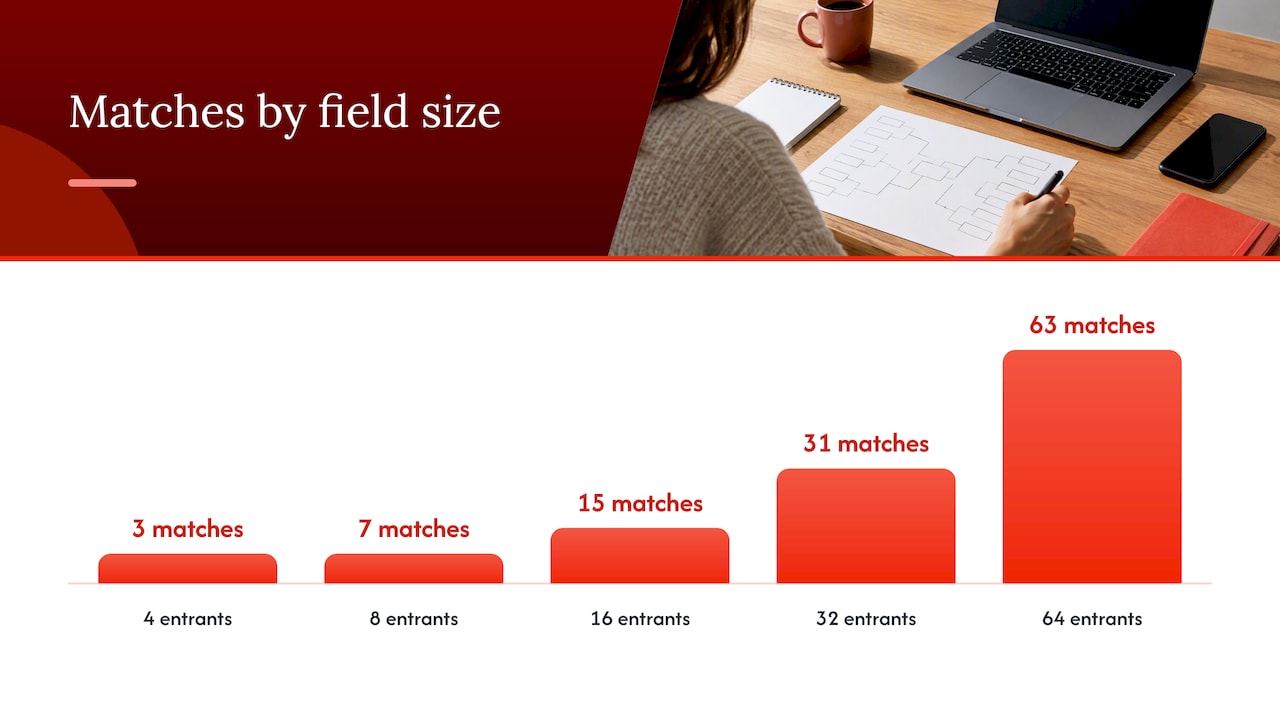
A knockout (also called single elimination or sudden death) removes a participant after a single loss, and winners advance round by round until a champion is decided. Wikipedia’s entry on single-elimination tournaments puts the arithmetic simply: with N participants you need N-1 matches, because every match eliminates exactly one person and everyone but the champion must be eliminated.
That gives you a quick planning table:
| Entrants | Rounds | Total matches | Round names |
|---|---|---|---|
| 4 | 2 | 3 | Semi-finals, final |
| 8 | 3 | 7 | Quarter-finals, semi-finals, final |
| 16 | 4 | 15 | Round of 16 onward |
| 32 | 5 | 31 | Round of 32 onward |
| 64 | 6 | 63 | Round of 64 onward |
The match counts for 4, 8, 16, 32 and 64 players come from the same Wikipedia page. The number of rounds is the number of times you can halve the field: 16 becomes 8, then 4, then 2, then 1.
The field halves each round, so the early rounds hold most of the matches. In a 16-player bracket, 8 of the 15 matches happen in round one. That matters for scheduling: you need the most equipment, space and staff at the start, and almost none by the final.
Why organisers choose it
The main appeal is efficiency. Guidance for club tournaments, such as the Petanque New Zealand resource manual, notes that single elimination copes with large entry numbers when time or court availability is limited. The same guidance warns against it when your priority is giving everyone as much play as possible, since half the entrants leave after one round.
So ask one question first: what matters more, a clear winner by a fixed time, or a good experience for everyone in the room?
- Pick a knockout when you have a hard finish time, many entrants, one scoring station, or a crowd that enjoys a tense final.
- Pick something else when the point is bonding, when a team has paid to attend and could be eliminated in ten minutes, or when children will be waiting around.
Handling numbers that are not a power of two
Most real groups are not 8 or 16. A team of 12, a class of 22 or a department of 10 is normal. The standard fix, described on Elimly’s bracket guide, is to expand the draw to the next power of two and give the highest seeds automatic byes. A bye lets a player skip round one and enter round two without playing.
Worked example: 12 players
- The next power of two above 12 is 16, so build a 16-slot bracket.
- 16 minus 12 leaves 4 empty slots, so the top 4 seeds get byes.
- The other 8 players play 4 matches in round one.
- Round two then has 8 players: the 4 bye seeds and the 4 round-one winners.
- Total matches: 11, which is 12 minus 1, exactly as the formula says.
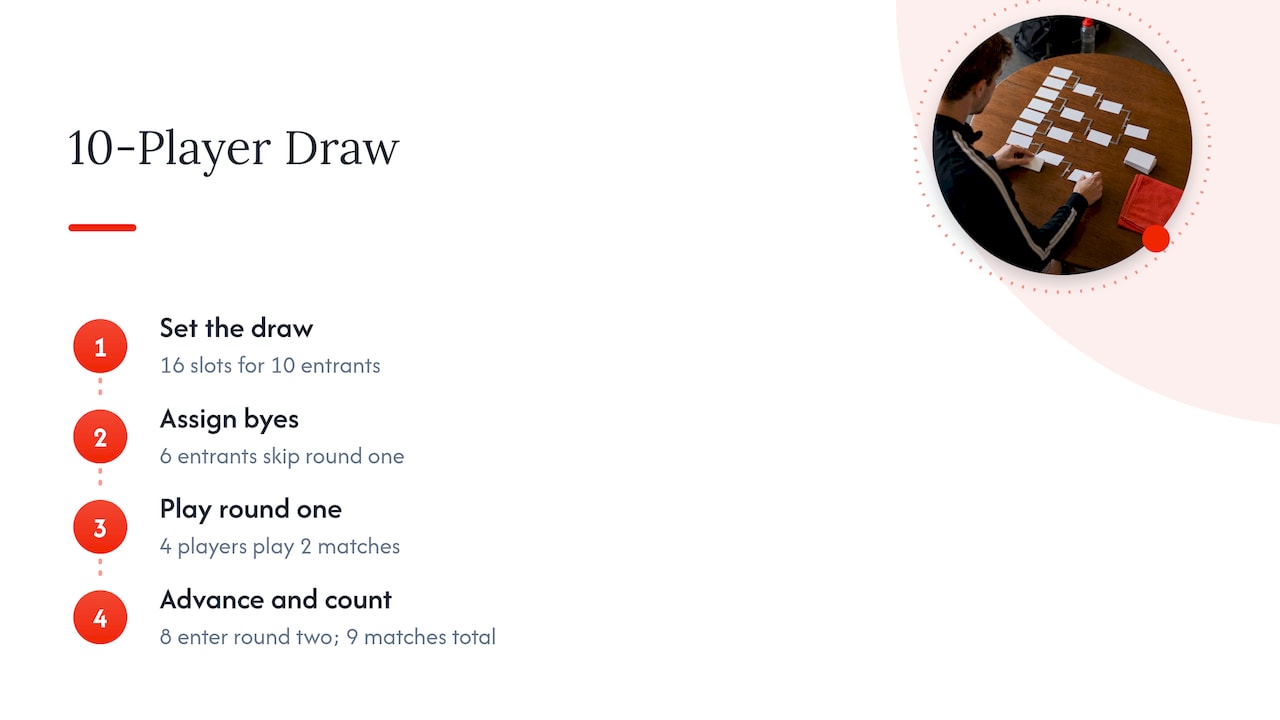
Worked example: 10 players
The draw is 16 again, with 6 byes. Only 2 matches are played in round one (4 players), then 8 enter round two. Total matches: 9.
Two practical points. First, byes should reward seeding, not luck, so give them to the top-ranked entrants. Second, if you have no ranking (a first-time team event), draw lots for who gets a bye and say so openly before anyone plays. Surprise byes feel unfair.
Seeding: how to keep the best entrants apart
Seeding exists so the strongest competitors do not knock each other out in round one. Professional rules put real weight on this. The FIDE regulations for Freestyle Chess show how elite organisers treat bracket integrity, and the general principle carries over: place top seeds in different parts of the bracket so they cannot meet before the late rounds.
In an 8-player bracket the standard layout pairs strongest against weakest:
- Seed 1 plays seed 8, and seed 4 plays seed 5, in the top half.
- Seed 2 plays seed 7, and seed 3 plays seed 6, in the bottom half.
Seeds 1 and 2 can then only meet in the final, and seeds 1 to 4 can only meet from the semi-finals. For a 16-team bracket the same logic holds: the 1 seed meets the 16 seed, 8 meets 9, and so on, with winners pairing off in listed order.
Seeding when you do not know anyone’s skill
At a company day or school camp you rarely have rankings. Options that work:
- Use a qualifier. Run one short scored round for everyone, then seed by score. This is the fairest method and doubles as a warm-up.
- Split known strong players. If a few colleagues are obviously keen, place them in different halves by hand.
- Draw randomly. Quick and transparent, though a final between two strong players is not guaranteed.
The qualifier approach is one we favour, and we explain why further down.
Fixing the one-and-done problem
The biggest complaint about knockouts is that half the guests play once. At a corporate team-building session or a birthday party, that is a real risk: someone who has taken time out of a working day should not spend the rest of it watching.
There are four sensible fixes.
1. A third-place match
The two losing semi-finalists play each other. It costs one extra match and gives four players a meaningful last game instead of two. This is the cheapest improvement you can make.
2. A group stage before the bracket
Many large tournaments run a round-robin phase so everyone plays several games, then send the top qualifiers into a single-elimination playoff. Wikipedia’s article describes this hybrid, and BracketsNinja lists group-stage-to-playoffs among the usual alternatives. You get repeated play for everyone and a sudden-death finish for the top few.
3. Double elimination
Participants must lose twice to go out. The Wikipedia page on double-elimination explains the structure. It is fairer, but it needs more matches, roughly double, and a more complicated chart. Use it only when you have time and a scorer who can manage two brackets.
4. A consolation bracket
First-round losers play their own mini-knockout for a plate or consolation prize. Nobody finishes the day after one game, and the prize can be light-hearted.
| Format | Playing time per person | Total length | Complexity | Best for |
|---|---|---|---|---|
| Single knockout | Low | Shortest | Low | Big fields, tight schedule |
| Knockout plus third-place match | Low to medium | Short | Low | Most social events |
| Group stage then knockout | High | Medium | Medium | Team-building, school camps |
| Double elimination | Medium to high | Long | High | Smaller, serious fields |
| Consolation bracket | Medium | Medium | Medium | Mixed-ability groups |
Planning time: a quick method
Work backwards from your finish time. Multiply total matches by minutes per match, add changeover time, then divide by the number of matches you can run at once.
As an illustration, assume a head-to-head round takes 6 minutes including handover. A 16-player knockout has 15 matches. On a single lane that is 90 minutes. On two lanes it is about 45 minutes, though the round-one bottleneck means you should add a buffer. A 16-player bracket with a third-place match is 16 matches. These are planning assumptions of ours, not fixed figures: time your own game first.
Two habits keep a bracket on schedule. Call the next pair while the current one is still playing, and keep a visible scoreboard so players know when they are up.
Knockout formats for common event types
Corporate team-building
Colleagues want banter, not early exits. We would run a short group stage or a scored qualifier, then a knockout for the top 8 or top 4, with the rest cheering and playing a side challenge. If you are comparing activity ideas, our competition ideas for Singapore planners page covers more formats.
School camps
Children are the hardest group to eliminate. Use teams rather than individuals, add a consolation round, and keep every child busy as scorer, caller or supporter. Check age requirements for any activity before you plan around it.
Birthday parties
Keep it gentle: a small bracket among the older guests, a third-place match, and prizes beyond first place. For younger groups, skip elimination entirely and compare scores across a fixed number of turns. Our guide to planning a laser clay birthday party for kids goes into detail.
Our perspective: why laser clay suits a knockout
We built our events around a simple observation: a format only works if the game inside it is short, clear and easy to score. Laser clay meets all three. A round is quick, the result is a number on a real-time electronic scoreboard, and nobody needs experience to take part. Participants can be as young as 10.
That makes a head-to-head knockout straightforward: two shooters, one score each, a winner in minutes, and no argument about the result. Because the game is accessible, the gap between a beginner and a regular is smaller than in, say, a racket sport, so early upsets are common and the bracket stays exciting.
Our advice, based on how we set up events:
- Run everyone through a qualifying round first. It warms people up, removes first-shot nerves and gives you honest seeding.
- Knock out only the top group. Eight or sixteen finalists make a proper showpiece. Everyone else stays involved through team scores or a consolation round.
- Put the scoreboard where everybody can see it. Bracket tension is half the fun.
- Keep numbers per session realistic. Our staffing guide sets out one operator and one marshal per 10 players, which shapes how many people can be on the field in each round.
We would rather your guests all remember a good afternoon than see a clean bracket that sent half of them to the sidelines after five minutes.
— Joshua
Safety and organisation
A bracket adds movement: people waiting, walking on and off, handing over equipment. Plan the flow so the next pair is ready behind a clear line. Singapore’s SS 681:2022 code of practice for sport safety takes a proactive risk-management approach to sport activities, and the sensible reading for an organiser is trained facilitators, regularly checked equipment and clear protocols, particularly for large groups. Ask any provider you hire how they meet this. If you are booking with us, our page on compliance for Singapore planners explains what to check before the day.
Running a knockout at your event with Laser Clay
If you are planning a team event, our Corporate Laser Clay Package is S$69 per person, and includes facilitators and event customisation, so your bracket, scoring and rounds can be set to suit your group. Birthday parties start from S$49 per person on our party package. If you already have a venue and a team to run things, system rental is S$500 to S$800 per hour. Tell us your headcount and your finish time through our contact page, and we will suggest a format.
A checklist before you publish the bracket
- Count entrants and round up to the next power of two.
- Work out byes: draw size minus entrants.
- Seed by qualifier score or by hand, and put top seeds in opposite halves.
- Decide in advance what happens in a tie, for example a sudden-death single shot or round.
- Add a third-place match, a consolation round or a group stage.
- Time one match, then multiply to check the schedule.
- Announce the rules before the first round, not during it.
- Prepare prizes for more than the winner.
FAQ
What is the difference between a knockout and a round-robin?
In a knockout, a loss removes you, so the field halves each round. In a round-robin everyone plays everyone else, so nobody is eliminated and results come from total points. Round-robins give more play but need many more matches.
How many matches does a knockout tournament need?
Always one fewer than the number of entrants. Eight players need 7 matches and 16 need 15, as Wikipedia’s single-elimination article sets out. A third-place match adds one more.
What is a bye?
A bye lets a player or team go straight to the next round without playing. Organisers use byes when the field is not a power of two, and they normally give them to the top seeds, as Elimly’s guide describes.
How do I seed a knockout when nobody has a ranking?
Run a short qualifying round and rank everyone by score, then place the best entrants in opposite halves of the bracket. If that is not possible, split the obviously strongest players by hand and draw the rest randomly.
Is a knockout a good choice for a children’s party?
Only in a softened form. Add a third-place match and prizes beyond first place, or skip elimination and compare scores across a set number of turns, so no child sits out after one go.
Sources
- Single-elimination tournament, Wikipedia
- Double-elimination tournament, Wikipedia
- Single Elimination Bracket Generator, Elimly
- BracketsNinja
- Petanque New Zealand resource manual, section B
- FIDE Freestyle Chess regulations
- SS 681:2022 Code of practice for sport safety, Singapore Standards eShop