You can build trust, communication and problem-solving in a team without anyone breaking into a sprint. The best no-running options fall into three groups: short seated or standing games, hands-on workshops, and facilitated skill games where the challenge is aim, timing and teamwork rather than speed. Below you will find twelve ideas, what each one needs, and the checks a Singapore organiser should make before booking.
TL;DR
- Pick activities where the challenge is thinking, talking or aiming, not speed. Most need only a function room and one to two hours.
- Quick games like Human Knot (15 to 30 minutes) and the Marshmallow Challenge (about 30 minutes) cost almost nothing to run.
- For a facilitated centrepiece, laser clay shooting packages start at S$69 per person for corporate groups.
- Check health, heat, haze and opt-out options first: every person should be able to join in at their own level.
- Book facilitated activities early and keep an indoor backup if your plan is outdoors.
Table of Contents
- What “without running” really means for a team
- Quick games you can run in an hour or less
- Hands-on workshops that fill an afternoon
- A facilitated centrepiece: laser clay shooting
- At a glance: time, materials and effort
- How to pick the right activity for your group
- Safety, health and inclusion checks
- Venue, budget and GST
- Book a facilitated session with us
- FAQ
- Sources
What “without running” really means for a team
When someone searches for this, they usually have one of three groups in mind. There are colleagues of mixed fitness, teams in work clothes in an office or hotel function room, and groups that include older staff, pregnant colleagues or people with a heart or lung condition. The goal is the same as any team event: shared effort, honest conversation and a bit of laughter.
So the real test is not “is it sedentary”, but “can everyone take part without being embarrassed or put at risk”. Keep that test in mind as you read the list. If you want a wider set of options, our guide to indoor team activities that need no experience covers more ground, and the low-risk team building playbook is a quick read for HR teams.
Quick games you can run in an hour or less
These need little or no budget and suit a team meeting, an off-site opening or a Friday afternoon slot.
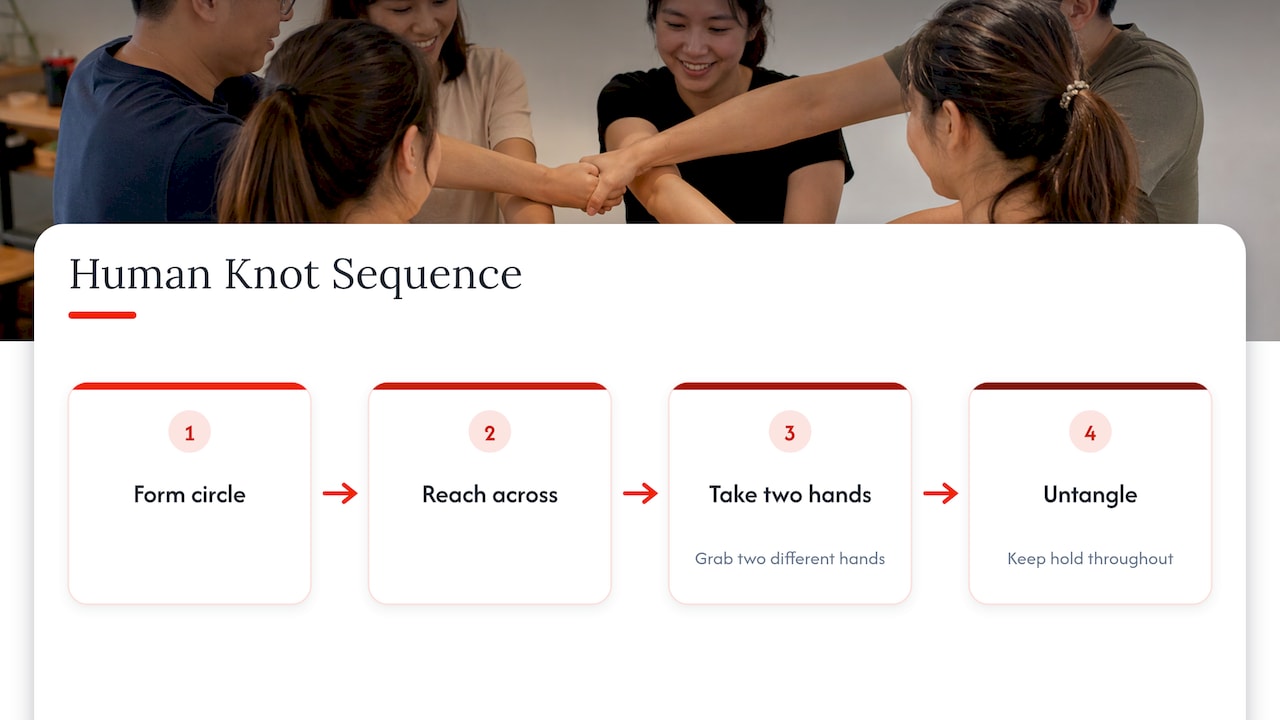
1. Human Knot
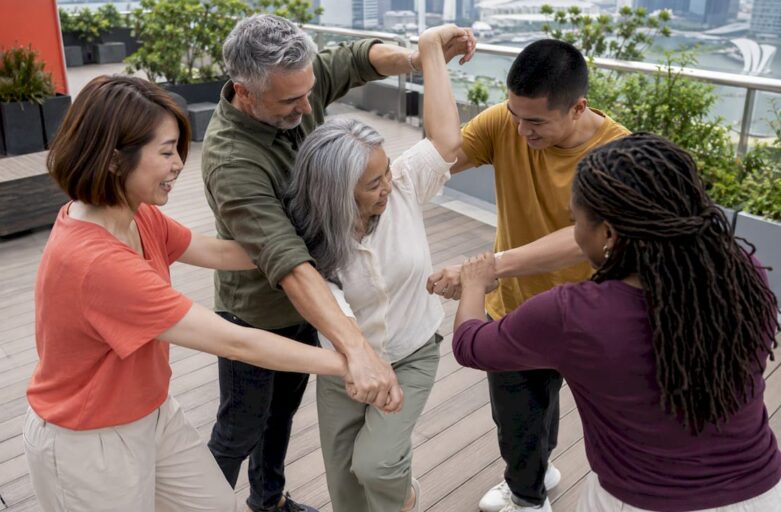
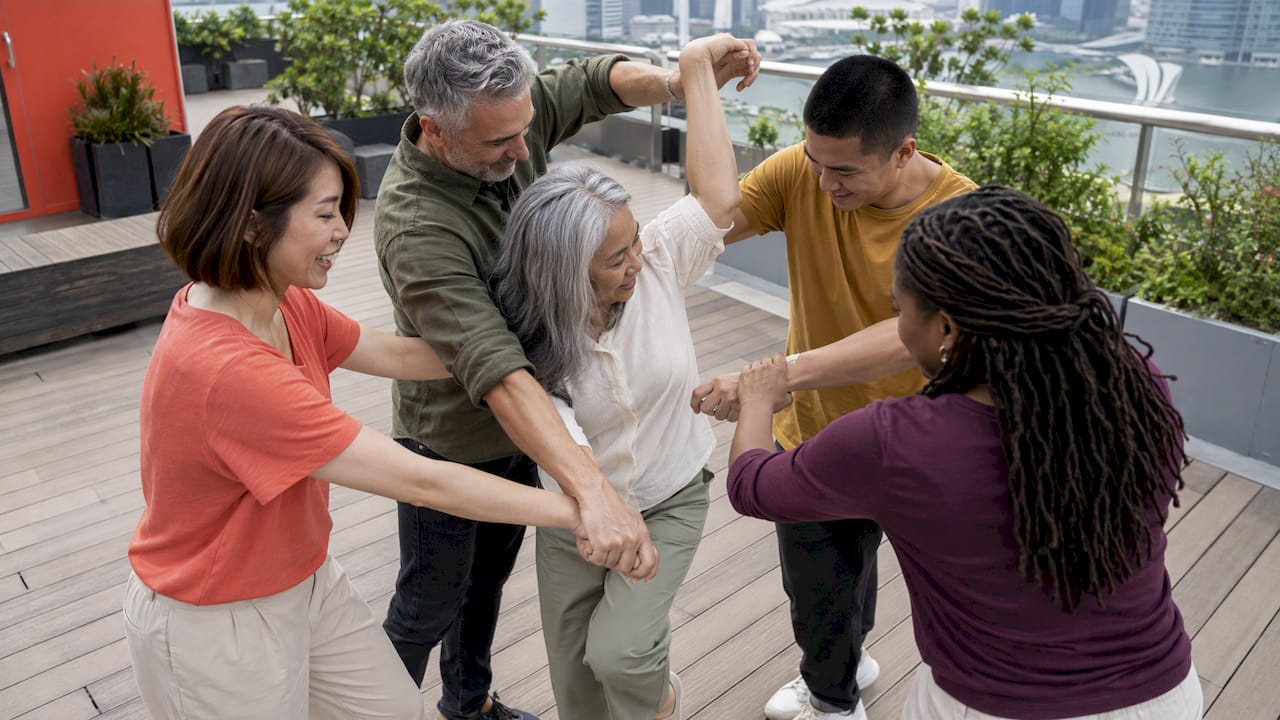
The group stands in a circle, reaches across and grabs two different hands, then untangles without letting go. SessionLab lists it at 15 to 30 minutes, with 10 to 12 people as the ideal group size. It needs no materials, only a little floor space. Movement is slow and shuffling, so it works for most groups, though you should check nobody has shoulder or wrist problems.
A useful twist from the same source: run it twice, first with a “manager” directing everyone, then without. The difference shows how leadership style affects problem-solving and gives you a natural debrief.
2. Marshmallow Challenge
Teams of four to six build the tallest freestanding structure they can. According to a Singapore activity roundup, it needs a table per team and about 30 minutes. Prepare spaghetti, tape, string and a marshmallow for each team, plus a timer. It rewards planning and early prototyping, and everyone stays seated or standing at a table.
3. Simon Says
A classic listening game. Players follow an instruction only when it starts with “Simon says”. SmallBizTrends describes it as an exercise that encourages communication and listening. It needs nothing but a caller and takes ten minutes, which makes it a good warm-up before a longer session.
4. Two Truths and a Lie
Each person shares three statements about themselves and the team guesses which is false. The same Singapore roundup counts it among the quick office games suited to a function room. It suits new teams, remote colleagues meeting in person, and any group where people do not yet know each other well.
5. Trust Fall, done carefully
Colleagues take turns falling backward into the arms of the team. SmallBizTrends notes that it encourages trust and helps people feel comfortable relying on others. Treat it as optional: some people will not want to do it, and that is fine. A supported seated alternative, such as passing a task to a colleague and trusting them to finish it, achieves a similar conversation.
6. Silent line-up
The team must arrange themselves by birthday month or years of service without speaking. It needs no materials and 10 to 15 minutes. It shows quickly who takes charge, who waits, and how a group invents its own signals.
Hands-on workshops that fill an afternoon
If you have two hours and a modest budget per head, a workshop gives the team something to make and talk about.
7. Terrarium or craft workshops
Singapore providers run terrarium building as a standard indoor option, listed among workshops, escape rooms and cooking classes. Everyone works at their own pace, which suits mixed ages and abilities.
8. Cooking or baking sessions
Teams split into groups, share ingredients and plate up together. Check allergies and dietary needs in advance, and ask about halal and vegetarian options when you collect RSVPs.
9. Escape rooms
These are puzzle-led and mostly about conversation. Confirm accessibility of the venue and whether a seated player can reach every puzzle.
A facilitated centrepiece: laser clay shooting
10. Laser clay shooting
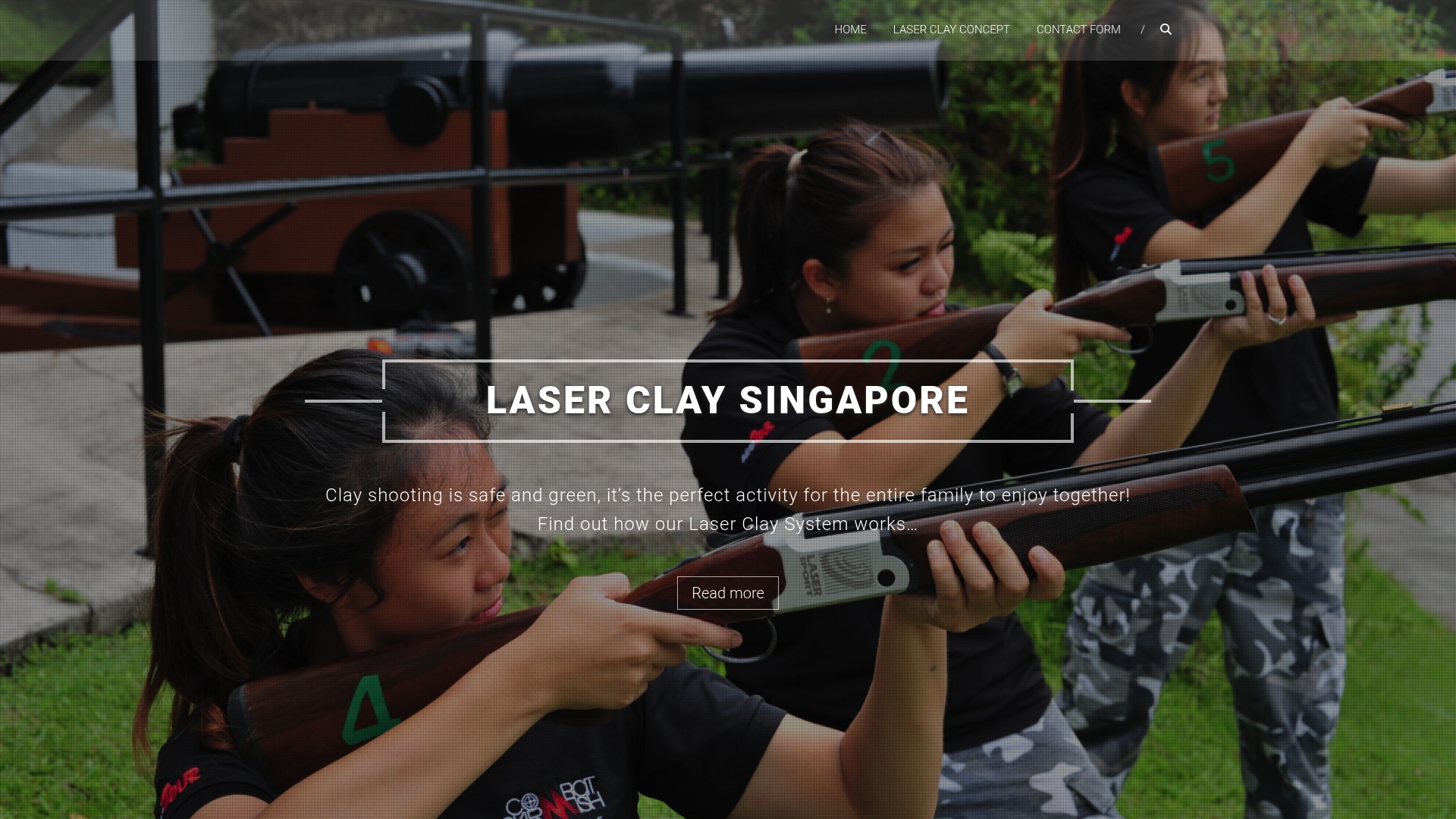
This is the activity we run. Laser clay is clay shooting reimagined with laser technology: sound-simulated deactivated shotguns, reusable clay targets, real-time electronic scoreboards and customisable game formats. It is an aim-and-score game, so the challenge is accuracy, timing and how well the team supports each other, not speed across a room. Because there is no lead ammunition, it avoids the safety and environmental issues of traditional clay shooting.
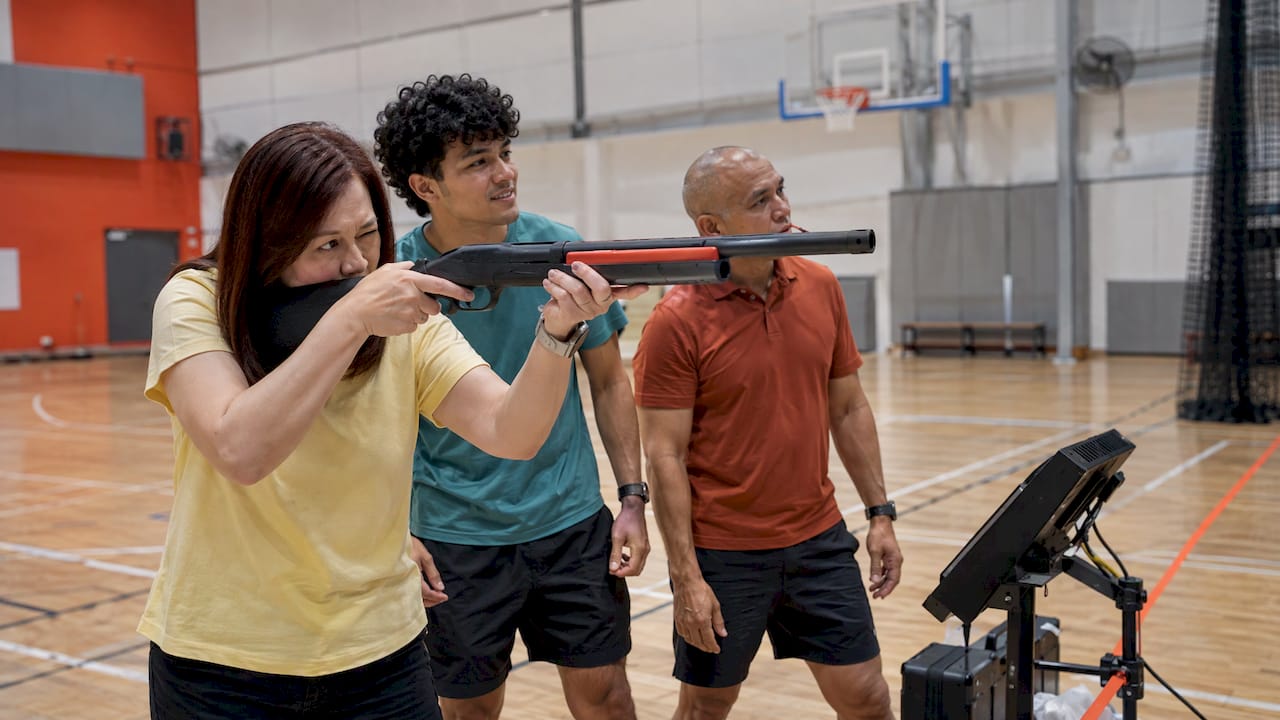
The session is fully facilitated, suitable for ages 10 and up, and can be set up indoors or outdoors, in competitive or casual formats. That makes it practical for teams with a wide range of fitness levels. You can read more in our explainer for event planners or see how to play laser clay.
Two practical details planners ask about: the setup requirements and power checklist tell you what your venue must provide, and our staffing guide explains how many operators and marshals a group needs.
11. Team quiz or trivia rounds
Mixed-skill teams answer rounds on company history, local trivia or picture clues. Keep teams to five or six people so that quieter members speak up, and mix departments on purpose.
12. Volunteer or planning sessions
Sitting together to pack care kits or plan a shared project builds teamwork through a common goal. It also works well as a half-day activity before a facilitated game in the afternoon.
At a glance: time, materials and effort
| Activity | Typical time | Materials | Physical effort |
|---|---|---|---|
| Human Knot | 15 to 30 minutes | None | Light, standing and reaching |
| Marshmallow Challenge | About 30 minutes | Table per team, building supplies | Very light |
| Simon Says | 10 minutes | None | Light |
| Two Truths and a Lie | 15 minutes | None | None |
| Trust Fall | 10 to 15 minutes | Clear floor | Light, optional |
| Terrarium or cooking workshop | 1.5 to 2 hours | Supplied by provider | Light |
| Laser clay shooting | Set by package or hourly booking | Supplied by us, with venue power and space | Light, aim and score |
Timings for the first two come from the sources linked above. The others vary by provider and group size, so confirm them in your quotation.
How to pick the right activity for your group
Start from the outcome, then check the practical limits.
- Decide the goal. Trust, communication, problem-solving or simply morale each point to different games. Human Knot and the Marshmallow Challenge are strong on problem-solving. Simon Says is about listening. A facilitated game is good when you want an event the team will talk about afterwards.
- Count heads. Quick games work best at 10 to 12 per group. Larger teams should be split into several groups, each with a leader.
- Match the room. Most of these need only a function room, but some need a table per team. Check the space, power outlets and noise limits.
- Add an optional role. Give anyone who prefers not to take part a job as scorer, timer or photographer, so they stay part of the team.
- Plan your debrief. Ten minutes of “what did we notice?” turns a game into learning.
Safety, health and inclusion checks
Low effort does not mean no risk. Singapore institutions publish useful checklists you can borrow, even for office events.
- Health screening. SIM University’s guidelines say a Physical Activity Readiness Questionnaire (PAR-Q) should be administered before an event, and at-risk participants, for example those with a heart or lung condition, should be advised to refrain from strenuous activity. Ask staff to tell you privately about any limits.
- Heat and lightning. The same guidelines call for plans to prevent heat disorders, and for activity to stop when lightning is detected within 8 km of the site, resuming only after more than 30 minutes with none detected. If your event is outdoors, keep a shaded or indoor fallback. Our wet weather plan for Singapore planners shows how to organise one.
- Haze. ActiveSG advises that during poor air quality you should choose gentle activities in a clean indoor environment, avoid strenuous exercise if indoor air is poor, and follow NEA advisories.
- Opt-out and inclusion. NUS guidelines state that all activities must be inclusive and that participants must be able to opt out, and that a risk assessment form is completed for each activity. A short written risk assessment is good practice for any company event.
- Standards. For outdoor programmes, the Singapore Standard SS 710:2024 sets minimum requirements for risk management, provider accountability, supervisor responsibilities and equipment adequacy. Ask any provider how they manage risk against these themes.
- Planning ahead. For general guidance on risk management for group activities, including booking lead times and briefing participants, a good organiser’s checklist is worth reading before you finalise your plan.
For school groups and youth events, see our guide to planning safe outdoor activities for school groups.
Mixed ages and abilities
If your event includes older relatives or children, shorten sessions and add seating. Singapore’s Agency for Integrated Care guide on intergenerational activities recommends age-appropriate, developmentally sensitive design. For frailer seniors it suggests groups of 8 to 10 and sessions within 45 minutes. Those figures are for community care settings, but they are a sensible reference for family days. Our family day games guide has more ideas.
Venue, budget and GST
When you compare quotes, check whether each is GST-inclusive. Singapore’s GST rate is 9% for taxable supplies from GST-registered businesses, and service charges may be shown separately. The same checklist notes that public buses and trains are wheelchair accessible, which helps when you choose a venue near an MRT station. Our page on team building venues in Singapore lists what to look for.
Our view on low-effort team building
We built Laser Clay around a simple belief: a team event should include everyone, not only the fittest person in the room. Traditional clay shooting carries lead, noise and safety concerns that put many groups off. Laser technology removes those, so the activity is open to anyone from age 10.
What we see work is a clear structure. A facilitator explains the rules, teams share a scoreboard, and the format can be competitive or relaxed depending on your group. People support each other because the scoring is live and visible. The result is conversation and encouragement, not exhaustion.
If you are planning a day, we would pair a short icebreaker like Human Knot with a facilitated game in the main slot, then leave time to talk. It gives you thinking, aiming and laughing in one session.
Joshua
Book a facilitated session with us
If you want a ready-made option, our corporate package is S$69 per person and includes a facilitated laser clay session, with customisable game formats, scoring and equipment for indoor or outdoor venues. See the Corporate Laser Clay Package for details.
Parents can choose the birthday party package, from S$49 per person. If you already have a venue and facilitators, the system rental is S$500 to S$800 per hour. To ask about dates or discuss a plan, use our contact page.
FAQ
What is a good team building activity for people who cannot run?
Choose games where the challenge is thinking or aiming, such as the Marshmallow Challenge, a quiz, a craft workshop or facilitated laser clay shooting. Always let people opt out or take a support role, so nobody has to explain a health reason in front of colleagues.
How long should a no-running team building session be?
Quick games run 15 to 30 minutes, and workshops usually fill one to two hours. For a half-day event, combine a short icebreaker, one main activity and a debrief rather than stacking many games.
Can children join a corporate family day?
Yes, if the activity is age-appropriate. Our laser clay sessions are suitable from age 10, and the format can be adjusted for casual play. For younger children, add shorter sessions and seating.
Do I need a large venue?
Not for most of these. Games like Human Knot need floor space for a circle, and the Marshmallow Challenge needs a table per team. For laser clay, check our setup and power requirements before you choose a room.
Sources
- Human Knot | SessionLab
- 21 Indoor Team Building Activities In Singapore
- 24 Team Building Exercises and Games Your Team Will Enjoy
- SIM recommended safe practice guidelines
- Haze in Singapore: 6 Indoor Exercise and Wellness Activities
- NUS Guidelines on Safety and Welfare
- SS 710:2024 Code of practice for outdoor adventure education
- Intergenerational Guide for the Community Care and Early Childhood Sectors
- Corporate Event Venue Checklist
- Organiser’s Surf Checklist for Waikiki Groups