

Traditional shooting sports have a problem most enthusiasts would rather not discuss. The lead, the noise, the safety barriers, and the environmental toll have quietly been pushing curious newcomers away for years. That is precisely why ammunition-free shooting is growing at a pace that is hard to ignore. From corporate team-building events in Singapore to eco-conscious sport shooters rethinking their weekends, the shift is real, measurable, and accelerating. This guide explains the forces driving that change, the technology making it possible, and why it matters for anyone planning an event or simply looking for a smarter way to enjoy the sport.
Table of Contents
- Key takeaways
- Why ammunition-free shooting is growing so fast
- The environmental toll of traditional ammunition
- Safety and health advantages
- Technology and performance of modern systems
- Applications in events, training, and eco-conscious recreation
- My perspective on where this is all heading
- Experience ammunition-free shooting with Laserclay
- FAQ
Key takeaways
| Point | Details |
|---|---|
| Environmental pressure is real | Shooting ranges deposit roughly 60,000 tons of lead globally each year, making the case for alternatives urgent. |
| Safety benefits are proven | Ammunition-free methods remove airborne lead particles entirely, protecting both participants and venue staff. |
| Technology has caught up | Modern laser and synthetic systems now match traditional shooting in realism and skill development. |
| Events market is booming | The non-lethal and ammunition-free sector is on a strong growth trajectory, with broad appeal across corporate and social events. |
| Adoption barriers remain | Cost and availability still slow uptake for some users, but laser-based formats sidestep both issues entirely. |
Why ammunition-free shooting is growing so fast
The short answer is that traditional ammunition carries costs that extend well beyond the price per round. There is the environmental damage, the health exposure, the regulatory scrutiny, and the simple fact that a significant portion of the population finds live-fire ranges intimidating or inaccessible.
None of these pressures appeared overnight. But they have converged in 2026 in a way that is reshaping participation across shooting sports, law enforcement training, and recreational events. Understanding each driver separately makes the overall picture much clearer.
The environmental toll of traditional ammunition
Lead is the core issue. Shooting ranges deposit approximately 60,000 tons of lead into soil and water globally every year. That figure is not a projection. It is an ongoing reality at ranges across every continent, and it accumulates with every session.
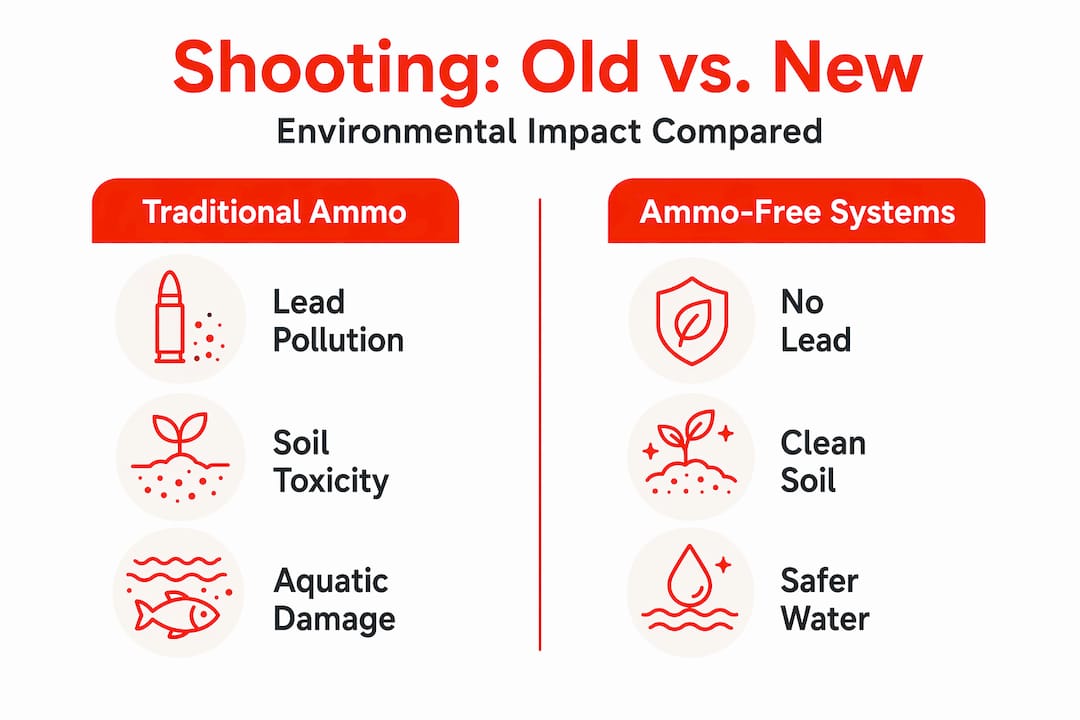
The contamination does not stay where it lands. Lead leaches into groundwater, disrupts soil chemistry, and enters the food chain through wildlife that feeds near affected areas. Birds of prey are particularly vulnerable, as they ingest lead fragments when scavenging carcasses from hunted animals. The ecological ripple effect is well documented and genuinely serious.
Here is a summary of the key environmental comparisons between traditional and ammunition-free shooting:
| Factor | Traditional lead ammunition | Ammunition-free alternatives |
|---|---|---|
| Soil contamination | High, accumulates over decades | None |
| Waterway risk | Significant leaching into groundwater | None |
| Wildlife impact | Toxic ingestion risk for birds and mammals | None |
| Regulatory pressure | Increasing restrictions globally | Minimal or no restrictions |
| Range clean-up cost | Expensive and legally complex | Not applicable |
Regulatory momentum is building alongside public awareness. Several countries have introduced voluntary or mandatory lead-free policies at public ranges, and hunters are increasingly switching to lead-free options driven by concern for both human health and wildlife. The direction of travel is clear, and ammunition-free formats like laser clay shooting sit at the most sustainable end of that spectrum.
Safety and health advantages
The health risks of traditional ammunition extend beyond the environment. Lead-core bullets release toxic airborne particles every time they are fired. For someone who shoots occasionally, the exposure is manageable. For indoor range employees or frequent competitive shooters, the cumulative risk is genuinely concerning.
Key health and safety benefits of ammunition-free shooting include:
- No airborne lead particles. Participants and staff breathe clean air throughout the session.
- No noise-induced hearing risk. Laser and simulation systems operate without the concussive sound of live fire.
- No projectile hazard. There is no risk of ricochets, misfires, or accidental discharge.
- Accessible to all ages and experience levels. Children, older adults, and first-time participants can join without safety prerequisites.
- No specialist storage or transport requirements. Organisers do not need to manage live ammunition logistics.
The safety case is not just theoretical. Law enforcement data offers a compelling real-world signal. Boise Police increased less-lethal tool use by 57% in 2025, and the result was 18 consecutive months without an officer-involved shooting as of May 2026. That outcome reflects a broader principle: when you reduce the lethality of the tools in play, you change the behaviour and outcomes around them.
“Non-lethal tools create time and distance, enabling restraint in high-risk situations.” This principle, drawn from law enforcement adoption of products like PepperBall’s VKS Phantom launcher, applies equally to recreational and event contexts. When the stakes of a mistake drop to zero, participation opens up dramatically.
For event planners in particular, this is the decisive factor. An activity where no one can be hurt, no specialist supervision is legally required, and no liability waiver covers a genuine risk is simply a better product to offer clients.
Technology and performance of modern systems
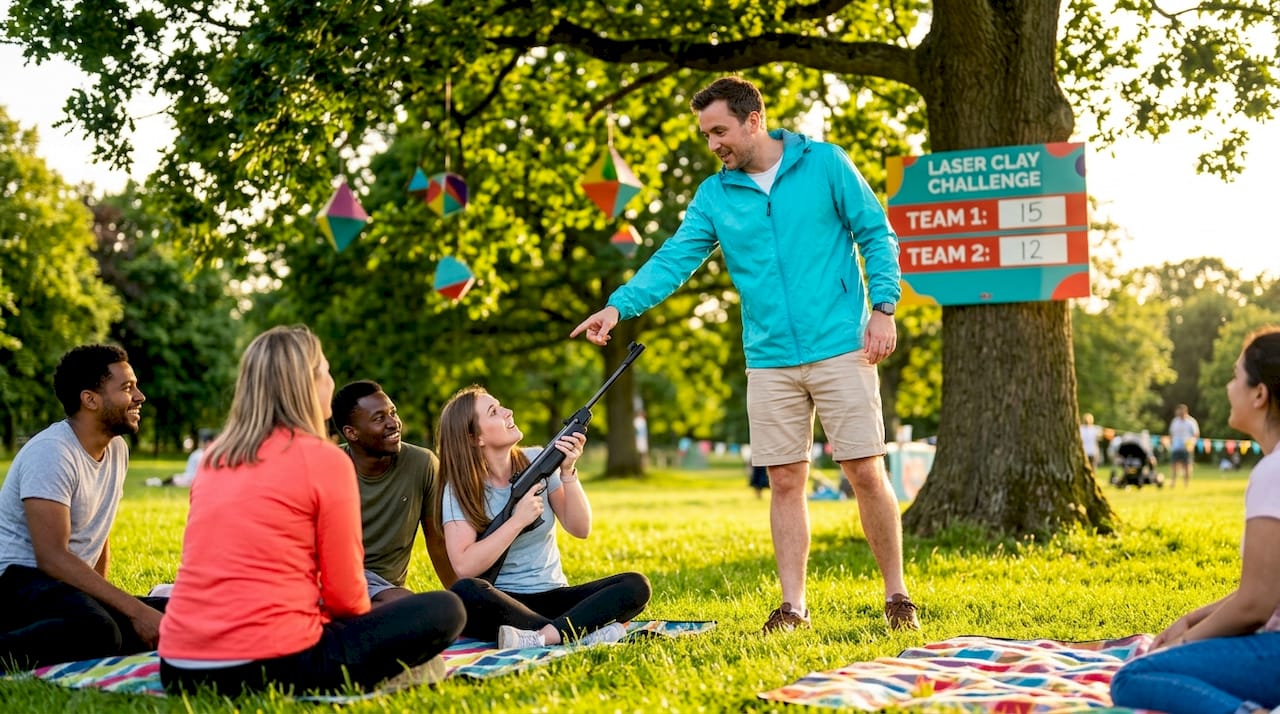
The most persistent objection to ammunition-free shooting has always been performance. Sceptics assumed that removing real ammunition meant removing real skill development. That assumption is no longer accurate.
Modern lead-free rounds using synthetic cores and alloy jackets now rival traditional bullets in ballistic performance. For shooters making the transition, the main practical consideration is a firearm break-in period caused by different fouling and cycling characteristics. It is a manageable adjustment, not a fundamental limitation.
Laser-based systems take this further. Rather than simulating ammunition, they replace it entirely with sensor-driven feedback that measures accuracy, reaction time, and target acquisition in real time. Laser clay shooting, for example, uses photoelectric sensors in clay targets that register hits with the same split-second feedback a live round would produce. The physical mechanics of mounting, swinging, and leading a moving target remain identical to traditional clay shooting.
Pro Tip: If you are evaluating ammunition-free systems for an event or training programme, prioritise platforms that provide real-time scoring data. Instant feedback is what makes the experience genuinely skill-building rather than just entertaining.
Here is a direct comparison of ammunition-free options against traditional lead-based shooting:
| Criteria | Lead-based ammunition | Laser and ammunition-free systems |
|---|---|---|
| Environmental impact | High | None |
| Health risk | Moderate to high with regular use | None |
| Skill transfer | High | High (with quality systems) |
| Cost per session | Moderate to high | Lower over time |
| Accessibility | Restricted by age, experience, regulation | Open to all participants |
| Setup complexity | High (range, storage, supervision) | Low |
Lead-free shooting is no longer a niche product. It is becoming viable across self-defence training, sport shooting, and eco-friendly recreation. Laser systems represent the logical endpoint of that trajectory: all the skill, none of the risk.
Applications in events, training, and eco-conscious recreation
The practical applications of ammunition-free shooting have expanded considerably, and this is where the growing trend in shooting becomes most visible for event planners and community organisers.
-
Corporate team building. Laser clay shooting works exceptionally well as a group activity because it requires no prior experience, levels the playing field between participants, and produces immediate, shareable results. Teams compete in real time, which creates natural energy and conversation. Outdoor corporate programmes built around laser shooting consistently receive high satisfaction scores because the activity is genuinely engaging rather than passively observed.
-
Birthday celebrations and social events. The absence of safety restrictions means younger participants can join alongside adults, making ammunition-free shooting one of the few active sports that genuinely works across age groups at a single event.
-
School and youth programmes. Without the regulatory and insurance complications of live fire, schools and youth organisations can introduce shooting sports as part of physical education or outdoor activity days.
-
Eco-conscious recreation. For individuals who want to enjoy the sport without contributing to lead contamination, laser and ammunition-free formats offer a clean conscience alongside genuine fun. This is a growing segment, particularly among urban participants who choose greener shooting activities as part of a broader sustainable lifestyle.
-
Law enforcement and security training. The rise of non-lethal shooting tools in professional contexts reflects the same logic driving recreational adoption: better outcomes with lower risk.
The market numbers support this momentum. The non-lethal weapons sector was valued at USD 8.58 billion in 2024 and is projected to grow at 5.52% annually through 2033. That growth spans professional, recreational, and event contexts, and it reflects a genuine shift in how people think about shooting as an activity.
Pro Tip: When planning a group event around laser clay shooting, book a session that includes a brief skills introduction before competitive rounds begin. Participants who understand the technique from the start engage more deeply and enjoy the experience far more.
My perspective on where this is all heading
I have watched the conversation around ammunition-free shooting shift considerably over the past few years. What used to be dismissed as a compromise is now being recognised as a genuinely superior option in many contexts. That change in perception matters more than any single statistic.
What strikes me most is how the adoption barriers are collapsing from multiple directions at once. Environmental pressure is coming from regulators and from shooters themselves, particularly hunters motivated by health concerns for their families and the wildlife they care about. Safety pressure is coming from event organisers who cannot afford the liability or the complexity of live-fire activities. And technology pressure is coming from systems that have simply got good enough to remove the performance objection entirely.
The one thing I would caution against is assuming this transition will be frictionless. Availability and cost remain real barriers for some users, particularly those in regions where ammunition-free equipment is not yet widely distributed. The laser clay format sidesteps this problem because the technology is portable and the ongoing cost is negligible compared to live ammunition. But for shooters who want to transition their existing firearms practice, the path requires some patience and investment.
My honest view is that the future of recreational shooting is predominantly ammunition-free. Not because traditional shooting will disappear, but because the ammunition-free formats are becoming better, cheaper, and more accessible every year. The direction is one way.
— Joshua
Experience ammunition-free shooting with Laserclay
If this article has made you curious about trying ammunition-free shooting for yourself or your next event, Laserclay is the place to start.

Laserclay uses advanced laser technology to deliver a clay shooting experience that is safe, genuinely exciting, and completely free from the environmental and health concerns of traditional ammunition. Whether you are planning a corporate team-building day, a birthday celebration, or simply a weekend activity with friends, Laserclay caters to all group sizes and experience levels. No prior shooting experience is needed, no safety briefing takes an hour, and no one goes home smelling of gunpowder. Visit Laserclay to explore upcoming sessions and book your group in.
FAQ
What is driving the growth of ammunition-free shooting?
The growth is driven by three converging factors: environmental concern over lead contamination at shooting ranges, health risks from airborne lead particles, and the increasing accessibility of laser and simulation-based systems that match traditional shooting in realism and skill development.
Is ammunition-free shooting effective for skill development?
Yes. Modern laser-based systems provide real-time accuracy feedback and replicate the physical mechanics of traditional shooting, making them genuinely effective for skill development in both recreational and professional training contexts.
How does ammunition-free shooting benefit event planners?
It removes the safety, liability, and logistical complications of live-fire activities, making it suitable for mixed-age groups, corporate events, and social occasions where traditional shooting would be impractical or restricted.
What is the environmental impact of traditional shooting ranges?
Shooting ranges deposit approximately 60,000 tons of lead into soil and water globally every year, contaminating ecosystems and posing risks to wildlife and human health over time.
Are there cost advantages to ammunition-free shooting?
Over time, yes. Laser-based systems eliminate the ongoing cost of purchasing ammunition, and formats like laser clay shooting require no specialist range infrastructure, reducing the total cost of participation for both organisers and individuals.