

The environmental benefits of lead-free shooting are no longer a niche talking point. They are a measurable reality backed by decades of ecological data. Hunters and target shooters discharge roughly 50,000 tons of lead into the environment every year, equivalent to the lead in 180 million car batteries. That figure sits in soil, waterways, and the bodies of wildlife long after the shooting session ends. This article breaks down exactly what switching away from lead ammunition achieves, which alternatives perform best, and how broader sustainable shooting practices compound those gains.
Table of Contents
- Key takeaways
- 1. The core environmental benefits of lead-free shooting
- 2. How to evaluate lead-free ammunition options
- 3. Top lead-free ammunition types and their environmental benefits
- 4. Lead-free versus traditional lead ammunition: a side-by-side comparison
- 5. Sustainable shooting practices beyond ammunition choice
- My honest take on switching to lead-free shooting
- Why laser clay shooting takes sustainability even further
- FAQ
Key takeaways
| Point | Details |
|---|---|
| Scale of lead pollution | Shooters release 50,000 tons of lead annually, making ammunition a significant environmental hazard. |
| Wildlife impact is proven | Post-ban data shows 1.5 to 3 million ducks saved each year after lead shot was banned for waterfowl hunting. |
| Copper outperforms on fragmentation | Copper bullets retain nearly all their weight on impact, leaving far fewer toxic fragments than lead. |
| Sustainability goes beyond ammo | Biodegradable targets, eco-friendly cleaning products, and proper waste disposal all reduce your shooting footprint. |
| Laser technology removes the problem entirely | Laser clay shooting produces zero lead contamination, no toxic residue, and no environmental clean-up. |
1. The core environmental benefits of lead-free shooting
The case for switching starts with what lead actually does once it leaves the barrel. Lead does not stay put. It fragments, leaches into soil, enters groundwater, and accumulates in the tissue of animals that ingest it directly or feed on contaminated carcasses.
The most immediate gain from switching to lead-free ammunition is the reduction in toxic heavy metals released into the environment. Every lead-free round fired is one less source of persistent contamination. Over a full season at a busy clay shooting ground or hunting estate, that adds up to a meaningful reduction in the toxic load deposited on the land.
Secondary contamination is the less obvious but equally serious problem. Scavengers such as red kites, golden eagles, and buzzards feed on gut piles and wounded animals. Lead fragments as small as a grain of rice can be fatal to raptors, and a single gut pile from a deer shot with a conventional lead bullet can contain dozens of such fragments. Switching to copper or other non-toxic alternatives removes that risk almost entirely.
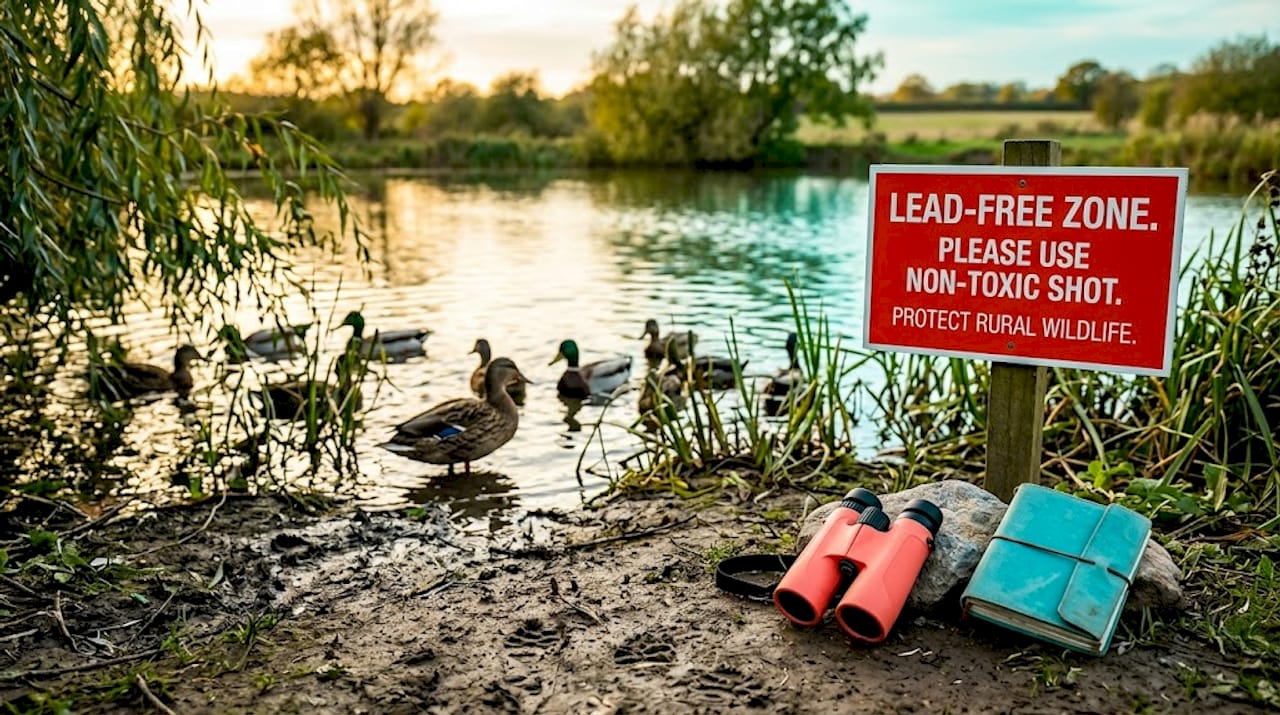
Soil and water contamination follow a slower timeline but carry long-term consequences. Lead shot pellets deposited in wetlands dissolve gradually, raising the lead concentration in sediment and water. Waterfowl mistake pellets for grit and ingest them directly. The 1991 US federal ban on lead shot for waterfowl hunting demonstrated what happens when you remove that source: an estimated 1.5 to 3 million ducks are saved annually as a direct result.
2. How to evaluate lead-free ammunition options
Not all non-toxic ammunition is equal, and eco-conscious shooters benefit from knowing what to look for before making a switch. The criteria below help you assess any lead-free option objectively.
- Fragmentation profile. The lower the fragmentation, the less toxic residue remains in the environment. Copper bullets lose only around 1% of their weight on impact compared to lead bullets, which can lose up to 30%.
- Wildlife poisoning risk. Does the material pose a secondary poisoning risk if ingested by scavengers? Copper, bismuth, and steel score well here. Tungsten alloys require more scrutiny depending on their composition.
- Soil and water persistence. Some metals persist in soil for centuries. Lead is the worst offender, but any alternative should be assessed for its own environmental half-life.
- Biodegradability of components. The bullet is only part of the equation. Wads, primers, and cartridge cases all contribute to the environmental footprint of a shooting session.
- Indoor air quality. Airborne lead dust from primers is the primary contamination source at indoor ranges. Lead-free primers paired with lead-free projectiles dramatically reduce this risk.
- Performance and reliability. An alternative that shooters reject because it underperforms will not be adopted. Ethical hunting requires clean, reliable kills, so performance matters as much as environmental credentials.
Pro Tip: When trialling lead-free ammunition for the first time, test it at the same distances you shoot in the field. Copper bullets often require a different zero on your scope due to their higher velocity and lower weight compared with lead equivalents.
3. Top lead-free ammunition types and their environmental benefits
The market for non-toxic ammunition has matured considerably. Here are the options worth knowing.
Solid copper bullets are the gold standard for big-game hunting. They produce minimal fragmentation, leave almost no toxic residue in gut piles or the surrounding soil, and maintain nearly all their weight on impact, delivering ethical, clean kills. The trade-off is cost: copper rounds typically run 30 to 50 per cent more expensive than lead equivalents, though prices have fallen as demand has grown.
Steel shot was the first mainstream replacement for lead in waterfowl hunting following the 1991 ban. It is harder than lead, which means it can damage older shotgun barrels not rated for steel. It is also less dense, requiring shooters to move up a shot size to achieve comparable patterns. That said, it is widely available, affordable, and has a strong track record of reducing waterfowl poisoning.
Bismuth shot is softer than steel and safe for use in older, tighter-choked shotguns. Its density sits closer to lead than steel does, making the transition easier for experienced shotgunners. It costs more than steel but less than tungsten, placing it in a useful middle ground.
Tungsten-based loads offer the highest density of the non-toxic alternatives, meaning smaller pellets can carry more energy downrange. They are the preferred choice for long-range waterfowl and goose shooting. The environmental profile of tungsten is broadly positive compared to lead, though some older tungsten-polymer formulations raised concerns that have since been addressed in modern products.
Eco-friendly primers complete the picture. Standard primers contain lead styphnate, which is a significant source of airborne lead at indoor ranges. Non-toxic primers replace this with alternatives such as diazodinitrophenol, reducing both indoor air contamination and the lead deposited in range soil.
4. Lead-free versus traditional lead ammunition: a side-by-side comparison
| Factor | Lead ammunition | Lead-free alternatives |
|---|---|---|
| Fragmentation on impact | High: up to 30% weight loss, 100+ fragments | Very low: copper loses ~1% weight |
| Wildlife poisoning risk | High: fatal to raptors and scavengers | Low to negligible with copper, bismuth, steel |
| Soil and water persistence | Centuries in soil; leaches into groundwater | Varies; generally lower environmental persistence |
| Human health during handling | Risk of skin absorption and inhalation | Significantly reduced with lead-free primers and projectiles |
| Biodegradability of components | Poor: lead persists indefinitely | Improving: eco-primers and biodegradable wads available |
| Cost | Lower upfront cost | 30 to 50% higher for copper; steel is comparable to lead |
| Market availability | Universally available | Growing rapidly; mainstream for waterfowl, increasing for big game |
| Ballistic performance | Well-established baseline | Comparable or superior with correct load selection |
The comparison makes clear that the environmental and health advantages of lead-free ammunition are substantial. The cost gap is real but narrowing, and education and improved availability are the primary drivers pushing voluntary adoption forward.
5. Sustainable shooting practices beyond ammunition choice
Switching ammunition is the single highest-impact change a shooter can make, but the environmental footprint of a shooting session extends further than the projectile.
- Biodegradable clay targets and wads. Conventional clay targets contain pitch and limestone, while wads are often made from polyethylene. Biodegradable wads and targets do break down over time, though proper waste management at ranges remains necessary because “biodegradable” does not mean “disappears overnight.”
- Eco-friendly firearm cleaning products. Standard solvents contain volatile organic compounds that off-gas into the air and contaminate surfaces. Bio-based cleaning products break down carbon, lead, and copper fouling effectively while reducing VOC emissions and improving safety for the shooter.
- Spent cartridge collection. Brass and steel cartridge cases are recyclable. Many ranges already collect brass, but field shooters can carry a small bag and collect their own spent cases for recycling rather than leaving them in the environment.
- Gut pile and carcass management. Removing gut piles from accessible areas, or burying them, reduces the risk of scavengers encountering lead fragments from conventional ammunition. When using lead-free ammunition, this concern is largely removed, but responsible disposal remains good practice.
- Voluntary adoption over waiting for bans. Conservation values and growing availability are already motivating hunters to switch independently. Advocacy groups consistently find that education outperforms regulation in driving meaningful, lasting change within shooting communities.
Pro Tip: Ask your local shooting ground whether they use biodegradable targets and collect spent wads. Many grounds are receptive to switching when members raise it directly. Collective pressure from regular shooters carries far more weight than individual action alone.
My honest take on switching to lead-free shooting
I have spoken with enough hunters and competitive shooters to know that the resistance to switching is rarely about the environment. It is about habit, cost, and the quiet anxiety that something will perform differently when it matters most.
What I have found, though, is that once shooters actually try copper or bismuth rounds in the field, the performance anxiety disappears quickly. The ballistics are different, not worse. You re-zero, you adjust, and within a session or two it feels entirely normal.
The harder conversation is about cost. Lead ammunition is cheaper, and that is a real consideration for anyone shooting regularly. But when I look at the data on blood lead levels in raptors falling directly in response to lead-free adoption, it becomes difficult to treat the price difference as a genuine obstacle rather than an inconvenience.
What I find most encouraging is the direction of travel. Prices are falling, availability is improving, and the shooting community is increasingly self-motivated to make the switch. Waiting for legislation is the slowest possible path. The shooters I respect most are the ones who made the change before they were required to, because they understood what was at stake.
The tradition of shooting is worth preserving. Preserving it responsibly means acknowledging that the way we have always done something is not automatically the right way to keep doing it.
— Joshua
Why laser clay shooting takes sustainability even further
If you want to experience the thrill of clay shooting without any of the environmental trade-offs, Laserclay offers something that even the best non-toxic ammunition cannot: zero lead, zero toxic residue, and zero environmental clean-up.

Laserclay uses advanced laser technology to replicate the clay shooting experience with complete accuracy, making it accessible to all skill levels and completely safe for any venue. There are no spent cartridges to collect, no lead fragments in the soil, and no airborne particulates from primers. For corporate team-building events, birthday celebrations, or group days out, it is the most genuinely eco-friendly shooting experience available. You can explore how it works and book your session at Laserclay Singapore, where sustainable fun and genuine shooting sport sit comfortably together.
FAQ
How much lead do shooters release into the environment each year?
Hunters and target shooters discharge roughly 50,000 tons of lead annually, equivalent to the lead content of 180 million car batteries. This makes ammunition one of the largest sources of dispersed lead contamination globally.
Do lead-free bullets perform as well as lead bullets for hunting?
Yes. Copper bullets retain around 99% of their weight on impact compared to lead bullets, which can lose up to 30%. This means cleaner wound channels, more reliable kills, and significantly less toxic residue left in the animal or environment.
What is the safest lead-free option for older shotguns?
Bismuth shot is the recommended choice for older shotguns with tighter chokes or Damascus barrels, as it is softer than steel and will not damage the barrel. It offers density closer to lead, making it easier to transition to without changing shot sizes.
Does switching to lead-free ammunition actually help wildlife?
The evidence is clear. After the 1991 US ban on lead shot for waterfowl hunting, an estimated 1.5 to 3 million ducks were saved annually. Studies also show that blood lead levels in raptors fall directly when lead-free ammunition use increases in an area.
Is laser clay shooting genuinely more eco-friendly than lead-free ammunition?
Yes. Laser clay shooting produces no projectiles, no toxic residue, and no spent cartridges of any kind. It removes the environmental equation entirely, making it the most sustainable form of clay shooting currently available.