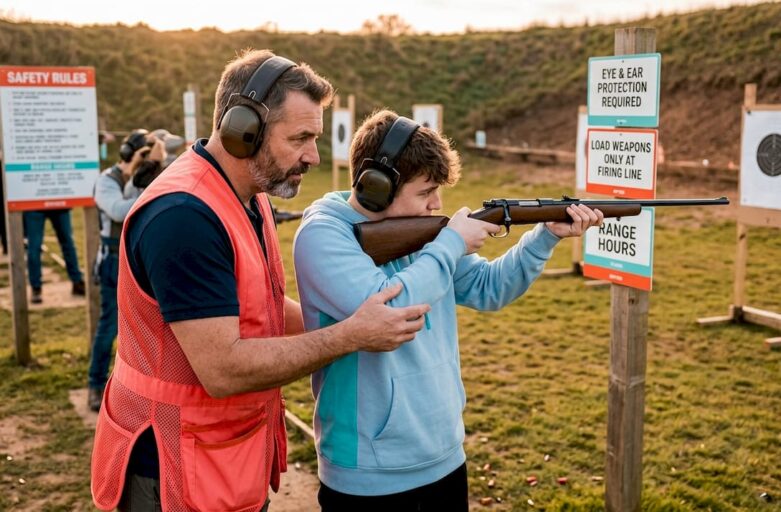
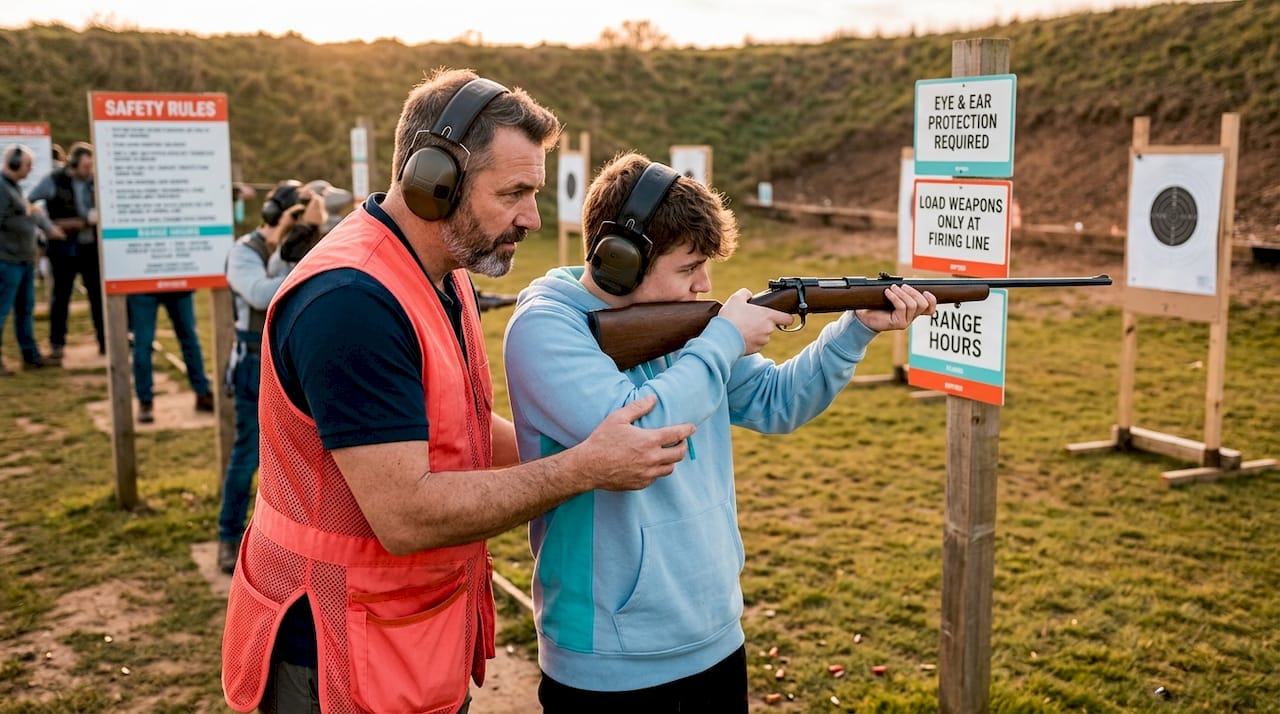
Selecting the right marksmanship skill builder is harder than most people expect. The types of safe marksmanship skill builders available range from static precision drills to laser-based group experiences, and each demands a different level of preparation, environment, and safety oversight. A common misconception is that any shooting activity automatically builds good skills. In reality, fundamentals must come first before adding complexity like movement or competition pressure. Whether you are organising a team event, planning personal practice, or designing an educational programme, knowing which format suits your goals makes all the difference.
Table of Contents
- Key takeaways
- Criteria for types of safe marksmanship skill builders
- 1. Static fundamentals drills
- 2. Dynamic and movement-based skill builders
- 3. Dry-fire and ammunition-free skill builders
- 4. Organised competition-style skill builders
- 5. Group event and team-building skill builders
- 6. Educational and youth-oriented skill builders
- 7. Simulated and game-based skill builders
- My take on safety first in skill building
- Try a safer way to build marksmanship skills with Laserclay
- FAQ
Key takeaways
| Point | Details |
|---|---|
| Safety must come before skill | Mastery of the four firearm safety rules is a non-negotiable prerequisite for any skill builder format. |
| Progression matters more than speed | Building a reliable foundation in static fundamentals prevents safety breakdowns when adding movement or stress. |
| Dry-fire and laser formats suit groups | Ammunition-free skill builders are ideal for team events and educational settings with mixed skill levels. |
| Competition adds structure and accountability | Organised matches with certified range officers provide the safest, most measurable skill-development environment. |
| Fun and safety are not opposites | The best skill builders are designed so that safe practice is inherently engaging and repeatable. |
Criteria for types of safe marksmanship skill builders
Not all shooting activities are created equal. Before comparing specific formats, it helps to have a clear checklist for evaluating whether a skill builder is genuinely safe and genuinely developmental.
The four fundamental safety rules form the baseline: treat every firearm as loaded, never point at anything you are not willing to destroy, keep your finger off the trigger until ready to shoot, and always know your target and what lies beyond it. Any skill builder that cannot consistently enforce these rules is not worth your time or your group’s safety.
Beyond the basics, here is what separates a well-designed skill builder from a poorly planned one:
- Progressive difficulty. Drills should start at the fundamentals level and increase complexity only when baseline skills are stable. Skill degradation is real if fundamentals are not practised regularly.
- A structured environment. Supervised ranges with enforced rules reduce errors dramatically, especially in mixed-skill groups.
- Suitability for your group. A drill that works brilliantly for a solo practitioner may be inappropriate for a team-building event with novices.
- Balanced engagement. The best formats keep participants interested without sacrificing accuracy, control, or safety.
Pro Tip: Before selecting a skill builder for a group, ask whether every participant can demonstrate safe gun handling independently. If they cannot, that becomes the first skill builder on your list.
1. Static fundamentals drills
Static drills are the bedrock of safe shooting practice. The fundamentals of precision shooting include body position, sight alignment, sight picture, and trigger control. These are not exciting in isolation, but they are the non-negotiable foundation for every other skill builder on this list.
Static drills typically involve shooting from a fixed position at a paper target, often using standardised scoring targets like the NRA B-8 or the TQ-4. These targets provide clear, measurable feedback. A tight group tells you that your position and trigger press are consistent. A scattered group tells you exactly the opposite.
For beginners, static fundamentals drills offer low stress and clear progression. You are not managing movement, time pressure, or other shooters. You are simply learning to make the gun do what you intend, repeatedly. That reliability is what trainers call the “floor,” and raising that floor must happen before adding any further complexity.
A solid starter routine might look like this:
- 10 rounds slow-fire at 25 yards on a B-8 target, focusing entirely on trigger press
- 5 rounds with eyes closed at 10 yards to check natural point of aim
- 10 rounds with a focus on breathing and shot timing
These are not glamorous drills. They are effective ones.
2. Dynamic and movement-based skill builders
Once static fundamentals are reliable, movement-based skill builders introduce a different kind of challenge. Shooting on the move, drawing from a holster, and engaging multiple targets all demand that safe handling becomes genuinely automatic rather than just consciously remembered.
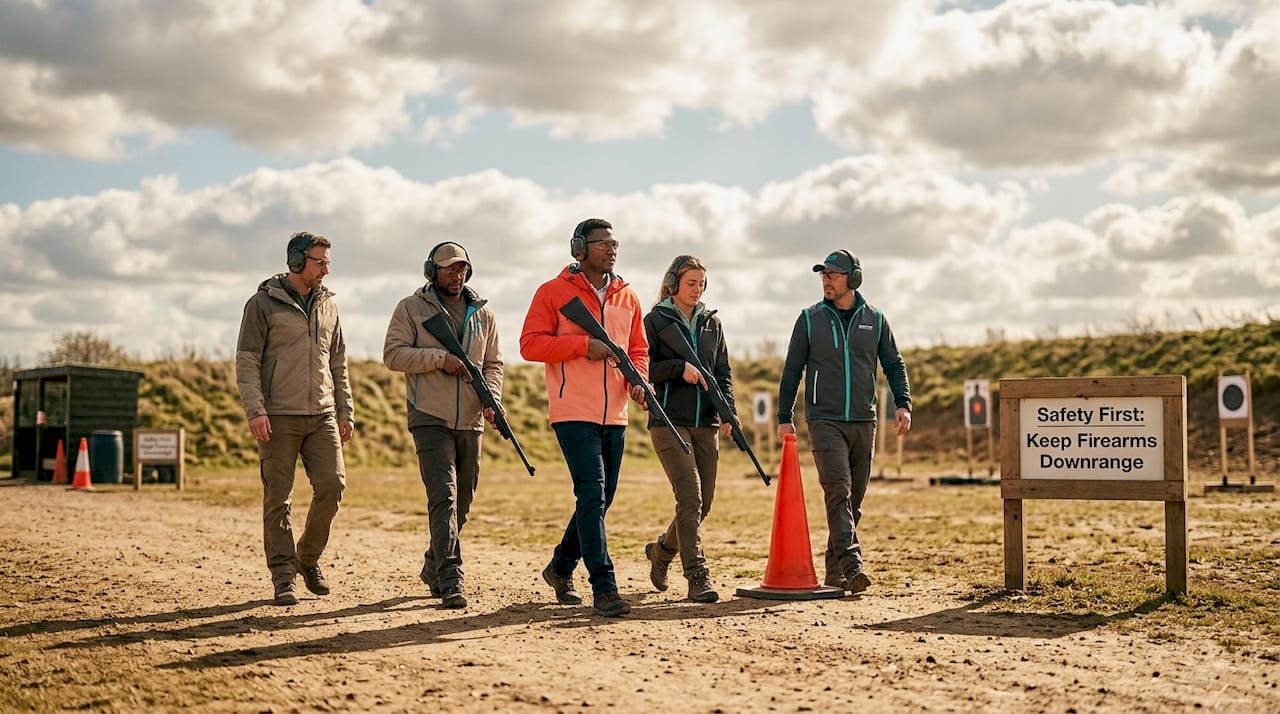
The SIG SAUER Academy’s Shooting on the Move II course is a practical example of how professional programmes handle this transition. It is a four-hour, drill-based course that requires participants to demonstrate safe handling and foundational marksmanship before they are permitted to attend. That prerequisite model is the correct one.
Dynamic skill builders introduce two challenges that static drills do not:
- Elevated heart rate. When your body is moving, your heart rate rises, your breathing changes, and fine motor control becomes harder.
- Divided attention. You are simultaneously managing footwork, target acquisition, muzzle discipline, and trigger control.
Neither challenge is insurmountable. But both require that your fundamentals are already automatic, not something you are still consciously working through.
Safe range practices become even more critical here. The 180-degree rule, which prevents the muzzle from sweeping past the firing line, must be observed during all movement. Finger-off-trigger discipline during transitions is another absolute requirement.
Pro Tip: If you are introducing movement drills to a group for the first time, run the drill dry, without any ammunition, before going live. This surfaces footwork and muzzle-control errors in a zero-risk environment.
3. Dry-fire and ammunition-free skill builders
Dry-fire practice is one of the most underused tools in recreational marksmanship. Removing live ammunition from the equation eliminates recoil, reduces cost, and makes high-repetition practice genuinely accessible, especially for groups and educational settings.
The core principle behind dry-fire is straightforward: you are training the trigger press and sight mechanics without the consequence of a live round. That means you can practise far more repetitions per session than live fire would allow, which accelerates muscle memory development significantly.
Laser-based training devices extend this further. Products that project a laser point of impact allow you to see exactly where your shot would have landed, giving real-time feedback on grip consistency and sight alignment. For group and educational settings, this format is particularly powerful because multiple participants can practise simultaneously without the logistical and safety complexity of a live-fire range.
The benefits for team events and educational groups are substantial:
- No ammunition management or storage requirements
- No noise exposure or hearing protection logistics
- Immediate feedback that coaches and facilitators can observe in real time
- High engagement without intimidation for first-time participants
The natural progression from dry-fire to live fire is well established in structured marksmanship programmes. You build the neural pattern first, then introduce the live-fire element once the pattern is reliable. That approach means live-fire sessions are safer because the fundamentals are already in place.
If your group is curious about practising without live ammo, laser-based formats are the most accessible entry point available today.
4. Organised competition-style skill builders
Formal marksmanship competitions introduce a layer of structure and accountability that informal range sessions rarely achieve. They also, done correctly, represent some of the safest shooting environments available, precisely because they are governed by trained officials and standardised rules.
The Civilian Marksmanship Program certifies Range Officers across multiple shooting disciplines, training them to enforce safety rules, manage courses of fire, and respond to safety incidents. That level of formal oversight is what separates a well-run competition from a casual range day.
Structured competitions like CMP Games matches use defined courses of fire specifying exact shot counts, firing positions, and target distances. A typical example includes 15-shot slow-fire prone, 10-shot rapid-fire prone, and 10-shot slow-fire standing stages, all at 200 yards. That structure removes ambiguity. Every participant knows exactly what is expected, when, and in what order.
Here is a comparison of how competition-style events stack up against other formats for different user groups:
| Format | Best for | Safety oversight | Skill level required |
|---|---|---|---|
| CMP-style match | Serious individual shooters | Certified range officers | Intermediate to advanced |
| Club-run local match | Recreational and club members | Club safety officers | Beginner friendly |
| Corporate shooting event | Teams and groups | Facilitated by event provider | Any level |
| Laser clay competition | Mixed groups and beginners | Provider staff, no live ammo | Any level |
Competition formats also provide something that solo practice cannot: measurable performance under pressure. Scores are recorded. Stages are timed. That accountability pushes skills forward in ways that unconstrained practice rarely does.
5. Group event and team-building skill builders
Marksmanship skill building does not have to be a solitary pursuit. Group formats have grown significantly in popularity for corporate team-building, birthday events, and school outings, and the best of them are designed with safety and accessibility at their core.
The key distinction for group formats is that participants arrive with a wide range of experience levels. A well-designed group skill builder accommodates everyone from first-timers to experienced shooters without creating safety gaps.
Ammunition-free shooting formats are particularly well suited here. They remove the most significant safety variables: live ammunition, recoil, and noise. Participants can focus entirely on technique, competition, and enjoyment without the intimidation factor that live fire often creates for newcomers.
Effective group skill builders share a few common features. They include a clear safety briefing before any activity begins. They use facilitated instruction so that every participant understands the basics before picking up any equipment. And they build in a progression, starting with simple targets and increasing difficulty as confidence grows.
6. Educational and youth-oriented skill builders
Introducing young people and students to marksmanship requires a different approach than adult recreational practice. The emphasis shifts heavily towards safety education, responsible handling, and building respect for the equipment before any accuracy-focused practice begins.
Organisations that work in this space recommend age-appropriate safety guidance as the starting point for any youth-focused programme. The principles are the same as adult safety rules, but the delivery, pacing, and reinforcement need to match the developmental stage of the participants.
Laser-based and non-recoil formats are particularly appropriate for educational settings. There is no live ammunition to manage, no hearing protection requirement, and no recoil to startle or discourage younger participants. The focus remains entirely on form, awareness, and safe habits from the first session.
Youth marksmanship programmes structured well also have a broader educational benefit. They teach focus, patience, consequence awareness, and self-regulation. Those are transferable skills that extend well beyond the range.
7. Simulated and game-based skill builders
Gamified marksmanship formats occupy a different category from traditional drills, but they are increasingly recognised as legitimate skill-development tools, particularly for engagement and retention in group settings.
The key insight here is that repetitive fundamentals practice builds the automatic behaviours that make marksmanship safer under pressure. Gamified formats can deliver that repetition in a context where participants are genuinely motivated to keep practising, which matters more than most instructors acknowledge.
Laser clay shooting is a strong example of this category. It replicates the arc and challenge of clay pigeon shooting using laser technology instead of live ammunition. Participants develop genuine tracking, timing, and trigger-discipline skills while engaging with a format that feels more like a recreational game than a formal lesson. The how laser clay works format demonstrates how simulated environments can capture the core skill-building elements without the safety complexity of live fire.
For recreational groups, team events, and anyone new to marksmanship, this category offers the most accessible entry point of all.
My take on safety first in skill building
I have spent considerable time observing how different groups approach marksmanship skill building, from corporate team days to dedicated recreational shooters. The single most consistent pattern I see is this: groups that skip the fundamentals phase and jump straight to dynamic or competition formats have a noticeably harder time, not just with accuracy, but with safety discipline.
There is a temptation to treat static drills as boring prerequisites to get through quickly. In my experience, that framing is backwards. The fundamentals phase is where the most important learning happens. Automating safe behaviours early means those behaviours remain intact when the environment gets more demanding, whether that is a competition format, a group event, or just a faster pace of fire.
What I find encouraging is that the formats I enjoy recommending most, particularly laser-based and gamified skill builders, actually do a better job of reinforcing fundamentals for mixed groups than many traditional approaches. They remove the intimidation factor and create the kind of focused, high-repetition practice that builds real skills.
My honest view is that safety culture and enjoyable skill building are not in tension. The best formats make safety the natural way to have fun, not a set of rules you tolerate on the way to the fun part.
— Joshua
Try a safer way to build marksmanship skills with Laserclay
If you are planning a group experience that genuinely combines skill development with safety and enjoyment, Laserclay offers exactly that. Using advanced laser technology rather than live ammunition, the Laserclay format is accessible to all skill levels, environmentally responsible, and genuinely engaging for participants from first-timers to experienced shooters.
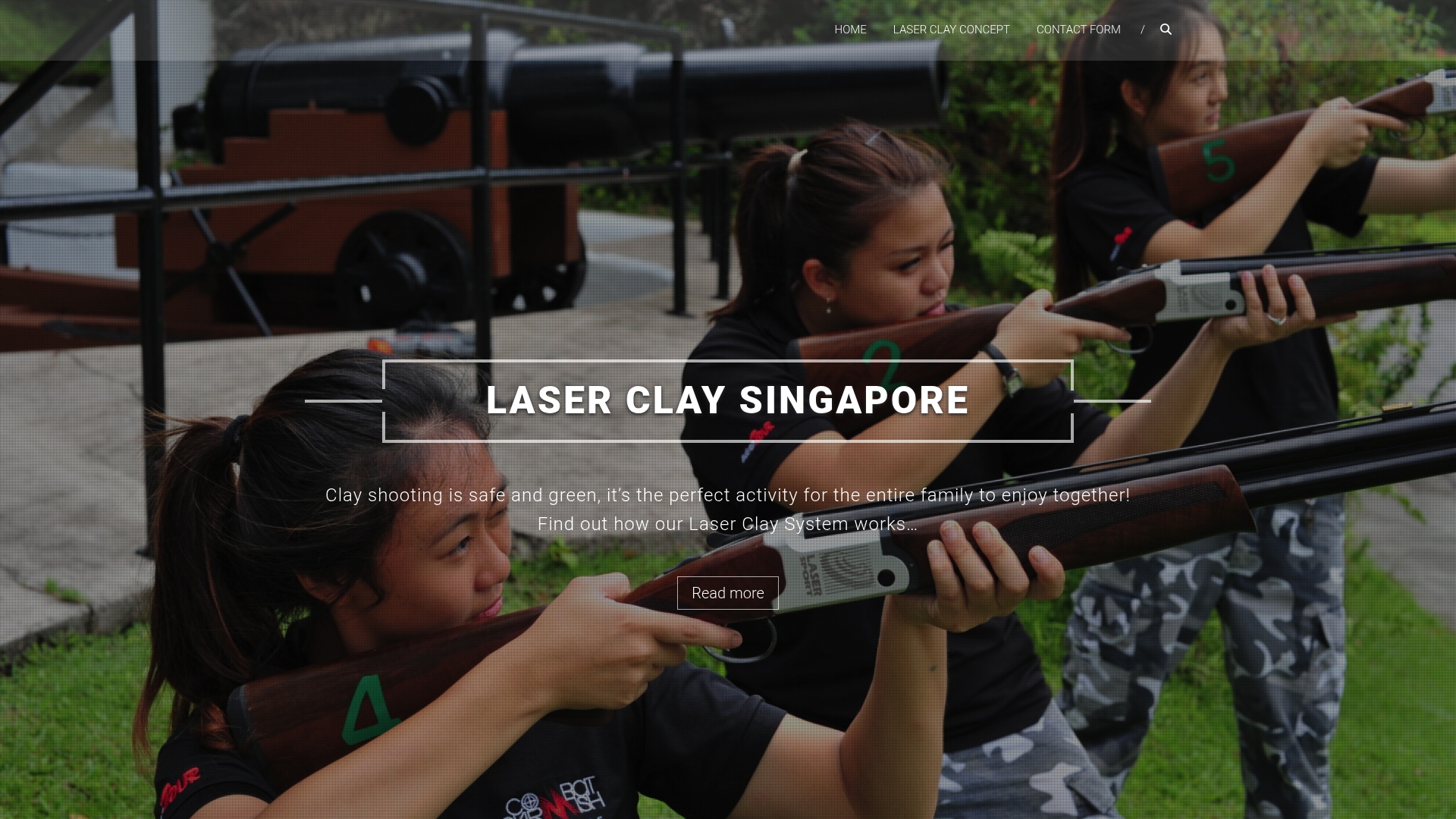
Whether you are looking for a corporate team-building programme or a recreational group event, Laserclay’s facilitated sessions include structured safety briefings, progressive skill challenges, and the kind of competitive format that keeps every participant invested. No hearing protection. No recoil. No live ammunition. Just real skill-building in a format everyone can enjoy. Book your session and experience the difference a well-designed marksmanship activity makes.
FAQ
What are the main types of safe marksmanship skill builders?
The main types include static fundamentals drills, dynamic movement-based practice, dry-fire and laser training, organised competition formats, and group or gamified experiences. Each type suits a different skill level and setting.
Do beginners need prerequisites before joining a skill builder programme?
Yes. Any structured programme should require participants to demonstrate basic safe handling before progressing to dynamic or competition formats. Safe handling prerequisites are a standard requirement in well-run courses.
Are dry-fire and laser formats effective for real skill development?
Yes. Dry-fire and laser training build trigger control and sight mechanics through high-repetition practice, and research supports their use as a foundation before live-fire progression.
How do competition-style skill builders improve safety?
Competitions managed by certified range officers use standardised courses of fire and formal rule enforcement, which creates a more disciplined and consistently safe environment than informal range practice.
Which skill builder format works best for team or group events?
Laser-based and gamified formats are the strongest choice for mixed-skill groups. They eliminate live-ammunition risks, require no prior experience, and deliver genuine skill-building repetition in an engaging, accessible format.