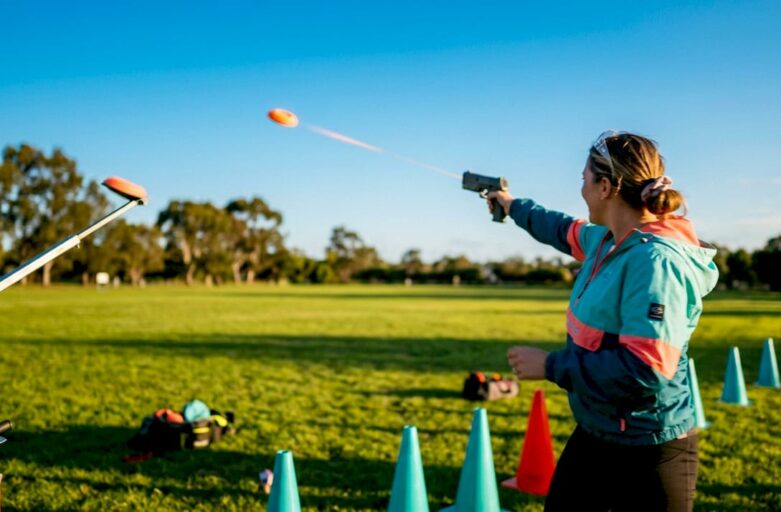
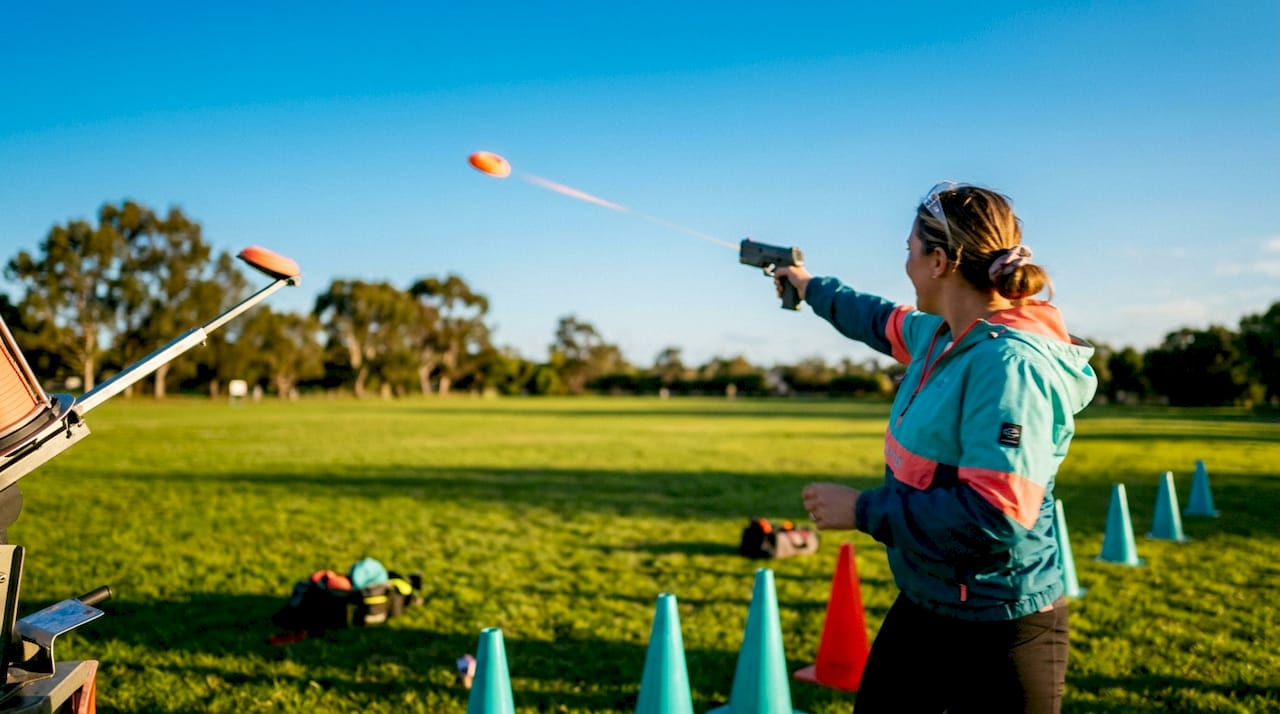
Laser clay shooting is the right call for any UK group booking where safety, spectacle and genuine inclusivity all need to land on the same day. Confirm your group size, preferred date and whether your venue is indoor or outdoor, then request a written quote. Here is what to expect on the day:
- Deactivated shotguns and reflective clay targets set up by the Laserclay team
- A qualified instructor-led safety briefing before anyone picks up a gun
- Practice rounds followed by scored competitive rounds on an electronic scoreboard
- Full setup and takedown handled by the crew, typically about half an hour each end
Table of Contents
- Who is laser clay for, and which event types does it suit?
- What does a booking include and what drives the cost?
- How do you choose a reliable laser clay supplier?
- What venue, space and power do you actually need?
- UK safety, insurance and safeguarding requirements
- Sample event timelines and game formats
- How do you make laser clay accessible for everyone?
- Why laser clay is better for the environment and for skill development
- Key takeaways
- Why the safety conversation matters more than the fun conversation
- Laserclay brings the full setup to your venue
Who is laser clay for, and which event types does it suit?
The activity works across a wider range of audiences than most organisers expect. Interactive shooting games like laser clay sit in a sweet spot: competitive enough to engage seasoned sports enthusiasts, accessible enough for someone who has never held a gun.
Primary audiences:
- Corporate teams seeking a team-building activity with measurable outcomes
- Schools and colleges running activity days, PE enrichment or end-of-term events
- Birthday parties for adults and teenagers (typically 16+)
- University societies and freshers’ week organisers
- Summer fun days, carnivals and festival stalls
Typical group sizes and facilitator ratios:
- 12–20 participants: 1 facilitator, single-lane setup
- 21–40 participants: 2 facilitators, dual-lane or rotating format
- 40+ participants: discuss a multi-station layout with your supplier
Event formats range from stand-alone competitive sessions and head-to-head knockouts to mixed-activity fun days where laser clay is one of several stations, complemented by simple physical target games like the kids tic tac toe toss game for indoor and outdoor play. Festival and carnival operators often hire the rig as a pay-per-go stall, which suits high footfall and short dwell times.
What does a booking include and what drives the cost?
Standard rental packages typically cover facilitators, all equipment, the electronic scoreboard, travel and setup, public liability insurance, and PAT-tested kit. Some suppliers include a marquee or shelter for outdoor bookings subject to UK weather.
Pricing factors to check when comparing quotes:
- Group size and session length
- Number of guns and lanes required
- Travel distance and load-in logistics
- Bespoke branding, custom scoreboards or prize options
- Whether a marquee or shelter is needed
Typical package tiers:
- 30-minute starter: single lane, up to 12 participants, practice and one scored round
- 1-hour competition: dual lane, up to 25 participants, multiple scored rounds and a leaderboard final
- Half-day multi-activity: rotating stations, 30–60 participants, includes breaks and an awards ceremony
Pro Tip: For mixed-ability groups where some participants will need extra coaching time, a flat per-head price protects your budget better than a per-hour rate. Coaching pauses eat into hourly sessions fast.
How do you choose a reliable laser clay supplier?
Treat this like any other hire of specialist equipment for a public event: verify the paperwork before you pay a deposit.
Supplier checklist:
- Written risk assessment and method statement provided before the event
- Public liability insurance confirmed in writing (ask for the policy number and the insured amount)
- DBS-checked staff confirmed if any participants are under 18
- PAT test certificates for all electrical equipment
- Equipment sanitisation procedures documented
- Facilitator qualifications or demonstrable training record
Questions to ask on the supplier call:
- What time do you arrive and how long does setup take?
- What is the footprint of the full rig including safe clay landing area?
- Do you need mains power or is the scoreboard battery-operated?
- What is your contingency plan if weather turns bad mid-session?
- What are your cancellation and rescheduling terms, and when is the deposit non-refundable?
- Can you provide session data or a scoring report after the event?
Red flags: a supplier who cannot produce a written risk assessment on request, gives a vague insurance answer (“we’re covered, don’t worry”), refuses to confirm DBS status for a school booking, or quotes a 10-minute setup time for a full outdoor rig.
Trust signals to look for: a live electronic scoring demo during your site visit or video call, named client testimonials from comparable events, and a willingness to share a sample risk assessment excerpt before contract.
What venue, space and power do you actually need?
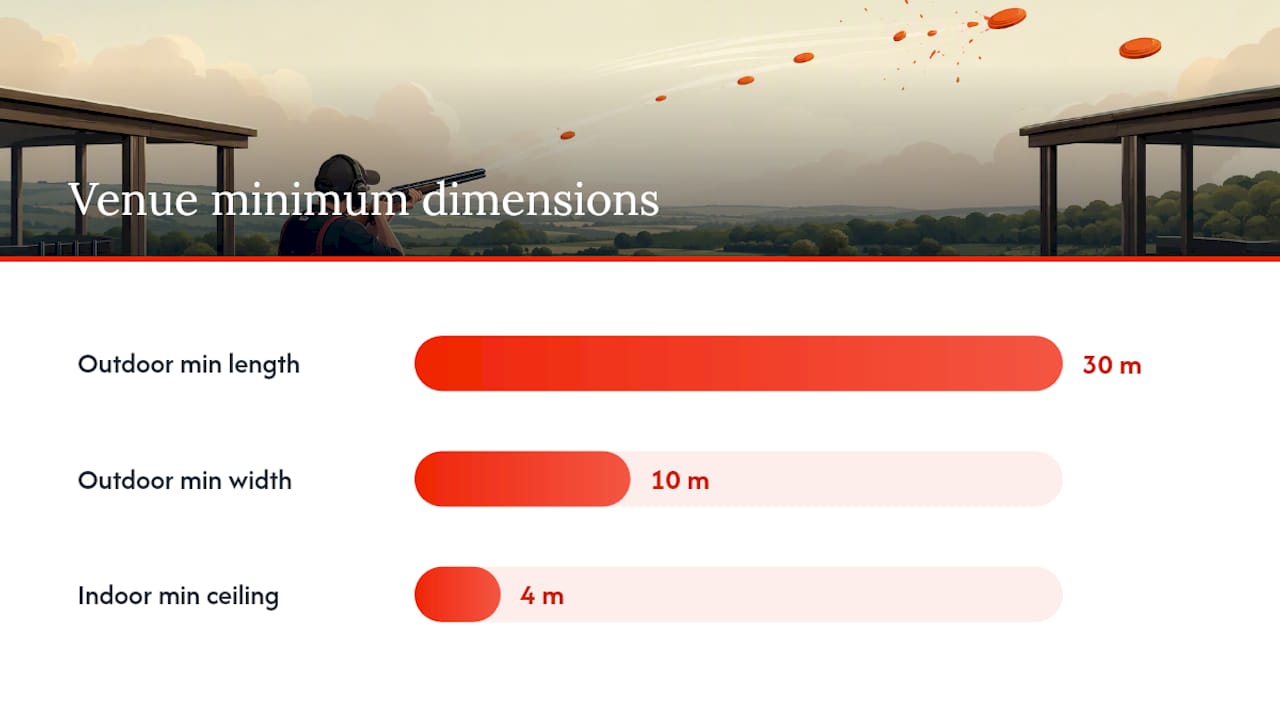
A workable outdoor setup needs a clear and sufficient footprint to allow clays to fly safely and room for shooters, with a safe clay landing zone beyond the firing line that is cordoned off from spectators. Indoor setups need less depth but require ceiling clearance of at least 4 metres for a realistic clay arc.
Venue checklist:
- Minimum 30m x 10m footprint for outdoor; confirm indoor ceiling height
- Flat or gently sloping ground (steep gradients affect trap angle)
- Clear spectator area with crowd-control bunting or barriers
- Parking close enough for a van load-in (equipment is bulky)
- Permission from the venue or landowner for a clay trap
Power and access:
- Battery-powered scoreboards remove the need for mains, but confirm battery life against your session length
- Mains power is preferable for longer half-day events
- Load-in distance from parking to setup point affects arrival time
Setup timeline (typical outdoor session):
- T-45 min: crew arrival, van unload
- T-30 min: trap positioned, guns checked, scoreboard linked
- T-15 min: safety cordon set, briefing area prepared
- T-0: safety briefing begins
- +Session duration: competitive play
- +20 min: pack-down and van reload
Pro Tip: Before confirming the venue, ask the site manager three things: whether any other event is sharing the space that day, whether there is a noise curfew, and who holds the key to the loading bay. These three questions prevent 90% of last-minute hold-ups.
UK safety, insurance and safeguarding requirements
Every reputable laser clay supplier operating at UK events should carry these documents as standard. Your job as the organiser is to request them in writing before the event date.
Must-have safety documents:
- Written risk assessment specific to the venue and activity
- Method statement covering setup, operation and takedown
- Public liability insurance certificate (the recommended minimum for group events is £5 million; many corporate venues require £10 million)
- PAT test certificates for all electrical equipment
- Equipment maintenance and inspection log
Safeguarding checklist for sessions involving minors:
- All staff DBS-checked at enhanced level
- Designated safeguarding lead contact provided to the school or organiser
- Parental or guardian consent forms issued where appropriate
- Safety considerations for children confirmed with the supplier in writing
Cancellation and payment terms: ask for these in the contract before signing. Standard practice in the UK events industry is a non-refundable deposit of 25–50% at booking, with the balance due 7–14 days before the event. Rescheduling windows vary; get the exact terms in writing.
Pro Tip: Request the insurance policy number, not just a certificate copy. Then check the exclusions section for hired equipment and outdoor activities. Some policies exclude damage to third-party property caused by a clay trap, which matters if you are on a managed venue.
Sample event timelines and game formats
30-minute session
- 0–5 min: safety briefing
- 5–12 min: practice rounds (unscored)
- 12–27 min: scored round, single elimination
- 27–30 min: results and prizes
60-minute session
- 0–7 min: safety briefing and warm-up
- 7–20 min: practice rounds
- 20–45 min: team relay or head-to-head rounds
- 45–55 min: final playoff between top scorers
- 55–60 min: leaderboard reveal and awards
120-minute session
- 0–10 min: briefing and coaching block
- 10–30 min: practice and accuracy drills
- 30–80 min: team league rounds (three rounds of five clays per person)
- 80–105 min: semi-finals and grand final
- 105–120 min: debrief, session data review, awards
Popular game formats:
- Speed shoot: most clays hit in 60 seconds; tests reaction time
- Accuracy first-shot knockout: one clay per turn, miss and you’re out
- Team relay: squads of four shoot in rotation; cumulative score wins
- Head-to-head playoff: two shooters, simultaneous clays, highest score advances
For mixed-ability groups, run a coaching block before scored rounds and use a handicap scoring system where beginners receive bonus points for their first five clays.
How do you make laser clay accessible for everyone?
The activity is more adaptable than it first appears. Most suppliers can accommodate participants with mobility limitations, and the absence of recoil makes it genuinely manageable for people who could not handle a live shotgun.
Adaptations to request:
- Seated shooting positions with adjustable gun rests
- Lightweight gun options or alternative grip fittings
- Visual scoring displays alongside audio cues for participants with hearing impairments
- Shorter individual rounds (three clays instead of five) to reduce fatigue
- Slower clay release speed for beginners or older participants
Questions for your supplier:
- What is the weight of the lightest gun in your kit?
- Have your facilitators worked with participants with physical disabilities before?
- Can you adjust the trap speed and arc mid-session?
For mixed-ability competitive formats, a points-per-hit system (rather than total clays hit) keeps the leaderboard competitive across skill levels. Pairing experienced and novice shooters in team relays also works well, since it shifts the dynamic from individual performance to collective strategy.
For school bookings, laser games in school programmes have shown particular value in PE enrichment contexts precisely because the activity levels the field between athletic and non-athletic pupils.
Why laser clay is better for the environment and for skill development
Traditional clay pigeon shooting leaves lead shot and clay fragments across the ground. Laser clay removes both problems entirely. Reusable reflective clays produce no ground contamination, no spent shot, and no chemical residue.
Environmental advantages:
- Zero lead or spent shot deposited on site
- Reusable plastic clays replace single-use traditional targets
- No litter or clay fragment cleanup after the session
- Lower noise footprint than live ammunition
- Smaller venue impact, making it viable for managed parks and school grounds
Training and performance benefits:
The electronic scoring system does more than display a leaderboard. Session data captures each participant’s hit rate, reaction time and consistency across rounds, giving facilitators material for a structured debrief. For corporate clients, this feeds directly into a team-building narrative: who improved most, which team communicated best under pressure, where individual performance dipped in the final round. For schools, the data can map onto PE assessment objectives around coordination, focus and competitive resilience.
A sustainable training approach also means the activity can be repeated on the same site without cumulative environmental damage, which matters for schools running termly activity days.
Key takeaways
Laser clay shooting is the most practical, safe and eco-friendly target practice game for UK group events, provided you verify insurance, DBS checks and a written risk assessment before signing any contract.
| Point | Details |
|---|---|
| Verify safety documents first | Request a written risk assessment, method statement and public liability insurance certificate before paying a deposit. |
| Match session length to group size | Groups of 1–12 suit a 30-minute slot; 20–40 participants need at least 60 minutes for a fair competition. |
| Budget by head, not by hour | A flat per-head price protects costs better than hourly rates when mixed-ability groups need extra coaching time. |
| Confirm DBS for child sessions | Any session involving under-18s requires enhanced DBS-checked staff; get written confirmation from the supplier. |
| Laserclay for UK group bookings | Laserclay offers fully mobile, eco-friendly laser clay packages for corporate, school and party events across the UK. |
Why the safety conversation matters more than the fun conversation
The events industry has a habit of leading with spectacle and burying the compliance questions at the bottom of the sales call. With laser clay, that order should be reversed. The activity is genuinely low-risk compared with live clay shooting, but “low-risk” is not the same as “no paperwork required.” It is important for organisers to confirm DBS and insurance status when booking suppliers to manage liability effectively.
The other thing organisers underestimate is how much the electronic scoring changes the room. A leaderboard that updates in real time does something a paper scoresheet cannot: it creates a shared focal point that keeps non-shooters engaged between turns. That is the detail that separates a good laser clay session from a great one, and it is worth asking suppliers specifically how their scoring system handles simultaneous lanes and tie-breaks before you book.
Laserclay brings the full setup to your venue
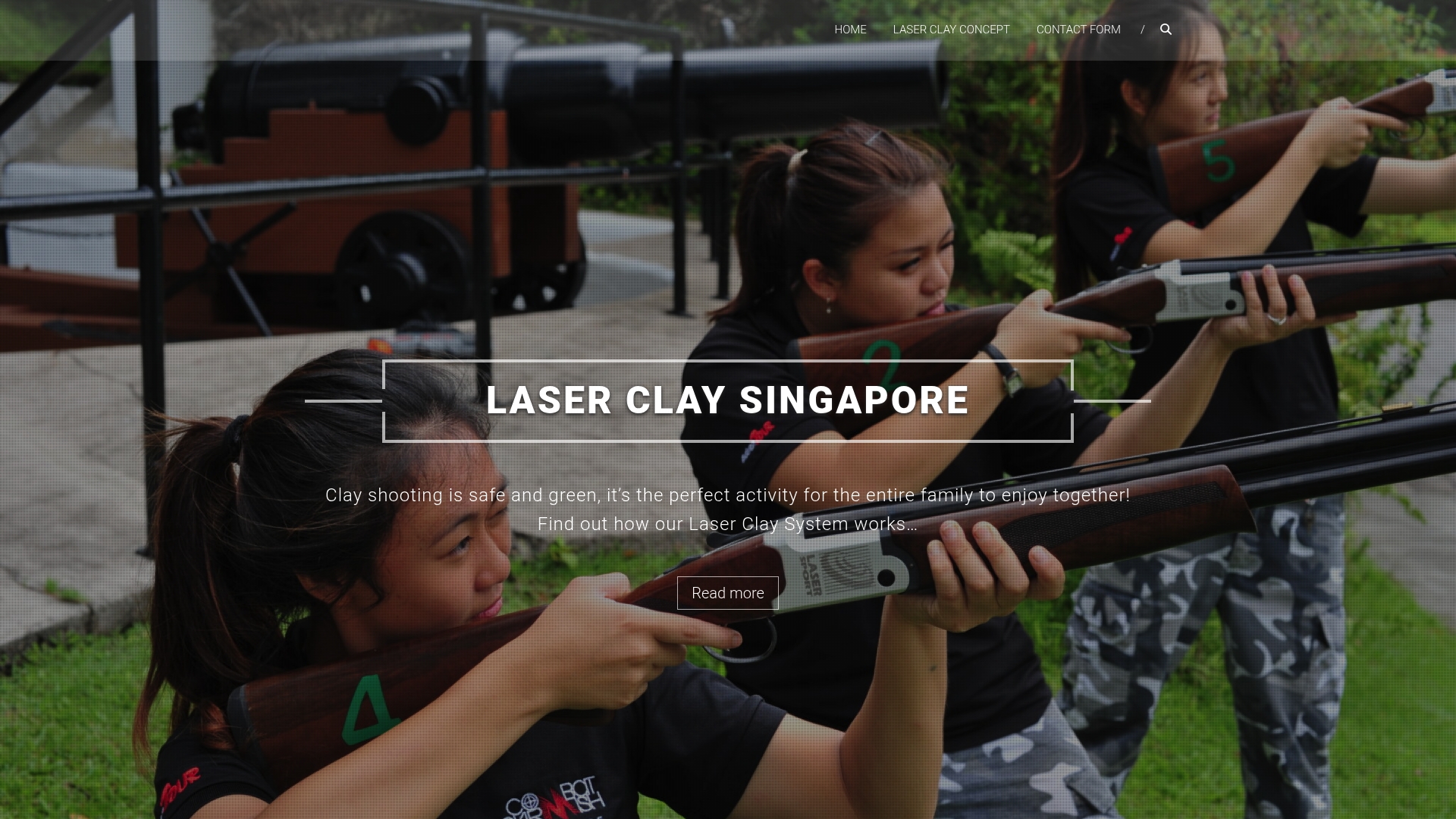
Skip the venue-hunting and the equipment sourcing. Laserclay arrives with everything: deactivated shotguns, reflective clay targets, a live electronic scoreboard, and qualified facilitators who run the session from safety briefing to prize-giving. The difference from hiring a bare equipment kit elsewhere is that Laserclay handles the risk assessment, the insurance, and the setup, so you arrive as the organiser, not the safety officer.
Packages cover corporate team-building days, school activity sessions, birthday parties and carnival stalls, with indoor and outdoor configurations available. To get an accurate quote, have your group size and age range, preferred session length, venue footprint, and event date ready. Laserclay also offers optional marquee cover, bespoke scoreboard branding and post-event scoring reports for clients who need them.
Ready to book? Visit the event rentals page to check availability and request a quote. Quotes are typically turned around within one business day, and a deposit secures your date.
Recommended
- Electronic shooting game for events: the UK planner’s guide | Laser Clay Singapore
- Best leveluplive.com alternatives for laser clay shooting in the UK | Laser Clay Singapore
- What is laser clay shooting? A complete guide | Laser Clay Singapore
- Sport accessibility without ammunition: the UK organiser’s guide | Laser Clay Singapore