
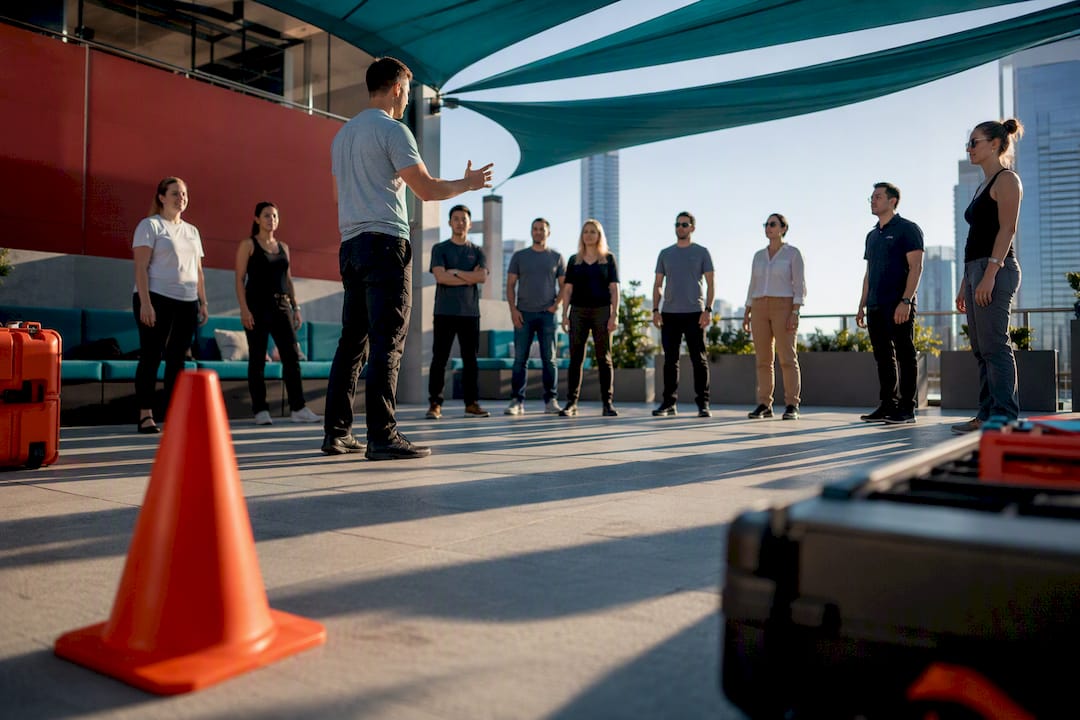
If you want measurable behaviour change from a team event, hire a professionally hosted, facilitated programme rather than running a DIY games day. Laser Clay is one option worth considering for organisers who want a safe, eco-friendly, tech-enabled format with proper facilitation built in. Formats range from a three-hour half-day session to multi-day offsites, and increasingly, virtual or hybrid versions of the same thing.
TL;DR:
- External facilitation neutralizes power dynamics, encouraging honest input and more meaningful discussions compared to internal-led sessions.
- The ideal format depends on your goal, with half-day workshops suitable for skill-building and multi-day offsites meant for strategic alignment or conflict resolution.
- Proper outcome measurement requires baseline assessments and 30-day follow-ups, which significantly improve the chances of lasting behavioural change.
- Clear logistics, including venue access, equipment setup, and accessibility needs, must be confirmed in writing to avoid last-minute problems on event day.
- Comparing providers requires detailed, itemized quotes including facilitation, materials, venue, and follow-up to ensure true cost differences.
Table of Contents
- What are hosted team building activities and which format fits your goal?
- Why does professional facilitation improve outcomes?
- How do you choose a hosted provider? Eight questions to ask before booking
- What do typical agendas and durations look like?
- What drives the cost and how do you compare quotes fairly?
- What logistics and accessibility details need checking before the day?
- What does the evidence say about what makes hosted events stick?
- What hidden costs, cancellation terms, and add-ons should you expect?
- Do real organisers see results from hosted events?
- How do you measure ROI on a hosted team-building event?
- Planner’s perspective: three lessons from running hosted events
- How Laser Clay meets the hosted-event brief
- Sources
- FAQ
What are hosted team building activities and which format fits your goal?
A hosted team building activity is any programme delivered by an external facilitator, rather than an internal manager running games from a printout. That distinction matters more than most organisers realise: the facilitator owns the structure, the pacing, and the debrief, which frees your own leaders to actually participate instead of stage managing.
Formats fall into five broad categories, and each solves a different problem.
- Half-day workshops (around three hours) target one or two specific skills, such as communication under pressure or cross-department trust. Half-day sessions typically run about three hours, which is enough time for a warm-up, one core activity, and a facilitated debrief, but not enough for deep strategic work.
- Full-day team development (six to seven hours) combines a morning working session with an afternoon shared experience, closing on documented commitments.
- Multi-day offsites suit leadership teams working through reorganisation, strategy resets, or unresolved conflict, where a single session cannot cover the ground.
- Large-group experiences, including tech-enabled formats like laser clay shooting with live scoreboards, work well for company-wide events where inclusivity and instant engagement matter more than deep discussion.
- Virtual and hybrid sessions replicate the same arc online, using breakout facilitation to keep remote colleagues as engaged as those in the room.
Choosing between them comes down to what you actually need: connection (large-group, half-day), skill-building (half-day to full-day, narrowly scoped), or alignment (full-day to multi-day, decision-heavy). A charity build-a-bike session might deliver connection in an afternoon; a leadership team wrestling with a merger needs the multi-day version, with facilitators trained to hold difficult conversations rather than just running icebreakers.
Why does professional facilitation improve outcomes?
An external facilitator changes the physics of the room. When a manager runs their own team’s session, junior staff tend to defer, agree, and hold back concerns. Bringing in outside facilitation neutralises those power imbalances and makes people noticeably more willing to speak honestly, particularly when the topic involves consensus-building or high-stakes decisions.
Facilitators also manage what practitioners call the energy arc: knowing when to push a group into hard, uncomfortable conversation and when to pull back into lighter bonding. Left to their own devices, most internal organisers either avoid the hard part entirely or push too hard with no relief valve. A skilled facilitator functions more like a conductor than a referee, giving structure so the group’s own expertise produces real decisions rather than a meandering chat that goes nowhere.
Workshops built this way don’t just feel better on the day. Programmes that pair activities with structured debriefs and measurable follow-up show observable gains in communication, trust, and problem solving that a one-off games day rarely produces.
Facilitation earns its cost most clearly in three situations: leadership alignment after a restructure, any reorganisation touching reporting lines or roles, and decisions where silence in the room would be expensive later.
Pro Tip: If your event involves a decision the group has to live with afterwards, such as agreeing new team norms or resolving a conflict, always bring in an outside facilitator. Internal staff running their own session almost never gets the same candour.
How do you choose a hosted provider? Eight questions to ask before booking
Vetting a provider properly takes fifteen minutes on a call, provided you ask the right questions in the right order. Start with these criteria, then move to the specific questions.
Selection criteria worth weighing before you even pick up the phone:
- Facilitator experience with your sector and group size, not just a generic events background.
- A stated method for measuring outcomes, ideally including a baseline and a follow-up check.
- Documented safety practices and current insurance cover.
- A genuine plan for inclusivity across mobility, language, and comfort levels.
- Clear logistics ownership: who sets up, who packs down, who’s on-site throughout.
- Transparent pricing with no vague “final quote on the day” language.
Once you’ve shortlisted two or three providers, ask them these eight questions on the call:
- What group size and headcount range do you typically run, and where does ours sit?
- What’s your facilitator-to-participant ratio, especially for breakouts or multi-room events?
- Do you offer any follow-up after the event, and what does it look like?
- Can you send a sample agenda for a group our size and goal?
- What’s your cancellation and rescheduling policy in writing?
- What insurance do you carry, and can you provide proof on request?
- How do you handle accessibility needs, dietary requirements, or participants who opt out of physical activities?
- Can you provide references or a case study from a similar organisation?
Watch for three red flags. First, a provider who can’t describe how they measure outcomes beyond “everyone had fun.” Second, vagueness about who’s actually running the session versus who’s on the sales call. Third, insurance or follow-up answers that get hand-waved rather than stated plainly. Any of those should push you towards a different shortlist.
What do typical agendas and durations look like?
Duration should follow your goal, not the other way round. A common mistake among first-time organisers is booking a half-day slot for a problem that genuinely needs a full day, then wondering why nothing changed.
A half-day session (roughly three hours) typically opens with a proper check-in rather than a round of name badges, since a strong opening builds psychological safety before the real work starts. That’s followed by one core activity and a facilitated debrief tied to a specific skill.
A full-day programme (six to seven hours) usually splits into a morning strategy or diagnosis block and an afternoon shared experience, such as a tech-enabled activity that resets group energy before the final commitments close. Fully facilitated offsites generally follow this same architecture: agenda design, session facilitation, a shared experience, logistics management, and a close where named owners commit to specific actions and dates.
Multi-day offsites extend that pattern across multiple days, weighting the balance towards working sessions with one or two signature experiences used as circuit breakers rather than filler.
| Format | Typical duration | Core structure |
|---|---|---|
| Half-day | a few hours | Check-in, one core activity, facilitated debrief |
| Full-day | a full working day | Morning strategy, afternoon experience, commitments close |
| Multi-day offsite | multiple days | Working sessions with signature experiences, daily debriefs |
| Virtual/hybrid | several hours (often split) | Plenary open, breakout facilitation, shared close |
For virtual and hybrid programmes, plan on one facilitator for every eight to twelve participants in breakout rooms to keep remote attendees from quietly disengaging. Skimp on facilitator density here and hybrid sessions tend to split into two experiences: an engaged in-room group and a muted, half-present online one.
What drives the cost and how do you compare quotes fairly?
Six factors move the price on almost every hosted team-building quote: headcount, duration, facilitator-to-participant ratio, materials and customisation, venue and travel, and whether measurement and follow-up are included at all.
Budgets tend to cluster into three bands, though exact figures vary by provider and aren’t something we’ll invent here:
- Entry-level bookings cover a shorter session, a single facilitator, and minimal customisation, suited to smaller teams wanting a straightforward bonding activity.
- Mid-range packages add a facilitator-to-participant ratio built for larger groups, some customisation of activities or branding, and basic post-event reporting.
- Premium programmes include a full facilitation team, bespoke agenda design, measurement with a baseline and follow-up, and often venue sourcing handled entirely by the provider.
The trap most organisers fall into is comparing quotes that aren’t actually comparable. One provider’s number might include facilitators, equipment, and follow-up; another’s might be equipment-only with facilitation billed separately. Before you compare anything, ask every shortlisted provider to break out: facilitator fees, equipment or materials, venue and travel, and any measurement or follow-up component, as separate line items. That alone usually reveals which quote is genuinely cheaper and which just looks that way on the headline figure.
What logistics and accessibility details need checking before the day?
Most event-day problems trace back to a logistics detail nobody confirmed in writing. Before signing off, check the venue can handle power requirements, has shelter for outdoor formats, and that the floor or ground can bear any equipment being brought in.
- Confirm equipment delivery, setup, and packdown windows against the venue’s own access hours.
- Ask what safety measures and first-aid provision the provider brings, and confirm their insurance covers your venue.
- Flag accessibility needs (mobility, hearing, vision) and dietary requirements at least a week ahead, not on the day.
- Clarify any privacy or confidentiality requirements if the session involves sensitive discussion.
- Confirm photo and video policy in writing, particularly if participants or attendees haven’t consented to external use.
- Check permit requirements for outdoor or public venues before you commit to a date.
Pro Tip: Ask for the setup and packdown timing in writing, not just the event duration. A three-hour session that needs ninety minutes of setup either side can quietly eat your whole afternoon if the venue booking doesn’t account for it.
What does the evidence say about what makes hosted events stick?
The research on this is fairly consistent: the activity itself matters less than the structure around it. Facilitators who neutralise power imbalances get more honest input, and sessions that build in a 30-day follow-up are more likely to produce lasting behavioural change than a one-off event.
The gap between a “fun day out” and a measurable shift in how a team works almost always comes down to two things: whether someone independent ran the room, and whether anyone checked back in thirty days later to see what actually changed.
Technology plays a real, if narrower, role here too. Tech-enabled formats with live scoring and leaderboards give facilitators something objective to point to in the debrief, rather than relying purely on how the room felt. Laser Clay’s tech-enabled, eco-friendly format supports this kind of measurement while keeping the activity safe and inclusive across a wide range of physical ability, since there’s no live ammunition and no marksmanship background required to score well.
A good facilitator will also use structured techniques, such as small-group rounds before opening the floor, to make sure quieter voices contribute before the loudest person in the room sets the tone. None of this shows up in a brochure photo, but it’s the difference between an event people remember fondly and one that actually changes how a team operates on Monday morning.
What hidden costs, cancellation terms, and add-ons should you expect?
The advertised price rarely tells the whole story, and the gaps usually show up in three places: what’s excluded from the headline quote, what happens if you need to cancel, and what optional extras get pitched once you’ve already committed.
Common exclusions to check for before signing: travel or delivery fees for equipment outside a provider’s usual radius, overtime charges if your event runs past the agreed window, and charges for extra facilitators if your headcount grows after the initial quote. None of these are unreasonable on their own, but they should be disclosed upfront rather than surfacing on the final invoice.
Cancellation policies vary widely between providers, and this is worth pinning down before you pay a deposit. Ask specifically: how many days’ notice is required for a full refund, what the fee structure looks like for late cancellations, and whether a reschedule is treated differently from a cancellation. A provider unwilling to put this in writing is telling you something.
Add-ons are where most of the genuine value or genuine upsell lives, depending on the provider. Reasonable optional extras include extended facilitation time, customised branding on materials or scoreboards, professional photography, and the 30-day follow-up session that research consistently ties to lasting change. Treat that follow-up less as an optional extra and more as a core part of what you’re buying, since it’s the piece most closely linked to results that outlast the event itself.
Do real organisers see results from hosted events?
Patterns repeat across well-run hosted programmes even without naming specific companies. Teams that book a facilitated half-day around a defined problem, such as cross-team friction after a merger, consistently report clearer communication in the weeks after, provided the session included a proper debrief rather than just an activity.
Large-group tech-enabled formats tend to succeed where inclusivity was the stated goal from the outset. A company-wide event mixing desk staff, warehouse staff, and management works best when the activity requires no prior skill, which is part of why formats like laser clay shooting, with a low physical barrier to entry and live scoring that rewards accuracy over strength, tend to score well on post-event feedback across mixed-ability groups.
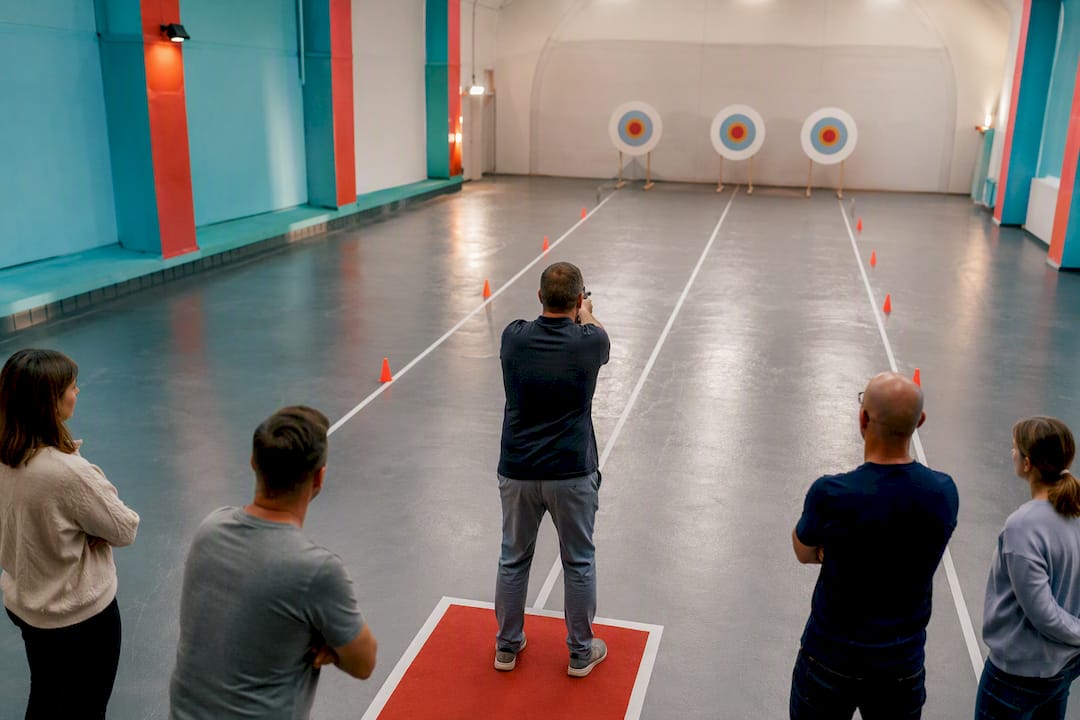
The common thread across successful bookings isn’t the activity itself. It’s whether the organiser gave the facilitator a genuine goal, rather than a vague brief to “bring the team together,” and whether someone followed up afterwards to see what stuck. Events booked purely as a reward, with no stated objective, tend to be remembered fondly and change nothing. Events booked against a specific problem, with a facilitator briefed properly and a follow-up scheduled, are the ones organisers rebook the following year.
How do you measure ROI on a hosted team-building event?
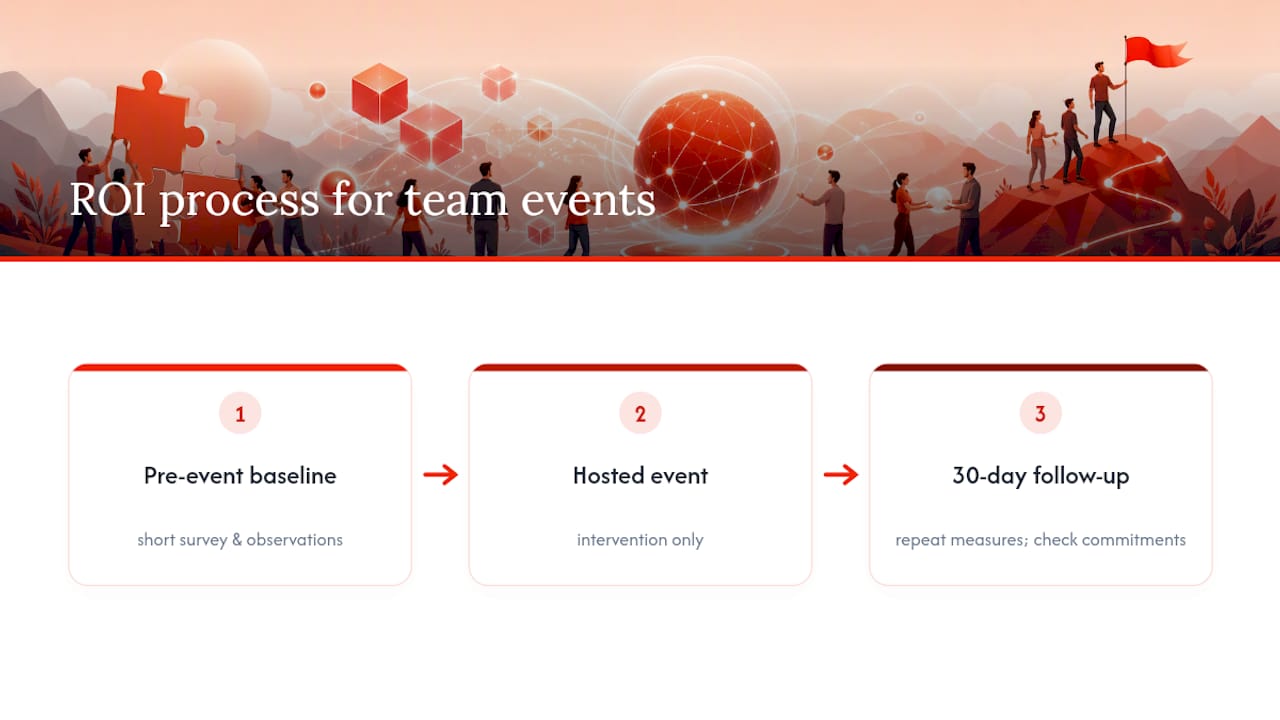
Measuring ROI on a team event starts before the event, not after. You need a baseline: a short survey or informal set of observations about communication, trust, or whatever the event is meant to shift, captured before people walk in the room.
The event itself is the intervention, not the measurement point. What matters more is the 30-day follow-up check, where you compare the same metrics against your baseline and ask whether the commitments made during the closing session were actually kept. If a leadership team agreed to weekly check-ins during the offsite close, did those check-ins happen in week three?
Softer signals still count. Watch for whether cross-team communication patterns change in the weeks after, whether people reference the event’s language or frameworks unprompted in later meetings, and whether the specific decisions made during the session got followed through. None of these show up in a single spreadsheet, but together they tell you more than a satisfaction score collected on the day, which mostly measures how good the catering was.
If a provider can’t describe how they’d help you track any of this, that’s a fair signal their focus stops at the event itself rather than the outcome you’re actually paying for.
Planner’s perspective: three lessons from running hosted events
The biggest mistake organisers make isn’t choosing the wrong activity. It’s skipping the brief. Tell your facilitator the actual problem, not the sanitised version you’d put in a company newsletter, and the session gets noticeably better.
Second, don’t underestimate setup time. A three-hour activity with ninety minutes of equipment setup either side needs a half-day venue booking, not a three-hour one. Organisers who cut this corner end up rushing the debrief, which is the part that actually matters.
Third, and this is the one people skip most often: book the follow-up before the event, not after. Once the event’s done and everyone’s back at their desks, a 30-day check-in feels optional and gets quietly dropped. Put it in the calendar on day one.
— Joshua
How Laser Clay meets the hosted-event brief
Laser Clay runs facilitator-led shooting experiences for corporate teams that want something genuinely different from a standard games day, without any of the safety or environmental drawbacks of live ammunition. Packages include venue setup, customisable game formats, and real-time electronic scoring, all delivered indoors or outdoors by facilitators who manage the session from start to finish.
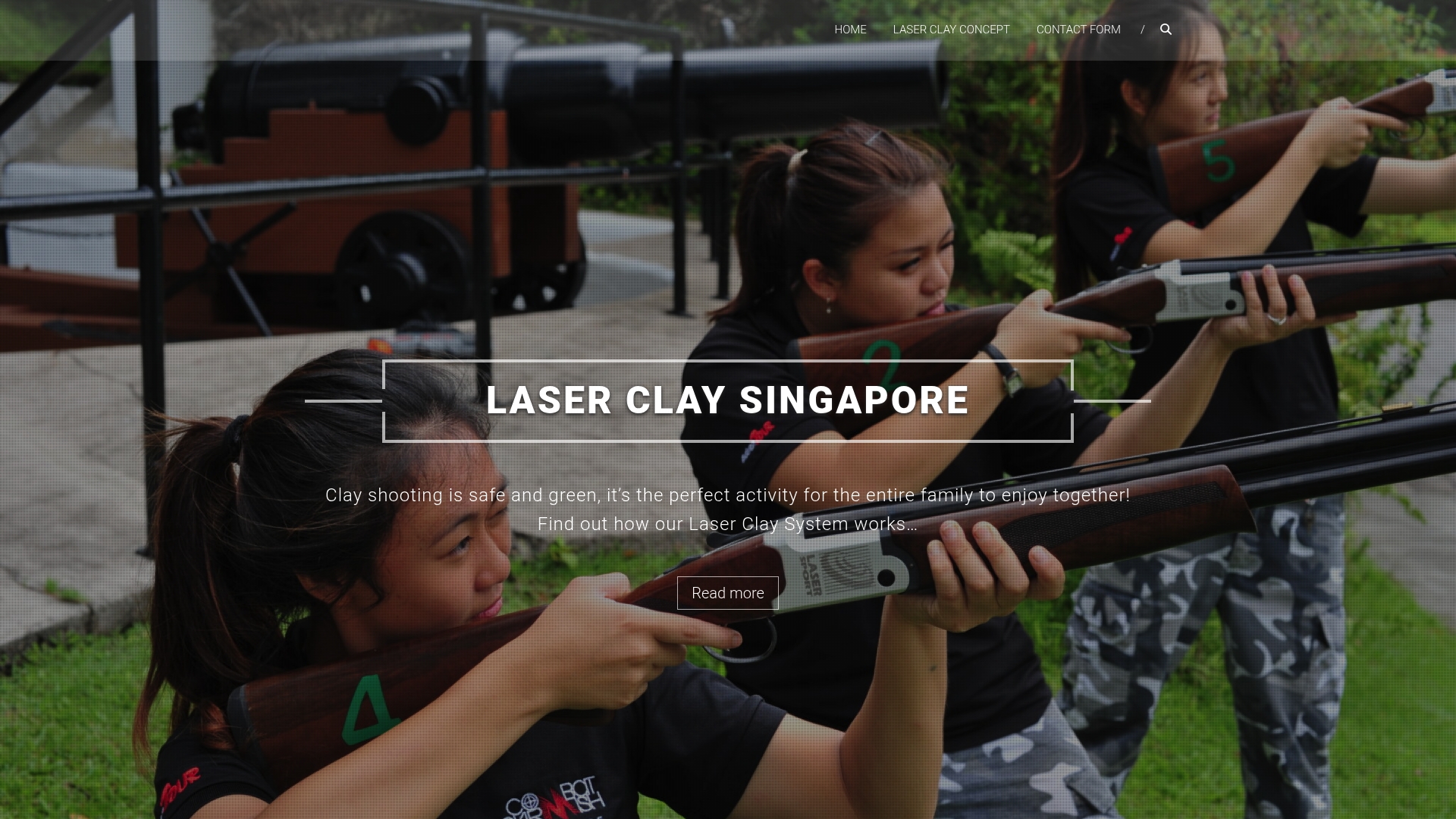
Against the selection checklist covered earlier, Laser Clay checks the boxes organisers actually care about: dedicated facilitators rather than a drop-off-and-leave rental, a low physical barrier to entry that keeps mixed-ability groups genuinely included, and eco-friendly reusable targets that avoid the lead and range restrictions of traditional clay shooting. The live scoreboard system also gives you something concrete for the debrief, rather than relying on how the room felt afterwards.
For corporate bookings, start with the corporate team building page to see headcount ranges and typical facilitation setups, or check how the format works if you want the mechanics before requesting a quote. Either way, get in touch to check dates and headcount fit for your event.
Sources
- Team building activities — GetOut Singapore
- Facilitate strategic planning — Deep Impact Online
- Team building workshops — Building Teams
FAQ
What are good 10-minute virtual team building activities?
Quick virtual formats work best as structured check-ins, such as a rapid “1-2-4-All” round where people answer a prompt alone, then in pairs, then as a foursome, before sharing back with the group. Keep the facilitator active throughout so quieter voices get pulled in rather than staying muted in the background.
What are good 5-minute team-building activities?
Five minutes is really only enough for a warm-up, not a full activity: a rapid-fire check-in question, a one-word mood share, or a quick paired icebreaker before the main session starts. Treat it as priming the room for psychological safety, not as the activity itself.
What are some fun online team-building activities?
Virtual scavenger hunts, trivia with live scoring, and breakout-room challenges all work well online, provided you keep roughly one facilitator per eight to twelve participants so nobody disappears into a quiet breakout room unnoticed. Hybrid versions of tech-enabled activities, including laser clay formats adapted for remote scoring, can also bridge in-office and remote attendees.
What are good indoor team-building activities?
Indoor formats that need minimal setup and work for mixed-ability groups tend to perform best, including tech-enabled shooting formats like laser clay, escape-room style challenges, and facilitated problem-solving exercises. Check the venue’s power and floor-space requirements before booking, since indoor equipment needs differ from outdoor setups.
How is a hosted event different from a DIY team building day?
A hosted event brings an external facilitator who manages structure, pacing, and debriefs, which research shows produces more honest participation than a manager running their own team’s session. DIY days can still build connection, but they rarely include the measurement or follow-up that turns an event into a lasting change.