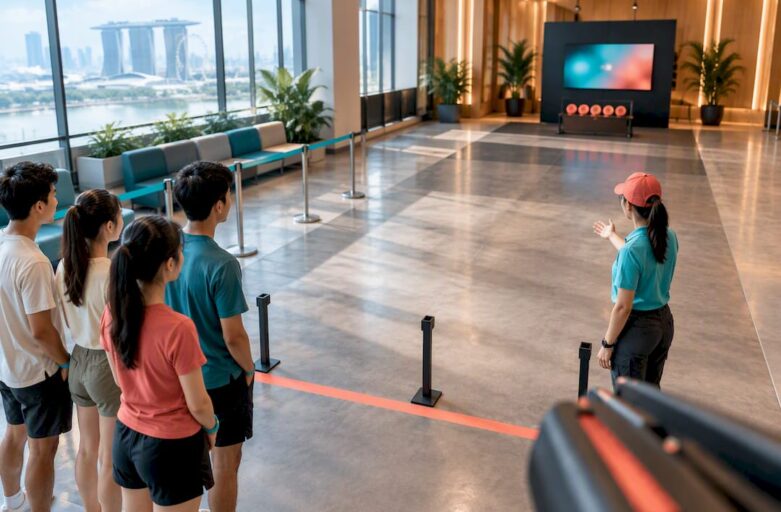
Most outdoor laser clay setups need a clear grass footprint between 40m × 20m and 70m × 30m, while compact indoor sessions can run in a room with a 3 to 5 metre wall, 2.4 to 3 metre ceiling height, and 2 to 2.5 metres of shooter clearance. Before booking anything, confirm three non-negotiables: a controlled landing zone with no public access, a trained facilitator on site for the full session, and proof of the supplier’s public liability insurance. Get those right and the rest of the planning is arithmetic.
TL;DR:
- Most outdoor setups require a clear, obstacle-free space of at least 40m by 20m, with larger events needing up to 70m by 30m for multiple launchers.
- Indoor configurations need a space of about 3 to 5 metres wide, with ceiling heights of 2.4 to 3 metres and a shooter clearance of 2 to 2.5 metres, affecting range and difficulty.
- Confirm the venue has secure, level ground for the launcher, reliable power sources, a stable network or offline scoring, and easy access for loading and transport before booking.
- Ensure the supplier provides proof of public liability insurance, trained facilitators, and a physically closed landing zone with fencing or stewards for safety.
- Weather considerations include light rain allowing play and heavy rain requiring indoors or rescheduling, with a need to verify the provider’s exact weather thresholds and backup plans.
Table of Contents
- How much space does laser clay actually need?
- What infrastructure does the equipment need on site?
- What paperwork and safety checks should you confirm?
- How long should sessions run and how many staff do you need?
- What weather and surface conditions affect play?
- Site manager checklist: five checks before the first shot
- Noise and local regulations: what planners need to check
- Ventilation matters for indoor laser clay setups
- How terrain and surface type change the setup
- Common mistakes planners make with laser clay space
- Book a turnkey setup that already meets these requirements
- Where to check dimensions and book a survey
- Sources
- FAQ
How much space does laser clay actually need?
Start with the longest clear run and the narrowest usable width, not the total plot size on a floor plan. A garden or field might look enormous on paper, but if a tree, fence line, or marquee pole cuts across the shooting lane, that’s your real boundary. Walk the space and measure from the firing line to the furthest safe backstop, then check the width at its tightest point, not its widest.
Three footprint bands cover almost every event Laserclay sets up:
- Compact (roughly 30m × 10m): suits function rooms, small courtyards, or condo common areas where throughput matters more than spectacle.
- Typical (40m × 20m to 70m × 30m): the range most outdoor setups fall into, and the one to plan around for a standard corporate day or birthday party.
- Large-format (up to 70m × 30m or beyond): needed when running multiple launchers side by side for tournaments or festival-scale bookings.
Indoors, the equation changes. A compact configuration can work in a wall or screen space of 3 to 5 metres wide, with ceiling heights of 2.4 to 3 metres and shooter clearance of 2 to 2.5 metres for calibration. The trade-off is range: tighter indoor setups mean shorter target flight paths, which changes the difficulty curve and the calibration settings the facilitator needs to dial in before the first shot.
Spectator zones deserve their own line item, not an afterthought. Position onlookers to the side of the firing line rather than behind the shooter, and keep sightlines to the scoreboard clear. A scoreboard tucked behind a pillar or facing into glare defeats the point of live scoring, since the competitive pull of laser clay comes largely from participants watching their numbers update in real time.
Before the site visit, pull up satellite imagery to pre-measure the longest run and narrowest width. Aerial mapping tools let you rule out obviously unsuitable venues before anyone drives out, which saves a wasted survey when the plot is clearly too tight.
What infrastructure does the equipment need on site?
The launcher itself needs firm, level ground. Grass, hard court, or a solid indoor floor all work, but loose gravel or heavily sloped turf make positioning unreliable and can throw off the target trajectory. Power draw is modest enough to run from a standard mains socket in most venues, though outdoor sites without easy mains access should have a generator confirmed in advance rather than assumed.
Scoreboards work best with a stable network connection, but the equipment is built to run offline if the venue’s Wi-Fi drops out mid-session. Testing this fallback before guests arrive is standard practice among setup guides for electronic scoring systems, and it’s worth asking your facilitator to demonstrate it during setup rather than finding out live.
Storage and transport are easy to overlook until loading day. Confirm the venue has:
- Secure, dry storage for equipment between sessions or overnight.
- Clear loading and unloading access for a van or trailer, ideally close to the shooting area.
- A route from the vehicle to the pitch that avoids stairs, tight corners, or lifts too small for the launcher casing.
Operators consistently flag lockable storage and easy load access as a recurring friction point at venues that look perfect on the site photos but turn out to have a single narrow service lift.
Pro Tip: Ask the venue for loading dock or lift dimensions before confirming the booking. A launcher that won’t fit through the door on the day is a far bigger problem than a slightly tight shooting lane.
What paperwork and safety checks should you confirm?
Request the supplier’s public liability insurance certificate before the event, not on the day. It should list the current policy period and cover the specific activity, and a reputable provider will send this without hesitation. Scouts activity guidance for laser clay pigeon shooting is explicit that clear landing zones with no public access and trained facilitators are baseline requirements, not optional extras.
Confirm on arrival that the landing zone is physically closed off: temporary fencing, cones, or stewards positioned at any access points, plus visible signage where the public might otherwise wander through. Build a short risk assessment into your event file covering:
- Landing zone closure method and who checks it.
- Facilitator qualification and insurance document references.
- Nearest first aid point and emergency access route.
- Weather contingency and who makes the call to pause.
Check age suitability and accessibility with the provider directly, since minimum ages and any physical accommodations vary by supplier rather than being universal across the activity.
How long should sessions run and how many staff do you need?
- Match session length to group size. Providers typically run 60 to 75 minutes for groups of 10 to 14, stretching to 70 to 90 minutes for 15 to 19 people, and up to 120 minutes for 20 to 25 participants.
- Add buffer time on top of the shooting slot. Setup, calibration, safety briefing, and teardown eat into the schedule, so book the venue for longer than the session itself rather than squeezing rounds to fit.
- Keep facilitator ratios tight enough for safety and pace. One trained facilitator per firing line keeps both supervision and throughput on track; larger corporate days often run two lines in parallel with a facilitator on each.
- For tournaments or festival stalls, schedule in heats. Rotating small groups through fixed time blocks keeps queues manageable and gives every participant a fair shooting window.
What weather and surface conditions affect play?
Light drizzle rarely stops a session, but heavy downpour does. Operator booking pages are consistent on this: play can continue in light rain but heavy rain triggers a pause or a move indoors, so confirm the supplier’s exact weather threshold before the event, not during it.
Wind rarely affects laser targets the way it affects physical clays, but glare does, particularly on bright afternoons when the sun sits low behind the target zone. Firm, level ground beats soft or sloped turf every time, since uneven footing changes shooter stance and can shift the calibration.
- Book a sheltered or indoor fallback space as a written contract clause, not a verbal assumption.
- Record the weather decision and who made it in the event file, in case of later disputes.
- Agree cancellation and rescheduling terms before the deposit is paid.
Pro Tip: Build a covered backup zone into the venue hire from day one, even for outdoor bookings. It costs little to reserve and saves the entire event if the forecast turns.
Site manager checklist: five checks before the first shot
- Confirm the clear run length and width match the footprint agreed at booking.
- Verify the landing zone is closed to public access, with fencing or stewards in place.
- Check power and network connections are live, and test the scoreboard’s offline mode.
- Confirm the trained facilitator has arrived and has insurance documentation on hand.
- Identify and confirm the nearest weather shelter or indoor fallback space.
If any check fails, hold the start, relocate to the fallback space, or cancel and reschedule under the agreed contract terms. Log each check with a timestamp for the event file, since this record becomes useful for post-event feedback and for any future booking at the same venue.
Noise and local regulations: what planners need to check
Laser clay produces sound-simulated shot effects rather than live ammunition discharge, which sidesteps the noise and licensing issues tied to traditional clay pigeon shooting. That said, any amplified scoreboard audio or celebratory sound effects at an outdoor venue can still fall under a building’s or estate’s own noise guidelines, particularly in residential condo settings or shared event spaces.
Check with the venue management or building administration about permitted hours for amplified sound, especially for evening corporate events or birthday parties running into the early evening. Most residential developments in Singapore set quiet hours, and function room bookings often carry their own noise clauses in the tenancy or facilities agreement. Confirm these before finalising a booking rather than discovering a restriction on the day.
For outdoor public spaces or void decks, check whether the venue requires a permit for organised activities, since some management corporations treat any structured event, regardless of noise level, as requiring advance notice. This is a five-minute phone call at the booking stage that avoids an awkward conversation with a security guard mid-session.
Ventilation matters for indoor laser clay setups
Indoor sessions running in function rooms, condo clubhouses, or event halls need decent air circulation, particularly when a group of 15 to 20 people is active and moving through firing positions for over an hour. Poor ventilation makes a room feel stale fast, and that fatigue shows up in participant energy and shot accuracy alike.
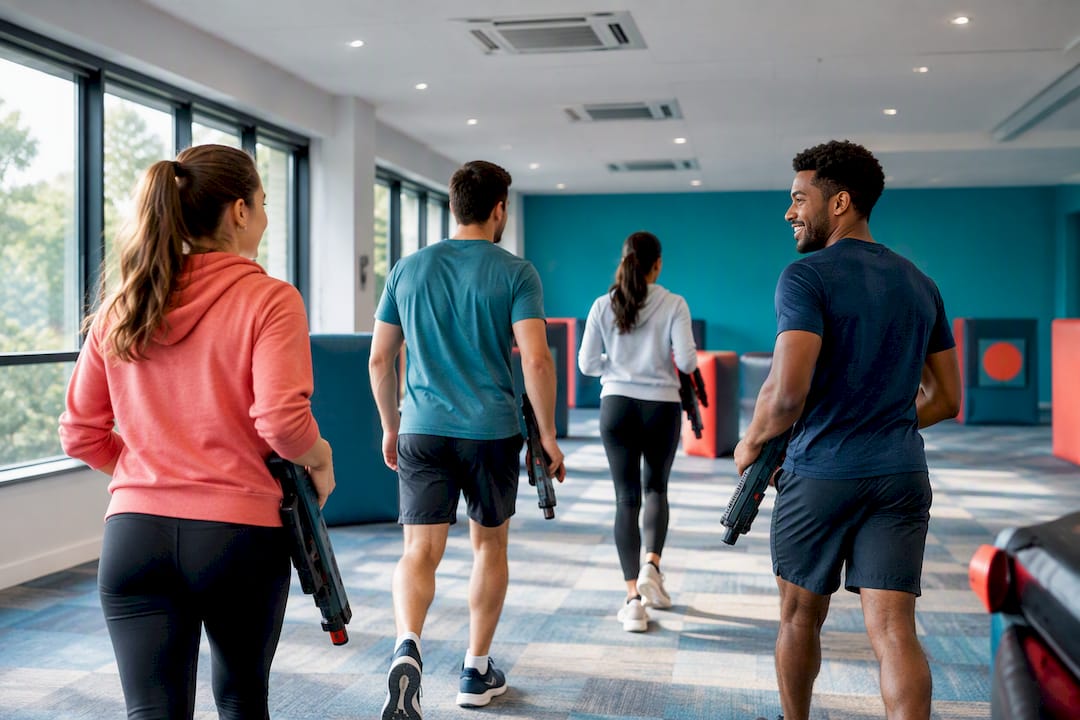
Confirm the room has working air conditioning or mechanical ventilation before booking, not just a ceiling fan pushing warm air around. Rooms with operable windows are a bonus for airflow but check that window placement doesn’t interfere with the shooting lane or introduce glare that affects the laser sensors.
Ceiling height interacts with ventilation too. A room at the minimum 2.4 metre clearance with poor air movement will feel cramped within thirty minutes, especially for a full corporate group. Where possible, choose a room closer to 3 metres in height, since the extra volume of air helps keep the space comfortable through longer sessions without needing to pause for breaks.
How terrain and surface type change the setup
Grass is the most forgiving surface for outdoor setups, giving both stable footing and a safe backstop for target flight paths. Hard court surfaces work well too, particularly for corporate events at office rooftops or sports facilities, though they demand more care around slip resistance if the ground gets damp.
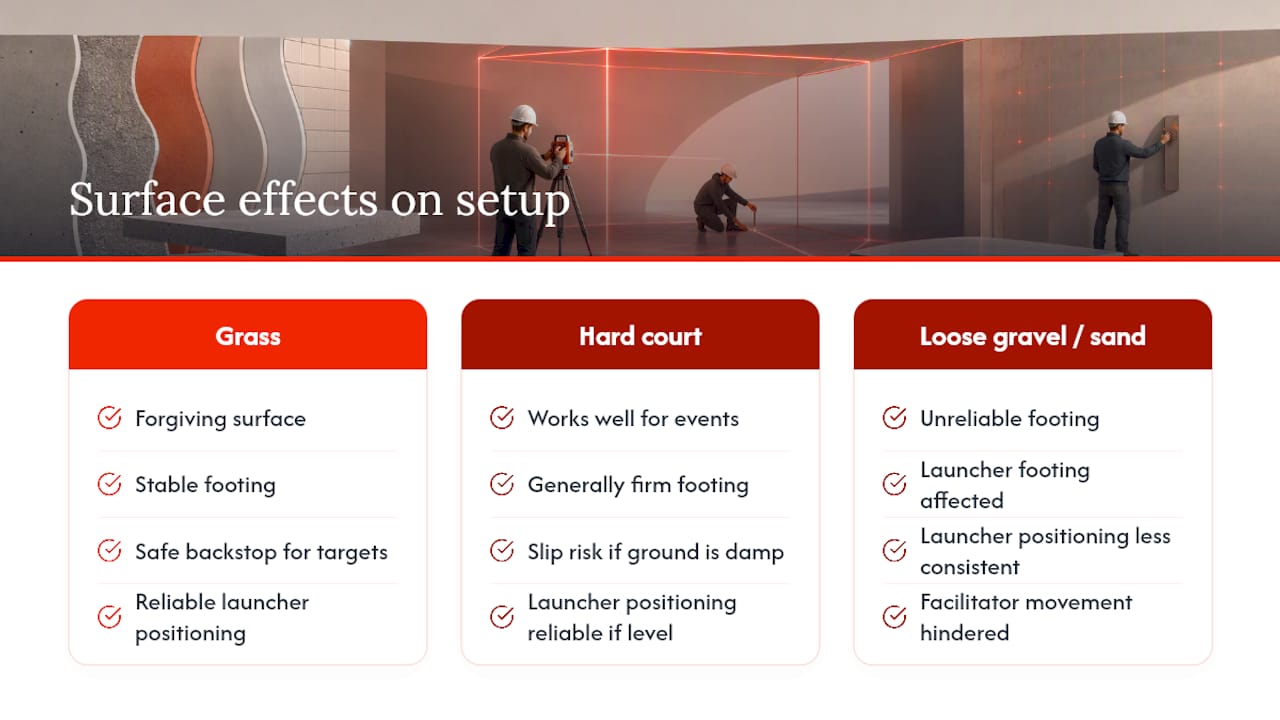
Sloped or uneven terrain changes more than comfort. It shifts the shooter’s stance, alters the launcher’s positioning angle, and can affect how consistently targets present themselves across a group of participants. A field that looks flat from a distance often has a subtle gradient that only becomes obvious once you’re standing at the firing line with the launcher set up.
Loose surfaces like gravel or sand make the launcher’s footing unreliable and can affect facilitator movement between firing points during a session. Where the only available site has an uneven or loose surface, ask the facilitator whether portable matting or a levelling platform is available. It’s a small addition that keeps the shooting line stable regardless of what’s underfoot.
Common mistakes planners make with laser clay space
The two mistakes that come up most often: underestimating how much clear run a landing zone actually needs, and treating setup time as an afterthought squeezed into the booking window. Both are avoidable with a proper site walk beforehand rather than trusting a floor plan.
If you’re choosing between throughput and spectacle, pick throughput for corporate days with tight schedules, and reserve the larger, multi-launcher format for events where the shooting range itself is part of the entertainment, such as festivals or milestone celebrations.
— Joshua
Book a turnkey setup that already meets these requirements
Laserclay’s Corporate Laser Clay Package is built around the exact checklist above: a trained facilitator, insurance documentation ready on request, and full venue setup handled by the team rather than left to a planner working from a tape measure. Where a private event calls for something smaller, the Birthday Party Package covers the same safety standards at a scale suited to gardens, function rooms, or condo common areas from $49 SGD per person.
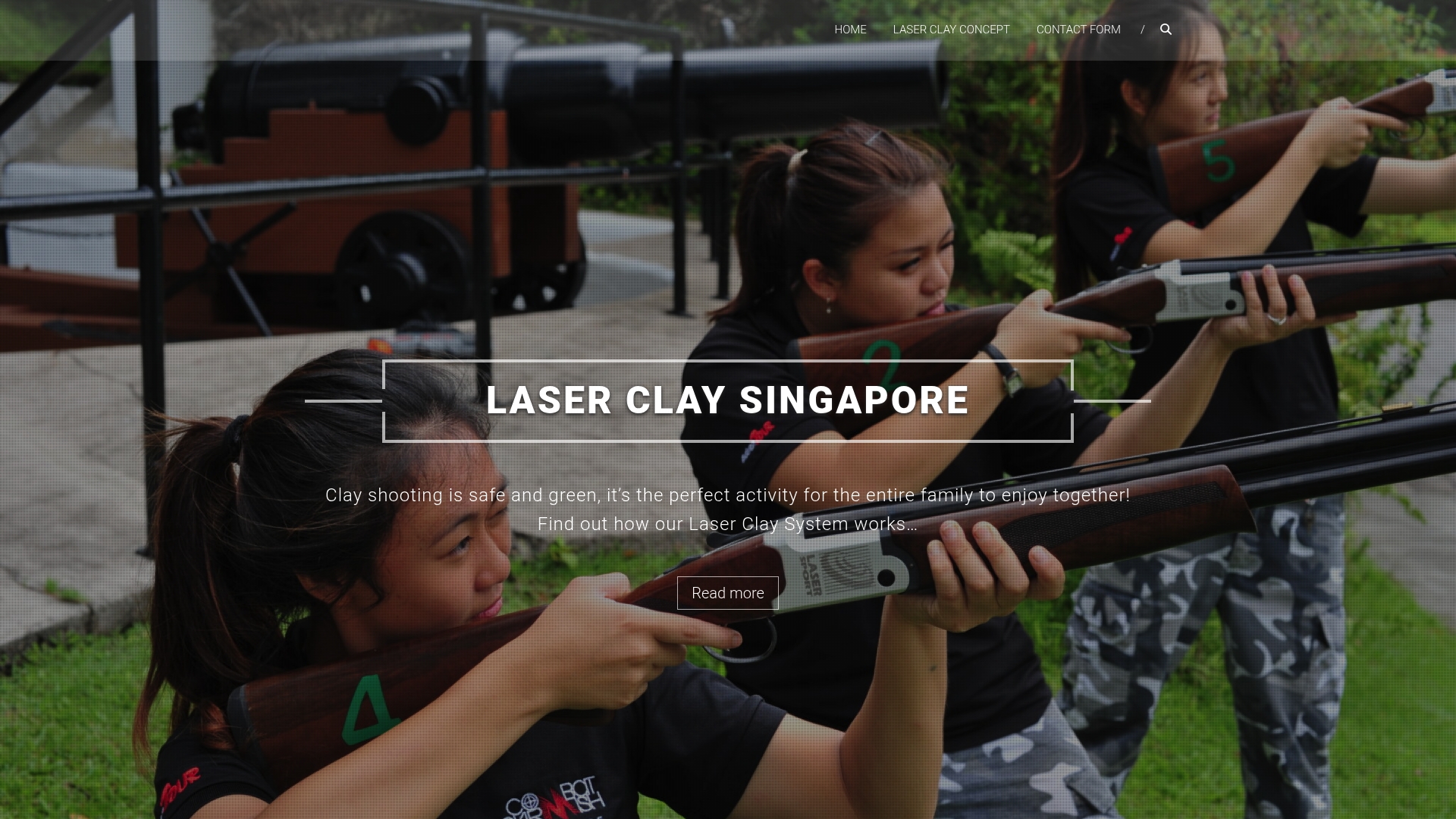
For planners who prefer to run their own facilitation, the System Rental option makes the equipment available at $500 to $800 SGD per hour, with setup guidance included. Whichever route fits your event, have your venue’s dimensions, ceiling height (if indoor), and power access noted before you get in touch. That single step turns a site survey from a guessing exercise into a quick confirmation call. Get in touch to check dates and talk through your venue’s layout.
Where to check dimensions and book a survey
Cross-check footprint figures against the setup requirements page and the how to play guide before your site visit. For spectator sightline accessories and target visibility, providers like Ferus Outdoors offer relevant range equipment worth reviewing. Use satellite mapping tools to pre-measure clear run length ahead of any physical survey.
Sources
- Private Laser Clay Shooting | Team Building | Seek Sophie
- Shotgun Laser Clay Shooting Experience in Singapore | Pelago
- Scouts activities: laser clay pigeon shooting
FAQ
What is the minimum space needed for laser clay outdoors?
A compact outdoor setup can work in roughly 30m × 10m, but most events need between 40m × 20m and 70m × 30m depending on launcher configuration and group size. Always measure the clear, obstacle-free run rather than the total plot boundary.
Can laser clay be set up indoors?
Yes. Compact indoor configurations need a wall or screen space of 3 to 5 metres wide, a ceiling height of 2.4 to 3 metres, and shooter clearance of around 2 to 2.5 metres for calibration.
How long does a laser clay session typically last?
Session length scales with group size: expect 60 to 75 minutes for 10 to 14 people, rising to 120 minutes for larger groups of 20 to 25. Always add buffer time on top for setup, briefing, and teardown.
Does laser clay work in the rain?
Light drizzle usually doesn’t stop play, but heavy downpour requires suspension or a move indoors. Confirm your provider’s specific weather policy and backup location before booking.
What insurance should a laser clay supplier provide?
The supplier should provide proof of public liability insurance covering the specific activity, valid for the event date. This documentation, alongside a trained facilitator on site and a closed landing zone, forms the baseline safety standard for any booking.