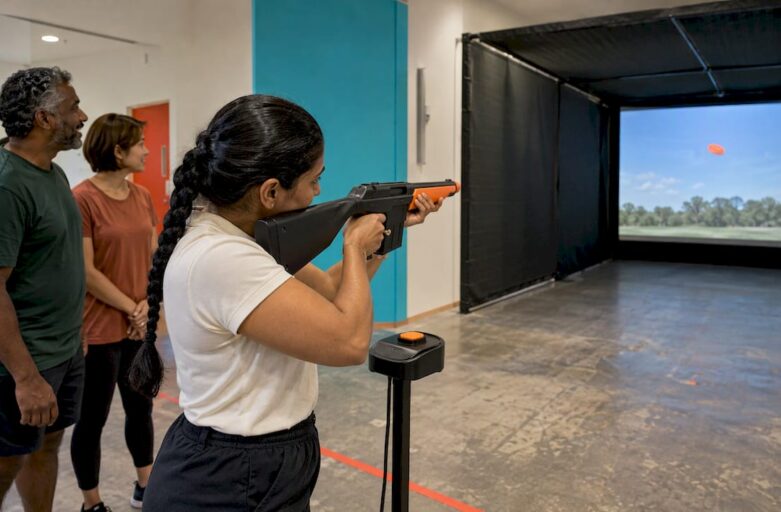
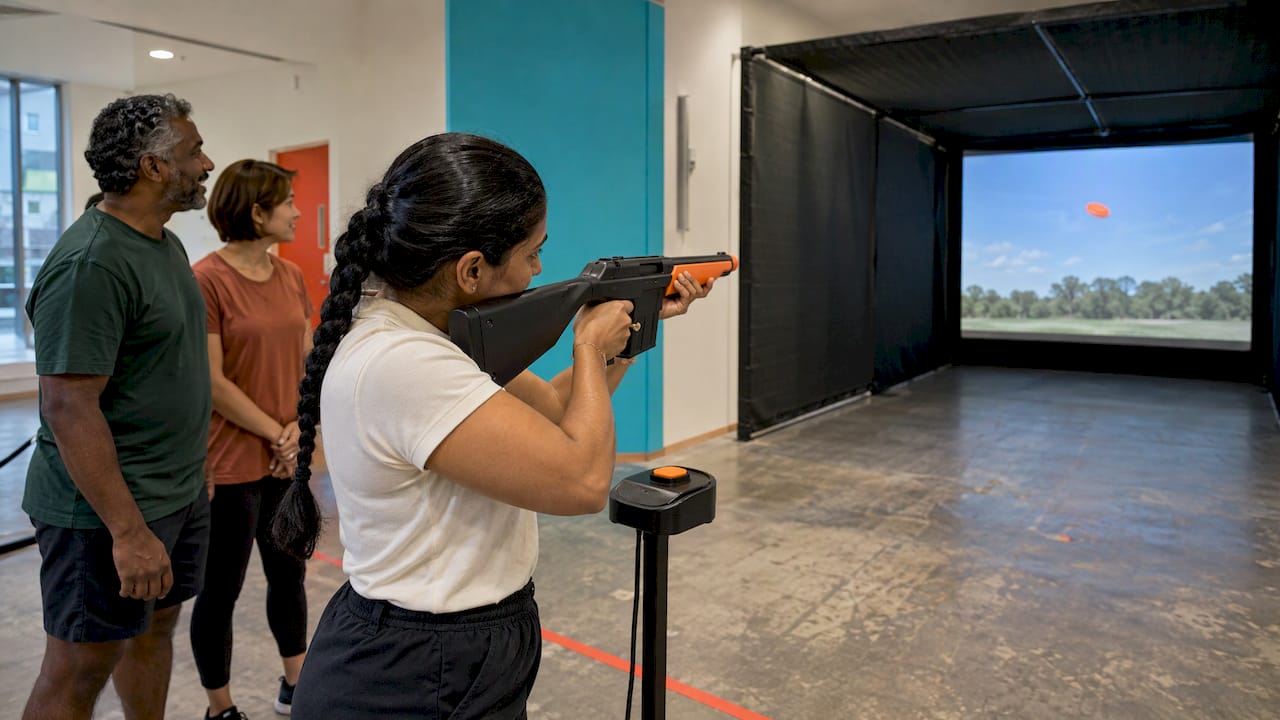
Non-contact team building means activities where nobody has to touch, tackle, carry or physically compete against a colleague. The best ones still get people talking, laughing and relying on each other. For a Singapore team, the practical options fall into three groups: quiet communication exercises you can run in a meeting room, card, polling and word games, and a facilitated activity such as laser clay shooting, where everyone plays side by side with no body contact.
This guide helps you pick between them, run them well and adapt them to your group.
TL;DR
- Non-contact formats suit mixed teams: different ages, fitness levels, comfort zones and cultures can all take part on equal terms.
- Cheap options (silent line-ups, bingo, live polls) work in a meeting room; a facilitated activity gives a bigger shared moment.
- Laser clay is a non-contact, no-lead, reusable-target format that we run for teams from age 10, indoors or outdoors. Our corporate package is S$69 per person.
- Match the activity to the skill you want to practise, then adjust the space, rules and grouping for your group size.
- Brief people clearly, keep participation optional where you can, and plan for dietary needs, heat and mobility.
Table of Contents
- What counts as non-contact team building
- Three kinds of non-contact activity
- Quiet communication exercises
- Games and low-pressure icebreakers
- Where laser clay fits
- Choosing by the skill you want to build
- Adapting to group size, age and ability
- Inclusion and safety for Singapore workplaces
- Our perspective
- Plan your event with us
- How to run a non-contact team event step by step
- FAQ
- Sources
What counts as non-contact team building
The phrase covers two things that people often mix up. The first is no physical contact: no human pyramids, trust falls, three-legged races or tackle-style games. The second is low physical exertion: activities that do not depend on stamina or athletic ability. Many non-contact formats are both, but not all.
The point of any team activity is the same. JobStreet Singapore describes team building as activities that strengthen social connections, clarify roles and encourage collaboration, with benefits such as better communication, more trust and a shared sense of purpose. None of that needs bodies colliding. It needs people working towards something together, with enough structure that nobody feels singled out.
Why do organisers look for non-contact formats?
- Mixed teams. A department may include colleagues in their twenties and their fifties, people with injuries, and people who simply dislike roughhousing.
- Comfort and professionalism. Not everyone wants to hold hands or lean on a manager at a work event.
- Venue flexibility. Without running or tumbling, the activity can fit an office floor, a function room or a covered outdoor area.
- Lower injury risk. Fewer collisions and falls means fewer things to plan around.
Three kinds of non-contact activity
| Type | Examples | Best for | Typical setting |
|---|---|---|---|
| Quiet communication exercises | Silent line-up, sign pass, tower building with limited talking | Practising listening and non-verbal cues | Meeting room, 15 to 30 minutes |
| Games and low-pressure icebreakers | Card and word games, bingo, two truths and a lie, live polls | New teams, remote or hybrid groups | Meeting room or online |
| Facilitated shared experience | Laser clay shooting | Bonding, friendly competition, whole-team outings | Office, function room or outdoor venue, 1 to 3 hours |
Most good events mix two of these: a short icebreaker to settle the room, then one main activity.
Quiet communication exercises
These cost nothing and need no equipment.
Silent line-up. Ask the group to arrange themselves in order of birthday month or height without speaking, using only gestures and eye contact. The Improv Archive suggests starting with an easy criterion, then having each person say their value aloud once the group signals it is done. The debrief is where the value sits: where did the line go wrong, and why?
Sign pass. Players stand in a circle and pass gestures around it. According to the Improv Archive, it builds group awareness because participants must send and receive clear signals while watching the whole circle.
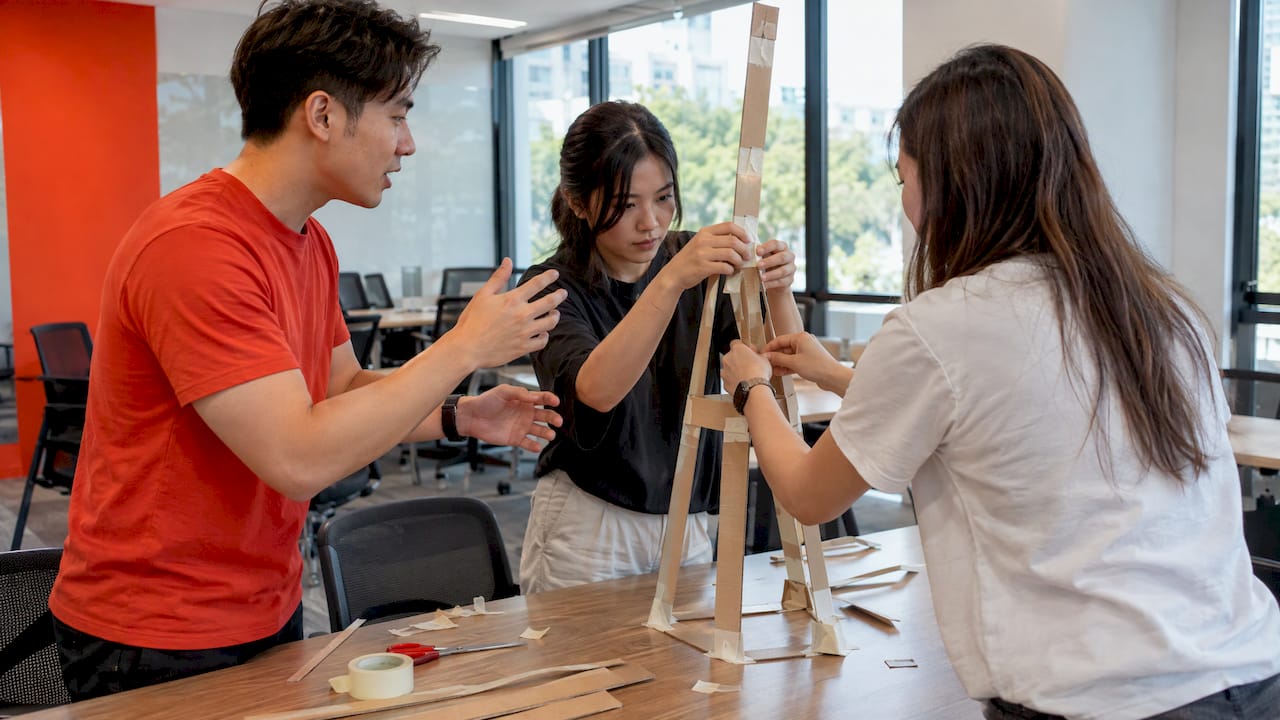
Tower building with constraints. Give small groups limited materials and a communication barrier, such as one person who can speak and others who cannot. A lesson plan on building a tower uses this to practise cooperation and to show that people can read the same expression differently. Allow around two hours for a small group if you run it in full.
Keep these short and well framed. A silent exercise with no debrief is just an awkward few minutes.
Games and low-pressure icebreakers
For larger or hybrid groups, broad-participation formats work best. Eventbrite notes that live polling works in person, online or hybrid because everyone can take part without speaking in front of the room, and that event bingo creates low-pressure conversations. It also says small groups can handle more personal conversation, while larger groups need clearer instructions and formats everyone can join.
Good choices include:
- Bingo with prompts such as “has lived in three countries” or “takes the MRT to work”. It gets people talking without forcing them to perform.
- Two truths and a lie, in person or on a phone app.
- Card and word games for groups of four to eight, where a judge picks the best match and the table laughs at the answers.
- Virtual escape rooms for remote colleagues, usually short sessions for small groups.
These are excellent warm-ups. They rarely create the shared memory that people talk about the next week, which is where a facilitated activity earns its place.
Where laser clay fits
Laser clay shooting takes the look and rhythm of clay shooting and removes the parts that make it hard to run for a work group. Our system uses sound-simulated, deactivated shotguns and reusable clay targets, so there is no lead and no live ammunition. Players take turns, score appears on real-time electronic scoreboards, and nobody needs to touch anyone else.
Why teams like it for non-contact events:
- Equal footing. Strength, speed and fitness barely matter. A new joiner and a director can sit at similar scores on the first round.
- Natural conversation. People wait their turn side by side, cheer, compare and tease. That is easier than forced talking exercises.
- Facilitated throughout. Our facilitators set up, explain the rules and run the session, so your HR or admin team can take part instead of managing logistics.
- Customisable formats. Games and scoring can be shaped for a relaxed outing or a competitive tournament between departments. For ideas, see our corporate competition ideas for Singapore planners.
- Indoor or outdoor. It can run at your office, a function space or an outdoor site. Our page on team building venues in Singapore explains what planners should consider.
- Ages from 10. That makes it workable for company family days, which we cover in our corporate family day games guide.
If you want to see how a session works from the first shot, our guide on how to play laser clay walks through it.
Choosing by the skill you want to build
Start from the outcome, not the activity. Asana’s team-building guide suggests choosing by the collaboration skill you want to practise, such as communication, creative thinking or problem-solving. Eventbrite adds that the right format depends on group size, the event’s goal and whether it is in person, virtual or hybrid.
A simple way to apply that:
- A new team or a recent merger. Use icebreakers and bingo first, so people learn names and small facts. Follow with a shared activity in mixed groups.
- A team that talks past each other. Use silent line-ups or constrained tower building, then debrief on what got lost.
- A team that needs a reward and a reset. Choose a shared experience with light competition and a clear finish. Laser clay suits this well, because rounds are short and scores are visible.
- A cross-department event. Mix the teams deliberately, with a scoreboard that rewards combined results rather than only individual ones.
If you are weighing the return on any of this, our team building ROI article shows how to measure it.
Adapting to group size, age and ability
The same activity can feel brilliant or dull depending on the fit. Sport Singapore’s guidance on facilitating movement is written for early childhood educators, but its principles carry over: vary the challenge, offer choices, and adapt tasks to what participants can do, because tasks that are too hard cause disengagement. The same guide also points to simple instructions, visual cues, access for mobility aids, larger or safer equipment, and rest areas.
In practice:
- Small groups (under 12). Run one game with everyone involved, and allow longer debriefs.
- Medium groups (12 to 40). Split into teams of four to six, rotate stations, and keep one shared scoreboard.
- Large groups (40 and above). Use stations or waves so no one waits too long, and add a broad-participation activity such as bingo for people in the queue.
- Mixed ages. Keep rules simple and let teams choose their own format for a round, such as a handicap or a team score.
- Different abilities. Ask in advance about mobility, vision or hearing needs. Seating, shorter rounds and clear verbal and visual instructions help everyone.
With laser clay, our facilitators adjust the game format and scoring to the group in front of them, so a mixed-age family day and a competitive sales-team afternoon can look quite different.
Inclusion and safety for Singapore workplaces
Singapore’s Ministry of Manpower treats workplace activities as a way to build inclusion. Its workplace diversity toolkit says activities help employees of different profiles and departments interact, and cites a 2010 study in which companies rated workplace activities the most effective practice for an inclusive, harmonious culture. It recommends organising around common interests, encouraging participation at all levels and accommodating sensitivities such as dietary restrictions.
Turn that into a checklist:
- Choose an activity that does not depend on fitness, language fluency or alcohol.
- Offer halal, vegetarian and other dietary options, and say so in the invitation.
- Let people join as scorers, cheerers or players, so nobody is pressured.
- Plan for Singapore’s heat and humidity: shade, water and cooler indoor options for outdoor events.
- Brief participants clearly at the start, with the rules and the plan for breaks.
On safety more broadly, Enterprise Singapore’s SS 681:2022 Code of Practice for Sport Safety covers active recreation and fitness activities, and recommends risk management, safety training, medical-support planning, heat-injury prevention and pre-participation screening. It is voluntary unless made mandatory or written into a contract, but it is a useful reference when you brief any provider on what your event needs.
Our perspective
We built Laser Clay around a simple observation: the best team events are the ones where everyone can play and nobody has to be good at sport.
Traditional clay shooting involves lead, noise and a steep learning curve. Our version keeps the part people love, the moment a target breaks and the group reacts, and removes the rest. The shotguns are deactivated and sound-simulated, the clays are reusable, and there is no lead or noise pollution to worry about.
For non-contact team building, that matters. A colleague who would never join a game of touch rugby will happily take a turn at the station, and the scoreboard gives the whole room something to talk about. Because the session is fully facilitated, you spend the event with your team, not setting it up.
Our advice to planners: pair a short icebreaker with one shared activity, mix departments, and let the format match the mood. Competitive for a sales team, relaxed for a family day.
Joshua
Plan your event with us
If you want a non-contact activity your whole team can join, our corporate package runs at S$69 per person, with facilitators, venue setup, event customisation and equipment included in the package. Tell us your headcount, venue and the mood you want, and we will shape the format around it.
See the Corporate Laser Clay Package for details. Planning a smaller gathering or a school camp? Our System Rental is S$500-800 per hour, and birthday parties start from S$49 per person on our birthday party package page. For a full cost breakdown, read our laser clay pricing guide for Singapore, or contact us with your date and group size.
How to run a non-contact team event step by step
- Set one goal. “Help the new hires meet the wider team” is a goal. “Have fun” is not specific enough to choose an activity.
- Know your group. Count headcount, age range, access needs and dietary needs before you shortlist.
- Pick a main activity and a warm-up. Ten minutes of bingo or a silent line-up makes the main event feel easier.
- Mix the teams. Pre-assign groups across departments and seniority levels.
- Make the rules visible. Say them aloud and show them on a screen or card.
- Keep rounds short. Short rounds with visible scores keep energy up and give quieter people a turn quickly.
- End with a short debrief. Ask what the group noticed about how it worked together. Even two minutes helps the activity carry over to Monday.
For first-time players of laser clay, our laser clay beginner’s guide and skill development guide show how people improve across rounds, which helps if you plan a repeat event.
FAQ
What is the difference between non-contact and non-physical team building?
Non-contact means no physical contact between participants, though there may still be movement. Non-physical usually means low exertion, such as discussion, puzzles or games. Laser clay is non-contact and light on exertion: players stand at a station and take turns.
Can non-contact team building work for remote or hybrid teams?
Yes. Live polls, bingo, two truths and a lie, and virtual escape rooms all work online or in hybrid form. For the in-person part of a hybrid event, add a facilitated activity so office-based colleagues have a shared experience too.
How long should a non-contact team activity last?
Quiet exercises and icebreakers usually take 15 to 30 minutes. A main activity is typically one to three hours including briefing and a short debrief. We can tell you how long a laser clay session should run once we know your group size and format.
Is laser clay suitable for staff of different ages and fitness levels?
It is designed to be. The activity is fully facilitated, suitable from age 10, and does not rely on strength or speed, so a wide range of colleagues and family members can take part. Tell us about any access needs when you book, and we will plan around them.
How much does a non-contact team building session cost in Singapore?
Our corporate laser clay package is S$69 per person. If you only need the equipment, system rental is S$500-800 per hour. Quiet exercises and card games cost little beyond your time, so many planners combine a free warm-up with one paid main activity.
Sources
- What is team building? Activities, benefits and career growth (JobStreet Singapore)
- Silent Organization (The Improv Archive)
- Sign Pass (The Improv Archive)
- Building a Tower lesson plan
- 13 creative team-building activities (Eventbrite)
- 45 team building games (Asana)
- Facilitating Movement (Sport Singapore)
- Workplace diversity management toolkit (Ministry of Manpower)
- SS 681:2022 Code of Practice for Sport Safety (Enterprise Singapore)