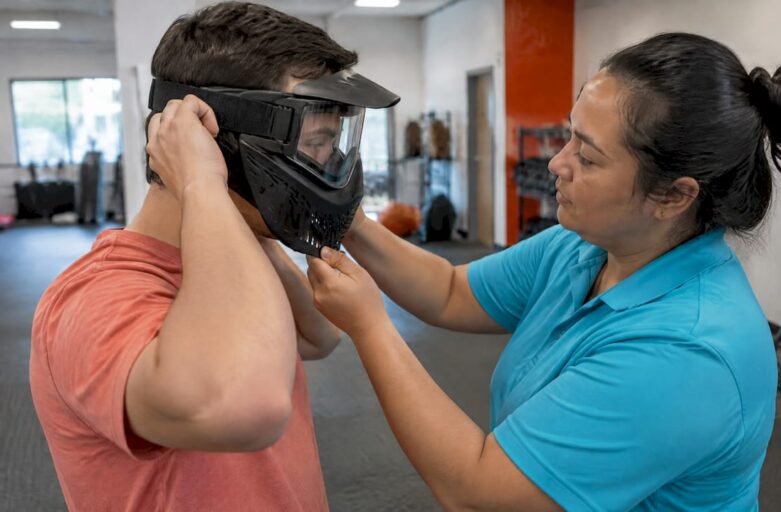
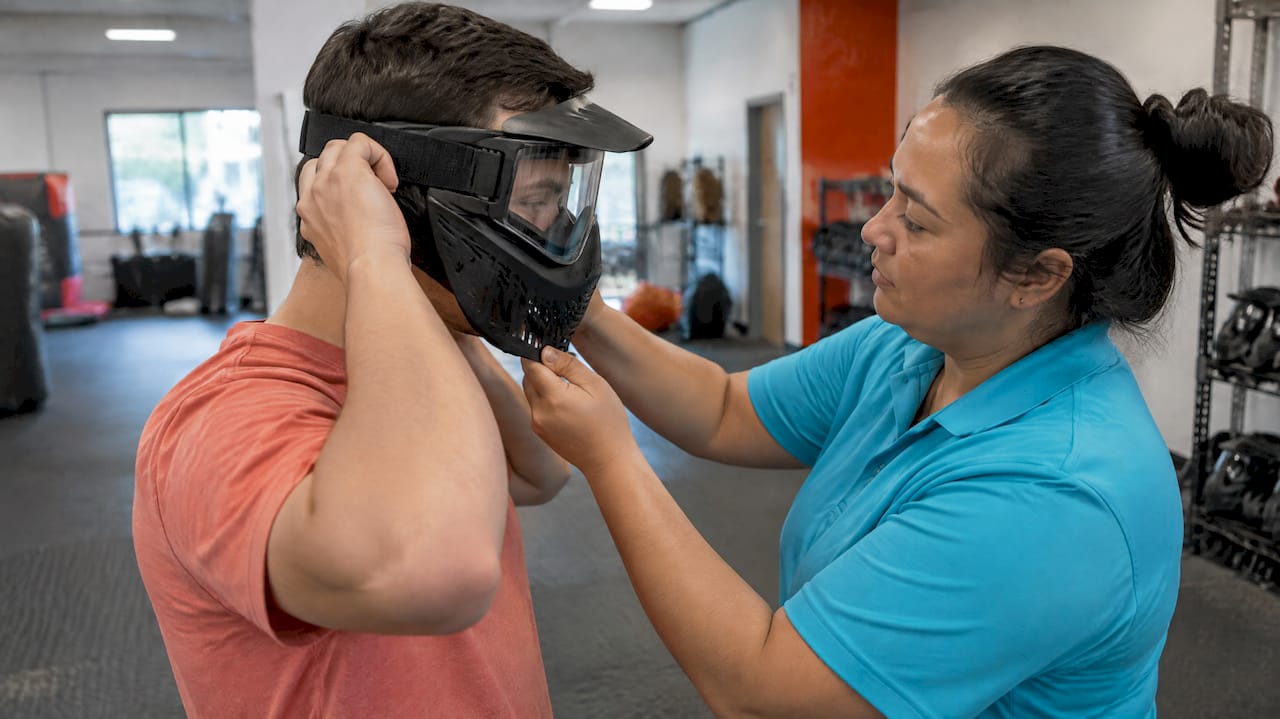
Paintball suits high-impact, outdoor groups chasing adrenaline, while archery tag suits families and mixed-ability groups who want lower-impact play. Whichever you pick, insist on eye protection that meets the ASTM F1776 standard, which Prevent Blindness recommends for every paintball player, and on strict mask enforcement.
TL;DR:
- For paintball, verify that masks meet ASTM F1776, confirm active enforcement, and ask how many referees supervise your group before booking.
- Paintball costs rise with consumed paint and air, so compare quotes that include those supplies, masks, field fees, and referees rather than headline rates.
- Archery tag uses reusable arrows and short rounds, but confirm mask coverage, arrow supply, match length, scoring, and the operator’s age policy before paying.
- For younger children or groups with varied mobility, request more referees, shorter rounds, stationary roles, and immediate removal from play if anyone removes a mask.
Table of Contents
- How do archery tag and paintball compare at a glance?
- How does a round of each game actually play out?
- What kit do you need, and what does each cost to run?
- How safe is each activity, and what protection matters most?
- Who can play, and how physically demanding is it?
- Which game fits team-building, tournaments and parties?
- What rules and scoring should you confirm before booking?
- How do you choose between archery tag and paintball?
- What does enforcement change about the experience?
- What can we offer if you want a lower-harm alternative?
- FAQ
- Sources
How do archery tag and paintball compare at a glance?
The two games look similar from a distance: two teams, cover, and a goal of eliminating opponents. Up close, they feel very different.
- Gameplay rhythm: paintball is fast and continuous, with constant fire across a field. Archery tag is more deliberate, built around rounds and careful shot selection.
- Impact and pain: paintball hits sting and can leave welts. Press reporting on archery tag describes foam-tipped arrows as producing less pain and fewer welts.
- Protective kit: paintball calls for a full-face mask and usually protective clothing. Archery tag needs a mask and little else.
- Cost shape: paintball has recurring costs because paint and air are consumed. Archery tag kit is largely reusable.
- Ideal use case: paintball for competitive, outdoor, adrenaline-seeking groups. Archery tag for family days, parties and mixed-skill teams.
- A third route: facilitated laser-based clay shooting sits next to both. It uses reusable kit and no projectiles, and we cover where it fits later in this guide.
How does a round of each game actually play out?
In archery tag, players use bows to fire foam-tipped arrows. Under a published archery tag ruleset, a live arrow that touches a player eliminates that one player, while head hits do not count as eliminations. Bows may only be used to shoot arrows, so you cannot swat an arrow out of the air with one. Matches may use a time limit and a best-of-five format, which keeps rounds brisk and gives losing teams a chance to reset.
Paintball works differently. Players operate a marker that fires paint-filled capsules powered by compressed air or CO2. A hit leaves a paint splat and the player is out. Common formats include straight elimination and capture-the-flag, played on fields dotted with barriers, bunkers and natural cover.
These mechanics shape tactics. Paintball rewards suppressing fire and coordinated advances, because shots reach far and hits are easy to confirm. Archery tag, with slower projectiles you can often see coming, rewards movement, dodging and catching rules where the setup allows them. Cover matters in both, but in archery tag a well-timed dash across an open gap is often possible, while in paintball it can be risky. Player mobility is also higher in archery tag, since there is no heavy gear to carry and no hopper or air tank on your back. Paintball tends to feel more like a simulation of a firefight, which some groups love and others find too intense.
What kit do you need, and what does each cost to run?
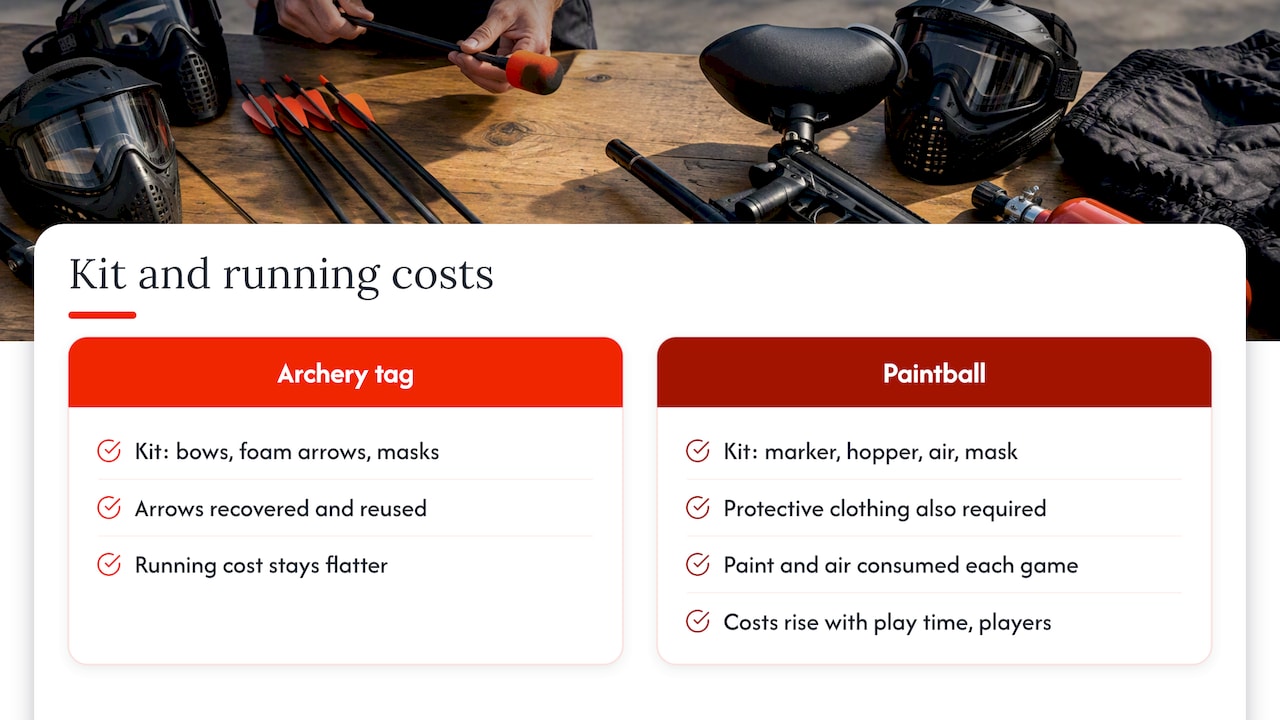
For archery tag, the core items are bows, foam-tipped arrows and a protective mask for each player. For paintball, you need a marker, a hopper to feed the paint, a CO2 or air supply, a full-face mask and protective clothing.
The cost difference comes down to what gets used up. Paintball consumes paintballs and air with every game, so the cost climbs with play time and the number of players. Archery tag kit is largely reusable: arrows get recovered and reused, so the running cost per session stays flatter.
Hire pricing typically takes one of three shapes. Operators may charge a per-player day rate that bundles kit hire. They may add venue or field fees, especially for outdoor sites. And they may charge for referees or facilitators, which matters because supervised play is a safety requirement rather than an optional extra. For paintball, ask whether paint is included or sold by the bag, since that single line can change a quote significantly. For archery tag, ask whether the price covers masks and how many arrows are supplied per player.
When you compare quotes, compare like with like. A cheap headline rate that excludes paint, referees or mask hire can end up costing more than a rate that includes them.
How safe is each activity, and what protection matters most?
Paintball has documented eye-injury risks, and eyes are a key concern. A study of paintball-related eye injuries analysed paintball-related eye injuries and found severe outcomes, with surgery needed in some cases. It stressed the need for impact-tested eye and face protection and pointed to the ASTM F1776 standard.
Paintball eye injuries are largely a protection problem: the study above found that some patients lost an eye, and it calls for impact-tested face protection that meets ASTM F1776.
Prevent Blindness recommends that paintball players wear eye protection meeting or exceeding ASTM F1776, that facilities supervise play according to ASTM F1777, and that nobody plays unsupervised in backyards or homes.
Archery tag has its own mitigations. Arrows are foam-tipped, masks are worn, and games run under referee supervision with clear rules, including the head-shot exemption. The ruleset also keeps bows from being used to block arrows in flight, which reduces awkward collisions. Practitioners follow a simple protocol if a mask fails mid-game: hold the bow and both hands in the air to alert the referee and stop play, rather than removing or adjusting the mask on the field.
Here is a checklist to use when vetting any operator:
- Confirm that masks are impact-tested and fit each player properly.
- Ask how mask rules are enforced during play, not just at the briefing.
- Check how many referees supervise a given number of players.
- Ask what happens when protective kit fails mid-game.
- Make sure there is a briefing before every session covering rules and signals.
Who can play, and how physically demanding is it?
Minimum ages come down to three things: whether the equipment fits, whether a child can follow safety instructions, and whether they can tolerate the impact. Paintball operators typically set higher age limits because markers fire at speed and hits are painful, and masks must fit snugly. Archery tag is generally treated as suitable for a younger range, because foam arrows are gentler and the game is more forgiving. Always check the specific operator’s policy, since age rules vary by venue.
Physical intensity differs too. Paintball involves running, crouching, diving into cover and wearing heavier kit, which can tire players quickly. Archery tag has bursts of sprinting but also pauses between rounds. For less mobile players, simple accommodations help in either game: designate a lower-movement role, allow shorter rounds, set up a stationary position near cover, or let them act as a scorer or flag-holder.
For family or youth bookings, extra supervision is wise. Ask for a lower player-to-referee ratio, a clear briefing in plain language, and a rule that any player who removes their mask is out of the game immediately. If you are planning for younger children, our parent’s guide to child-safe shooting activities covers what to look for.
Which game fits team-building, tournaments and parties?
For team-building, the game mode matters more than the sport. Capture-the-flag and objective-based rounds push teams to talk, assign roles and adapt on the fly, which is where leadership and strategic thinking show up. Straight elimination is simpler and more chaotic, which can be fun but gives quieter team members less to do.
Archery tag scales better for mixed-skill groups. Because rounds are short and the equipment is easy to pick up, a first-timer can contribute within minutes, and a colleague who has never held a bow is not at a huge disadvantage. Paintball can reward experienced players heavily, since knowing how to move between cover and manage ammunition gives a real edge. For competitive tournaments among keen players, that depth is a plus. For birthday parties and corporate days with varied fitness levels, it can be a drawback.
Planners who want low-consumable, lower-risk options have another choice. Facilitated, laser-based activities use reusable kit and no projectiles, and our guide to the benefits of interactive shooting events explains why groups enjoy them.
What rules and scoring should you confirm before booking?
A fair operator will explain its rules clearly before you pay. For archery tag, the published ruleset gives a useful benchmark.
- One live arrow, one elimination: a live arrow that contacts a player eliminates that one player, and equipment or arrows they are holding count too.
- Head shots: head hits do not count as eliminations.
- Bow use: bows are for shooting only, not for knocking or blocking arrows in the air.
- Match format: matches may use a time limit and a best-of-five format.
- Paintball scoring: common systems include last team standing, flag capture and point-based objectives, with penalties for removing masks, shooting at close range or blind-firing.
Before booking, ask how long each match lasts, how a winner is decided, and what happens when a player breaks a rule. Vague answers are a warning sign.
How do you choose between archery tag and paintball?
Work through these questions in order:
- Age range: if the youngest player is under the operator’s paintball minimum, archery tag is the safer starting point.
- Pain tolerance: if anyone in the group dislikes being hit hard, choose the lower-impact option.
- Venue: paintball generally needs outdoor fields, while archery tag works indoors and outdoors.
- Budget: compare total quotes, including paint, air, masks and referees, not just headline rates.
- Safety policy: look for ASTM-compliant eye protection, supervised play and a clear mask-failure protocol.
Pro Tip: Ask every operator two questions: “Does your eye protection meet ASTM F1776?” and “How many referees will supervise our group?” A confident, specific answer to both is the best sign of a well-run venue.
As a rule of thumb, favour paintball for fit, competitive adults who want intensity and are happy to wear full kit. Favour archery tag for families, mixed-ability groups and anyone who wants the team strategy without the sting.
What does enforcement change about the experience?
Joshua’s view: the sport matters less than the supervision around it. In my reading of how these events go, the same group can enjoy either activity if referees enforce masks firmly and stop play the moment something looks wrong. The groups that struggle are the ones where rules are announced once and then ignored.
I also think lower-impact formats are underrated for repeat business. Family groups tend to return to activities where nobody goes home sore or anxious, and that matters more than raw adrenaline when you are planning something every child and every grandparent can join. Paintball has its place, but only when the operator treats safety as the product rather than an afterthought.
— Joshua
What can we offer if you want a lower-harm alternative?
If you want a facilitated shooting activity without projectiles, our Laser Clay packages use reusable clay targets, a facilitator and set-ups for indoor or outdoor venues. Groups often choose us for:
- corporate team-building days
- birthday parties
- school camps and social gatherings
Our Corporate Laser Clay Package costs 69 SGD one-off per person, and our Birthday party package is from 49 SGD one-off per person. Get in touch and we will help you pick the right package for your group.

FAQ
What sport involves shooting arrows at each other?
Archery tag does. Players fire foam-tipped arrows at opponents, and a hit eliminates the player under the published ruleset, with head hits exempt. It is often described as a gentler cousin of paintball.
How is archery tag scored?
Matches are played in rounds, and the team that eliminates all opponents wins the round. The ruleset describes formats that can include a time limit and a best-of-five format. Confirm the exact format with your operator.
Is archery tag safer than paintball?
Archery tag is generally lower-impact, since foam-tipped arrows cause fewer welts and less pain, as press reporting notes. Both activities need masks and supervision to be safe. Paintball has the more documented eye-injury evidence.
Do I need special eye protection for paintball?
Yes. Prevent Blindness recommends eye protection that meets or exceeds ASTM F1776. Ask operators to confirm their masks are impact-tested.
Is archery an outdoor or indoor sport?
Archery tag is played both indoors and outdoors, depending on the venue. Indoor arenas are common because the arrows are foam-tipped and the game needs only a controlled space with barriers.
Sources
- Patterns of ocular injury from paintball trauma
- Paintball Position Statement
- Archery Tag Rules
- Hunger Games, but safer: Archery tag may just be the next paintball | Calgary Herald