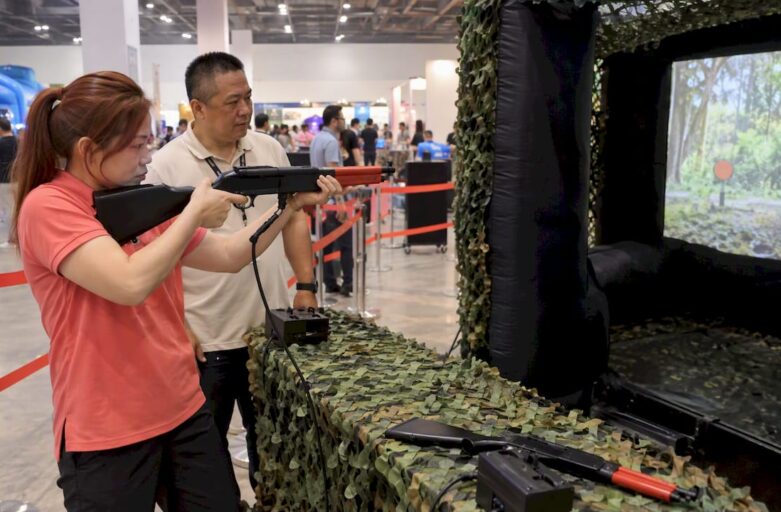
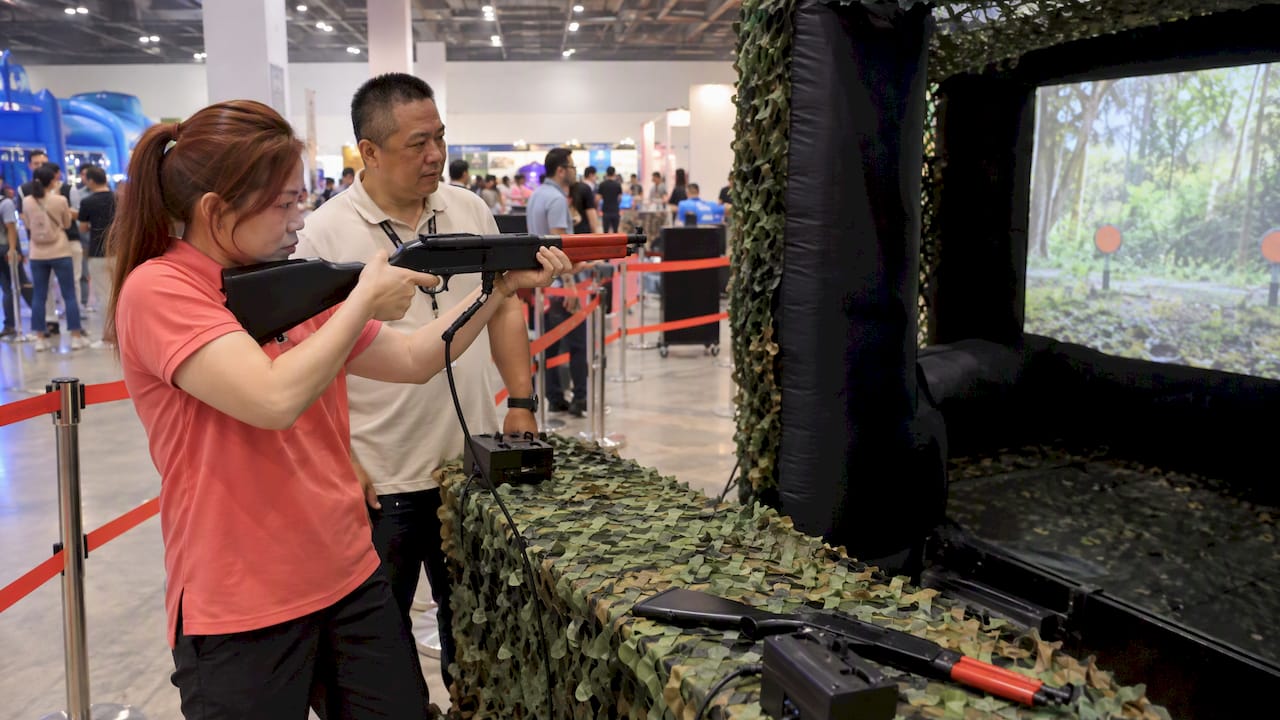
The best interactive game for a Singapore roadshow is one that strangers understand in ten seconds, that a small crew can run safely, and that fits the booth footprint your permit allows. Spin wheels and claw machines meet the first test. Skill-based games with live scores meet all three, and laser clay shooting is one of the few that adds a proper competitive pull without lead, noise or mess. This guide walks through the formats, the space and staffing each needs, the Singapore safety checks, and a realistic budget.
TL;DR
- Pick games with a short learning curve, a visible score and a round that takes a few minutes, so the queue keeps moving.
- Check the venue and SCDF fire-safety conditions first: aisle width, booth height and extinguishers shape what you can set up.
- Laser clay is a skill game with a real-time scoreboard, reusable targets and no lead. Our corporate package is S$69 per person, and system rental runs S$500 to S$800 per hour.
- Plan for one operator and one marshal per 10 players, and allow 60 to 90 minutes for setup.
- Ask every supplier what waste the setup leaves behind and what is reused.
Table of Contents
- What counts as an interactive roadshow game
- How skill-and-score games keep a crowd
- Where laser clay shooting fits
- Matching formats to your audience
- Space, staffing and setup time
- Singapore safety and permit checks
- Budgeting for roadshow games
- Keeping the footprint small
- Our perspective: games should work for the queue, not the brochure
- Bring laser clay to your roadshow
- A simple planning timeline
- Common mistakes to avoid
- FAQ
- Sources
What counts as an interactive roadshow game
A roadshow game is any activity that turns a passer-by into a participant. The point is footfall and dwell time: people stop, play, talk to your team and often leave contact details or a purchase. In Singapore these usually sit in mall atriums, community clubs, campus fairs, corporate family days and trade events.
The formats most organisers consider fall into a few groups:
- Luck games: prize wheels, lucky draws, claw machines. Cheap and quick, but there is no skill, so people rarely stay or share.
- Physical challenge games: basketball hoops, giant board games, obstacle lanes. They are good for families but need floor space and constant supervision.
- Digital and screen games: touchscreen quizzes, AR filters, photo booths. They capture data well but feel the same from booth to booth.
- Skill-and-score games: target shooting simulators, laser tag, timing challenges. They create a leaderboard, repeat play and onlookers cheering.
A mix works best. A fast luck game can feed the queue into a longer skill game, and a leaderboard gives everyone a reason to come back before the event ends.
How skill-and-score games keep a crowd
Three things hold attention at a roadshow: a clear goal, a result you can see, and a reason to try again. A leaderboard delivers all three. Someone scores 14 out of 20, sees the number on a screen, hears a friend beat it, and joins the queue again.
Skill-and-score games also make good content. Onlookers watch, laugh and film, which brings in more passers-by than any banner. The round length matters: two to four minutes keeps throughput high while still feeling like a proper game.
Where laser clay shooting fits
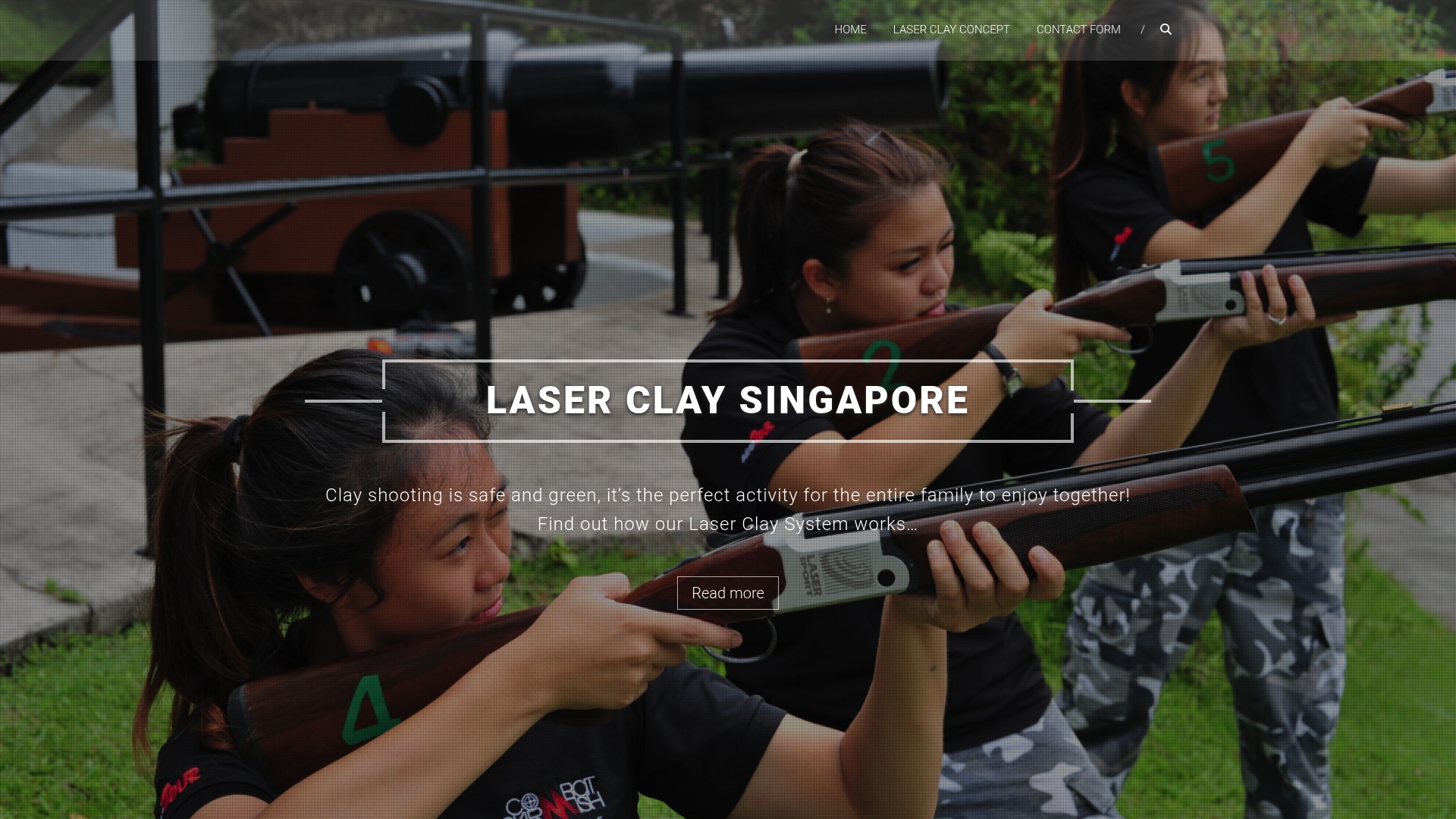
Laser clay is clay shooting without the live ammunition. Players use sound-simulated, deactivated shotguns, targets are reusable clays, and a real-time electronic scoreboard records hits. There is no lead and no gunshot noise pollution, which is why it suits public, mixed-age venues. Our laser clay rules and format guide explains how a round is played.
Why organisers choose it for roadshows:
- Easy to learn: a facilitator briefs each player in a minute or two, so first-timers hit targets quickly.
- Competitive or casual: game formats and scoring systems can be customised, from team leaderboards for a corporate brand day to relaxed rounds for families.
- Age range: suitable for ages 10 and above, which covers most family and school audiences. For younger children, pair it with a separate activity.
- Indoor or outdoor: the system can be set up in either, which matters when the weather turns.
- Safer and cleaner: no lead, no live rounds, and reusable targets mean little to throw away.
If you are weighing laser clay against other active formats, our comparison of laser tag versus paintball for age 10 and 14 covers the trade-offs for planners.
Matching formats to your audience
| Audience | What works | Why |
|---|---|---|
| Corporate teams and staff family days | Team leaderboards, relay rounds, brand-themed scoring | Colleagues compete, cheer and mix across departments |
| Families and shoppers | Short casual rounds, a single high-score board | Parents and children join the same queue |
| Schools and camps | Rotational stations with a facilitator at each | Large groups move through in turns |
| Sports enthusiasts | Timed or accuracy-based competitive rounds | Gives a real skill test to chase |
| Birthday parties | A party round with a host and prizes | Keeps ages 10 and above engaged |
For corporate planners, our guides to family day games and competition ideas for planners set out round structures you can adapt to a roadshow. If your event leans towards a game-show feel, see how game show team building is run.
Space, staffing and setup time
This is where roadshow plans usually go wrong. A game that looks small in a brochure needs room for the play lane, the queue, the scoreboard and the staff.
Space
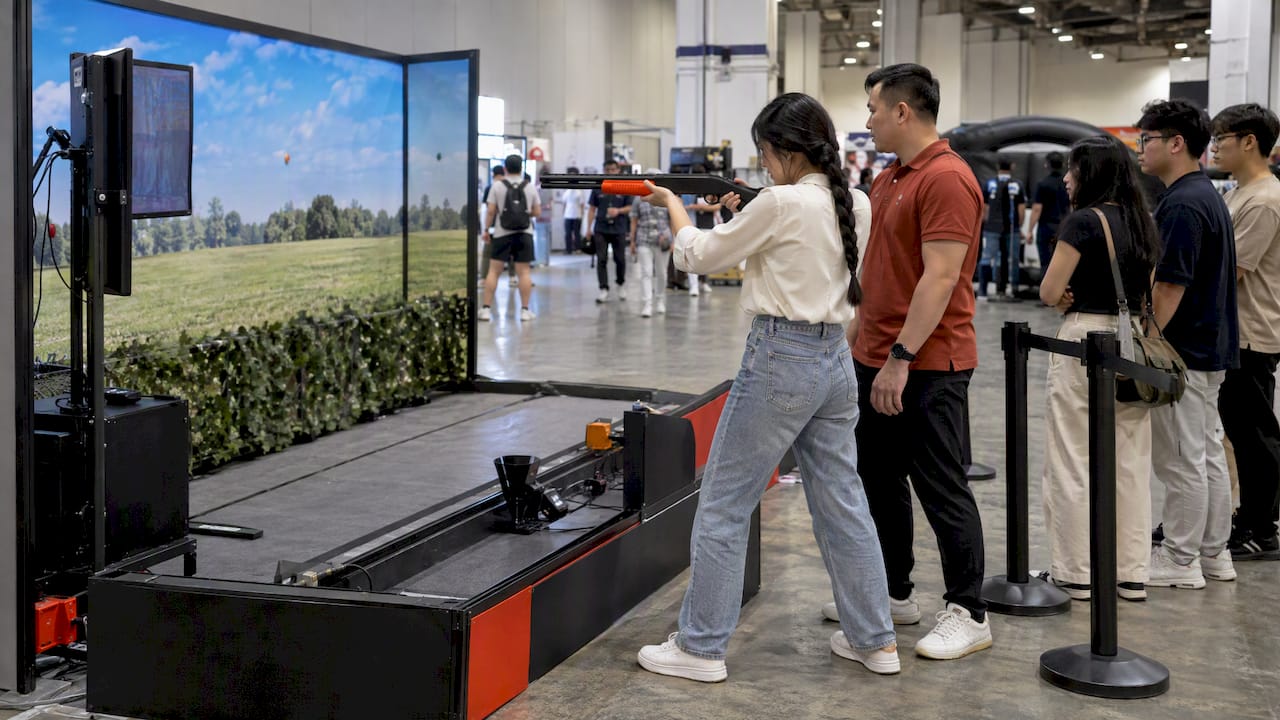
Work backwards from the venue’s rules. A roadshow in a mall atrium or a community space usually gives you a fixed pitch, so confirm dimensions before you choose a game. Leave room for a queue that does not block the walkway, and a clear area behind the players. Our setup requirements checklist lists the three checks planners should run before confirming a laser clay setup.
Power
Electronic scoreboards and equipment need reliable power. A battery that dies mid-session ends the queue and the crowd with it. Our power requirements guide shows how to size batteries and what to ask the venue.
Staffing
A self-service game is rarely safe or fast enough at a busy roadshow. For laser clay, we plan one operator and one marshal for every 10 players, so briefing, scoring and safety are always covered. Read more in our staffing guide. Add your own brand ambassadors beside the game to talk to the queue, because the game attracts people and your team converts them.
Setup time
Allow 60 to 90 minutes for setup before doors open, plus a buffer for load-in. Loading lifts, loading-bay slots and security checks often take longer than the setup itself. Our setup time run sheets show how to schedule it so you do not overrun.
Singapore safety and permit checks
Singapore is strict about temporary structures and crowds, and your game supplier does not carry that responsibility for you. Check these before you pay a deposit.
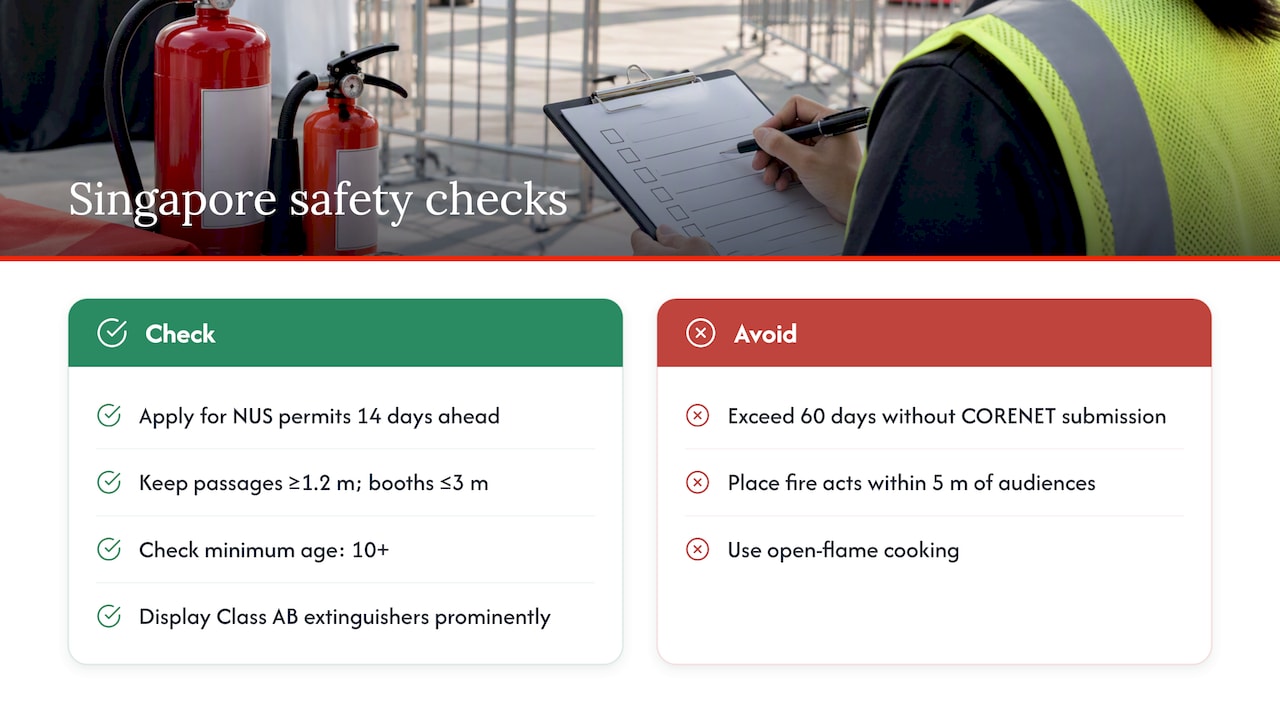
Venue rules first. Many venues have their own approval step. For example, NUS asks event organisers to apply for a Temporary Permit Application if the event involves makeshift structures or affects fire safety, at least 14 days in advance, according to its Office of Safety, Health and Environment. Other venues have similar processes, so ask early.
Outdoor events and temporary structures. SCDF’s Temporary Change of Use Permit covers temporary outdoor events, and the SCDF page on temporary change of use states that events running beyond 60 days are not eligible and must go through the standard fire safety plan submission on CORENET instead. A one-day roadshow is far from that limit, but a long-running activation could reach it.
Layout limits. The SCDF outdoor event fire safety conditions require clear passageways of at least 1.2 metres between booth rows and booth heights of no more than 3 metres. The same conditions require Class AB portable fire extinguishers to be prominently displayed within tentage and at performance areas. They also prohibit open-flame cooking such as blow torches, which matters if a food partner shares your pitch.
Fire-based acts. If your programme includes any fire show, SCDF’s fire-based shows and activities conditions set a minimum 5 metre distance from the audience for acts such as fire-juggling, with a physical cordon recommended. Keep those acts well away from your game lane.
Age and handling. Check the supplier’s minimum age and make sure it matches your audience. Ours is 10 and above. Ask whether the equipment looks realistic, how it is stored and who supervises it. A facilitator should hold the equipment between rounds and brief every player.
The rules above can change, and your venue may add its own. Confirm the current requirements with SCDF and the venue management before you commit to a layout.
Budgeting for roadshow games
Budget by throughput, not just by headline price. Ask how many people the game can serve per hour and divide the cost by that number.
Our published prices are:
| Option | Price | Best for |
|---|---|---|
| Corporate Laser Clay Package | S$69 per person | Team-building and staff events with facilitators and customisation |
| Birthday party package | From S$49 per person | Children’s and teen parties |
| System rental | S$500 to S$800 per hour | Roadshows, carnivals, school camps and open events |
For a public roadshow where visitors come and go, hourly rental is usually the better fit, because you pay for the time the game is running rather than for a fixed headcount. For a closed group such as a staff family day, the per-person package gives you a predictable total.
The things that move your final cost beyond the game itself:
- Venue fees and load-in time: longer load-in windows cost more.
- Staffing: your own ambassadors on top of the game crew.
- Prizes: a few well-chosen prizes for top scores go further than many small giveaways.
- Permits and insurance: check what the venue requires.
- Contingency: hold back a margin for weather, power or a longer queue.
If you want a quote tied to your pitch, contact us with the venue, dates and expected footfall.
Keeping the footprint small
A roadshow can generate a surprising amount of waste: printed backdrops, single-use giveaways, cardboard props. Singapore has national guidance for MICE events. The SACEOS Workshop Agreement WA 3 encourages a reduce, reuse and recycle approach aligned with the Singapore Green Plan 2030, as described in the SACEOS media release on waste management guidelines. Among its recommendations, event builders should prioritise reusable or recyclable materials for core structures.
In practice, ask each supplier three questions:
- What is reused from one event to the next?
- What do you leave behind, and who clears it?
- Can branded items be worn or used again after the event?
Laser clay scores well on the first two: the clay targets are reusable and there is no lead or spent ammunition. On the third, staff apparel is a good example. A team that wears the same branded layer across several events creates less waste than one printing new giveaways each time, and custom windbreaker jackets for events are one option organisers use to dress crews for outdoor days.
Our perspective: games should work for the queue, not the brochure
We set up laser clay at events of every kind, and the pattern is consistent. The activities that succeed are not the flashiest. They are the ones where a first-timer is playing within two minutes, the score appears the moment they finish, and the person behind them in the queue is already planning how to beat it.
Skill is what makes that work. People remember hitting a target. They do not remember spinning a wheel. That is why we built our offering around real-time scoring, customisable game formats and a facilitator who keeps every round safe and friendly. We also think the safer, cleaner version of a traditional sport is a genuine advantage at public events: no lead, no live ammunition and no noise complaints from the neighbouring booths.
My advice to planners is to decide your goal before you pick a game. If you want leads, choose something quick and add a sign-up at the end of the round. If you want dwell time and conversation, choose something with a leaderboard. If you want both, run two stations and send people from one to the other.
— Joshua
Bring laser clay to your roadshow
We supply the system, the facilitators, the venue setup and the customisation, indoors or outdoors. Whether you need a closed team session or a public hourly activation, our system rental runs S$500 to S$800 per hour, and our corporate package is S$69 per person.
Tell us your venue, audience and timing through our contact page and we will suggest a format that fits your space and budget.
A simple planning timeline
Work backwards from the event date so the permit and venue steps never become a last-minute scramble.
- Eight to six weeks out: confirm the venue, your pitch size and any internal approvals. Shortlist game suppliers and ask for a layout drawing.
- Six to four weeks out: lock the game format, scoring and prizes. Confirm staffing numbers and the setup window with the venue.
- Two to four weeks out: submit any venue permits. NUS-style approvals, for example, need at least 14 days’ notice. Confirm power points and extinguisher placement.
- The week before: brief your own ambassadors, confirm load-in access and send the supplier your run sheet.
- On the day: arrive early for the 60 to 90 minute setup, walk the aisles to check the 1.2 metre clearance, and run a test round before doors open.
- Afterwards: gather the scoreboard results and lead data, return or recycle materials and note what you would change next time.
This timeline is a guide. Large malls and government venues may need longer lead times, so ask what they require as soon as you have a date.
Common mistakes to avoid
- Choosing by looks, not throughput. A beautiful game that serves 20 people an hour will frustrate a crowd of 200.
- Forgetting the queue. The queue needs its own space, and it is also your best advertisement. Place it where passers-by can see it.
- Underestimating power. Test the supply and carry spare batteries.
- Leaving safety to the supplier. You hold the venue relationship. Make sure someone on your team knows the venue’s fire-safety conditions.
- No call to action. A game without a sign-up, offer or next step wastes the attention it earns.
FAQ
What is the best interactive game for a Singapore roadshow?
The best game is one that is easy to learn, shows a score straight away and runs in a few minutes per round. Skill-and-score games such as laser clay do this well, and they give visitors a reason to queue and return. Match the choice to your audience and your pitch size.
How much does laser clay cost for an event?
Our corporate package is S$69 per person, our birthday party package starts from S$49 per person, and system rental is S$500 to S$800 per hour. For an open roadshow, hourly rental is usually the better fit. Contact us with your date and venue for a quote.
How much space and time does the setup need?
Space depends on your venue and layout, so share your pitch dimensions with us early. We allow 60 to 90 minutes for setup, and we plan one operator and one marshal for every 10 players. Venue load-in rules can add to the time.
Is laser clay safe for children and families?
It uses sound-simulated, deactivated shotguns and reusable targets, with no lead or live ammunition, and a facilitator runs every session. It is suitable from age 10. For younger children, add a separate activity that suits their age.
Do I need a permit for a roadshow game?
It depends on the venue and the structures involved. Outdoor temporary events may fall under SCDF’s Temporary Change of Use Permit, and venues such as universities have their own approval steps. Check with the venue and SCDF before you finalise the layout.
Sources
- SCDF: Outdoor event fire safety conditions (TCOUP)
- SCDF: Fire-based shows and activities conditions
- SCDF: Temporary change of use
- NUS Office of Safety, Health and Environment: approval guides
- SACEOS: Waste management guidelines for MICE events