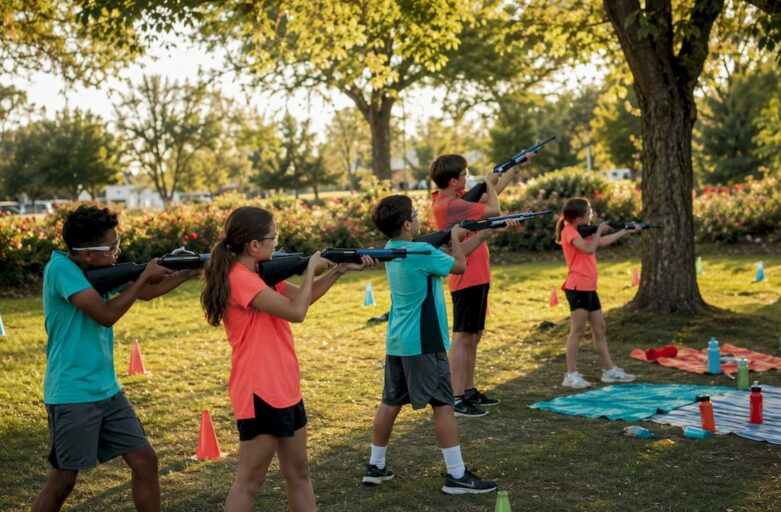
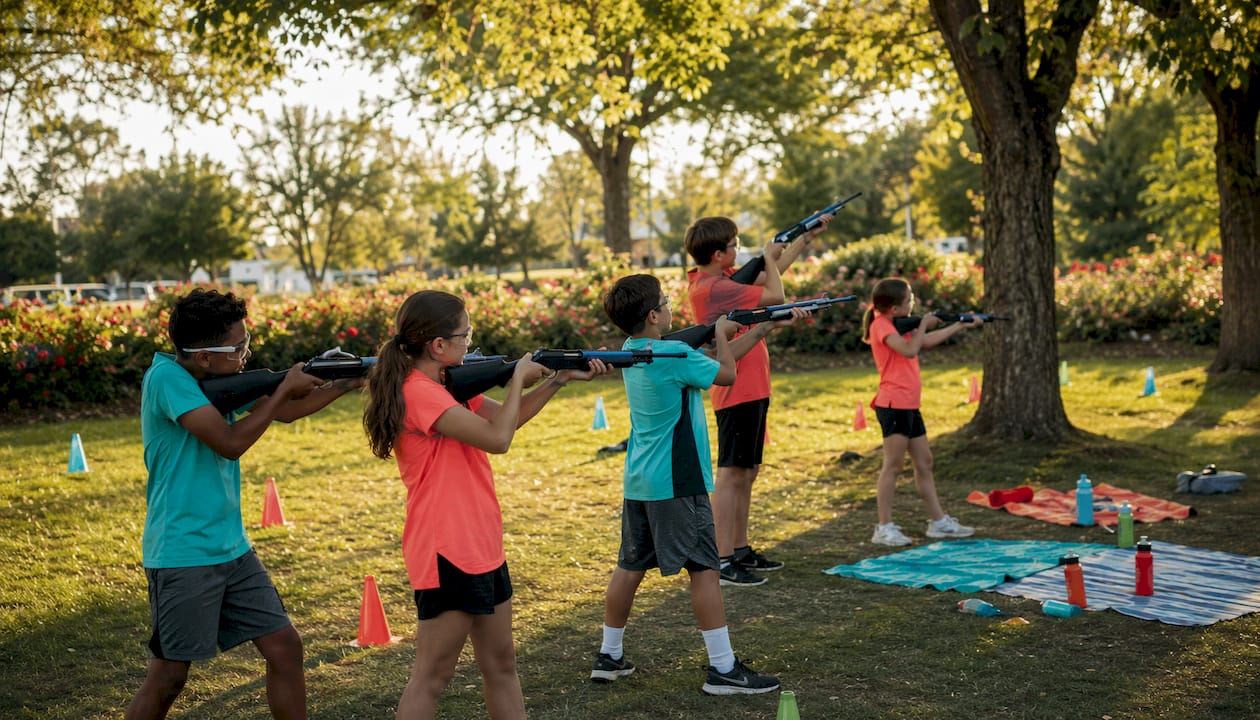
Laser clay appeals to younger athletes because it delivers the full sensory experience of clay shooting — the bang, the flying target, the scoreboard — without live ammunition, recoil, or hearing risk. It is high-energy, low-risk, and structured around the exact things that keep young people engaged: instant feedback, social play, and visible progress.
Top reasons younger athletes take to it quickly:
- No live rounds or recoil means zero firearms risk and no intimidating kickback
- An electronic scoreboard updates in real time, so every hit registers immediately
- Multiple shooters compete simultaneously, making it a group game rather than a solo wait
- Mixed-ability groups can all participate from the first session, with no prior experience needed
For parents, coaches, and school trip organisers, laser clay works well as a structured activity for camps, beginner sports clubs, and birthday parties — particularly for groups aged 10 and above.
Table of Contents
- Why laser clay keeps younger athletes coming back
- How laser clay works — a plain-English explanation
- Safety, supervision, and age guidance for UK sessions
- What a typical laser clay session looks like
- Making laser clay accessible for different ages and abilities
- Practical tips for parents and youth coaches
- Laser clay vs traditional clay shooting: what actually changes for young people
- Key takeaways
- Why laser clay deserves more credit in youth sport programming
- Book a Laserclay session for your group
- Useful sources for parents, teachers, and organisers
Why laser clay keeps younger athletes coming back
Youth-development research points to a clear pattern: up to 70% of young people drop out of traditional competitive sport by age 13. The main culprits are high-pressure environments, a lack of visible progress, and activities where beginners spend more time waiting than doing. Laser clay addresses each of those directly.
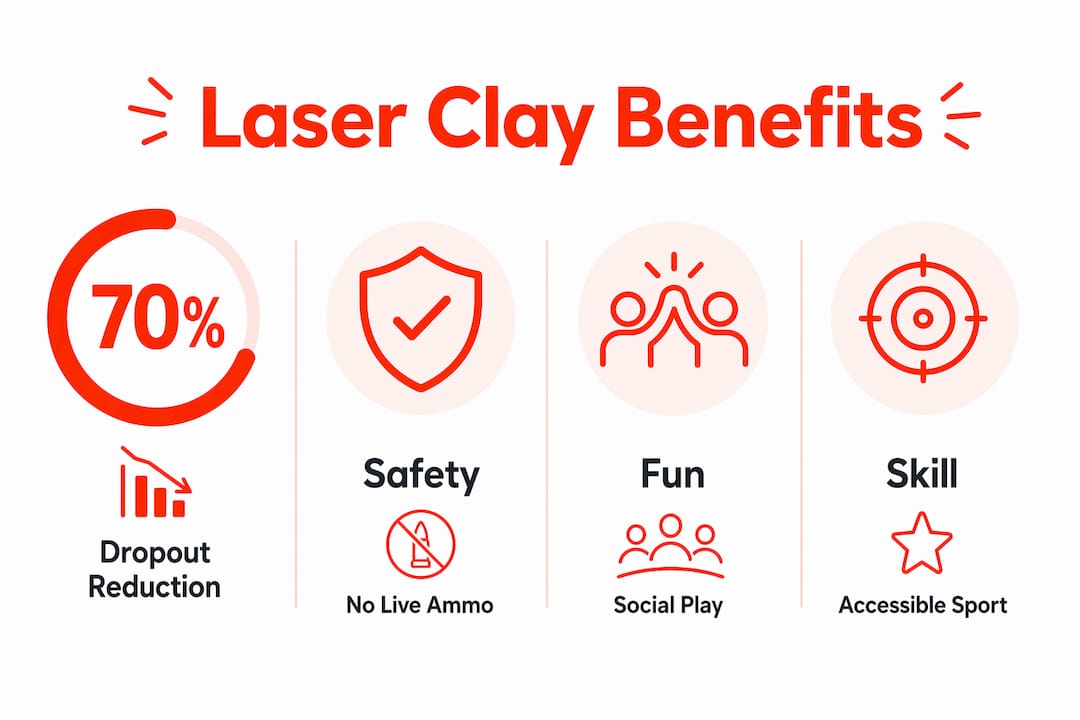
The instant hit/miss indicator on the gun, combined with a live scoreboard, means a child knows within a second whether their shot connected. That feedback loop is motivationally powerful. Short rounds keep concentration high, and because everyone shoots at once, there is no standing at the back waiting for your turn.
Developmental benefits that coaches and educators notice:
- Hand–eye coordination: tracking a moving clay and timing the trigger builds the same motor skills as racket sports
- Focus and composure: each shot requires a brief moment of stillness — a useful mental skill that transfers to other sports
- Friendly rivalry: shared scoreboards encourage peer interaction without the all-or-nothing pressure of a league table
- Perseverance: short rounds mean a poor first attempt is quickly followed by another chance, reducing the sting of failure
The Aspen Institute’s national survey found that having fun and playing with friends are by far the top reasons children play sport — not winning, not scholarships. Laser clay is built around exactly those motivators. It is also worth noting that 81% of current young players in that survey reported their mental state improves when playing sport, and 84% said their social connectedness improves. An activity that delivers both in a single 45–60 minute session is a strong proposition for any youth programme.
Pro Tip: If you are running a session for a school group, ask the provider whether scores can be exported after the event. Some systems allow this, and a printed leaderboard makes a surprisingly effective debrief tool.
How laser clay works — a plain-English explanation
The kit centres on a deactivated shotgun that fires an infrared beam rather than shot. When the trigger is pulled, the gun emits a simulated bang. If the beam strikes the reflective clay target, a sensor in the clay registers the hit, the gun indicator lights up, and the electronic scoreboard updates instantly.
Key components at a typical session:
- Deactivated 12-bore shotguns — authentic in feel and weight, but incapable of firing live ammunition
- Reflective clay targets — reusable, fluorescent-coloured discs launched by a standard trap
- Control module and scoreboard — displays individual and team scores in real time, with hit/miss sounds
- Simulated audio — the crack of a breaking clay plays on a confirmed hit, reinforcing the experience
Compared with traditional clay shooting, the differences that matter most to families are straightforward: no recoil, no lead shot, significantly lower noise, and no requirement for ear defenders or heavy protective kit. The environmental benefit is also real — reusable clays and no spent shot mean no range contamination.
Pro Tip: Before booking, ask the provider how their scoring display works and whether it supports team formats. A large visible scoreboard makes a significant difference to group energy during competitive rounds.
Safety, supervision, and age guidance for UK sessions
Laser clay is low-risk compared with live shooting, but it still requires qualified supervision and clear procedures. Parents and group leaders should check the following before confirming a booking.
Safety checklist:
- Instructor holds a relevant activity-leader qualification and has current DBS clearance
- A written risk assessment covers the site, equipment, and participant ratios
- First aid provision is on site or within a defined response time
- Equipment is inspected before each session (no damaged stocks, secure IR components)
- A safeguarding policy is in place and available on request
- Session ratios are appropriate for the age group (younger groups need closer supervision)
On age guidance, most UK providers set a recommended minimum of around 10 years, primarily because of the size and weight of the deactivated shotgun. Some providers offer adapted equipment for younger participants, so it is worth asking directly. A provider who cannot answer questions about DBS checks, instructor training, and insurance clearly is not one to book with.
Common parent concerns, addressed briefly:
- Hearing damage — no significant noise is produced; ear defenders are not required
- Violent imagery — the activity is sport-focused, not combat-themed; it mirrors clay pigeon shooting, not shooting games
- Handling a gun-shaped object — the deactivated shotgun is a piece of sports equipment, handled under direct instructor supervision at all times
For school programmes, the absence of live ammunition removes the primary safeguarding barrier that prevents traditional shooting from appearing on most school activity lists.
What a typical laser clay session looks like
Sessions are short, modular, and designed for mixed-ability groups. A standard session runs 45–60 minutes and suits groups of around 6–30 participants, though providers vary. The minimum recommended age for most providers is around 10.
Typical session flow:
- Arrival and briefing (5–10 minutes) — safety rules, equipment handling, stance basics
- Practice round — each participant fires a short series to calibrate and build confidence
- Scored competitive rounds — individual scores displayed live; usually 3–6 rounds
- Team challenge or relay — pairs or small teams compete, adding a social dimension
- Debrief and results — final scores announced, optional prizes or certificates
Game formats that younger athletes particularly enjoy include speed rounds (fastest accurate shooter wins), pairs relay (alternating shots with a partner), and flush formats where multiple clays launch simultaneously. Multiple simultaneous shooters keep the pace high and eliminate the dead time that kills engagement in traditional shooting.
Sessions run equally well indoors and outdoors. Indoor setups suit school halls and sports centres; outdoor setups work for camps, fetes, and sports days. The social and competitive format transfers well to both environments.
Making laser clay accessible for different ages and abilities
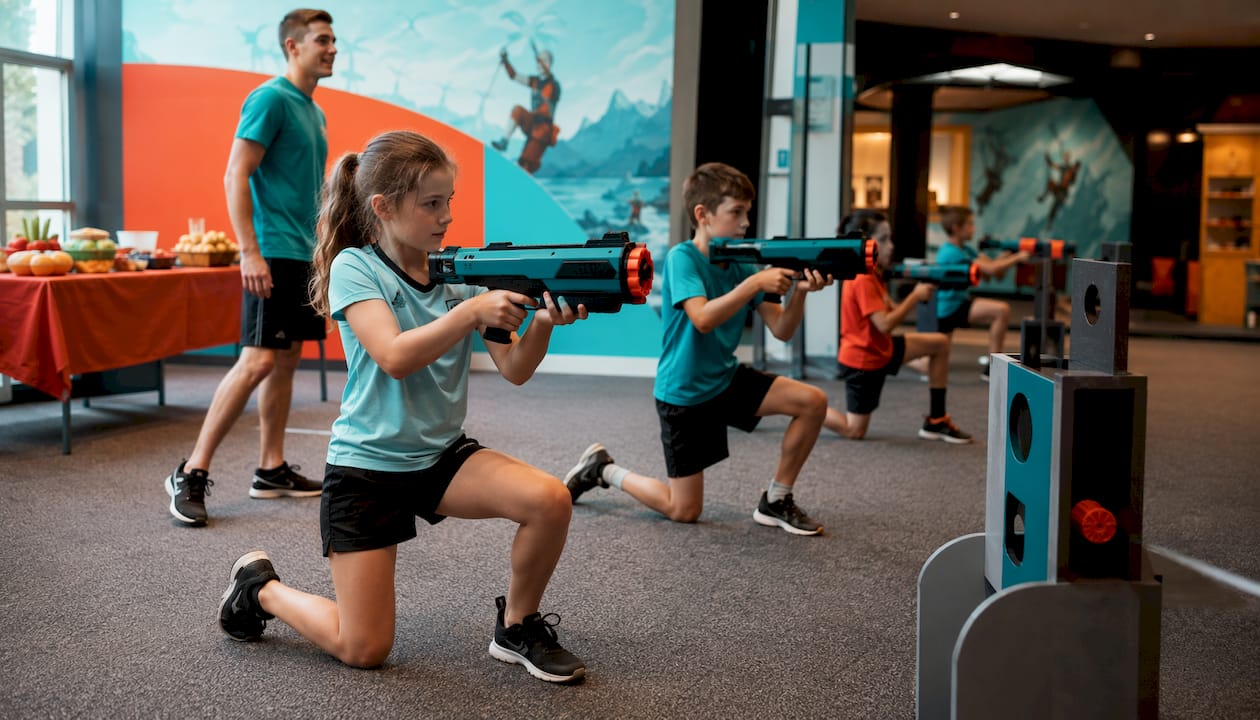
Simple adjustments make the activity genuinely inclusive. Providers experienced with youth groups and SEND pupils can adapt the session without significantly altering the experience for the rest of the group.
Practical adaptations:
- Seated or supported shooting positions for participants with mobility considerations
- Gun rests or bipod supports to reduce the weight burden on smaller or weaker participants
- Slower trap speeds to give participants more time to track the clay
- Larger or higher-contrast clay targets for participants with visual processing differences
- Modified trigger sensitivity where available on the provider’s equipment
For groups that include SEND pupils, contact the provider’s activity coordinator in advance. A short pre-visit or a tailored plan agreed with the school’s SENCO makes a meaningful difference to how the session runs. Most providers who work regularly with youth groups have done this before and will have a template to work from.
Pro Tip: Request a brief practice-only session before the scored rounds for any participant who needs extra familiarisation time. A good provider will build this in without making it feel separate from the group.
Practical tips for parents and youth coaches
What to bring and wear:
- Comfortable, weather-appropriate clothing (outdoor sessions can be cold or wet)
- Closed-toe shoes — most providers require these
- No specialist kit needed; ear defenders and eye protection are not required
Booking checklist:
- Confirm minimum and maximum group numbers before reserving a date
- Ask about group discounts for school or club bookings
- Check the cancellation and weather policy for outdoor sessions
- Confirm whether an indoor alternative is available at the same venue
Questions to ask the provider:
- Are all instructors DBS-checked and trained in safeguarding?
- What is the instructor-to-participant ratio for the age group?
- Is there a written risk assessment available?
- What happens if the weather prevents an outdoor session?
After a competitive session, a brief group debrief helps younger participants process results healthily. Acknowledge effort and improvement alongside scores, and frame the leaderboard as a starting point for next time rather than a final verdict. Good parent communication before and after the session sets the right expectations and reduces the chance of competitive disappointment overshadowing an otherwise positive experience.
Laser clay vs traditional clay shooting: what actually changes for young people
The comparison matters because many parents assume laser clay is simply a watered-down version of the real sport. It is not. The core skill — tracking a moving target and timing a shot — is identical. What changes is everything that traditionally made clay shooting inaccessible to younger or less experienced participants.
| Factor | Traditional clay shooting | Laser clay |
|---|---|---|
| Ammunition | Live shot cartridges | Infrared beam, no ammunition |
| Recoil | Significant; can bruise smaller frames | None |
| Noise level | Loud; ear defenders required | Low; no protective hearing kit needed |
| Minimum age (typical UK) | Often around 12 at licensed ranges | Around 10 with adapted equipment |
| Environmental impact | Lead shot, clay debris | Reusable clays, no shot |
| Instant scoring | Manual or delayed | Electronic, real-time |
| Group simultaneous play | Limited by range layout | Up to 5+ shooters at once |
The skill development that transfers from laser clay to the traditional sport is well-documented among shooting coaches. Young people who start on laser systems often progress to live shooting with noticeably better fundamentals than those who begin on live ranges without prior experience.
Key takeaways
Laser clay appeals to younger athletes because it combines genuine sport mechanics with a low-pressure, social format that keeps children engaged and coming back.
| Point | Details |
|---|---|
| Safety without compromise | No live ammunition, no recoil, and no hearing risk make it suitable from around age 10 upward. |
| Instant feedback drives motivation | A real-time scoreboard and hit indicator give children immediate results, reducing dropout risk. |
| Social format retains young players | Simultaneous group play and team formats mirror the social connection that youth-development research identifies as the primary reason children stay in sport. |
| Accessible to mixed abilities | Simple equipment adjustments and slower trap settings open the activity to a wide range of ages and physical abilities. |
| Laserclay for youth events | Laserclay’s sessions for school camps, birthday parties, and youth clubs include facilitators, scoring systems, and tailored game formats. |
Why laser clay deserves more credit in youth sport programming
The conversation around youth sport retention tends to focus on traditional team sports. Laser clay sits outside that conversation, which is a missed opportunity. The dropout problem in youth sport is not primarily about the sport itself — it is about formats that prioritise winning over participation, and activities where beginners feel exposed. Laser clay solves both problems structurally, not just in theory.
What strikes me most is how well the gamification element works on children who have never considered themselves sporty. The scoreboard removes the ambiguity that puts beginners off other sports. You either hit the clay or you did not, and the next shot is ten seconds away. That clarity is genuinely rare in youth programming, and it is why groups that arrive sceptical tend to leave asking when they can come back.
The one caveat worth stating plainly: the quality of the session depends heavily on the instructor. A qualified, engaged activity leader who understands how to manage competitive dynamics in a mixed-ability group makes the difference between a good session and a great one. Ask about instructor experience before you book, not after.
Book a Laserclay session for your group
Laserclay runs youth-friendly sessions for school camps, birthday parties, and youth clubs, with everything included: qualified facilitators, electronic scoreboards, deactivated shotguns, and game formats tailored to the group’s age and ability. Sessions are designed for mixed-ability groups from around age 10, and the team can adapt formats for SEND participants with advance notice.
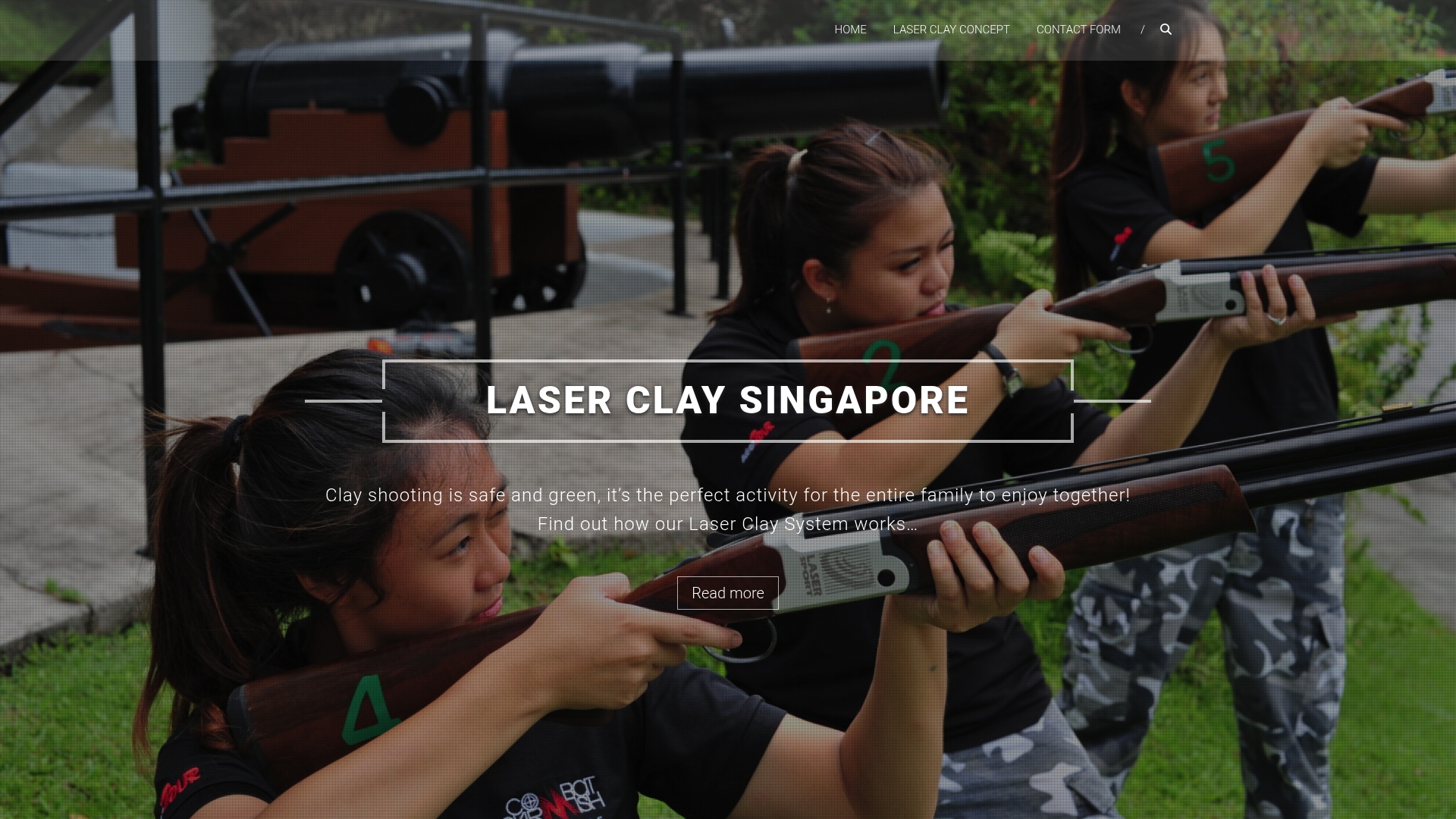
Every session comes with a full safety briefing, DBS-checked instructors, and a risk assessment. There is no specialist kit to bring and no prior experience needed. To find out what is included or to check availability for your group, visit the Laserclay booking page or browse the full range of event rental packages for schools and youth organisations.
Useful sources for parents, teachers, and organisers
-
Laser Clay Pigeon Shooting — Scout Activities — covers session formats, age suitability, and how the technology works; useful for Scout leaders and youth group organisers planning an activity day.
-
Leicestershire Scouts — Laser Clay Shooting — practical detail on the scoring system, equipment setup, and how the activity runs within a Scout programme; good reference for activity coordinators.
-
Essential Adventure — Youth Groups Laser Clay Shooting — operator page with age guidance, game formats, and group logistics; helpful for comparing what a commercial provider offers.
-
SafePlayPlus — Athlete Retention Playbook — youth-development analysis covering dropout rates and what keeps young people engaged in sport; the research underpinning the retention arguments in this article.
-
Aspen Institute Project Play — Youth and Sports Survey — large-scale survey data on why children play sport and what motivates non-players; authoritative reference for coaches and educators designing youth programmes.