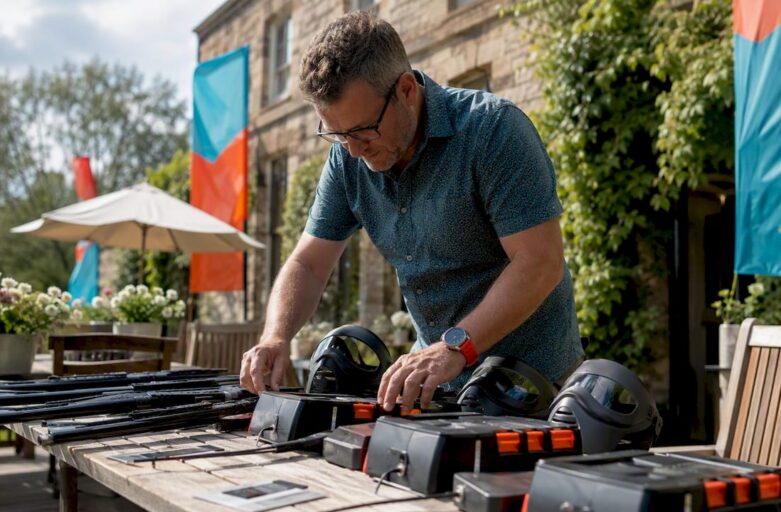
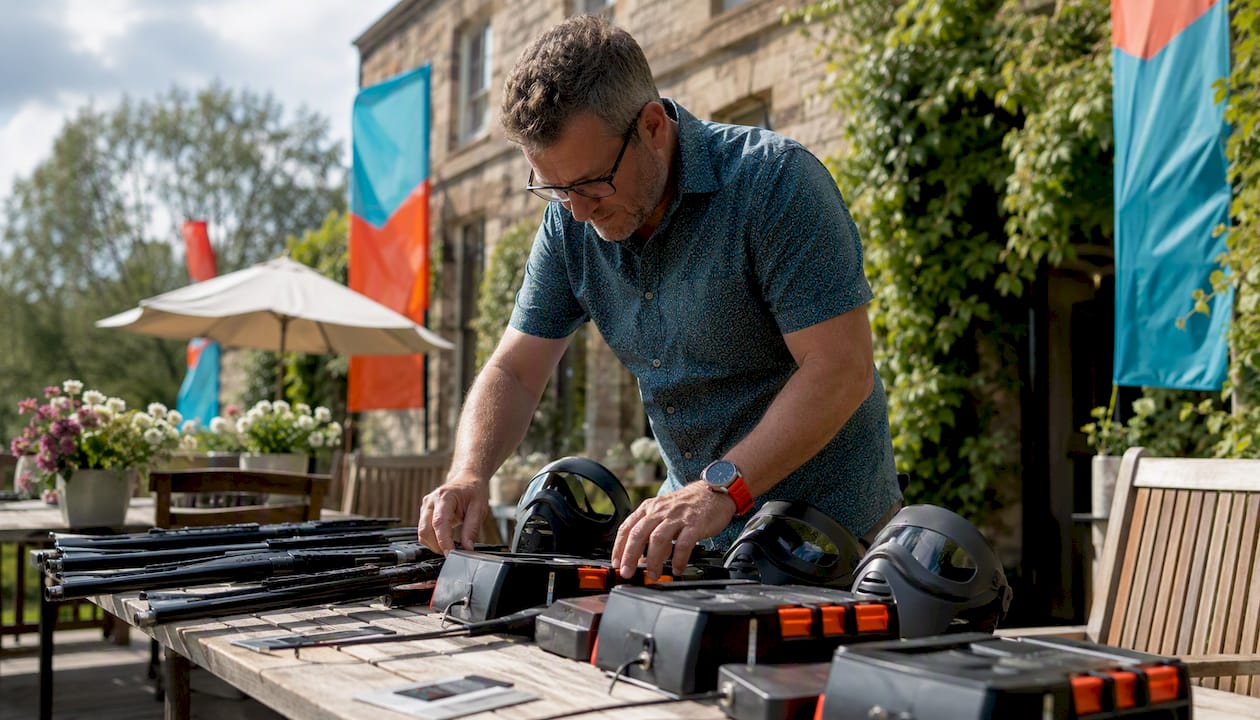
Laser clay shooting is hireable, event-ready, and fully legal for UK corporate, school, and private events right now. The equipment uses infrared laser technology fitted to deactivated shotguns, so it falls outside the definition of a firearm under the Firearms Act 1968, no firearms certificate required. Reputable suppliers carry public liability insurance and provide written risk assessments as standard. Here is what to check first:
- Legal standing: confirm with your supplier that their shotguns are deactivated and configured as laser training devices, not live-ammunition weapons.
- Insurance: request a copy of the public liability insurance certificate before signing anything.
- Venue suitability: check available space, power supply, and whether an indoor fallback exists for outdoor bookings.
Table of Contents
- What is laser clay shooting and how does it differ?
- Who does laser clay suit — ages, group sizes, and accessibility?
- What does a hire package include and what should you pay?
- Safety, legal, and insurance checks for UK events
- Venue and setup checklist for indoor and outdoor events
- Step-by-step planning timeline for your event
- 15 questions to ask a supplier before you book
- Sample formats for team-building, parties, and school events
- Key takeaways
- Why laser clay is the right call for UK events
- Laserclay for your UK event: get a quote today
What is laser clay shooting and how does it differ?
Laser clay shooting replaces live ammunition with infrared laser beams fired from deactivated shotguns. Electronic clay targets launch into the air and register a hit when the laser beam connects, triggering a visual or audio response. No lead shot, no cartridges, no noise complaints from neighbouring properties.
The contrast with traditional clay shooting is practical as much as philosophical; unlike small toy shooting sets such as the HISTOY large indoor/outdoor infrared laser tag set, laser clay uses event-grade equipment designed for corporate and school events. Traditional clay pigeon shooting generates spent lead shot across the ground, requires ear defenders, and carries strict licensing obligations for the firearms involved. Laser clay sidesteps all three. The targets are reusable, the shotguns are deactivated, and the sound levels are low enough for indoor venues. You can read a full breakdown of how the activity works if you want the technical detail before briefing a venue.
Key differences at a glance:
- No live ammunition: infrared laser replaces shot, so there is nothing to collect from the ground afterwards.
- No firearm licence needed: deactivated laser shotguns are legally distinct from lethal barrelled weapons.
- Lower noise: suitable for indoor halls, school sports halls, and noise-sensitive outdoor venues.
- Reusable targets: no clay debris, no lead contamination, and no per-session consumable cost for targets.
Who does laser clay suit — ages, group sizes, and accessibility?
The activity works across a wide age range. Children can participate with adult supervision, and Scouts guidance classifies laser clay pigeon shooting separately from firearm activities, requiring parental permission for under-18s rather than firearms-specific controls. Teenagers and adults need no prior shooting experience; the learning curve is short enough that a mixed-ability group finds its feet within the first rotation.
Group sizes vary by package. A single lane can usually handle multiple participants in rotation. Multiple lanes running simultaneously can accommodate larger corporate groups or school year groups. For festival or carnival formats, a continuous-rotation model keeps throughput high without long queues.
| Format | Typical group size | Supervision notes |
|---|---|---|
| Birthday party | a moderate number | 1 facilitator; parental supervision for under-12s |
| Corporate team-building | medium-sized groups | 1–2 facilitators; no external supervision needed |
| School session | larger groups | DBS-checked facilitators; suitable staff-to-pupil ratio |
| Carnival / festival | very large groups | Multiple lanes; facilitator per lane |
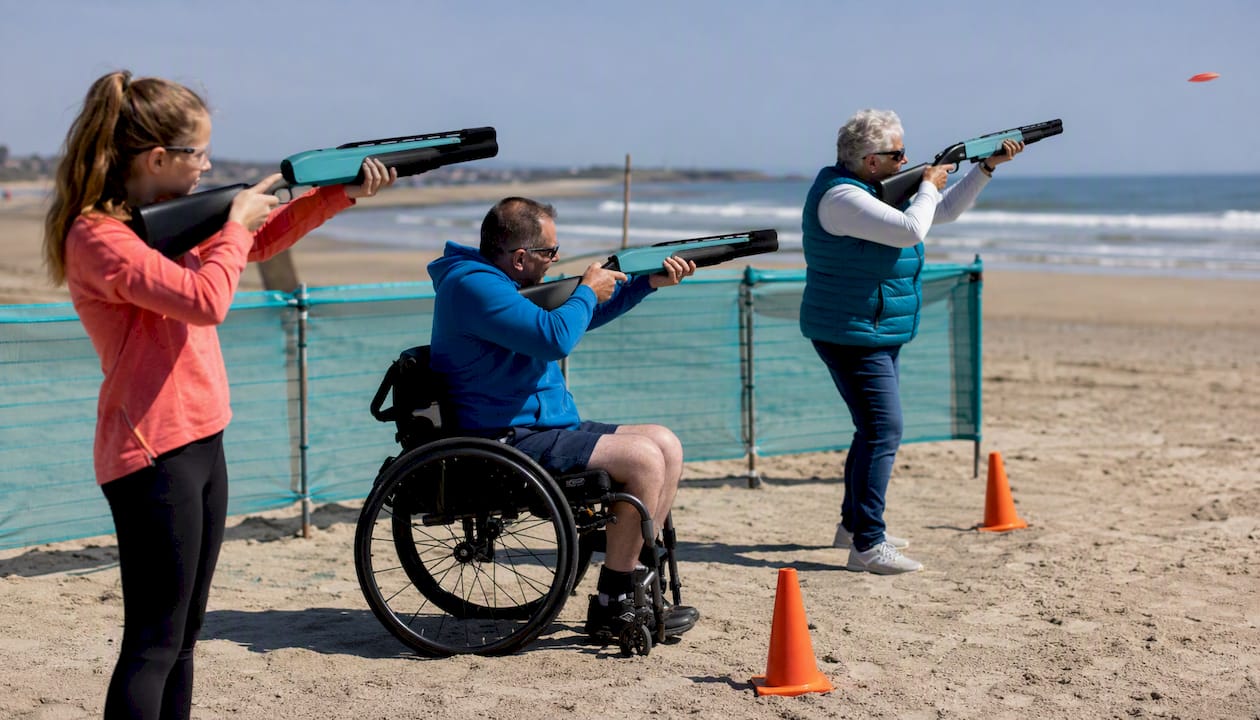
Accessibility is a genuine strength here. Participants who use wheelchairs can shoot from a seated position without modification to the equipment. For groups with sensory needs, the lower noise level removes one of the most common barriers in outdoor sports activities. Schools booking for pupils with special educational needs should discuss staff ratios and any specific adjustments directly with the supplier at the enquiry stage.
What does a hire package include and what should you pay?
A well-structured package covers equipment (deactivated laser shotguns and electronic clay launchers), a trained facilitator, real-time electronic scoring, set-up and strike, and travel to your venue. VAT is typically added on top of quoted prices, so confirm whether figures are inclusive or exclusive when comparing suppliers.
Pricing structures vary. Some suppliers quote per person, others per hour, and many combine both. To compare fairly, ask every supplier for a per-person and per-hour breakdown so you can normalise the figures. Watch for setup and strike fees quoted separately from the session rate; a headline price that looks low can climb once travel, facilitator overtime, and equipment delivery are added.
Optional extras worth asking about: custom scoring overlays, branded target graphics, trophies or certificates for winners, and photography packages. These add cost but can lift the perceived value of a corporate or birthday event considerably.
Pro Tip: Ask suppliers to itemise facilitator time, equipment hire, and travel as separate line items. That single request makes comparing quotes straightforward and prevents hidden fees appearing on the final invoice.
Safety, legal, and insurance checks for UK events
The legal position is clear for properly configured equipment. Deactivated laser shotguns do not meet the definition of a firearm under the Firearms Act 1968, so no firearms certificate is required for the equipment itself. If you have any doubt about a specific supplier’s configuration, the Guide on Firearms Licensing Law explains the licensing authority’s role and where to seek local police clarification.
Optical safety is a separate obligation. The Control of Artificial Optical Radiation at Work Regulations 2010 requires employers and contractors to assess and control risks from artificial optical radiation, including lasers, for anyone at work and others who might be affected. Even low-power devices fall within scope. Request written confirmation from your supplier that their equipment has been assessed and that devices conform to IEC-aligned laser classifications.
Documents to request from any supplier before signing a contract:
- Public liability insurance certificate (confirm the amount during your checks).
- Written risk assessment and method statement (RAMS) specific to your venue.
- Optical radiation assessment or written confirmation of device classification.
- Staff training records and DBS certificates for any facilitator working with under-18s.
- Equipment maintenance records and CE or UKCA compliance documentation where applicable.
Pro Tip: The HSE’s laser safety guidance is written for entertainment and event contexts. Send the link to your venue’s health and safety lead so they can confirm the supplier’s paperwork meets their requirements before the event date.
Venue and setup checklist for indoor and outdoor events
Space is the first constraint. A single lane needs adequate clear depth and width, with a solid backstop or safety zone behind the target flight path. Indoor sports halls, warehouse spaces, and large marquees all work well. Outdoor fields need a clear background free of public footpaths and neighbouring properties within the safety zone.
Power requirements are modest: a standard 13-amp socket is usually sufficient for electronic scoring and target launchers, though suppliers with larger rigs may need a 16-amp supply or a generator. Confirm this at the enquiry stage to avoid surprises on the day.
Practical venue checklist:
- Access: vehicle access for load-in, parking for the supplier’s crew, and a clear route from the vehicle to the setup area.
- Surface: level ground for outdoor setups; non-slip flooring for indoor venues.
- Spectator area: a clearly marked zone at least 5 metres from the shooting lane, separated by barriers or rope.
- Signage: laser-in-use signs at all entry points to the active area.
- First aid: confirm the nearest first aid point with the venue and include it in the supplier brief.
- Evacuation route: share the venue’s evacuation plan with the supplier before setup begins.
Pro Tip: Send the supplier a site plan and photos of the venue before the booking is confirmed. It saves a wasted site visit and means the RAMS document can be tailored to your specific space rather than being a generic template.
Step-by-step planning timeline for your event
- Several weeks out: confirm the date, venue, and approximate group size; send initial enquiry to suppliers and request quotes with itemised breakdowns.
- Before the event: select a supplier, sign contract, pay deposit; share venue details and site plan; request draft RAMS for review.
- Closer to event: confirm final headcount, any accessibility requirements, and optional extras; chase DBS certificates and insurance certificate if not yet received.
- Final week: share final run sheet with supplier; confirm arrival time, load-in access, and on-site contact details.
- Day of event: supplier arrives sufficiently early for setup and walkthrough; RAMS signed off on-site; safety briefing delivered before first shot.
- Session: rotations run to agreed schedule; facilitator manages scoring and participant flow.
- Strike: allow 30–45 minutes after the last session for equipment breakdown and load-out.
For school and corporate bookings during term time, eight weeks is a realistic minimum lead time. Summer and December dates fill quickly; twelve weeks is safer for those windows.
Pro Tip: Build a 30-minute contingency buffer between the end of the last session and your venue’s hard-out time. Equipment strike always takes longer when participants linger.
15 questions to ask a supplier before you book
- What is your public liability insurance cover amount, and can you provide the certificate?
- Are your shotguns fully deactivated and configured as laser training devices?
- Do you carry a written RAMS document specific to each venue?
- Have your laser devices been assessed under the Control of Artificial Optical Radiation at Work Regulations 2010?
- Are all facilitators DBS-checked, and can you provide copies before the event?
- What is your facilitator-to-participant ratio for children’s events?
- Do you hold equipment maintenance records, and is your equipment CE or UKCA compliant?
- Can you provide references or case studies from similar events?
- What is your deposit amount and payment schedule?
- What is your cancellation and refund policy, and at what notice does the deposit become non-refundable?
- What happens if a facilitator is unavailable on the day?
- How is scoring verified, and can participants see real-time results?
- Do you provide a safety briefing script, or does the facilitator deliver this independently?
- For school bookings: do you supply parental consent templates and a safeguarding policy?
- What is your bad-weather contingency, and do you carry indoor equipment if the outdoor setup is not viable?
Pro Tip: Ask for two references from events of a similar size and format to yours, not just the supplier’s best-case testimonials. A corporate event for 80 people is a different operational challenge from a birthday party for 20.
Sample formats for team-building, parties, and school events
Corporate team-building
A 90-minute session works well for groups of 20–60. Open with a five-minute safety briefing, then run two warm-up rounds where participants shoot individually to get a feel for the equipment. Move into team rounds with four to six people per team, using the electronic scoreboard to display live standings. A final shoot-off between the top two teams creates a natural climax. Close with a brief awards moment: certificates or a small trophy for the winning team. The competitive office event format works particularly well when the debrief is tied to a team-building objective rather than left as pure entertainment.
Birthday party
Keep it moving. A 60-minute session with groups of 10–25 suits most birthday formats. After a two-minute safety brief, run short rotations of three to five shots per person so everyone gets multiple turns without long waits. Involve spectators by giving them a role in the scoring or a cheering assignment. End with a prize round for the birthday person and the top scorer. Supervision ratios matter here: one facilitator can manage up to 20 participants, but for under-12s, at least one additional adult should be present throughout.
School sports day or camp session
Structure the session around clear learning objectives: hand-eye coordination, focus, and taking turns. Divide pupils into groups of eight to ten and rotate them through the lane every ten minutes. For pupils with SEN, pair them with a peer or teaching assistant for the first rotation. A 1:15 staff-to-pupil ratio is a reasonable starting point; adjust based on the school’s own risk assessment. Schools that adopt non-contact shooting sports consistently report that the low noise level and absence of physical contact make the activity accessible to pupils who opt out of more boisterous alternatives.
| Format | Duration | Group size | Facilitators needed |
|---|---|---|---|
| Corporate team-building | 90 minutes | 20–60 | 1–2 |
| Birthday party | 60 minutes | 10–25 | 1 (plus 1 adult for under-12s) |
| School session | 60 minutes | 30–60 | 1 per lane; 1:15 staff ratio |
Pro Tip: For corporate events, share the team-building benefits with your internal stakeholders before the booking. It makes the business case for the activity far easier to approve.
Key takeaways
Laser clay shooting is the most practical eco-friendly, licence-free shooting activity available for UK corporate, school, and private events, provided suppliers carry proper insurance and written RAMS.
| Point | Details |
|---|---|
| Legal status is favourable | Deactivated laser shotguns fall outside the Firearms Act 1968 definition; no firearms certificate needed. |
| Safety paperwork is non-negotiable | Always request RAMS, public liability insurance certificate, and optical radiation assessment before signing. |
| Book early for term-time events | Eight weeks minimum lead time; twelve weeks for summer and December dates. |
| Accessibility is a genuine strength | Wheelchair users and SEN pupils can participate without equipment modification; low noise removes a common barrier. |
| Laserclay is event-ready | Laserclay provides facilitators, scoring, setup, and safety documentation for corporate, birthday, and school events across the UK. |
Why laser clay is the right call for UK events
The conventional wisdom in event planning is that shooting activities are complicated: licensing headaches, safety concerns, and venues that say no before you finish the sentence. Laser clay dismantles that assumption entirely. The legal position is genuinely straightforward for properly configured equipment. The safety paperwork, while real and worth taking seriously, is no more burdensome than what any responsible outdoor activity supplier already carries. And the environmental argument is not a marketing add-on; it is a practical advantage that removes ground contamination, noise complaints, and per-session consumable costs in one move.
What organisers underestimate is how well the activity scales. A birthday party for fifteen and a corporate away-day for eighty use the same core equipment and the same facilitation model. The scoring system creates genuine competition without requiring any prior skill, which means a mixed group of complete beginners produces a competitive leaderboard within twenty minutes. That is a harder outcome to achieve with most team-building activities.
The one thing worth scrutinising is the supplier’s paperwork, not the activity itself. A supplier who cannot produce a current public liability certificate, a venue-specific RAMS, and DBS certificates for staff working with children is not event-ready, regardless of how good their equipment looks. The checklist in this guide exists precisely because that gap between a polished website and a complete compliance file is where most event problems originate.
Laserclay for your UK event: get a quote today
Laserclay brings the full package to UK corporate, school, and private events: deactivated laser shotguns, electronic scoring, real-time scoreboards, trained facilitators, and all the safety documentation your venue will ask for. No lead shot, no noise complaints, no licensing complications. The setup works indoors and outdoors, scales from a birthday party of fifteen to a corporate day of eighty, and every booking includes a written RAMS and public liability insurance as standard. DBS-checked facilitators are provided for all children’s events.
Trust signals are built in, not bolted on: insurance certificates, maintenance records, and UKCA-compliant equipment are available on request. To check availability for your date and get a transparent, itemised quote, visit the Laserclay corporate team-building page or the main Laserclay booking page. Most enquiries receive a response within one business day, and dates are confirmed on receipt of deposit.
Recommended
- Electronic shooting game for events: the UK planner’s guide | Laser Clay Singapore
- How laser clay scales for large events: planner’s guide | Laser Clay Singapore
- Sport accessibility without ammunition: the UK organiser’s guide | Laser Clay Singapore
- How laser clay fits event formats: a practical guide | Laser Clay Singapore