Most laser clay sessions are booked as a one-hour timeslot, but the actual time you need depends entirely on group size and how many guests shoot at once. Small groups of up to six can wrap up in around 30 minutes, mid-size groups of 7–10 need roughly 45–60 minutes, and anything above 20 people usually calls for 60–120 minutes or back-to-back slots. The main variable isn’t the activity itself. It’s throughput: how many shooting lanes you have running and which game modes you pick.
TL;DR:
- Sessions for groups over 20 people typically require 90 to 120 minutes or multiple back-to-back slots due to lane throughput limits.
- The standard one-hour booking includes time for safety briefings, warm-up, main rounds, and debrief, with actual shooting often lasting around 20 to 50 minutes.
- For groups larger than six, plan on 45 to 60 minutes for a single rotation, while multiple rotations or simultaneous stations help reduce waiting time.
- Adding buffers of 10 to 15 minutes before and after the session is essential for check-in, briefing, and pack-down, especially when scheduling other activities.
- Always confirm if a facilitator is included, how many clay targets are assigned, and the venue’s setup time before booking a session.
Table of Contents
- Typical session lengths and common booking slots
- How group size and shooting rotations determine actual time needed
- Other factors that extend or shorten a session
- Fitting a laser clay slot into your event timeline
- What actually happens during your hour
- Why the standardised hour works
- What I’ve learned watching these sessions run
- Book the right duration for your event
- Sources
- FAQ
Typical session lengths and common booking slots
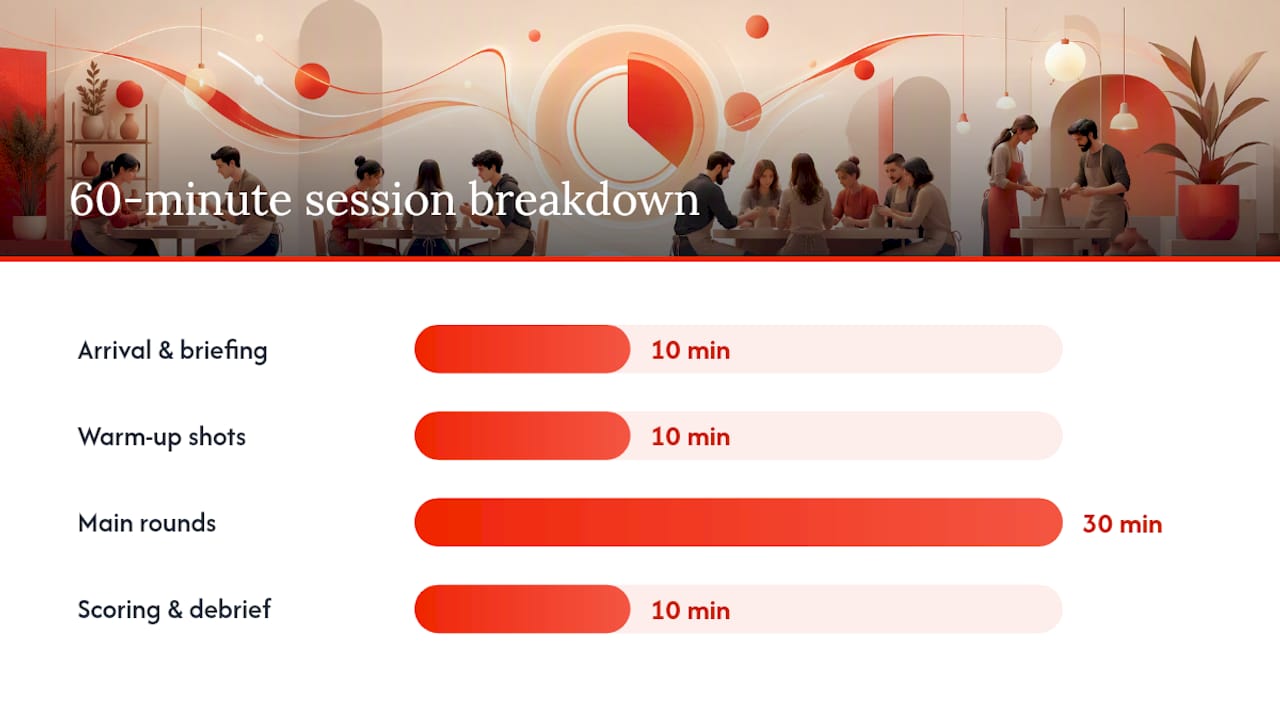
Booking pages across the activity and events industry default to the same figure: a one-hour session, packaged as a single bookable unit. That hour rarely means 60 minutes of continuous shooting. It covers arrival, a safety briefing, warm-up shots, the main rounds, and a short debrief or scoreboard reveal at the end.
Providers settle on hour-long slots for a practical reason: it’s the smallest unit that comfortably fits instruction time, actual play, and pack-down without rushing anyone. Shorter slots feel cramped once you account for a briefing; longer slots tend to waste time for smaller groups who finish early.
A typical one-hour corporate session breaks down something like this:
- 0 to 10 minutes — arrival, equipment fitting, safety briefing
- 10 to 20 minutes — warm-up shots and rule explanation
- 20 to 50 minutes — main rounds or tournament play
- 50 to 60 minutes — scoring, debrief, prize moment
Shorter slots (around 30 minutes) tend to suit small private groups or a quick activity slot at a party. Longer bookings, often sold as double slots of 90 to 120 minutes, suit larger team-building groups that need multiple rotations through the shooting stations. If you’re weighing up formats for a corporate day out, it’s worth reading how laser clay team-building sessions are typically structured before you lock in a slot length.
How group size and shooting rotations determine actual time needed
The maths behind session length comes down to one question: how many people can shoot simultaneously, and how long does each turn take? Most setups run a handful of shooting lanes at once, so everyone else is waiting, watching, or scoring between turns. Add a per-person shot allowance of a minute or two, multiply by the group, divide by the number of active lanes, and you get a rough total.
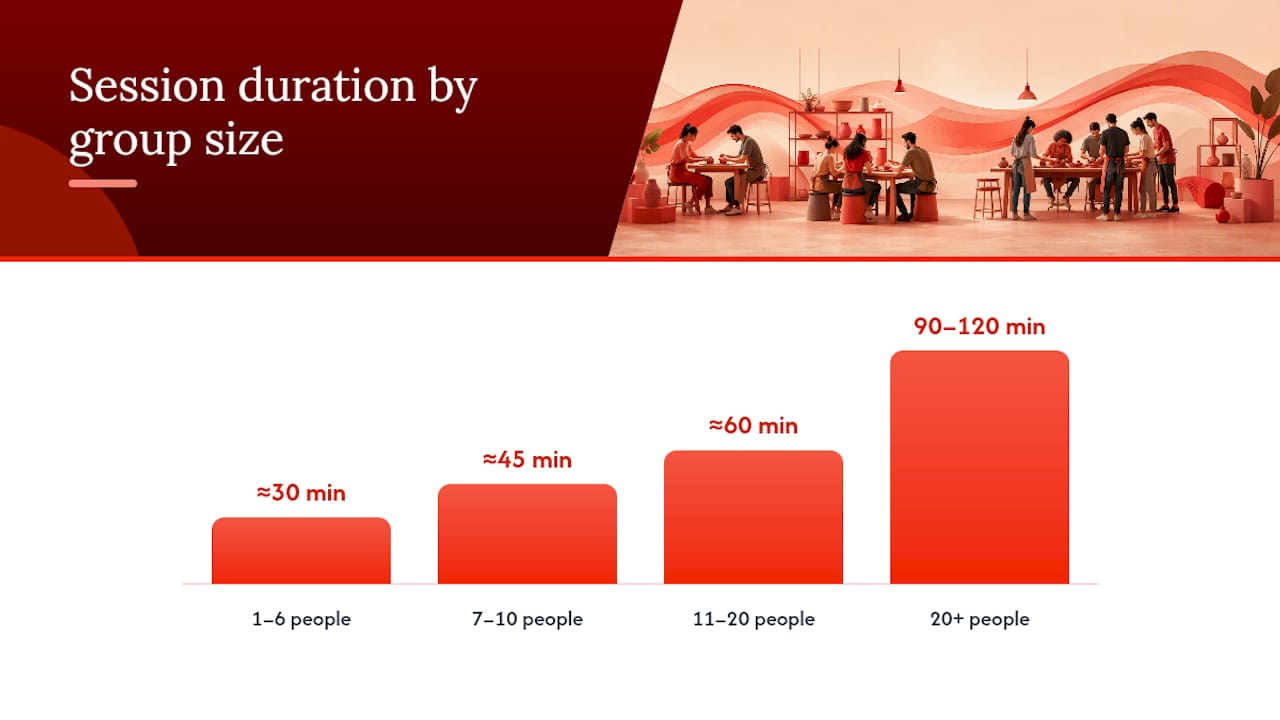
Working from the standard industry rule of thumb, typical estimates look like this:
- 1–6 people — around 30 minutes, single rotation with minimal waiting
- 7–10 people — around 45 minutes, one or two rotations
- 11–20 people — around 60 minutes, multiple rotations through the lanes
- 20+ people — 90 to 120 minutes, or split across two consecutive slots
Competitive or tournament formats add time on top of these baselines. Skill-shot and rapid-fire modes, for instance, extend the time each participant spends at the line compared with a straightforward round-robin, because scoring and re-racking between attempts takes longer.
Pro Tip: If your group is over 20 people, ask the provider about running two simultaneous stations rather than one long queue. It rarely changes the total booking cost much but can cut waiting time in half.
Other factors that extend or shorten a session
Group size sets the baseline, but several operational details shift the actual clock time up or down. None of these show up on a booking page’s headline duration, so it pays to ask about them directly.
Facilitator-led instruction is the biggest fixed cost. A proper safety briefing and equipment walkthrough take a set amount of time regardless of group size, whether you’ve got six guests or sixty. Skipping or rushing this isn’t really an option given the safety stakes, even with deactivated equipment.
Venue logistics matter more than most planners expect:
- Outdoor venues can lose time to weather checks, shade breaks, or repositioning stations
- Multi-station layouts mean walking time between shooting points, which adds up across rotations
- Indoor venues with fixed layouts tend to run faster because nobody’s moving equipment mid-session
Participant mix also plays a role. Groups with children, mixed age ranges, or guests with mobility needs generally need a slower pace through the briefing and rotation stages. And if you’re planning any kind of prize ceremony, trophy moment, or group photo at the end, build in an extra five to ten minutes. Those moments always run longer than anyone expects.
Fitting a laser clay slot into your event timeline
Buffers matter more than the headline duration. Build in 10 to 15 minutes before the session for check-in and briefing, and a similar window afterwards for pack-down, especially if another activity or catering slot follows straight after.
A few sample timelines that work well in practice:
- Standalone activity: one clean 60-minute slot with 15 minutes either side for arrival and wrap-up
- Add-on during a larger event: a tighter 45-minute slot works if the briefing overlaps with general arrival time
- Large groups: book two consecutive slots rather than stretching one long session, which keeps energy and accuracy higher
Providers generally recommend booking with reasonable lead time and flexible duration windows, and it’s worth asking directly about cancellation or rescheduling terms. Some vendors require confirmation 72 hours ahead of the event and won’t offer refunds once that window closes.
What actually happens during your hour
A standard session includes sound-simulated deactivated shotguns, reusable clay targets, a live scoreboard, and a facilitator running the whole thing from briefing to final score. Where volumes are published, sessions commonly allow for around 75 clays per slot, which gives a rough sense of how much actual shooting time each guest gets once you divide that among the group.
The guest journey follows a consistent shape: safety briefing, a few warm-up shots to find their aim, then the competitive rounds and finally a debrief where scores get read out. If you want the fuller picture of how rounds and scoring work before you commit to a slot length, the complete guide to laser clay shooting covers the format in more detail.
Why the standardised hour works
Sessions are run around facilitator-led formats with reusable eco-friendly clays and zero lead or noise pollution, which makes tight one-hour slots viable without cutting corners on safety. A trained facilitator handles the safety briefing and pacing throughout, so the advertised duration reflects genuine playing time rather than a padded estimate. That consistency is what lets planners book with confidence rather than guessing at buffers.
What I’ve learned watching these sessions run
The biggest scheduling mistake I see planners make is treating the safety briefing as optional padding they can trim if the day runs late. It can’t be trimmed, and trying to rush it just pushes the delay further down the timeline instead of removing it.
My best-practice tip: build a five-minute buffer between the briefing and the first shot, and use it to split guests into rotation groups before anyone picks up equipment. Doing the sorting during the “dead” transition time, rather than after the briefing ends, saves more real minutes than any other single change I’ve seen work.
— Joshua
Book the right duration for your event
Laserclay’s packages are built around the durations planners actually need, not a one-size-fits-all slot. The Corporate Laser Clay Package is priced at 69 SGD per person for the standard one-hour corporate format, ideal for team-building days where you need a clean, predictable slot. For shorter private bookings, the Birthday party package starts from 49 SGD per person and suits tighter windows around cake and other party activities. If your event runs longer, or you need the equipment across multiple sessions in one day, the System Rental option runs 500 to 800 SGD per hour depending on setup.
Whichever format fits your event, confirm three things before you book: whether a facilitator is included, how many clays are allocated per slot, and how much setup time the venue needs. Get in touch through Laserclay’s contact page to check availability and lock in the duration that matches your guest count.
Sources
- Shotgun Laser Clay Shooting Experience in Singapore | Pelago
- Private Laser Clay Shooting | Team Building
- Activities | Team Building, Laser Clay Shooting, Country Sports | Team Building Solutions
FAQ
How long does a typical laser clay session last?
Most sessions are booked as a one-hour slot, covering briefing, warm-up, main rounds, and a debrief. Actual time can run shorter for small groups or longer for groups above 20 people.
How long does a laser tag or laser clay game go for?
Individual rounds within a session usually last a few minutes each, with the overall booked slot running 30 to 120 minutes depending on group size and format. Providers commonly recommend flexible duration windows and discussing capacity ahead of booking.
What should I wear for clay shooting?
Comfortable closed-toe shoes and clothing you can move freely in work best, since the activity involves standing, turning, and mounting the shotgun repeatedly. No specialist gear is required because Laserclay’s equipment is fully facilitated and suitable for beginners.
Is clay pigeon shooting hard to learn?
Laser clay shooting is designed to be accessible regardless of prior experience, with a facilitator guiding technique during the warm-up. Most participants pick up the basics within their first few practice shots.
How much does a Laserclay session cost?
Pricing depends on the package: the Corporate Laser Clay Package is 69 SGD per person, the Birthday party package starts from 49 SGD per person, and System Rental runs 500 to 800 SGD per hour. Full details are available on Laserclay’s booking pages.