The best orientation camp games in Singapore do three jobs: they help new students learn each other’s names, get them solving something together, and show them around the place they will spend the next few years. Build the programme in that order, mix calm games with active ones, and keep a wet-weather plan for every outdoor slot. Below are the games, what each one is for, and how to fit them into a day.
TL;DR
- Open with low-pressure name games (Bingo, Two Truths and a Lie), then move to team problems (Human Knot, Team Pen Challenge, Minefield).
- Use a facility scavenger hunt so new students learn the campus while they play.
- Schools must use accredited operators and qualified instructors for height-based adventure activities, so check before you book anything off the ground.
- Plan every outdoor game with an indoor twin, because Singapore rain does not wait for your schedule.
- For a high-energy finale that all abilities can join from age 10, a facilitated laser clay session is an option we run (from S$69 per person for corporate groups).
Table of Contents
- What an orientation camp game has to achieve
- Stage one: name and ice-breaking games
- Stage two: team challenges that make people talk
- Stage three: explore the campus
- Building team identity
- A sample one-day programme
- Adapting for age, ability and space
- Safety and inclusion at orientation camps
- Perspective
- Adding a laser clay finale
- How to choose games for your own camp
- FAQ
- Sources
What an orientation camp game has to achieve
A game earns its slot only if it does something specific. Orientation groups are full of people who do not know each other, and many are nervous. Teaching centres describe icebreakers as quick activities that help students find out about their peers, reduce anxiety and energise them for learning. That is the baseline: anything you run in the first hour should lower the stakes, not raise them.
After that, ask three questions of every game:
- Does everyone play at once? Elimination games leave the shy students on the sidelines within two minutes.
- Does it need talking? The point of orientation is that people speak to people they did not choose.
- Can it be explained in under a minute? If the rules take longer than the game, drop it.
A good day moves through three stages: meet, cooperate, explore. The sections below follow that order.
Stage one: name and ice-breaking games
Bingo with people prompts
Singapore Sports School used this at its boarding orientation in January 2022: students learned one another’s names and began friendships, working in teams of five with five minutes to find classmates matching 16 prompts. Copy the structure and change the prompts to suit your cohort: “has been on the Downtown Line this week”, “speaks three languages”, “has a sibling in the same school”. Keep prompts neutral. Avoid anything about family background, income or grades.
Two Truths and a Lie
Each person gives three statements about themselves, two true and one false, and the group guesses which is the lie. It needs no materials and works with any group of four or more, so it suits tables, queues and bus rides. Run it in small circles rather than in front of a whole hall, since reading out personal facts to 200 people is the opposite of an icebreaker.
Superlatives line-up
Ask students to line up silently by birthday month, then by the number of siblings, then by how far they travelled this morning. Silence forces gestures and laughter. It takes five minutes and doubles as a way to form random groups for the next game: count off from the line.
Local-flavour name games
A hawker-centre theme works well in Singapore: each student names a favourite dish and a neighbour must repeat the whole chain before adding their own. It is a memory game, a name game and a conversation starter in one, and no one needs special knowledge.
Stage two: team challenges that make people talk
Human Knot
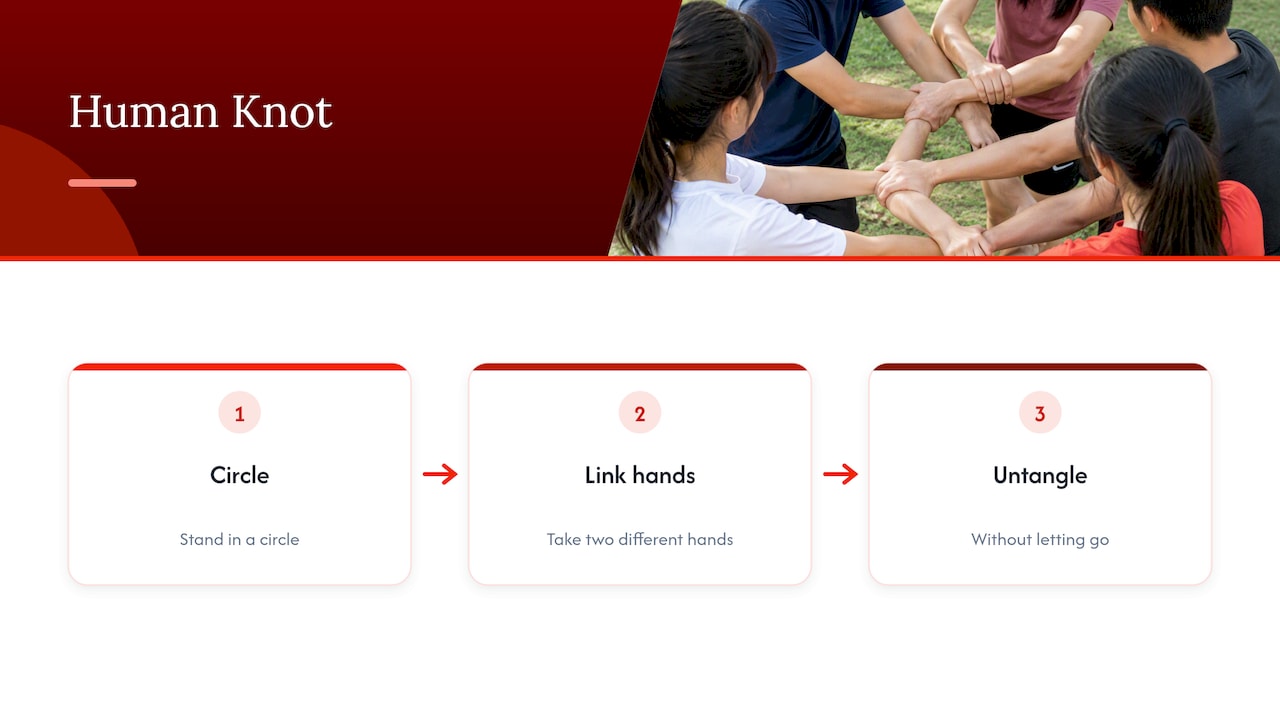
Everyone stands in a circle, reaches across to take two different hands, and the group untangles without letting go. Exact numbers vary between facilitators, but circles of roughly 10 to 12 are commonly recommended, with bigger groups split into several circles. SessionLab’s method notes point out that it is more than a warm-up: comparing a leader-directed attempt with a self-organised one makes leadership and decision-making styles visible. That gives you a ready debrief question: “Who started giving instructions, and why did the others follow?”
Two practical points. Clear the floor of bags and shoes. And let any student opt out of holding hands by acting as an “observer” who reports back, since not everyone is comfortable with contact, and the observer role is genuinely useful in the debrief.
Team Pen Challenge
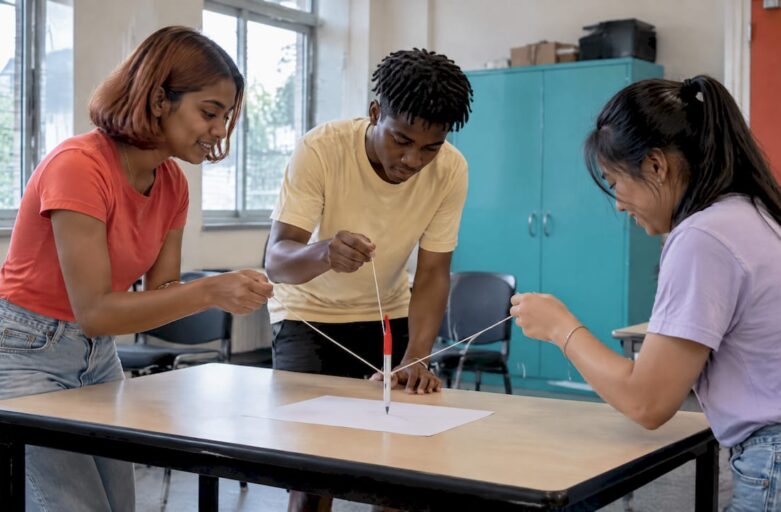
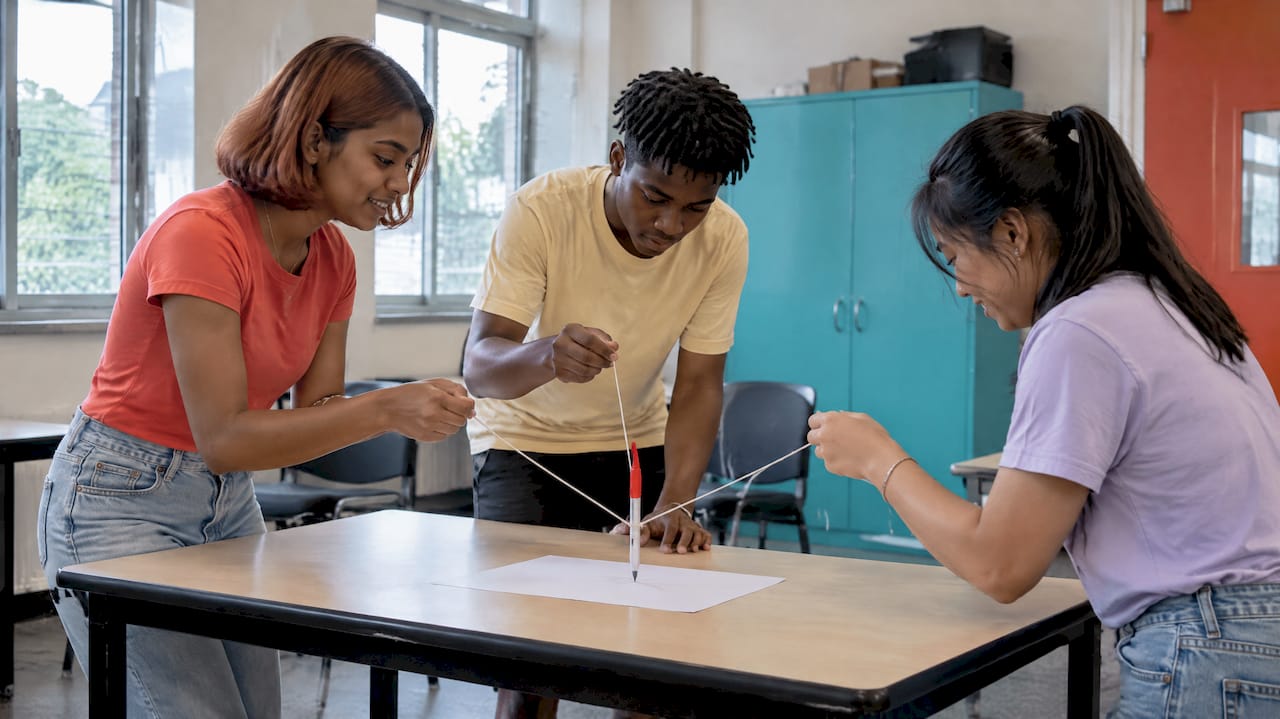
Teams move a pen attached to strings and must write or draw something together, which requires coordination and verbal direction. It is less physically taxing than most camp games, which makes it a good choice for mixed abilities, for air-conditioned rooms and for the post-lunch slump. Give teams a target such as writing the team name, then a harder one such as drawing a simple school crest.
Minefield
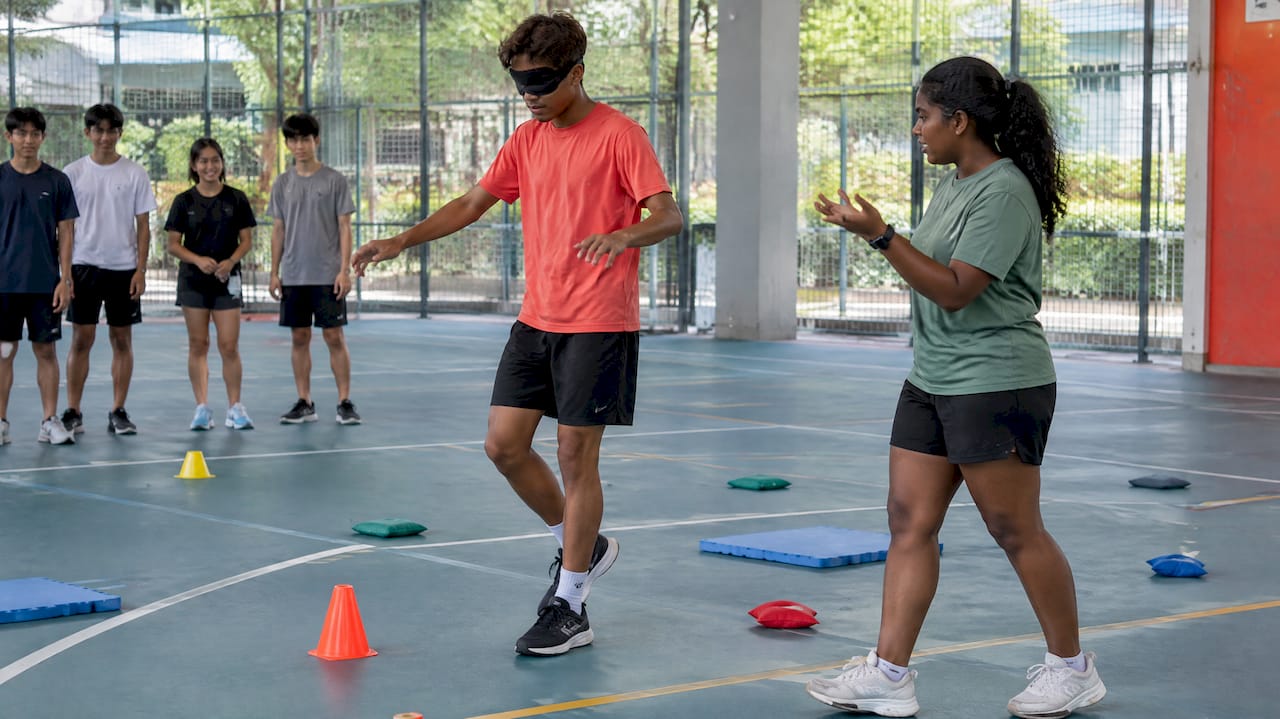
A blindfolded player crosses an obstacle area guided only by verbal instructions from their team. Use soft obstacles such as cones, bean bags and foam mats, never anything a student could trip on hard. Rotate roles so each person is both guide and walker, and set a rule that only one teammate speaks at a time, otherwise the walker hears noise instead of direction.
Caterpillar and other body-chain games
Teams line up, hold the shoulders or ankles of the person in front, and move together to a finish line. It rewards rhythm and calling out a shared pace, and it works indoors in a corridor or hall. Short bursts of two to three minutes keep energy high without tiring anyone out.
Build-it challenges
Give each team the same bundle of newspaper, tape and string and a single goal: the tallest freestanding tower, a bridge that holds a water bottle, or a boat that floats a coin. The materials are cheap, and the limit on resources creates the planning conversation you want.
Stage three: explore the campus
Facility scavenger hunt
At the same boarding orientation, a scavenger hunt familiarised new boarders with the sickbay, laundromat and common areas: 57 Secondary 1 students were split into teams and followed clues to five locations. Five stops is a good number. Fewer feels thin, more and the slowest team misses lunch.
Tips from running these:
- Put one useful fact at each stop (opening hours, who to ask for help) and make teams write it down as proof.
- Mix year levels in each team if seniors are helping, so new students meet someone who knows the answers.
- Give every team a staff or senior contact number in case they get lost.
Orienteering and field investigations
If you want to take students off campus, public bodies already welcome school groups. PUB, for example, invites teachers and students to conduct field investigations at its reservoirs and waterways, and teachers are expected to review the safety brief and know the emergency protocols and student materials needed. For younger students, NParks’ Kids for Nature programme for Primary 1 and 2 uses guidebooks to help teachers run group and individual activities that build social-emotional skills. Treat both as models: a printed map or guidebook, a clear route, a safety brief and a named adult at each checkpoint.
Building team identity
Games stick better when teams look like teams. Colour-coded bibs, a team name and a team cheer take ten minutes and give the whole camp a shared language. If you want something more lasting, custom camp T-shirts in house colours let students recognise their group from across a field, and they become the keepsake students wear after the camp ends. Order early, as printing takes time and final headcounts shift.
A sample one-day programme
Timings below suit a roughly six-hour day with 60 to 120 students. Adjust for your venue and school hours.
| Time block | Activity | Purpose | Wet-weather swap |
|---|---|---|---|
| 30 min | Welcome and Bingo | Names, first friendships | Same, indoors |
| 20 min | Two Truths and a Lie in small circles | Conversation | Same |
| 30 min | Human Knot and Caterpillar | Cooperation, leadership styles | Hall or corridor |
| 20 min | Water and rest | Recovery | Same |
| 40 min | Facility scavenger hunt | Campus familiarity | Covered walkways, indoor clues only |
| 45 min | Lunch | Rest | Same |
| 40 min | Team Pen Challenge and Minefield | Communication | Classroom setup |
| 60 min | Finale activity | Energy, bonding | Indoor format |
| 20 min | Debrief and house cheer | Reflection | Same |
Three planning rules sit behind that table. First, alternate high-energy and low-energy blocks. Second, put the debrief last, while the day is fresh, and ask each team one question: “What did your group do when it got stuck?” Third, write the indoor plan before the outdoor one, then decide which games can move outside if the weather is clear.
Adapting for age, ability and space
- Younger students (Primary): shorter rounds, simple rules, adult at every station. Prefer games with movement and no elimination.
- Secondary and junior college: add problem-solving and mild competition, and rotate team leaders.
- Mixed abilities: give every game a non-physical role, such as scorekeeper, observer, navigator or timekeeper.
- Big groups: run stations in rotation instead of one game for everyone. Eight teams of 12 moving through four stations beats one hall of 100 watching two players.
- Small spaces: pen-and-string tasks, build-it challenges and seated name games need only a table.
Safety and inclusion at orientation camps
Physical games need a plan for what goes wrong. Start with who is allowed to run what. As of February 2023, the Ministry of Education requires schools to use only accredited operators and qualified instructors for height-based outdoor adventure learning activities, and each school must appoint a staff member as an OAL Activity Leader to oversee safety. If your camp includes ropes, climbing or anything off the ground, confirm this first. Ground-level games such as those in this article sit outside that category, but the same habit applies: one named person responsible for safety.
Other checks worth making:
- Do a headcount at every transition, not just at the start and end.
- Brief senior helpers on what to do if a student is injured, unwell or upset.
- Ask about medical conditions and dietary needs in advance, and keep that information with the lead teacher.
- Offer an alternative role for any student who cannot or does not want to take part in a physical game.
- Provide water and shade breaks at least once an hour outdoors in Singapore’s heat.
Camps also run under changing health rules. At Raffles Institution’s 2021 orientation, group leaders enforced temperature checks, sanitisation and 1-metre distancing during games. Those specific measures belonged to that year, but it shows the kind of adjustment organisers may need to make, so check the current guidance from MOE or your institution before finalising the games.
Perspective
Most orientation days we hear about are well planned until the last two hours. The icebreakers are done, everyone is tired and hot, and the finale is either another circle game or a long walk back to the bus.
That is where we think a facilitated laser clay session earns its place. Our system uses sound-simulated deactivated shotguns, reusable clay targets and real-time electronic scoreboards, so there is no lead, no live ammunition and no noise problem. A facilitator runs the session, and the activity is suitable from age 10.
What matters for orientation is the format. Students play in teams, scores appear on a board everyone can see, and we can tailor the rules: a competitive league for the sporty group, or a relaxed round where the goal is simply to cheer each other on. Both indoor and outdoor venues are possible, so rain does not cancel the finale.
Use the games above to get students talking, then give them something they have never done together before. That shared first experience is what they will mention to friends afterwards.
Joshua
Adding a laser clay finale
If you want a closing activity that every ability level can join, we run laser clay shooting at schools, campuses and event venues. Packages include facilitators, venue setup and equipment, with customisable game formats and scoring.
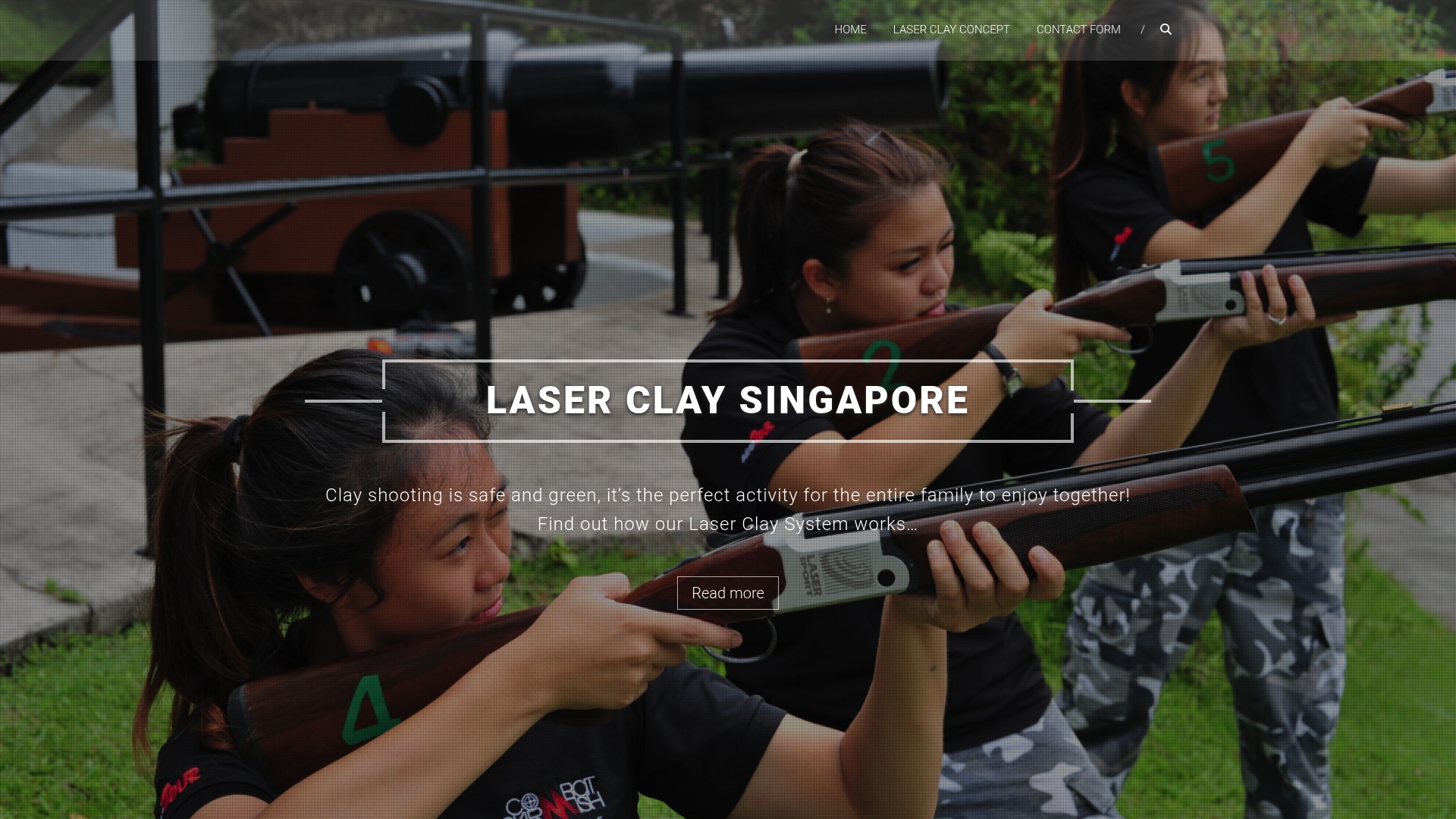
Corporate and group packages are priced at S$69 per person on our Corporate Laser Clay Package page, and if your school or committee prefers to run its own event, the system rental costs S$500 to S$800 per hour. For planning detail, our guides cover setup requirements, power needs and staffing per 10 players. If you are building a school event around several zones, see our school carnival ideas, or contact us with your date, headcount and venue.
For camps that run into the evening, our night camp plan covers games and permits. For shorter warm-ups, our guide to five-minute icebreakers with a debrief is a handy companion.
How to choose games for your own camp
Use this quick filter when your shortlist is too long:
- Count your minutes. Each game needs explanation, play and reset time. A 15-minute game usually takes 25 minutes in practice.
- Count your helpers. A game that needs one adult per team is not realistic if you have five adults for 100 students.
- Check your equipment. Cones, bibs, string, pens, paper and blindfolds are cheap. Order them a week ahead.
- Test one game. Run it with colleagues first. You will find the confusing rule in two minutes.
- Keep a reserve. Carry two spare games that need nothing but people, such as Two Truths and a Lie and the line-up game, for when a block finishes early.
Finally, plan the debrief as carefully as the game. A five-minute conversation about what happened is what turns a game into orientation.
FAQ
What are the best orientation camp games for a big group in Singapore?
Use station rotations rather than whole-group games. Split students into teams of 10 to 12 and rotate them through Human Knot, Team Pen Challenge, Minefield and a scavenger hunt. Each station needs one facilitator and a short briefing card.
How long should each game last?
Most icebreakers work in 10 to 20 minutes, and team challenges in 20 to 40 minutes including the explanation. Add five minutes after each block for a quick debrief and water. Shorter rounds suit younger students.
What can we do if it rains?
Keep an indoor twin for each outdoor slot. Pen-and-string tasks, build-it challenges, Bingo and Two Truths and a Lie all work in a classroom or hall. Laser clay can also run indoors, subject to venue space and setup checks.
Do we need special approval for physical camp games?
Ground-level games do not carry the same rules as height-based activities, but schools should still appoint a responsible staff member. For anything off the ground, MOE requires accredited operators and qualified instructors. Check with your school’s leadership and the MOE guidance before booking.
Sources
- Welcome on Board!, Singapore Sports School
- Human Knot, SessionLab
- University Orientation Games In Singapore, The Smart Local
- Geographical Investigation Field Studies, PUB
- Kids for Nature, NParks
- Progressive Resumption of Height-Based Activities, MOE
- Crepúsculo: Orientation 2021, Raffles Press
- Why Custom T-Shirt Printing Is a Must for School Camps in Singapore