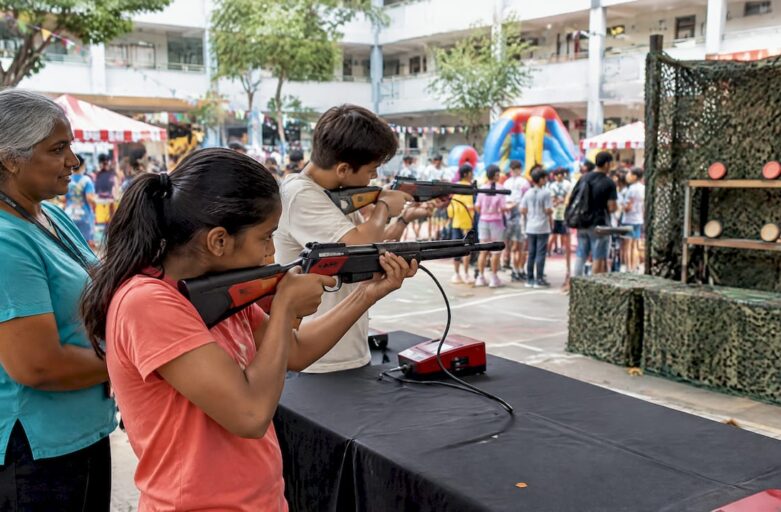
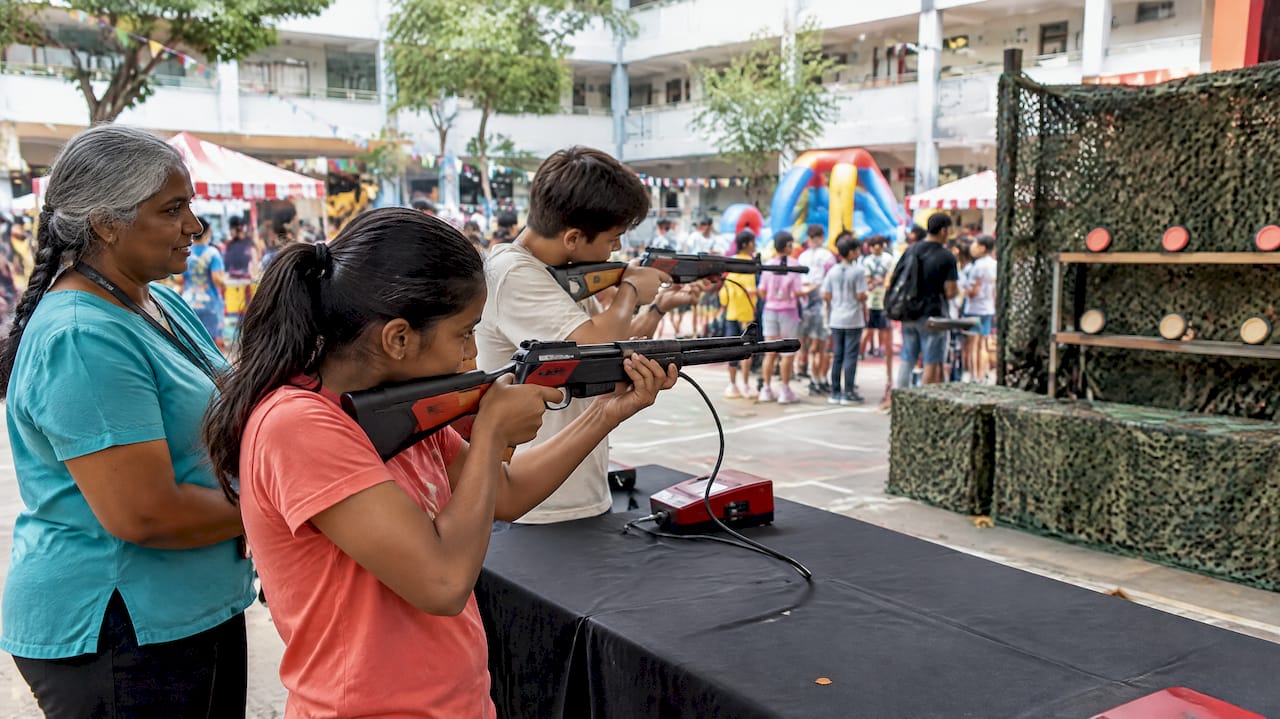
A good school carnival in Singapore mixes a few high-energy stations, a handful of low-effort booths, a food and craft corner and one or two “talking point” attractions, all laid out so queues never block exits. This guide gives you ideas for each, a way to match them to age groups, the permit and safety points that catch committees out, and a realistic budget logic for choosing what to rent and what to run yourselves.
TL;DR
- Build the carnival around four zones: active games, skill and challenge, creative and craft, and food and rest. Put one headline attraction at the far end so crowds spread.
- Match activities to age: simple chance and craft booths for lower primary, skill and team games for upper primary and secondary.
- A carnival is a temporary change of use. Check SCDF, police, EMA and SFA requirements well before the date, not the week of.
- Laser clay is a good headline station: no lead, no live ammunition, suitable from age 10, and our system rents from S$500 to S$800 per hour.
- Plan staff and supervision per station, and keep one rotating “floater” per zone.
Table of Contents
- Start with the purpose, then pick the games
- Game and activity ideas that work in a Singapore school
- Matching activities to age and ability
- Laying out the carnival: zones and crowd flow
- Safety, permits and approvals
- Equipment, space, staff and supervision
- Food, drinks and fundraising stalls
- Our perspective: why we think laser clay suits a school carnival
- Adding laser clay to your carnival
- A simple planning timeline
- FAQ
- Sources
Start with the purpose, then pick the games
Before choosing booths, decide what the carnival is for. A fundraiser needs high-throughput, low-cost booths that earn from tickets. A Teacher’s Day or National Day celebration wants something students remember. A CCA showcase wants student-run booths. The same budget produces very different days depending on this answer.
A useful rule: aim for about one station per 40 to 60 expected visitors at any one time, and make sure no single station is the only reason to come. If your headline attraction has a 30-minute queue, the rest of the carnival should still be worth visiting while people wait.
Game and activity ideas that work in a Singapore school
Classic booth games
These are cheap, run by students and need little training:
- Ring toss, bean-bag throws and tin-can knockdown
- Lucky draw and bingo stalls
- Capsule or prize-ball games
- Face painting and temporary tattoos
- Photo booths with a school or SG-themed backdrop
Northeast and neighbourhood schools often run these through Secondary student booths, as seen when Northland Secondary School announced its National Day carnival with games, photo and art and craft booths. Treat this as a format reference rather than a rulebook: the idea is that older students host booths for younger visitors, which gives your secondary students leadership roles at no extra cost.
Kampung games with a modern twist
Traditional play is one of the most Singaporean angles available and costs almost nothing. Sport Singapore’s ActiveSG Circle kampung games resource lists formats such as hopscotch, Bola Flags, Hop & Capture the Bola Flag, Bola Point Relay and Rollie Pollie. Set up a “Heritage Corner” with four or five of these, laminate simple rules, and have Primary 5 or 6 students explain them to younger visitors.
Obstacle courses and inflatables
Obstacle courses and bouncy castles are the most requested attractions for good reason: they burn energy and are easy to understand. Hire from a vendor who supplies trained attendants, and ask for evidence of the equipment’s safety checks and the operator’s insurance. Inflatables need level ground, a power supply and a wind or rain plan, so confirm these during your site visit.
Skill and challenge stations
Mini archery, target throws, basketball shootouts and mini golf suit older children who like to score. They also work well as team events: each class forms a team and collects points across stations, with a leaderboard near the entrance. This keeps students moving and gives teachers a simple way to run a house or class competition.
Creative and craft corners
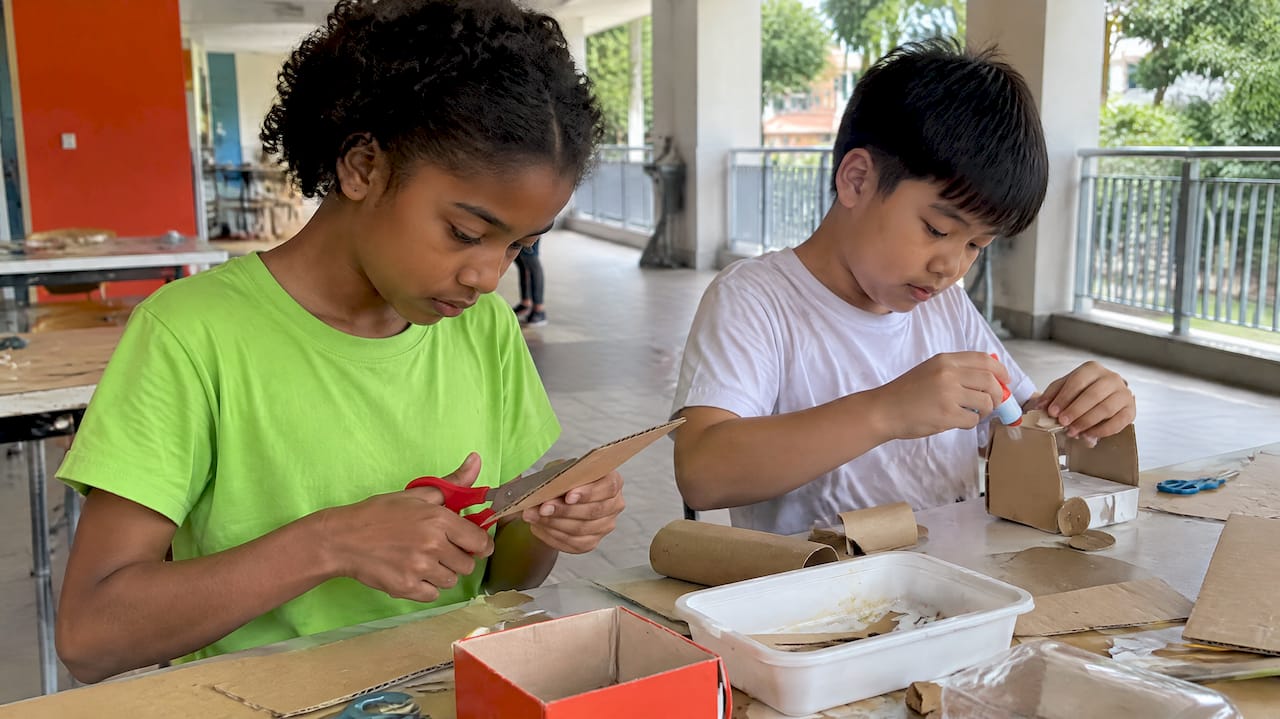
Craft stations calm the pace and suit shorter attention spans: badge making, tote bag painting, upcycled craft from recycled materials, and kite or origami tables. If you want an environmental theme, make recycled materials the star and ban single-use decorations.
A headline attraction
Choose one thing that gets talked about at home: an escape room, a robotics demonstration, a live performance or a laser clay range. This is where the carnival’s budget is best concentrated, and where an experienced vendor with its own facilitators saves your teachers the most work.
Matching activities to age and ability
One common mistake is running a single “fun for all” programme. Different ages want different things, and mixing them without a plan produces frustrated Primary 1 children and bored Secondary 3 students.
| Age group | What works | What to avoid |
|---|---|---|
| Lower primary (P1 to P3) | Chance games, face painting, craft, kampung games, soft play | Competitive scoreboards, long queues, anything with fine motor demands under time pressure |
| Upper primary (P4 to P6) | Team challenges, throw and aim games, obstacle courses, laser clay (from age 10) | Purely passive activities |
| Lower secondary | Student-run booths, escape rooms, skill stations, competitive formats | Anything that feels “babyish” |
| Upper secondary and staff | Hosting roles, leaderboards, a staff versus students match | Long-duration stations that block circulation |
| Students with special needs | Low-sensory-load stations, quiet times, accessible heights, buddy pairing | Flashing lights and loud noise without a quiet alternative |
On inclusion, a useful local reference is the Singtel Carnival, where mainstream students designed games for children from special education schools. You can borrow the principle without the scale: ask a few students to design or test a booth for accessibility, and publish a quiet-hour slot at your gate.
Laying out the carnival: zones and crowd flow
A four-zone layout keeps things readable on the day:
- Active zone: obstacle courses, inflatables, kampung games. Put it on the largest open area, away from the food zone.
- Challenge zone: aiming, scoring and team stations, plus your headline attraction.
- Creative zone: craft, face painting, photo booths. Sheltered or indoor if possible.
- Food and rest zone: stalls, seating, water points, bins and a first-aid post.
Crowd flow is not only about comfort. Under SCDF’s outdoor event fire-safety conditions, updated on 20 March 2026, booth rows must be no longer than 15 metres by 6 metres, passageways between rows must be at least 1.2 metres wide, booths may be no higher than 3 metres, and escape routes must stay unobstructed. Draw your plan to scale with these numbers before you confirm any vendor, because a 3-metre-high inflatable or a deep queue line can break them.
Practical flow tips:
- One entrance and one exit for ticketing, plus separate emergency exits that stay clear.
- Queue lines run parallel to booth rows, never across passageways.
- Put popular stations at opposite corners so queues do not meet.
- Place the food zone downwind of the play zones and away from generators.
- Use floor arrows or coloured tape, and assign a student marshal per zone.
Safety, permits and approvals
This is where school committees most often lose time, so start early.
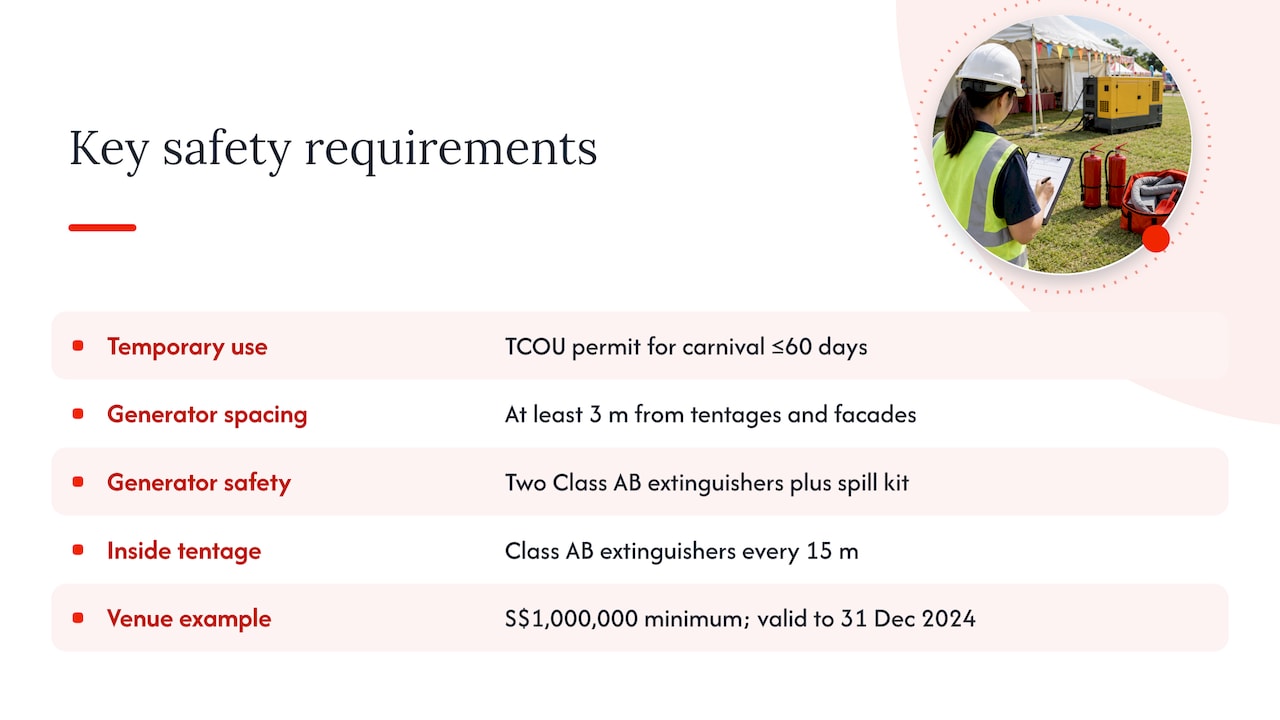
Fire safety. According to SCDF, a temporary change of use involving a carnival lasting no more than 60 days requires a TCOU permit and compliance with its fire-safety conditions. Keep fire-engine accessways and escape routes clear, and do not allow open-flame activities. The outdoor conditions also prohibit open-flame cooking such as blow torches, require generators to be at least 3 metres from tentages and building facades, and call for two Class AB extinguishers plus a spill kit near each generator. Inside tentage, Class AB extinguishers are required every 15 metres.
Other agencies. The Singapore Food Agency’s temporary fair declaration states that organisers must obtain the applicable approvals before starting. These include SCDF, the police for carnival rides or games stalls, EMA approvals for temporary electrical supply, and other site-specific approvals. Check with your vendors which of these they handle and which stay with the school.
Adventurous and height-based activities. For height-based outdoor adventure learning activities, MOE has said schools must engage accredited operators and qualified instructors, and that every MOE school has a trained OAL Activity Leader. If a climbing wall or high ropes course is on your wish list, speak to that person first.
Venue and insurance. Schools that hire out premises set their own terms. As one example, Anglo-Chinese School (Independent)’s venue hire terms ask hirers to keep cables safe, passageways clear, stop outdoor activities when a lightning alert is active, and hold at least S$1,000,000 in public liability insurance. Those terms were valid through 31 December 2024, so treat them as an example of what to expect, and ask your own school’s requirements, and every vendor’s insurance, in writing.
A simple rule for weather: decide a wet-weather location and a lightning-alert procedure before the day, and brief every stall holder on it.
Equipment, space, staff and supervision
A quick budgeting table helps committees avoid underestimating the human side:
| Station type | Typical space | Staff per station | Notes |
|---|---|---|---|
| Simple booth game | One table, 3 to 4 metres of frontage | 2 students plus a teacher nearby | Needs prizes, a ticket system and a float |
| Craft table | 2 to 3 tables | 2 to 3 helpers | Materials ahead of time, bins for waste |
| Obstacle course or inflatable | Open area, level ground | Vendor attendants plus a teacher | Power and weather plan needed |
| Laser clay range | Indoor hall or outdoor field | Facilitators supplied by the vendor | Confirm power and space at the site visit |
| Food stall | Per SFA requirements | Licensed or approved handlers | Handle as a regulated operation |
These are planning ranges to test against your own site, not official standards. Walk the site with each vendor and write down power points, access routes, sheltered areas and storage.
On supervision, aim for one adult-in-charge per zone and one floater who can cover breaks. Brief all student helpers on how to handle lost children, injuries and complaints, and give each a single contact number for the carnival controller.
Food, drinks and fundraising stalls
Food stalls raise funds, but they are regulated. The SFA declaration expects organisers to arrange an NEA-licensed cleaning contractor for daily site cleanliness and an NEA-licensed waste collector, or an approved alternative arrangement. Plan this into your costs from the start: a cheap stall becomes expensive once cleaning and waste are added.
Ideas that work well in schools:
- Pre-packed snacks and drinks sold by licensed vendors
- A “healthy corner” with cut fruit and water, which parents tend to appreciate
- Cold treats such as ice cream carts, which avoid open flame entirely
- Parent-donated baked goods, subject to your school’s food rules and SFA guidance
For the healthy corner, fruit boxes and packs for exam-season events or student rewards are a simple fit: a supplier such as Tai Kang’s PSLE care pack shows the kind of fruit gift box you could use as a prize or teacher thank-you. Whatever you choose, keep open flames and cooking apparatus out of the carnival, in line with the SCDF conditions above.
For greener fundraising, use reusable cups and bring-your-own container discounts, label bins for recycling, and avoid disposable decoration.
Our perspective: why we think laser clay suits a school carnival
We run laser clay events, so we are biased, but we have reasons. Most carnival attractions are either cheap and forgettable or exciting and difficult to supervise. Laser clay sits between the two. The equipment looks and feels like the real thing, including sound-simulated deactivated shotguns, yet there is no lead, no live ammunition and no noise pollution. The reusable clay targets mean there is nothing to sweep up afterwards.
A facilitated format matters even more in schools. Our team runs the briefing, the scoring and the safety rules, so teachers can watch their classes rather than run a station. The format suits students from age 10, and you can set it up as a relaxed turn-taking game for younger primary groups or a scored class competition for upper primary and secondary.
Our advice to committees: do not make laser clay your whole carnival. Make it the centrepiece of the challenge zone, and surround it with free or cheap booths so the queue has somewhere to go. Timed slots by class or house keep waiting down. See how laser clay fits different event formats if you want to compare a carnival with a camp or sports day set-up.
— Joshua
Adding laser clay to your carnival
For school events, the most direct option is our system rental, priced at S$500 to S$800 per hour depending on your set-up. Our rental and event packages include facilitators, venue setup, customisable game formats, real-time electronic scoreboards, and indoor or outdoor use. If you need guidance on how sessions run, our guide to how laser clay is played covers the basics, and our page on laser clay costs in Singapore explains how pricing compares across formats.
To check availability for your date, contact our team with your expected attendance, age range and venue type.
A simple planning timeline
| When | What to do |
|---|---|
| Three to four months before | Set the purpose, budget and date; choose a committee; start approval enquiries |
| Two to three months before | Confirm the site plan, headline attraction and vendors; apply for permits through the relevant agencies |
| One month before | Finalise the zone map, staffing roster, insurance papers and wet-weather plan |
| One week before | Brief student helpers, test power and equipment, print signs and maps |
| Day of | Walk the site two hours early, check exits and extinguishers, open on time |
| Afterwards | Collect feedback, tally income, and keep a vendor and permit file for next year |
The timing figures are a sensible working schedule, not a legal requirement. Agencies set their own lead times, so check each one’s current page.
FAQ
What are the easiest school carnival games to run in Singapore?
Ring toss, bean-bag throws, bingo, prize-ball games and kampung games need little equipment and can be run by trained students. Add face painting or a craft table for variety. Keep each booth to two students and an adult nearby.
Do we need a permit for a school carnival?
A carnival that involves a temporary change of use of a space can require a TCOU permit from SCDF, and other approvals such as police for games stalls and EMA for temporary electrical supply may also apply. Check each agency’s current page and ask your vendors which permits they handle.
What age is laser clay suitable for?
Our sessions suit participants from age 10, and they are fully facilitated. Younger children can still enjoy the carnival in other zones, so plan separate age-appropriate stations.
How much does it cost to add laser clay to a school carnival?
Our system rental is S$500 to S$800 per hour. Our corporate package is S$69 per person and our birthday package starts from S$49 per person, but for school carnivals the hourly rental is usually the relevant option. Contact us with your numbers for a recommendation.
How can we make the carnival more eco-friendly?
Use reusable cups, labelled recycling bins, recycled craft materials and reusable equipment rather than disposable items. Arrange proper waste collection for any food stalls, as the SFA declaration requires.
Sources
- ActiveSG Circle: kampung games resource
- SCDF: outdoor event fire-safety conditions
- SCDF: temporary change of use
- SFA: temporary fair declaration
- MOE: height-based activities for school programmes
- ACS (Independent): venue hire terms