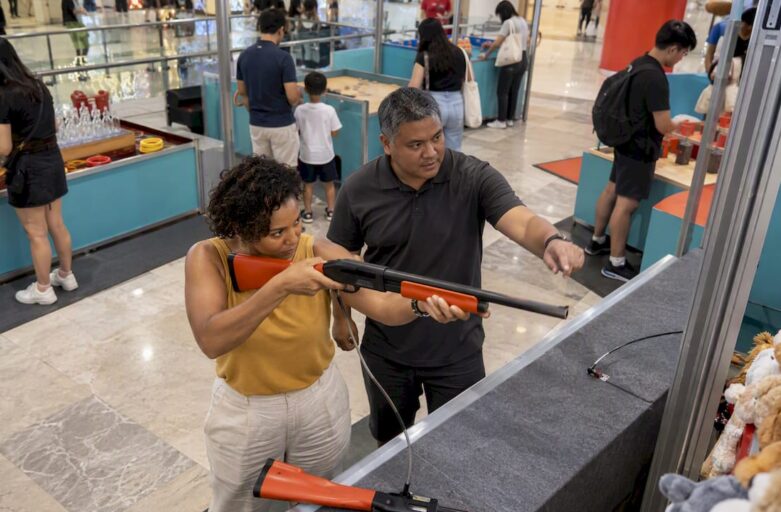
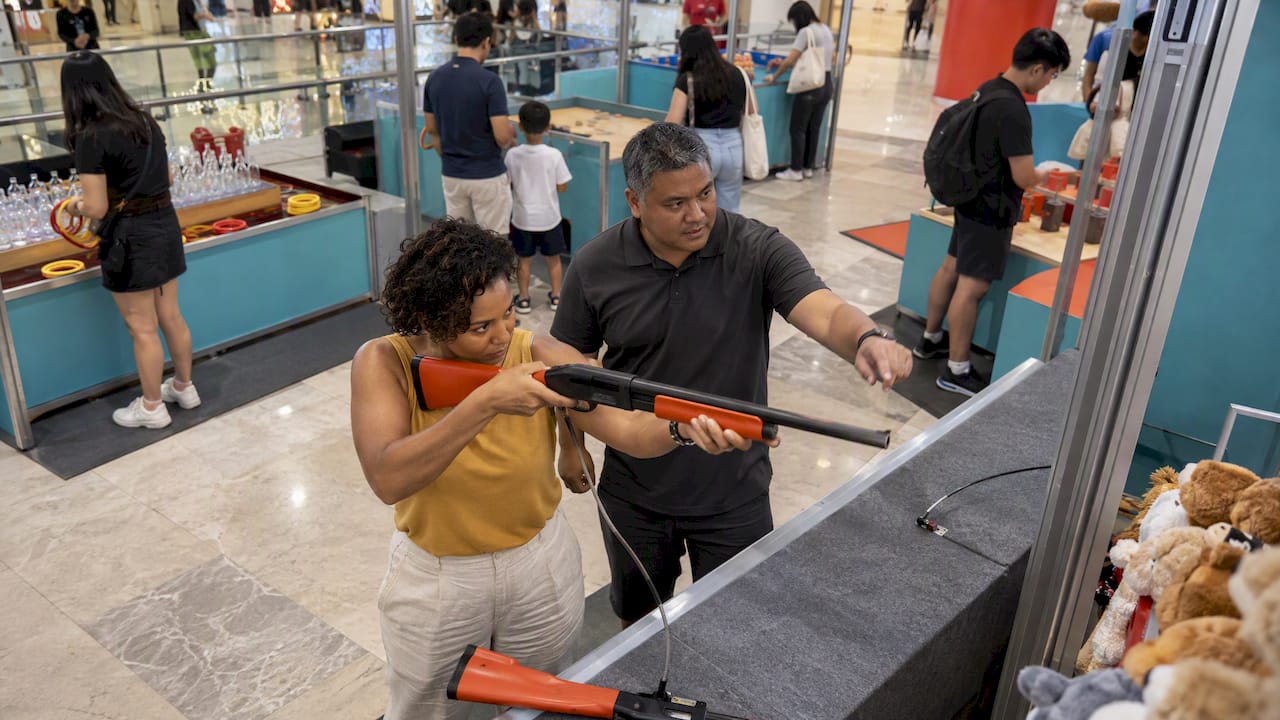
An indoor carnival in Singapore works best with a mix of three things: quick stall games for queues, one or two bigger “hero” attractions, and a layout that meets SCDF fire safety conditions. Get the mix and the layout right and the rest is logistics. This guide covers the game types, the rules that catch organisers out, realistic budgeting and where a laser clay shooting zone fits.
It is written for HR and admin teams planning a family day, school staff running a fun fair, and parents or event planners booking a large party in an air-conditioned space.
TL;DR
- Mix classic stall games (ring toss, ball toss, darts) with at least one competitive hero attraction, so queues stay short and guests have something to talk about.
- Indoor carnivals that count as a temporary change of use need an SCDF permit. Booths must stay within 3 metres in height, with aisles of at least 1.2 metres.
- Cables are a common hazard in crowded halls. Secure them away from walking paths, as the Workplace Safety and Health Council advises.
- A single vendor that delivers, sets up and facilitates takes the supervision burden off your team.
- Our laser clay system rents at S$500 to S$800 per hour, or you can book a per-person package from S$49.
Table of Contents
- What counts as an indoor carnival game
- Choosing the right mix for your crowd
- SCDF rules that catch organisers out
- Safety on the floor: cables, queues and supervision
- Why a vendor-inclusive service saves your day
- Our perspective: give the carnival a centrepiece
- Where laser clay fits in an indoor carnival
- What an indoor carnival costs
- Add a laser clay zone to your carnival
- A planning timeline that works
- Common mistakes to avoid
- FAQ
- Sources
What counts as an indoor carnival game
Search for carnival games in Singapore and you will find rental catalogues full of the same family: ring toss, milk can toss, balloon darts, basketball challenges, tic-tac-toe boards, tabletop games and arcade machines. They are cheap to run, need little instruction and suit all ages. That is why they fill school fairs and corporate family days.
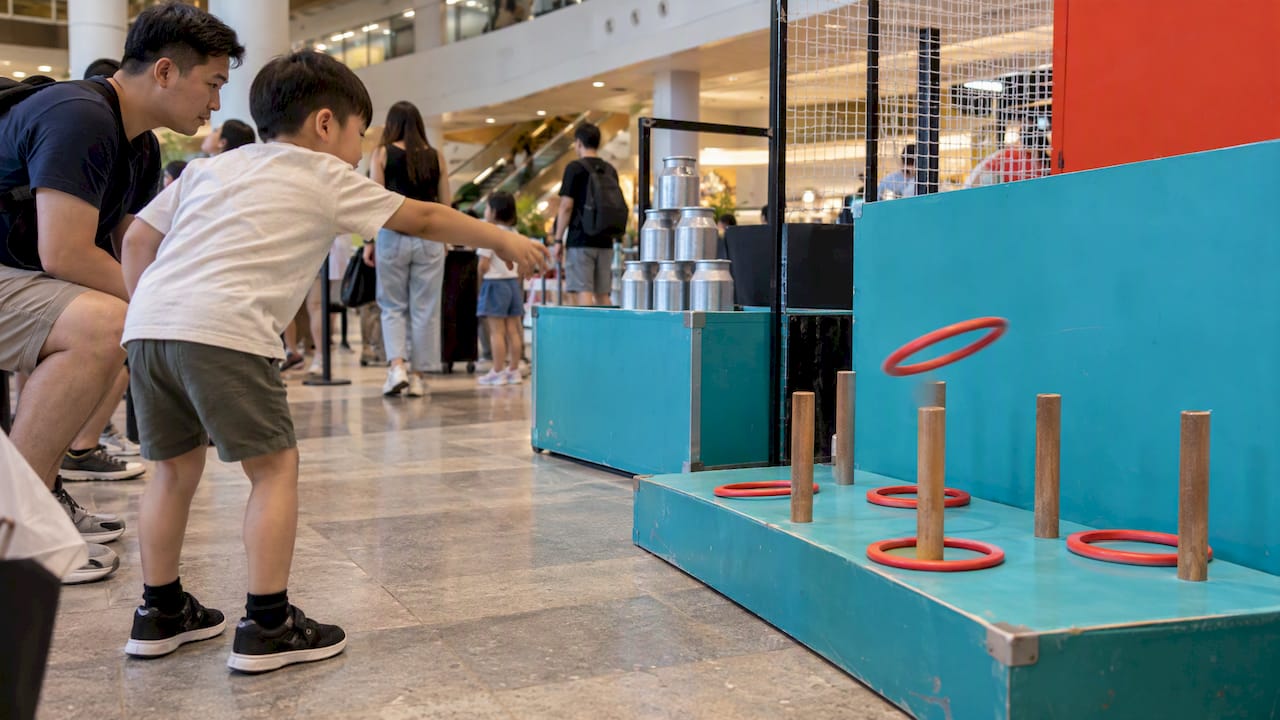
Their weakness is engagement. A guest plays for 30 seconds, wins a sticker and leaves. Nothing is built between players, and the stall does not give your event a talking point. A carnival made only of these stalls feels like a row of identical queues.
The better approach is to think in layers:
- Filler games: tabletop and small stall games that absorb waiting guests and young children.
- Skill stalls: basketball, darts and target games with simple scoring, where people compare results.
- Hero attractions: something guests plan their visit around, such as a competitive shooting zone, an obstacle course or a game-show setup.
Choosing the right mix for your crowd
The right balance depends on who is coming and how long they will stay. Use this table as a starting point.
| Event type | Typical crowd | Best mix | Watch out for |
|---|---|---|---|
| Corporate family day | Staff, spouses, children aged 3 to 15 | Many filler games, two skill stalls, one hero attraction for adults and teens | Age gaps: young children need low-key games |
| School carnival or camp | Students, teachers, parents | Skill stalls, group competitions, one hero activity per level | Supervision ratios and queue control |
| Team-building afternoon | Colleagues aged 20 to 55 | Fewer stalls, more competitive formats with a leaderboard | Mixed fitness levels and dress codes |
| Birthday party in a hall | Children plus parents | Tabletop games and one themed activity | Minimum age limits on the bigger attractions |
For adult and teen guests, a competitive attraction is what changes the feel of the day. Event specialists describe the shift as moving from low-engagement booth games to high-engagement contests. In their view, team activities such as laser clay shooting can build hand-eye coordination, planning and communication that a standard stall does not.
SCDF rules that catch organisers out
This is the part many first-time planners skip, and it can stop an event. SCDF runs a streamlined process for temporary changes of use. If the change is temporary, lasts a maximum of 60 days and involves activities such as carnivals, exhibitions or promotions, a Temporary Change of Use permit may apply.
The fire safety conditions for indoor events, updated as of 19 February 2026, include layout limits you should design around from day one:
- Booths must not exceed 3 metres in height.
- Clear passageways of at least 1.2 metres must be kept between rows of booths.
- Rows of booths must not exceed 15 metres in length and 6 metres in width.
Check the current document before you finalise your floor plan, because conditions can change and your venue may add its own requirements.
Check the venue before you sign
A hall that looks big enough may not be approved for events. Spaces designed for other uses, such as car parks or certain storage areas, can carry restrictions on holding gatherings. Ask the building’s Fire Safety Manager, or SCDF directly, whether the space can host your carnival before you commit to a venue contract. Do this first, not after you have paid a deposit.
Turn the rules into a floor plan
Here is a worked example. Say you have a hall of 30 metres by 20 metres and want two rows of booths.
- Each row runs no longer than 15 metres, so you can fit two rows lengthwise with a gap between them.
- The aisle between rows stays at least 1.2 metres wide. In practice, aim wider where queues form, because a queue of eight children at a ring toss will spill into the aisle.
- Tall items, such as an inflatable or a backdrop, stay under 3 metres.
- Keep the hero attraction near the edge of the hall, with its own queue space, rather than in the middle of a booth row.
If you cannot make the plan fit on paper, it will not fit on the day.
Safety on the floor: cables, queues and supervision
Carnivals are temporary installations, and temporary installations create housekeeping problems. The Workplace Safety and Health Council’s event management guidelines advise organisers to secure electrical cables and temporary installations away from public paths, so nobody trips. In a busy hall with arcade machines, scoreboards and speakers, that means planning where the power comes from before you plan where the games go.
A simple checklist for the day before:
- Walk the hall and trace every cable from socket to equipment.
- Route cables along walls or behind booths, and cover any that must cross a walkway.
- Mark queue lines on the floor so lines do not block aisles or exits.
- Confirm who is responsible for each game: a named person per stall, not “the volunteers”.
- Brief staff on where the exits are and who calls for help.
If your hero attraction runs on electronics, ask the supplier about power draw. Our own guides on setup requirements and power requirements list what to confirm before the event day.
Why a vendor-inclusive service saves your day
The most common failure at corporate family days and school carnivals is not a bad game. It is a team of volunteers who end up supervising equipment instead of enjoying the event. Industry practitioners recommend a vendor-inclusive approach, where one provider handles delivery, setup and on-site facilitation, so trained staff manage equipment safety and game pacing.
The same logic applies whatever the format. Active games run more smoothly when someone owns the rules, the scoring and the queue, which is the thinking behind guides on running company sports tournaments well. For carnivals, it means you hire a facilitator, not just a box of equipment.
When you compare quotes, ask each supplier:
- Is delivery, setup and collection included, and at what times?
- Who runs each game during the event?
- What is the minimum age for each activity?
- How much power and floor space does each game need?
- What happens if equipment fails midway?
Our perspective: give the carnival a centrepiece
We run laser clay shooting events, so we are biased, and we say so. But we have seen the same pattern in planning conversations: organisers book ten stalls and then wonder why the room feels flat at 3pm.
What changes it is a shared, competitive moment. Our system uses sound-simulated, deactivated shotguns and reusable clay targets, with a real-time electronic scoreboard. Guests aim at targets, scores appear on the board, and colleagues or classmates cheer and compare. There is no lead ammunition and no live-fire noise, so it can run indoors as well as outdoors. The activity is fully facilitated and suits ages from 10.
Three things matter most when you add something like this to a carnival:
- Give it a clear zone. It needs its own space and queue, separate from the stalls.
- Make scoring visible. A leaderboard turns a one-off turn into a conversation.
- Keep the format flexible. Casual rounds for families, competitive rounds for teams. We customise game formats and scoring to the crowd.
A stall game fills a minute. A good centrepiece gives people something to talk about on the MRT home.
— Joshua
Where laser clay fits in an indoor carnival
Laser clay slots in as the hero attraction in three common setups.
Corporate family day. Adults and teens get a competitive activity while younger children play the stall games. Our guide to family day games that meet SCDF conditions walks through how to combine activities.
School carnival or camp. Students rotate in groups through the zone, which keeps queues manageable. Because the activity is fully facilitated, teachers can supervise their class instead of running the game.
Team-building day. Run a short tournament with team scores. Our notes on competition ideas for Singapore planners cover formats from relaxed to serious.
For parties, the same equipment works for older children. See our guide to planning a laser clay birthday party for what to expect.
What an indoor carnival costs
Stall rental in Singapore is usually priced per game or per day, and prices rise with the size and complexity of the setup. Quotes vary by supplier, so request itemised pricing that shows delivery, setup, operators and collection separately. Without that, comparisons are meaningless.
Here is how our own pricing works, so you can budget the hero attraction:
| Option | Price | Best for |
|---|---|---|
| Corporate Laser Clay Package | S$69 per person | Team-building groups wanting a full facilitated session |
| Birthday party package | From S$49 per person | Children’s parties and smaller groups |
| System Rental | S$500 to S$800 per hour | Carnivals and events that want the system as one attraction |
For a carnival, hourly rental is usually the most practical choice, because guests drop in over several hours rather than playing as one group. Packages include facilitators, venue setup, event customisation and equipment. For more detail on how the numbers add up, see our cost breakdown for Singapore.
A useful way to budget: decide how many hours the hero attraction needs to run, then divide the guest count by the number of rounds your session can handle. That tells you whether one hour is enough or whether you need two. Our staffing guide explains how operators and marshals scale with group size.
Add a laser clay zone to your carnival
Planning a family day, school fair or party and want one attraction guests remember? We bring the equipment, set up the zone, run the games and handle the scoring. Choose a per-person package or rent the system by the hour, or contact us with your date, venue and headcount for a recommendation.
A planning timeline that works
- Eight to ten weeks out: confirm the venue and ask the Fire Safety Manager whether the space can host a carnival. Check whether a Temporary Change of Use permit applies.
- Six to eight weeks out: shortlist suppliers and request itemised quotes. Choose your hero attraction first, then fill the floor around it.
- Four weeks out: draw the floor plan to scale, with 1.2-metre aisles, booth heights and queue zones. Share it with your suppliers.
- Two weeks out: confirm power points, cable routes, delivery times and access to the loading bay.
- One week out: brief staff and volunteers, and confirm named owners for each game.
- Day of: arrive early, walk the floor, check cables and exits, then open.
These timings are a practical guide, not an official requirement. Permit processing and venue rules differ, so check lead times with SCDF and your venue.
Common mistakes to avoid
- Too many identical stalls. Variety beats volume. Five different games outperform ten copies of ring toss.
- Ignoring age limits. Check the minimum age for each activity. Ours starts at 10.
- Forgetting the quiet corner. Young children and older guests need somewhere to sit.
- No weather plan. An indoor venue protects you from rain, but check how guests will get from the MRT or car park.
- Late supplier briefings. Share your floor plan and power needs early, not the day before.
FAQ
Do I need a permit for an indoor carnival in Singapore?
Possibly. SCDF handles temporary changes of use for events such as carnivals, lasting up to 60 days, through a Temporary Change of Use permit. Whether you need one depends on your venue and event, so confirm with the venue’s Fire Safety Manager or SCDF before you book.
How wide should the aisles be between booths?
SCDF’s indoor event conditions require clear passageways of at least 1.2 metres between rows of booths. Booths must also stay within 3 metres in height. Check the latest version of the document before you finalise your plan.
Can laser clay run indoors?
Yes. Our system uses sound-simulated, deactivated shotguns and reusable clay targets, with no lead ammunition, so it works both indoors and outdoors. Confirm your venue’s floor space and power supply with us beforehand.
What is the minimum age for laser clay?
Our activity suits participants from age 10. For younger children at a family carnival, pair it with tabletop or stall games so everyone has something to do.
How much does it cost to add laser clay to a carnival?
System rental is S$500 to S$800 per hour. Per-person packages are S$69 for the corporate package and from S$49 for the birthday package. Contact us with your date and headcount to find the right fit.
Sources
- SCDF: Temporary Change of Use
- SCDF: Indoor event fire safety conditions (updated 19 February 2026)
- Workplace Safety and Health Guidelines: Event Management
- Laser clay team building activity
- Carnival game stall rental in Singapore
- Tornei aziendali sport: la guida pratica