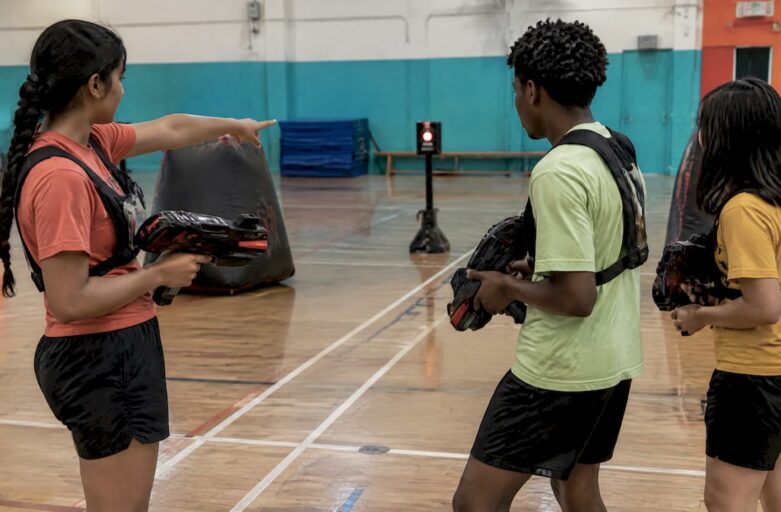
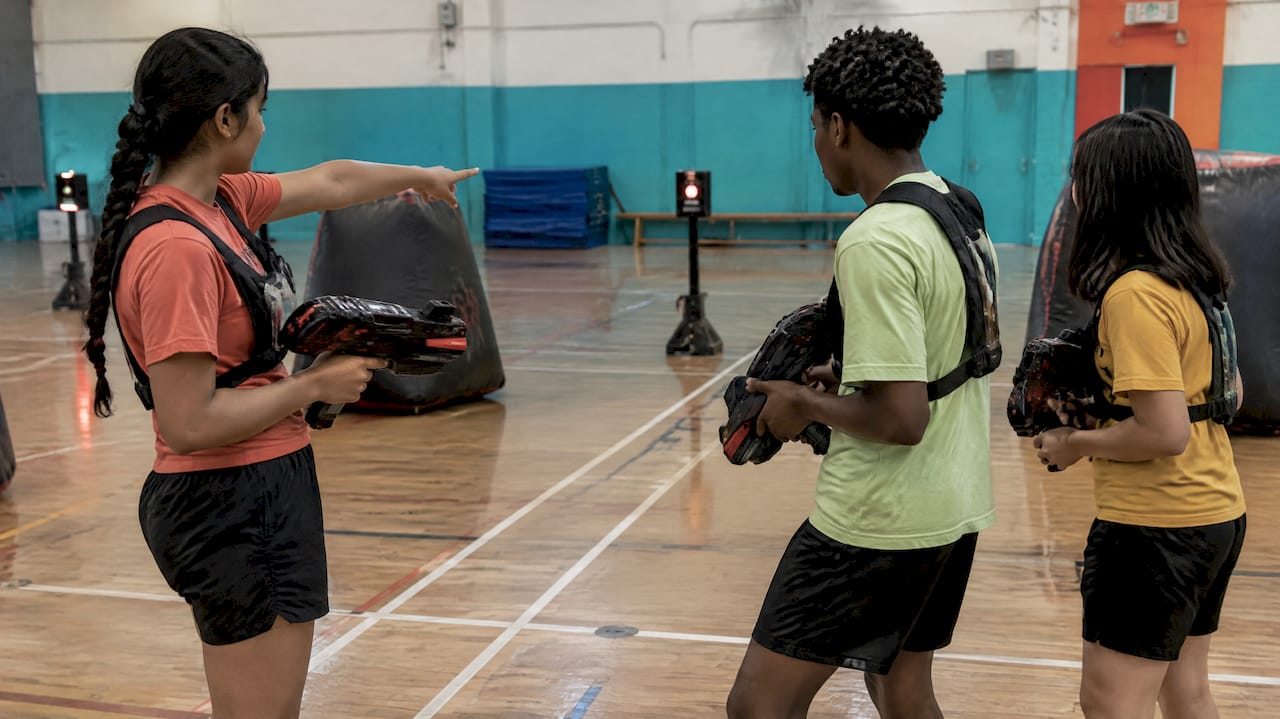
The best school leadership camp activities in Singapore share three traits: they put students in small teams with a real decision to make, they carry some pressure but no physical risk that needs a rescue plan, and they end with a structured debrief. Rope courses, orienteering, problem-solving relays and laser clay shooting can all do this. What separates a camp students remember from one they forget is the reflection that follows, and the vendor safety checks that come before.
This guide is for teachers, student development leaders and school administrators planning a camp for student councils, prefects, CCA leaders or whole cohorts. It covers which activities earn their slot, how to check vendors, what camps cost, and where we think laser clay fits.
TL;DR
- Pick activities that force communication, delegation and quick decisions, then budget real time for a debrief. The debrief is where leadership gets learned.
- MOE expects external vendors for school outdoor activities to be registered and assessed, so ask for certification, risk assessments and instructor ratios before you sign.
- Link the camp to CCE, PE or Values in Action so skills carry back to the classroom.
- Laser clay shooting is a facilitated, indoor-or-outdoor option for students aged 10 and above, with reusable targets, no lead and no live ammunition.
- Budget roughly 58 SGD to over 380 SGD per head across Singapore camp providers, depending on length and complexity.
Table of Contents
- What a leadership camp activity has to do
- Leadership camp activities worth including
- Build the camp into the school year
- Vendor safety checks Singapore schools should run
- Inclusive by design
- What does a school leadership camp cost in Singapore?
- Where laser clay fits in a leadership camp
- Our perspective
- Booking laser clay for your school camp
- Planning checklist for teachers
- FAQ
- Sources
What a leadership camp activity has to do
A leadership camp is not a day out. Students already know how to play games. What they rarely get is a safe place to lead a group of peers, get it slightly wrong, and talk about why.
School accounts of leadership training camps in Singapore describe this pattern. Jurong Pioneer Junior College described its 2023 camp as hands-on activities, games and reflection segments for 148 new student leaders. Fairfield Methodist School (Secondary) wrote up its 2025 camp as team challenges and reflection for 61 Secondary 3 student leaders, aimed at unity and resilience. The format is the same: challenge, then reflection.
Youth leadership practitioners say the same thing. A Singapore youth leadership programme frames effective camps around the experiential learning cycle: do something, reflect on it, link it to a real-world competency such as communication, adaptability or resilience, then try again. The activity itself is the vehicle, not the lesson.
So when you assess any activity, ask four questions:
- Does every student have a job, or can some hide at the back?
- Can roles rotate, so that different students lead?
- Is there a clear score or outcome, so the team can see the result of its decisions?
- Can you run a ten-minute debrief straight afterwards?
An activity that fails the first question is entertainment. One that passes all four is worth its time slot.
Leadership camp activities worth including
A good programme mixes three kinds of activity: trust and communication, strategy under time pressure, and skill challenges with a visible score. Here is how common options compare.
| Activity type | What it trains | Watch out for |
|---|---|---|
| Low-element challenge courses | Trust, spotting, communication | Needs certified facilitators; higher elements need stricter controls |
| Orienteering and treasure hunts | Navigation, delegation, time management | Weather, and a few students doing all the work |
| Problem-solving relays | Planning, adaptability | Can reward the loudest voice |
| Team strategy games (laser tag style) | Role allocation, tactics, reading the opposition | Needs clear rules on contact and boundaries |
| Laser clay shooting | Focus, composure, supporting a teammate, scoring strategy | Needs a facilitator and a set-up area, which we handle |
| Service or community projects | Initiative, ownership | Takes longer than a half-day slot |
Trust and communication challenges
Blindfolded navigation, a shared-rope puzzle or a low-element course teaches students to give and receive clear instructions. These are the foundation of a leadership camp because they expose how a leader speaks when the team cannot see what she sees.
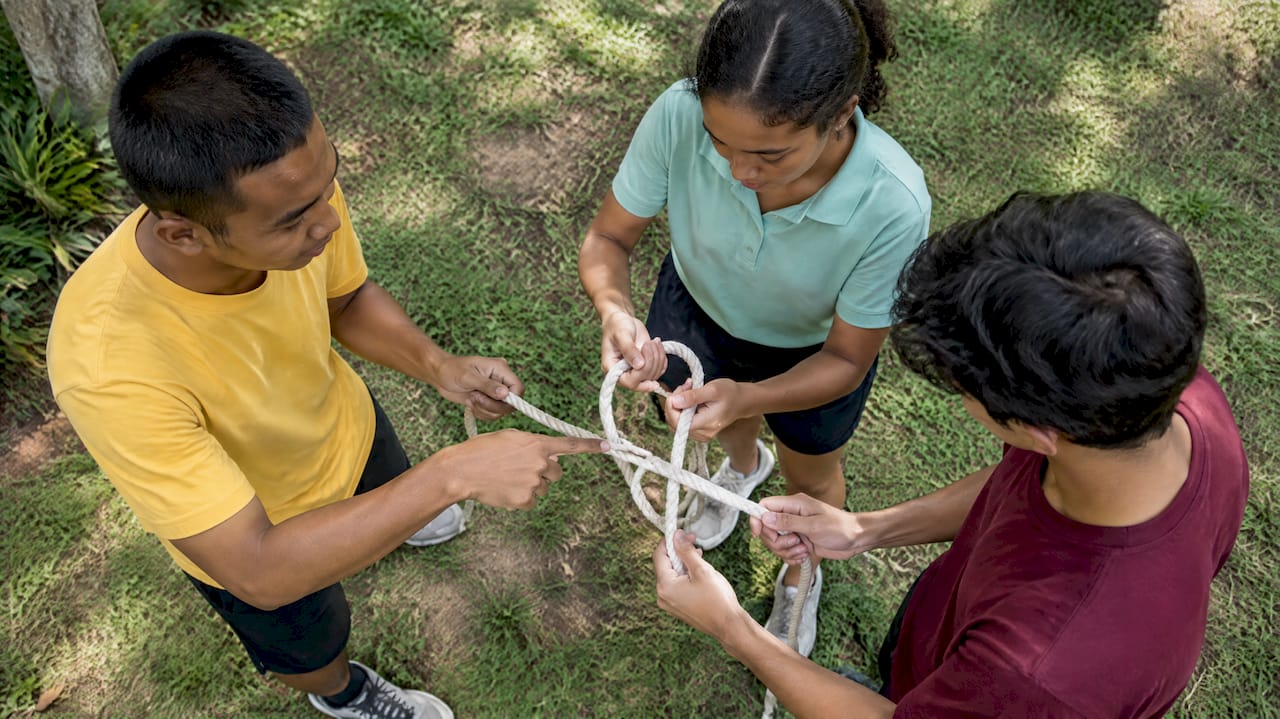
Keep these short and rotate the leader every round. Then ask the group what instructions worked, and which ones confused people.
Strategy under time pressure
Orienteering, treasure hunts and tactical team games force a group to split tasks and regroup. Give each team a limited resource, such as one map, a fixed number of attempts or a strict time cap, because scarcity forces a leader to decide rather than discuss endlessly.
Skill challenges with a visible score
This is where laser clay sits. A scoreboard turns the abstract idea of performance under pressure into something students can see. We cover this in detail below, because it is what we do every day.
Reflection circles
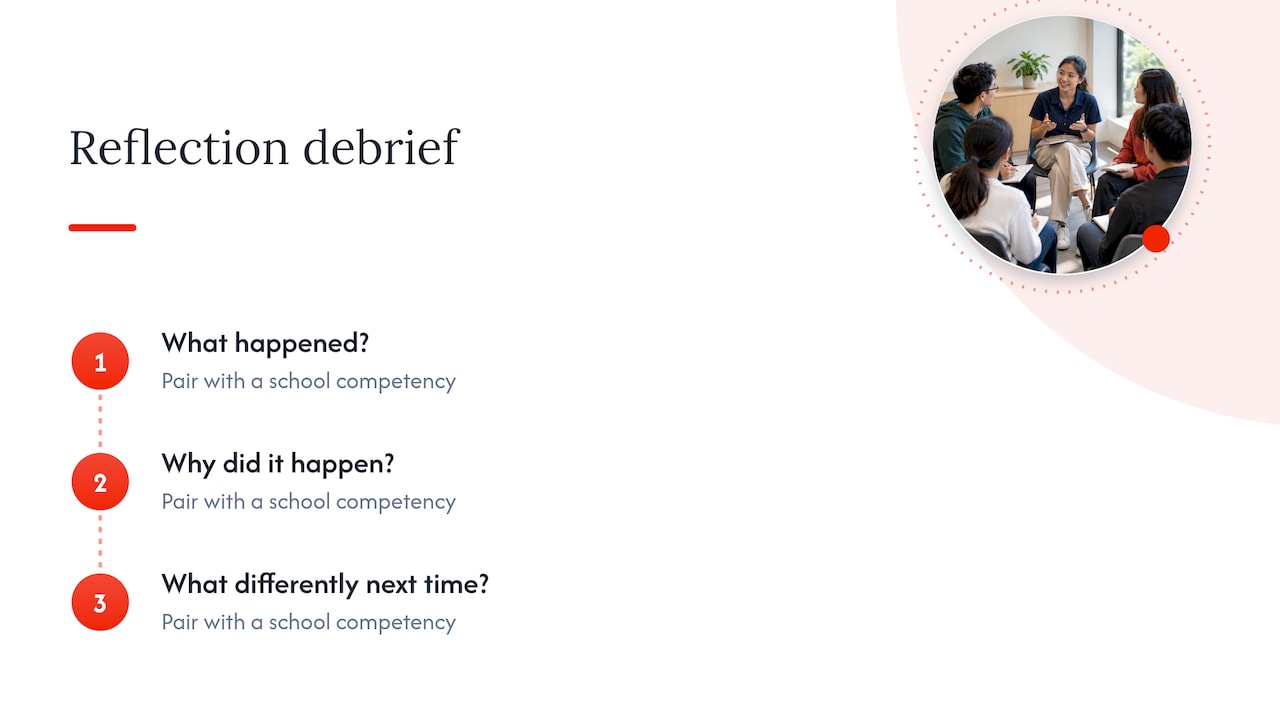
Treat the debrief as an activity in its own right. A simple format works: what happened, why did it happen, what would you do differently as a leader next time. Pair each question with a competency the school already uses, such as those in its Values in Action or CCE framework.
Build the camp into the school year
A camp that stands alone rarely changes classroom behaviour. MOE describes Character and Citizenship Education as taught through a range of platforms and experiences, including Student Development Experiences, which are programmes and activities that contribute to the holistic development of students. A leadership camp is a natural Student Development Experience, but only if it connects to something before and after.
A simple structure:
- Before the camp (one lesson): introduce two or three leadership competencies and ask students to set a personal goal.
- During the camp: tie each activity to one competency, and tell students which one they are practising.
- After the camp (one lesson or CCA meeting): have students report on how they applied their goal, then assign a small real task, such as running a CCA session or an assembly segment.
When you brief vendors, ask whether their content can be modular so it matches your goals. A vendor who can only offer one fixed package is harder to align with your curriculum.
Vendor safety checks Singapore schools should run
This part is not optional. Following serious incidents in Singapore school camps, scrutiny has tightened. CNA reported that a 15-year-old student died after an incident during a 2021 camp programme at a high-element rope course, and that a man was later charged. The lesson for planners is simple: the higher the physical risk, the more your due diligence matters.
What to ask any vendor:
- Registration and assessment. MOE’s position, set out in a parliamentary reply on outdoor education and activities, is that external vendors for school outdoor activities go through registration and assessment. Ask to see proof, and check with your school’s own process for approved vendors.
- The code of practice. Singapore has a code of practice for outdoor adventure education, SS 710:2024. Ask which parts of it apply to the activity on offer and how the vendor complies.
- Certified personnel. Ask for current certificates for the instructors who will actually be on site, not the company in general.
- Ratios. The same source notes that established programmes typically run at about 1 instructor to 12 to 14 students. Ask for the ratio in writing.
- Risk assessment. Request a written risk assessment for your venue and your age group, and an emergency plan.
- Weather plan. Ask what happens if it rains or if heat levels are high. MOE has issued updated guidelines on adverse climate events to safeguard student safety, so build your wet and hot weather plan around them.
These checks apply to us too. We are happy to answer the questions above for your specific event, and we recommend you ask every provider the same ones.
Inclusive by design
A leadership camp should not leave out the student who cannot climb, or the one who is nervous around heights. MOE’s new Coney Island campus, one of four consolidated outdoor adventure learning sites, has been designed with wheelchair-accessible options among its high-adventure elements. That is a useful signal for school planners: accessibility is now part of the baseline for good outdoor programmes.
For your own camp, choose at least some activities where every student can fully take part, and where leadership is about decisions rather than physical strength. Our guide to inclusive outdoor school sports gives ten examples educators can use.
What does a school leadership camp cost in Singapore?
Prices vary widely with length, venue and how much facilitation is involved. One Singapore camp provider’s published booking page shows short sessions starting around 58 SGD per person, while multi-day immersive camps can exceed 380 SGD per person. Treat that as an indication of the range, not a quote.
When you compare quotes, check what is included:
- facilitators and their ratio to students
- equipment and set-up
- venue hire, if any
- insurance and risk documentation
- transport and meals, which are often extra
- debrief materials or curriculum links
A cheap per-head price that leaves out facilitation is rarely cheaper in the end.
Where laser clay fits in a leadership camp
Laser clay shooting recreates the clay pigeon experience without lead, noise or live ammunition. Students use sound-simulated, deactivated shotguns and aim at reusable clay targets, while an electronic scoreboard tracks results in real time. It is fully facilitated, suitable from age 10, and can run indoors or outdoors. For a general introduction, see what laser clay shooting is.
Why it works for leadership development:
- Composure under watch. Students shoot while teammates look on, and the scoreboard makes the result visible. That is a mild, safe version of performing under pressure.
- Custom formats. We can set up game formats and scoring systems to suit your goal. A relay format rewards teamwork. A knockout format rewards tactics. A team-total format makes every shooter responsible to the group.
- Role rotation. Students can act as team captains, scorers, strategists or coaches between rounds, which gives more students a leadership role than a single captain.
- Natural debrief material. The scoreboard gives you data. Ask: why did the team’s score drop in round three? Who noticed? What did you say to the shooter?
- Low barrier. Strength and prior experience matter little, so a student who is not sporty can finish at the top of the scoreboard. That challenges assumptions about who a leader is.
- No lead, no noise pollution. It suits schools that want an eco-friendly option and a calm setting for a briefing and debrief on the same site.
For a closer look at how the skills translate, our practical guide to skill development in laser clay walks through them. If you are weighing it against other team games, see our comparison of laser tag and paintball for age 10 versus 14.
A sample half-day leadership programme
This is an example structure, not a fixed package, and we adjust it to your cohort size and aims.
- Opening briefing (15 minutes): introduce the competency for the day, such as communication, and assign teams.
- Trust warm-up (30 minutes): a blindfolded navigation or rope puzzle with rotating leaders.
- Laser clay round one (40 minutes): each team has a captain who plans the shooting order. Scores are posted live.
- Mid-point debrief (15 minutes): what did the captain decide, and what would change?
- Laser clay round two (40 minutes): a new captain per team, a different scoring format, for example team total.
- Closing reflection (30 minutes): each student names one thing they will do differently as a leader, linked to a CCE or Values in Action goal.
That gives students two rounds of leading, two rounds of being led, and two chances to reflect, in under three hours of activity.
Our perspective
We built our school offering around one belief: students learn leadership by being given real responsibility in a setting where mistakes are cheap. Laser clay suits this because the stakes feel real to a 12-year-old, with a scoreboard and teammates watching, while the physical risk stays low.
We also think schools should be sceptical of any camp that sells activities without a debrief. We would rather give you 20 fewer minutes of shooting and 20 more of reflection. We run every session with facilitators and size staffing to the group, as set out in our laser clay staffing guide, which describes one operator and one marshal per 10 players.
Before booking anything, including with us, check the set-up needs of your venue. Our laser clay setup checklist lists the three checks planners should run, and the power requirements guide helps you avoid mid-session stalls in a school hall or field.
— Joshua
Booking laser clay for your school camp
We bring the system, the facilitators and the set-up to your school or chosen venue. Our Corporate Laser Clay Package is priced at 69 SGD per person and is often used as the template for group programmes. If you have your own facilitators and only need the equipment, our system rental runs from 500 to 800 SGD per hour. For pricing specific to a school cohort, contact us with your date, headcount and the competency you want to focus on, and we will tailor a format to it.
If you are planning a wider event, such as a carnival or night camp, our night camp planning guide covers games and permits, and our overview of how laser clay fits event formats shows the options.
Planning checklist for teachers
Use this list at least eight weeks before the camp date.
- Define one or two leadership competencies the camp will target.
- Link them to a CCE, PE or Values in Action goal.
- Shortlist vendors and request registration proof, certification, ratios and risk assessments.
- Choose a mix of activities: one trust activity, one strategy activity and one scored skill challenge.
- Build in a debrief after every major activity.
- Plan for wet and hot weather, and for students with different physical abilities.
- Brief parents on the schedule, safety arrangements and costs.
- Schedule a follow-up session in school within two weeks.
If you run an MOE-supported pathway as well, remember that the national programme already exists for certain levels. The MOE-OBS Challenge Programme is described as an outdoor adventure learning experience across primary and secondary levels, so a school-run leadership camp works best as a complement that targets student leaders rather than a replacement.
FAQ
What are good leadership camp activities for secondary school students?
The best mix includes a trust or communication challenge, a strategy game with a time limit, and a scored skill challenge such as laser clay shooting. Rotate the leader in every round and finish each activity with a short debrief. Without that reflection, the activities are fun but teach little about leadership.
How do I check that a camp vendor is safe for students?
Ask for proof of registration and assessment under MOE’s requirements for external vendors, current certificates for the instructors on site, a written risk assessment and the instructor-to-student ratio. Ask how the vendor applies SS 710:2024 to the activities on offer. Your school’s own approval process has the final say on whether a vendor can be used.
Is laser clay suitable for primary school students?
Our laser clay sessions are suitable from age 10, which covers upper primary. The equipment uses sound-simulated, deactivated shotguns and reusable targets with no lead or live ammunition, and every session is fully facilitated. Contact us with your group’s ages and size so we can recommend a suitable format.
How much does a school leadership camp cost in Singapore?
One Singapore provider’s published pricing runs from around 58 SGD per person for short sessions to over 380 SGD for multi-day camps. Our Corporate Laser Clay Package is 69 SGD per person, and system rental is 500 to 800 SGD per hour. Always check what is included, such as facilitators, set-up and insurance, before comparing quotes.
Sources
- MOE: New Outdoor Adventure Learning Centres
- MOE: Outdoor education and activities (parliamentary reply)
- MOE: Updated school guidelines on adverse climate events
- MOE: What is Character and Citizenship Education
- SS 710 outdoor adventure education code of practice
- Youth leadership camp: experiential learning approach
- Jurong Pioneer Junior College: Leadership Training Camp 2023
- Fairfield Methodist School (Secondary): Blackmore Leadership Training Camp 2025
- CNA: Man charged over death of ACS(I) student at rope course
- Camp provider booking page with published prices