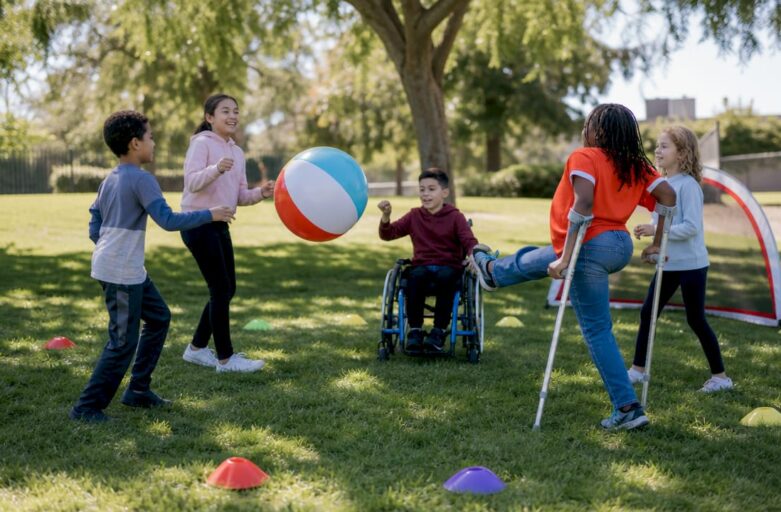
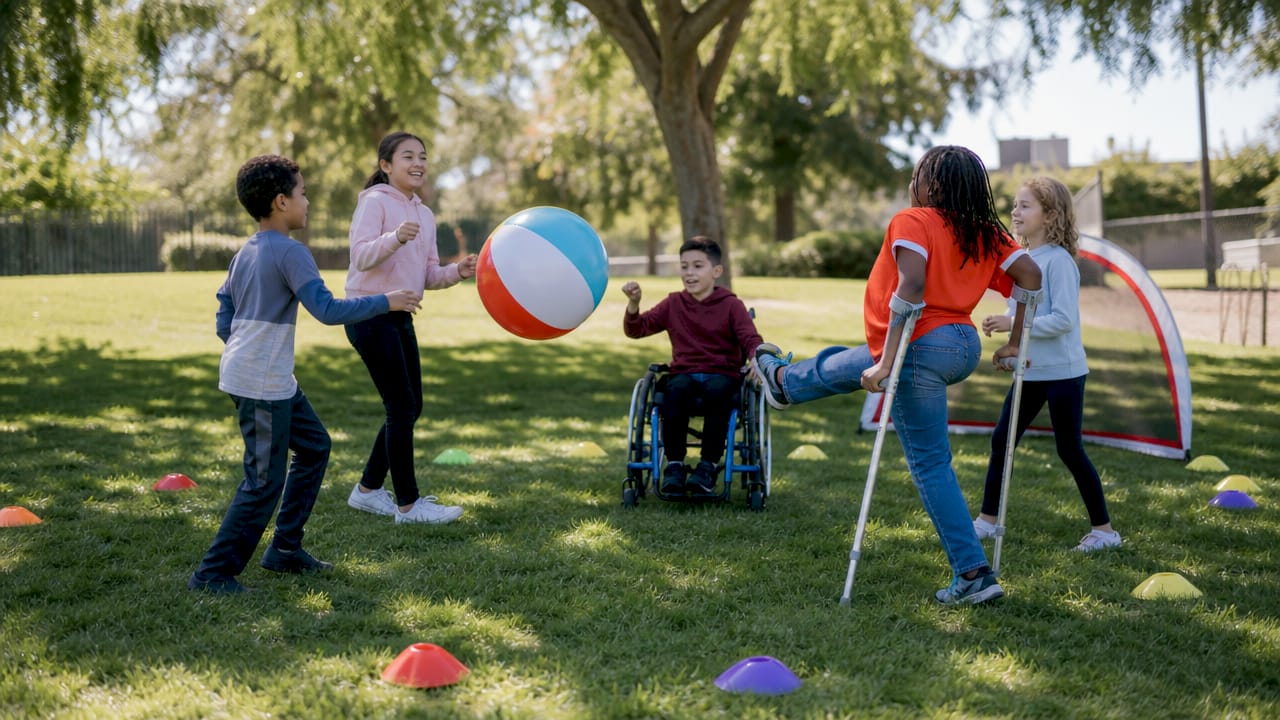
Inclusive outdoor school sports are activities designed to enable meaningful participation by students of all abilities, building teamwork, confidence, and enjoyment in physical education. The term used by practitioners is adaptive physical education, though “inclusive sport” is now the standard in school policy. Frameworks like the STEP model (Space, Task, Equipment, People) and co-design approaches give educators a clear method to adapt almost any outdoor activity. A 2026 inclusive sports festival showed that 135 students across Grades 3–7 participated across eight or more stations, proving that large-scale, multi-activity formats work in real school settings.
Examples of inclusive outdoor school sports to try this term
The strongest examples of inclusive outdoor school sports share one quality: they lower the barrier to entry without removing the challenge. Each activity below can be delivered outdoors with minimal specialist equipment.
1. FunEball
FunEball is a cooperative ball sport built around one rule: any body part counts. Players may use hands, feet, thighs, or head to keep the ball in play, with up to seven touches allowed per rally. That single rule change removes the technical gatekeeping that excludes students with limited coordination or mobility. The result is a game where a wheelchair user and a county-level athlete compete on genuinely equal terms.
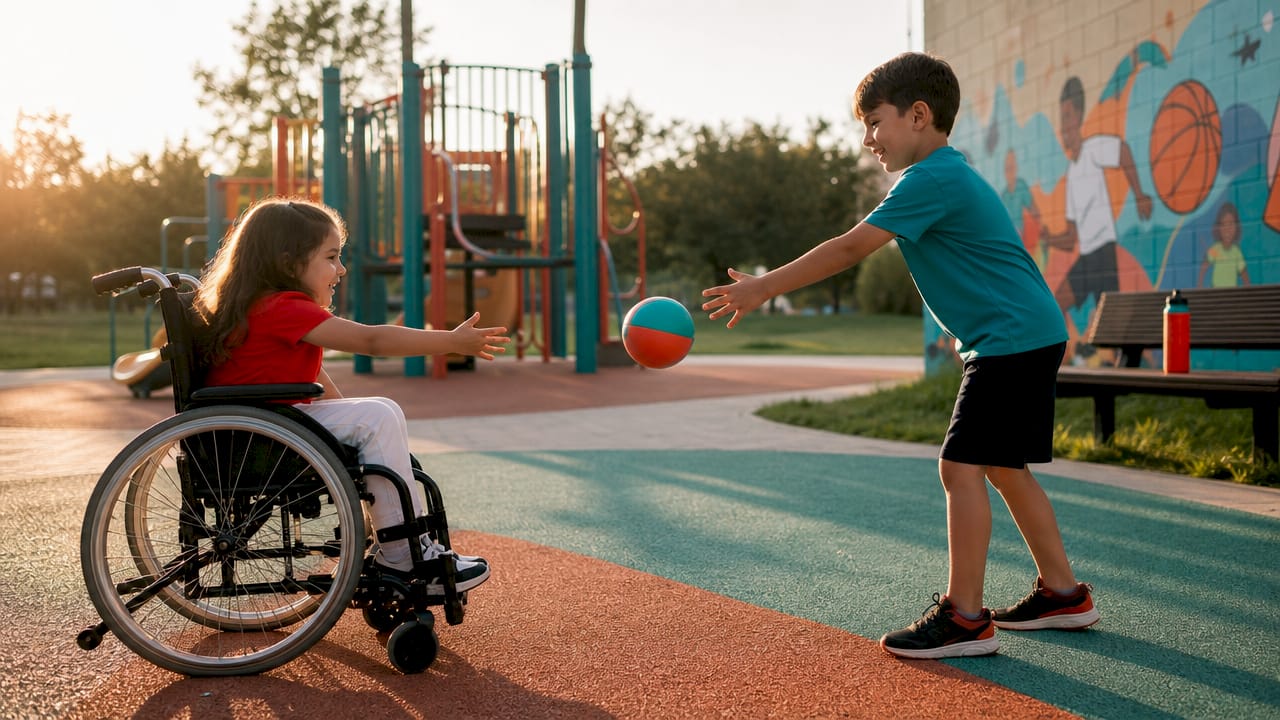
Pro Tip: Run FunEball in mixed-ability pairs first. Pairs build trust faster than large teams, and you will see students self-organise fairer rotations within ten minutes.
2. Adaptive boccia
Boccia is one of the most transferable outdoor sports for schools because it requires no running and rewards precision over power. Set up on grass with coloured balls and a target jack, and the game is immediately accessible to students with physical disabilities, visual impairments, or limited upper-body strength. Ramp assists and larger target zones extend participation further. The 2026 Comox Valley festival included boccia as one of its core stations, confirming its value in a multi-ability setting.
3. All-abilities outdoor soccer
Structured soccer programmes for mixed-ability groups use 12-week skill-building cycles with gentle warm-ups and no competitive scoring pressure. The format replaces match results with personal progress goals, so every student has a reason to attend. Coaches use smaller pitches, lighter balls, and modified offside rules to keep the game flowing regardless of mobility level. This structure works equally well as a lunchtime club or a formal PE unit.
4. Unified track and field
Unified track pairs students with disabilities alongside partner athletes in the same events. A 2026 programme in Klamath County ran 14 athletes with disabilities alongside 15 partner athletes in relay and sprint events. The unified format builds school pride because both groups train together, not in separate sessions. Relay events work especially well outdoors because they require communication and timing rather than raw speed alone.
5. Wheelchair obstacle courses
Outdoor obstacle courses designed for wheelchair users teach spatial awareness, problem-solving, and peer support simultaneously. Non-wheelchair users navigate the same course using scooter boards or crawling, which creates genuine empathy rather than a spectator dynamic. Courses can be built from cones, rope bridges, and low ramps using standard PE equipment. Rotating roles so every student uses the adapted route at least once is the key design principle.
6. Parachute games
Parachute play is one of the most underrated inclusive physical education activities for primary and lower secondary schools. Every participant holds a section of the parachute, so contribution is equal regardless of strength or coordination. Activities range from wave-making and mushroom lifts to ball-rolling challenges that require the whole group to communicate. The outdoor setting adds wind resistance as a natural variable, making the activity unpredictable and genuinely exciting.
Pro Tip: Assign a student with a disability as the “caller” who directs the group’s movements. This shifts the social dynamic and builds leadership confidence in students who rarely hold that role.
7. Modified cricket and rounders
Cricket and rounders adapt well for outdoor sports for all because the core skill, striking a ball, can be modified at every level. Use a tee stand instead of a bowled delivery, a larger bat, or a softer ball to accommodate students with visual impairments or limited grip strength. Fielding positions can be assigned by mobility range rather than by convention. These modifications preserve the social structure of the game while removing the barriers that typically exclude students with disabilities.
8. Target archery (foam-tip)
Foam-tip archery requires focus, breath control, and upper-body stability, making it one of the few outdoor sports that genuinely favours students who struggle with running-based activities. Seated and standing positions are equally valid, and draw-weight adjustments mean students of any strength level can participate. Schools that have introduced archery as part of an inclusive sports programme report that it attracts students who opt out of traditional team sports. The outdoor setting and the quiet concentration required create a noticeably different social atmosphere.
9. Cooperative orienteering
Orienteering becomes inclusive when teams are mixed-ability and the scoring rewards cooperation rather than individual speed. Assign each team member a specific role: navigator, timekeeper, recorder, or support partner. Students who use mobility aids navigate accessible checkpoints marked on a simplified map of the school grounds. The activity builds map-reading skills, communication, and trust across ability groups in a single session.
10. Inclusive athletics festivals
Multi-station athletics festivals, modelled on the Comox Valley format, are the most scalable example of inclusive outdoor school sports at a whole-school level. Stations rotate every ten to fifteen minutes, so no student is locked into one activity for the full session. Events include seated shot put, beanbag target throws, and assisted sprint relays alongside standard track events. Lifelong participation pathways from school to community and representative levels are built into the best festival models, giving students a reason to stay engaged beyond the school day.
How the STEP model adapts outdoor sports for all students
The STEP model is a four-part framework that turns any mainstream sport into an inclusive activity. Each letter represents one variable you can adjust independently.
- Space. Reduce court or pitch size to keep students with limited mobility involved in every play. Larger zones around goal areas give wheelchair users a realistic chance of scoring.
- Task. Simplify rules or reduce the number of steps required to complete an action. FunEball’s multi-touch rule is a direct application of task modification.
- Equipment. Swap standard balls for lighter, larger, or softer alternatives. Foam balls, beach balls, and tee stands all lower the physical demand without changing the game’s social structure.
- People. Adjust team sizes, assign roles by ability, and use peer-support pairings. Unified team formats, where disabled and non-disabled students compete together, are the strongest application of the People variable.
Pro Tip: Apply only one STEP variable at a time when trialling a new modification. Changing space, task, and equipment simultaneously makes it hard to know which adjustment actually improved participation.
Benefits of inclusive outdoor sports in school communities
Teachers report that inclusive school sport builds empathy and stronger peer relationships that extend well beyond PE lessons. That finding matters because social bonds formed during physical activity tend to be more durable than those formed in classroom settings. Students with disabilities show measurable gains in confidence and autonomy when they participate in co-designed programmes that align activities with their own interests and needs.
“Inclusive sport shifts the culture of a school. When students with and without disabilities train and compete together, the default assumption changes. Ability stops being the measure of who belongs.”
The cultural shift is not limited to students. Families and educators both report changed attitudes after sustained inclusive programmes. Schools that commit to outdoor sports for all over a full term, rather than a single event, see the deepest and most lasting changes in school culture.
Practical tips for educators implementing inclusive sports programmes
Getting an inclusive programme off the ground requires more than good intentions. These steps address the most common barriers educators face.
- Co-design with students. Involve students with disabilities in choosing and designing activities from the start. Co-designed programmes show higher participation rates and stronger student confidence than top-down formats.
- Partner with external organisations. Disability sport organisations provide equipment loans, trained coaches, and session planning support. Partnering with community experts directly addresses the knowledge and staffing gaps that most schools face.
- Start with one station format. A single adapted activity station added to an existing sports day is a lower-risk entry point than a full programme redesign.
- Secure dedicated time for teacher training. Release time for staff to learn adaptive PE methods is the single most effective investment a school can make in programme quality.
- Use low-cost, scalable activities first. Parachute games, boccia, and modified cricket require minimal budget and no specialist facilities. Build confidence with these before investing in equipment-heavy formats.
- Communicate with families early. Parents of students with disabilities are often the most effective advocates for programme expansion. Involving them in planning builds trust and increases attendance.
Key takeaways
Inclusive outdoor sports succeed when educators apply structured frameworks, involve students in design, and commit to sustained delivery rather than one-off events.
| Point | Details |
|---|---|
| Use the STEP model | Adjust space, task, equipment, or people to make any outdoor sport accessible. |
| Co-design with students | Programmes designed with disabled students show higher participation and confidence gains. |
| Start small and scale | One adapted station at an existing sports day is a practical and low-risk starting point. |
| Partner with experts | External disability sport organisations fill knowledge and staffing gaps effectively. |
| Prioritise fun over competition | Cooperative formats like FunEball and parachute games build belonging faster than competitive structures. |
What I have learned from watching inclusive sports programmes succeed and fail
The programmes I have seen work best share one quality that no framework captures: the teacher genuinely enjoys the activity alongside the students. The STEP model is an excellent tool, but it is a checklist, not a culture. Schools that treat inclusive sport as a compliance exercise produce sessions that feel exactly like that.
The co-design principle changed my thinking most. I used to assume that educators needed to design the perfect activity and then deliver it. Watching students with disabilities redesign a boccia court layout in real time, arguing about distances and angles with the same intensity as any sports coach, showed me that the design process is itself a form of participation. The activity does not need to be perfect before it starts.
Family involvement is the variable most often left out of educator training. A parent who understands why their child is playing FunEball rather than football will advocate for the programme at the next school board meeting. That advocacy is what turns a single inclusive sports day into a permanent fixture in the school calendar. The non-contact, participation-first approach that schools are increasingly adopting reflects exactly this shift in priorities.
— Joshua
Laserclay: an inclusive outdoor activity for school groups
Schools looking to extend their inclusive sports offer beyond traditional PE will find that Laserclay fits naturally into the mix. Laserclay uses laser technology to replicate clay shooting without ammunition, physical contact, or specialist fitness requirements. Every student, regardless of mobility or athletic background, can participate on equal terms.
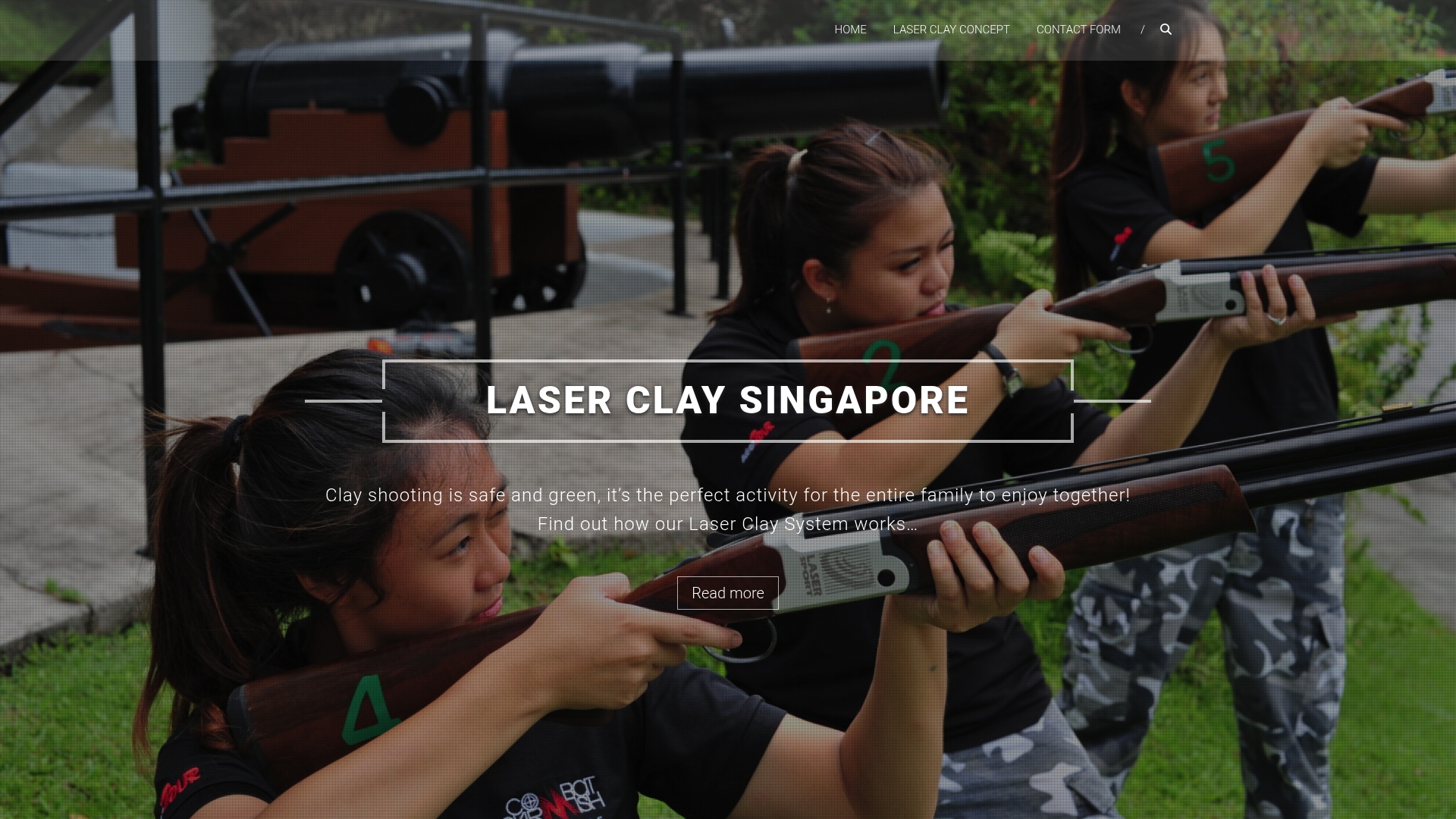
Laserclay sessions are structured around team scoring, which means the activity builds the same communication and cooperation skills as unified track or cooperative orienteering. The format works for school sports days, end-of-term events, and team-building days. There are no safety concerns associated with traditional shooting sports, and the group event format scales from small class groups to whole-year cohorts. Find out how to play Laser Clay and see how it fits your school’s next outdoor event.
FAQ
What are the best inclusive outdoor sports for primary schools?
Parachute games, adaptive boccia, and FunEball are the most accessible starting points for primary schools. All three require minimal equipment and no specialist facilities.
How does the STEP model help educators adapt outdoor sports?
The STEP model modifies Space, Task, Equipment, or People independently, allowing educators to adjust one variable at a time until participation improves for all students.
What is a unified sports programme?
A unified sports programme pairs students with disabilities alongside non-disabled partner athletes in the same events and training sessions, building shared participation and school pride.
How do I start an inclusive sports programme on a limited budget?
Begin with parachute games, modified cricket, or boccia, all of which use standard PE equipment. Add one adapted station to an existing sports day before committing to a full programme redesign.
Why is co-design important in inclusive physical education activities?
Co-designed programmes align activities with students’ actual interests and needs. Research shows they produce higher participation rates and stronger confidence gains among students with disabilities than programmes designed without student input.