

Prioritise one physical or active pursuit, one creative outlet, and occasional STEM or life-skills blocks, and you cover most of what a child needs beyond the classroom. That balance beats stacking five subjects nobody has time to enjoy. Below is a curated list of ideas by category, a framework for choosing providers without wasting money on the wrong fit, realistic costs and time commitments, and local pointers for finding programmes worth trusting.
TL;DR:
- External enrichment should focus on building skills aligned with the school’s 21st-century competencies, such as resilience, teamwork, and creativity.
- Test providers with trial classes and clear curriculum explanations to avoid long-term commitments and ensure quality.
- Active, experiential formats like laser clay shooting enhance decision-making, focus, and teamwork in a safe, portable setting.
- Prioritize one or two enrichment activities per week to prevent fatigue, with options available through school CCAs, community centres, and STEM centres.
Table of Contents
- School enrichment ideas Singapore parents can act on this term
- How to choose the right enrichment programme for your child
- Planning enrichment around school life: time and cost
- Finding trustworthy programmes in Singapore
- An experiential example: what active enrichment like laser clay adds
- Weaving in Singapore’s culture and heritage
- How to judge whether a programme is actually working
- Making enrichment work across ages and abilities
- Popular and recommended enrichment providers to know
- A parent’s take on starting without overwhelm
- Book laser clay for your school’s next camp or event day
- Sources
- FAQ
School enrichment ideas Singapore parents can act on this term
Singapore’s schools already run co-curricular activities as a core part of holistic education, with the Ministry of Education framing CCAs around 21st-century competencies such as resilience, teamwork and creativity, not just extra tuition hours. That’s the right lens for choosing external enrichment too: ask what skill it actually builds, not just what subject it covers. Here’s a working list, grouped by what each category tends to deliver.
1. Academic extension
Creative writing workshops, debate clubs and language enrichment sit in this bracket, and they do more than polish grammar. Debate teaches structured argument and quick thinking under pressure; a good maths olympiad programme trains problem decomposition rather than speed calculation. Most run as weekly one-hour classes in small groups of six to twelve, with language clubs (Mandarin, Malay, Tamil, French) often blending conversation practice with cultural content so it doesn’t feel like extra homework.
2. STEM enrichment ideas
Coding and robotics classes for primary-age children usually start with block-based tools before moving to text-based languages around upper primary. Maker labs, where kids build circuits or simple machines, suit tactile learners who switch off during lecture-style science. Science centre workshops are worth a special mention: they deliver inquiry-based STEM exposure in a single visit rather than a term-long commitment, which suits families still working out whether a child actually enjoys the subject or just likes the idea of it.
3. Arts and performance
There’s a real difference between arts lessons and performance groups, and parents often conflate the two. A weekly piano or art lesson builds technical skill through repetition. A drama troupe or choir, by contrast, works toward a public performance, which adds deadline pressure, group coordination and stage confidence that solo lessons rarely touch. If a child freezes in front of an audience, a performance group is the more useful (if less comfortable) choice.
4. Sports and movement
Gymnastics, swimming and martial arts build different things. Swimming is closest to a life skill; gymnastics develops body awareness and discipline; martial arts (judo, taekwondo, silat) tend to layer in respect and self-control alongside fitness. Team sports like football or basketball teach something none of the individual sports can: how to lose as a group and try again the following week.
5. Outdoor and experiential learning
Camps, coastal walks, nature programmes and museum workshops fit best as periodic events rather than weekly fixtures. A three-day school holiday camp delivers concentrated exposure, teamwork under novel conditions and a break from screens. These work well slotted into the school holidays rather than competing with term-time CCAs for the same afternoon slot.
6. Life skills
Public speaking, cooking classes, mindfulness sessions and youth leadership programmes round out the list. These often get overlooked because they don’t map to a school subject, yet they’re exactly the kind of transferable skill that MOE’s competency framework points to. A child who can plan a simple meal or calm themselves before a test carries that further than another hour of assessment books.
7. High-tech experiential options
A newer category worth knowing about: laser-style electronic shooting and simulation activities, increasingly used at school co-curricular events and camp days for active, strategy-driven engagement. These sit closer to a structured game than a sport, combining physical coordination with scoring and teamwork, and they work as an occasional highlight rather than a weekly class. More on how one of these formats runs is covered further down.
How to choose the right enrichment programme for your child
Start with what your child already gravitates toward, not what looks impressive on a school application. A child who lights up during PE but drags their feet to piano practice is telling you something. Layering in three or four activities on top of school and homework almost always backfires, no matter how good each one is individually.
Favour providers that let you test the fit before committing. Semester or term-based sign-ups, common across Singapore schools offering hundreds of co-curricular options, give children room to sample without locking a family into a year-long fee. A single trial class tells you more than any brochure.
Before signing up, ask the provider directly:
- What’s the typical class size, and what’s the instructor-to-child ratio?
- What qualifications or background checks do instructors hold?
- What safeguarding policies are in place for pick-up, supervision and incidents?
- How is progress assessed, and will you get any feedback during the term?
- Is there a trial class or a short introductory package before a full-term commitment?
Watch for red flags: no trial option, no willingness to explain what the curriculum actually covers session by session, or pressure to sign a long-term contract on the first visit. A provider confident in their own quality rarely needs to lock you in before you’ve seen a single class.
Pro Tip: Book the trial for a Saturday morning rather than a weekday evening. You’ll see your child’s genuine energy level, not the version worn down by a full school day.
Planning enrichment around school life: time and cost
Weekly evening classes suit most academic and arts enrichment, while weekend workshops fit sports or STEM sessions that need more space or equipment. Term-based blocks (roughly ten to twelve weeks) are the norm for structured skills like language or coding, and holiday camps concentrate a theme into three to five days when regular term-time slots are already full.
A sensible load by age: one to two activities a week for lower primary, building to two or three for upper primary as children handle their own schedules better. Adding a third or fourth activity rarely improves outcomes and often just adds fatigue.
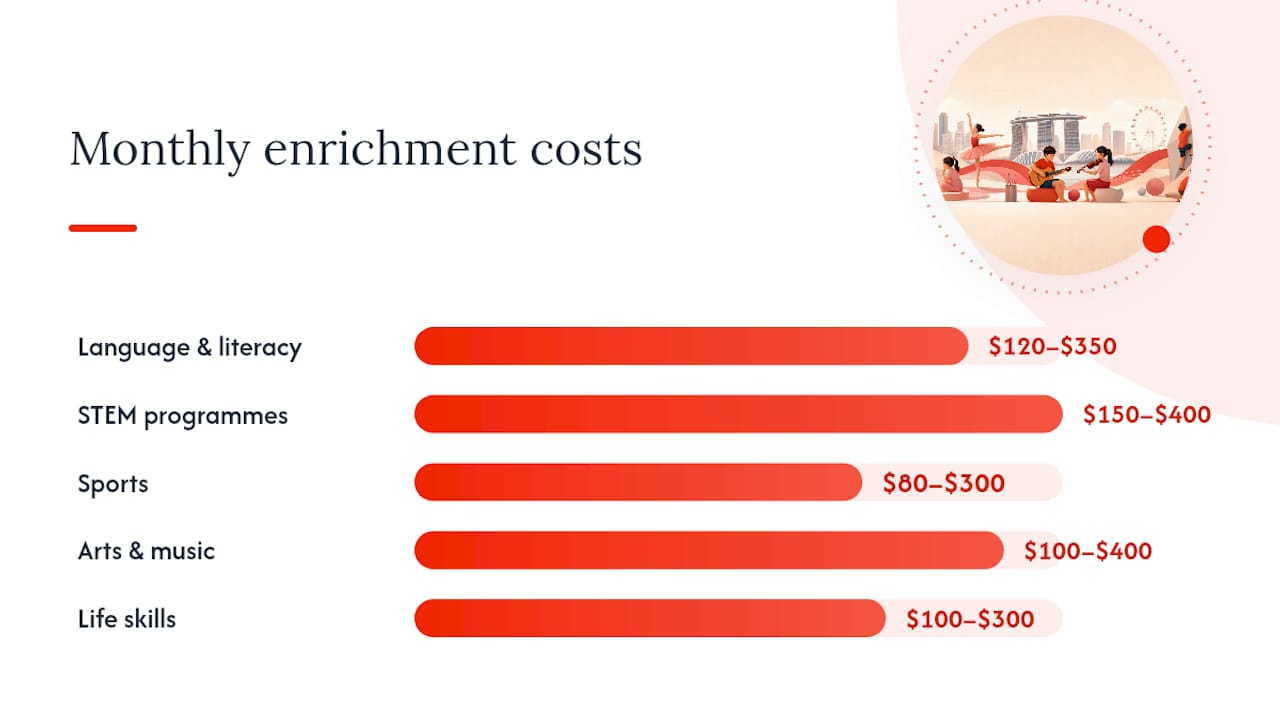
Costs vary a fair amount by category. Illustrative monthly ranges reported across Singapore enrichment providers put language and literacy classes at roughly $120 to $350, STEM programmes at $150 to $400, sports at $80 to $300, arts and music at $100 to $400, and life skills programmes at $100 to $300 a month.
A quick note on combining CCAs with external classes: school CCAs already cover a chunk of the “extra” development time, so treat external enrichment as filling a genuine gap, not duplicating what’s already happening on campus. If your child’s school CCA already covers sport, spend the external budget on arts or STEM instead of doubling up.
Finding trustworthy programmes in Singapore
School CCAs remain the first port of call, and most now run on semester or term models with partnership providers brought in for specialist skills like robotics or fencing, which the Ministry of Education’s curriculum guidance frames as integral to holistic development rather than optional extras.
Beyond school gates, several local channels are worth bookmarking:
- onePA lists community-run education and enrichment courses spanning abacus, speech and drama, tuition and general enrichment across community clubs islandwide.
- Community Development Councils (CDCs) often run subsidised holiday programmes and workshops, particularly useful for cost-conscious families.
- Science Centre Singapore and the ArtScience Laboratory at Marina Bay Sands run school-bookable and holiday-camp STEM workshops that deliver hands-on inquiry-based learning without a term-long sign-up, a genuinely cost-effective way to test STEM interest.
Verify any new provider through a trial class, a referral from another parent at your child’s school, or by checking whether a major school (Dulwich College, SAIS, Stamford American) already uses them as a partner provider. Schools vet these partnerships far more thoroughly than most individual families can manage alone.
An experiential example: what active enrichment like laser clay adds
Active, experiential formats earn their place because they build outcomes drills rarely reach: fast decision-making, focus under mild pressure and cooperation within a team, all while children are moving rather than sitting. A typical session runs as a facilitator-led safety brief, several rounds of team-based scoring, then a short debrief where the group talks through what worked.
Logistically, these formats travel well:
- Group sizes commonly range from a class of 20 up to a full cohort split into rotating teams.
- Setup works indoors or outdoors, so a school hall or field both work.
- Safety sits at the centre of the format, with sound-simulated equipment removing the risks tied to live ammunition entirely.
Pro Tip: Slot an activity like this into an inter-house day or the last afternoon of a camp. It works best as a highlight, not a replacement for a weekly class.
Weaving in Singapore’s culture and heritage
Enrichment doesn’t have to mean importing a Western framework wholesale. Heritage trails through Kampong Glam, Chinatown or Little India teach local history far more vividly than a textbook chapter, and several community groups run guided walks specifically pitched at school-age children during the holidays. Batik painting, dikir barat percussion, or Peranakan craft workshops give children a hands-on link to the cultures that shape Singapore, often through community centres or heritage boards rather than commercial providers.

Language clubs covering Mandarin, Malay or Tamil beyond the Mother Tongue syllabus can double as cultural enrichment when they include festival cooking, traditional games or storytelling sessions rather than pure grammar drills. Museums such as the Malay Heritage Centre and Indian Heritage Centre run school-holiday workshops built around these themes, often at a fraction of the cost of a private class.
For families who want enrichment to mean something beyond skill-building, heritage-based activities offer a quieter kind of value: a child who understands the dikir barat rhythm or knows why Thaipusam matters carries that context into adulthood, long after a coding badge has been forgotten. Treat this category the same as any other. Ask what the session actually teaches, check for a trial or single-visit option, and use it as a periodic addition rather than a weekly fixture.
How to judge whether a programme is actually working
The clearest signal is straightforward: does your child talk about the activity unprompted at dinner, or does getting them there feel like a weekly negotiation? That single observation tells you more than a glossy year-end certificate.
Beyond gut feel, look for programmes that give structured feedback rather than vague progress notes. A decent instructor should be able to tell you, in specific terms, what your child has improved on this term and what still needs work. Programmes anchored in 21st-century competencies such as communication, collaboration and resilience tend to build these check-ins into their structure, precisely because those skills are harder to see than a spelling score.
Watch for outcome markers that fit the activity: a debate club should produce a child more comfortable arguing a position out loud; a coding class should leave your child able to build something small, unprompted, without a worksheet in front of them. If a term ends and nothing observable has changed, that’s a legitimate reason to try something else next term rather than renewing out of habit.
Ask providers directly whether they run periodic parent check-ins or send even brief written feedback. A provider with nothing to say beyond “he’s doing well” after ten weeks either isn’t tracking progress or isn’t paying close enough attention.
Making enrichment work across ages and abilities
Age matters more than most enrichment marketing admits. Lower primary children generally do better with shorter sessions (thirty to forty-five minutes), heavy on movement and light on sitting still, while upper primary and secondary students can handle sixty to ninety minutes of focused work. Pushing a seven-year-old into a ninety-minute STEM class designed for eleven-year-olds usually ends in frustration rather than learning.
For children with additional needs, ask providers directly about their experience and adjustments before signing up rather than assuming inclusion. Some enrichment providers in Singapore run small-group or one-to-one formats specifically suited to children with attention difficulties, sensory sensitivities or physical disabilities, though this varies enormously by provider and isn’t something to assume without asking. A short trial session is the fastest way to see whether an instructor genuinely adapts on the fly or simply repeats a fixed script regardless of how a child responds.
Cost also shapes accessibility. Community-run options through CDCs and onePA tend to sit at the lower end of the price range, making them a sensible starting point for families testing a new interest before committing to pricier private providers. Physical accessibility matters too: check whether a venue has lift access, ground-floor rooms, or adequate space for a wheelchair or mobility aid before booking, since not every community centre or private studio is set up equally.
Popular and recommended enrichment providers to know
International and major schools offer some of the widest CCA portfolios in Singapore, and they’re a useful benchmark even for families at national schools. Dulwich College Singapore, SAIS and Stamford American each run extensive co-curricular programmes spanning arts, sport, STEM and community service, often with semester-based rotation that lets students sample widely before specialising.
Beyond school gates, Science Centre Singapore and the ArtScience Laboratory stand out for STEM specifically, offering both school-bookable workshops and public holiday programmes without requiring a term-long sign-up. For community-based options, onePA’s course listings cover everything from abacus and speech and drama to general tuition, run through community clubs across the island, generally at more accessible price points than private studios.
For active, event-style enrichment, whether an inter-house competition day, a camp highlight or an end-of-term celebration, providers offering laser clay shooting experiences bring a portable, facilitator-led format that neither a private tuition centre nor a sports academy typically covers. It fills a specific gap: structured, safe, high-energy team play that works as a standalone event rather than a term commitment.
A parent’s take on starting without overwhelm
Pick one activity, not five, and use the trial class to test genuine interest rather than your own hopes for it. Watch how your child talks about it afterwards. That single conversation tells you more than any glossy brochure.
For camps and one-off events, pack light and plan transport first: a change of clothes, a water bottle, and a clear pick-up time removes most of the actual stress. The activity itself rarely goes wrong. The logistics around it usually do.
— Joshua
Book laser clay for your school’s next camp or event day
There are options that allow schools to add genuinely active, memorable sessions without the safety and cost overhead of live ammunition. These often feature portable equipment, run by trained facilitators, and use sound-simulated shotguns with reusable, eco-friendly clay targets, avoiding live ammunition, lead residue, and lengthy cleanup afterward.

It fits best as a camp highlight, an inter-house competition day, or an end-of-term celebration rather than a weekly commitment, which makes it a natural complement to whatever academic or arts enrichment your child already attends during term time. Sessions typically accommodate groups of students, can be run indoors or outdoors, and incorporate scoring systems to keep teams engaged between rounds. Schools and event organisers can check how a typical Laser Clay session runs and get in touch for camp or event packages, or look at venue and format options for schools before booking a date.
Sources
- 550+ Co-Curricular Activities (CCAs) | SAIS Singapore
- onePA | Education & Enrichment
- Enrichment classes for primary students: building skills beyond the syllabus — iWorld Learning
FAQ
What are the best school enrichment ideas in Singapore right now?
A balanced mix works best: one weekly active or sports activity, one creative outlet like art or drama, and occasional STEM or life-skills blocks through camps or workshops rather than weekly classes.
How much does enrichment typically cost in Singapore?
Monthly costs generally range from around $80 for sports to $400 for STEM or arts and music, depending on the category and provider.
How many enrichment activities should a child do at once?
One to two a week suits lower primary children, rising to two or three for upper primary, since stacking more rarely improves outcomes and often just adds fatigue.
Where can I find enrichment programmes near me in Singapore?
Check your child’s school CCA list first, then browse community options through onePA’s course listings or visit Science Centre Singapore for STEM-specific workshops.
Is laser clay shooting suitable for school events?
Yes. It works well as an occasional camp highlight or event-day activity rather than a weekly class, using safe, sound-simulated equipment and facilitator-led team formats, with more detail available on how a session is structured.
How do I know if an enrichment provider is trustworthy?
Look for term-based sign-ups, a trial class option, clear answers about instructor qualifications and safeguarding, and ideally a track record as a partner provider at an established school.