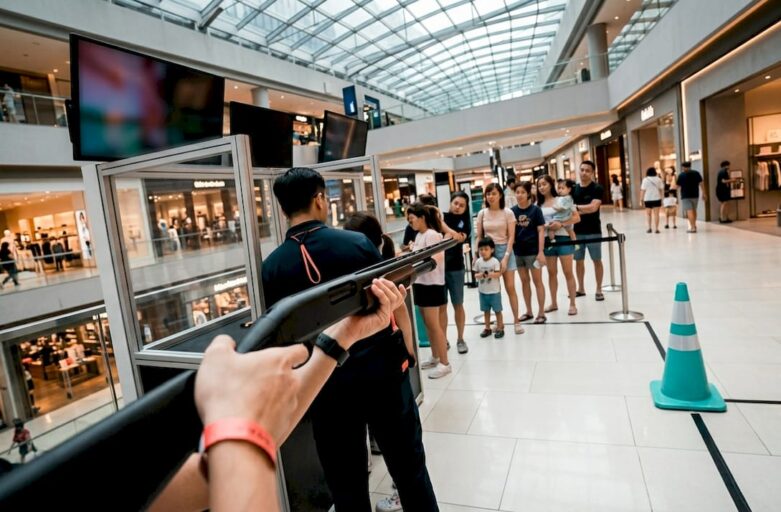
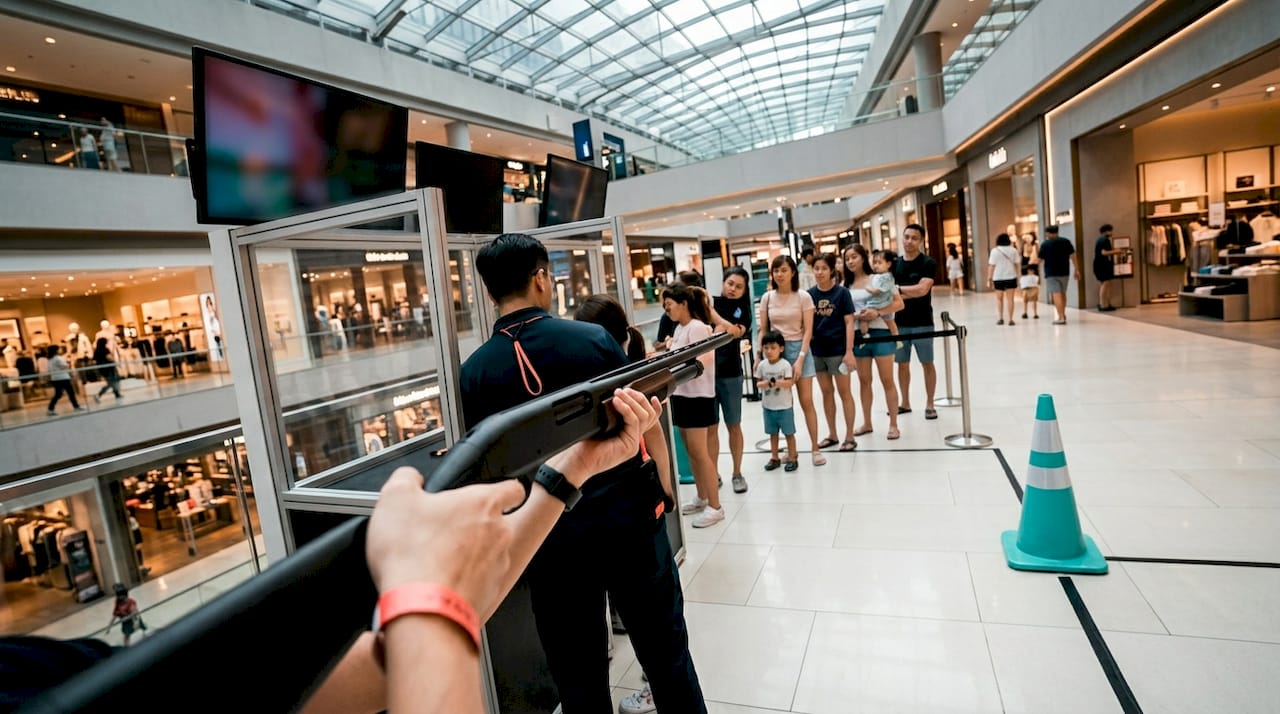
Laser Clay is a strong fit for short, gamified mall activations built around attention, trial, or lead capture. Reusable targets keep waste low, electronic scoring makes results measurable in real time, and facilitator-run sessions keep risk down for family footfall. Before scoping anything, write a one-line brief covering your objective, your KPI, and your available footprint.
TL;DR:
- Laser Clay is ideal for short-term mall activations focused on engagement, lead capture, or awareness, and requires a footprint of at least 4×6 meters per lane.
- Safety measures include supervised sessions, queue barriers, and compliance with fire, laser, and data regulations, especially for outdoor or spillover areas.
- Most activations run for three to ten days with 10-15 minute sessions, and costs range from 49 SGD to 69 SGD per person, depending on the package.
- Clear objectives and KPIs must guide format choice, with formats like leaderboards for awareness and brand missions for direct conversions.
- Permits, especially for outdoor or external setups, take about a month; early planning is essential to ensure smooth approval and compliance.
Table of Contents
- What Makes a Laser Clay Mall Activation Work?
- Pitchable Laser Clay Concepts You Can Run for 3 to 10 Days
- How Do You Choose the Right Laser Clay Format?
- Choosing the Right Mall Typology and Space
- How Long Should It Run, and What Does It Cost?
- What Permits and Safety Rules Apply?
- Sustainability and Your Pre-Build Checklist
- How Do You Amplify Reach with Phygital Mechanics?
- What Laser Clay Actually Provides for Mall Activations
- When Does Laser Clay Deliver, and When Should You Pass?
- Ready to Book Your Laser Clay Mall Activation?
- Where to Check Permits and Safety Rules
- Sources
- FAQ
What Makes a Laser Clay Mall Activation Work?
A laser clay mall activation succeeds for the same three reasons a shopping centre marketer would want any activation to succeed: it’s safe enough to run near families, it produces a number you can report to a client, and it doesn’t leave a mess behind. That third point matters more than most planners give it credit for.
Traditional clay shooting relies on lead pellets and disposable clay discs. A laser clay setup swaps that for sound-simulated deactivated shotguns and light-based scoring, so there’s no ammunition to sweep up and no spent shells to dispose of. That single substitution is what turns clay shooting from a niche outdoor sport into something you could plausibly run in an atrium next to a bubble tea kiosk. This is the eco-friendly phygital gamification angle mall marketing teams increasingly want: a physical activity that produces digital, shareable data, without leaving a waste footprint behind.
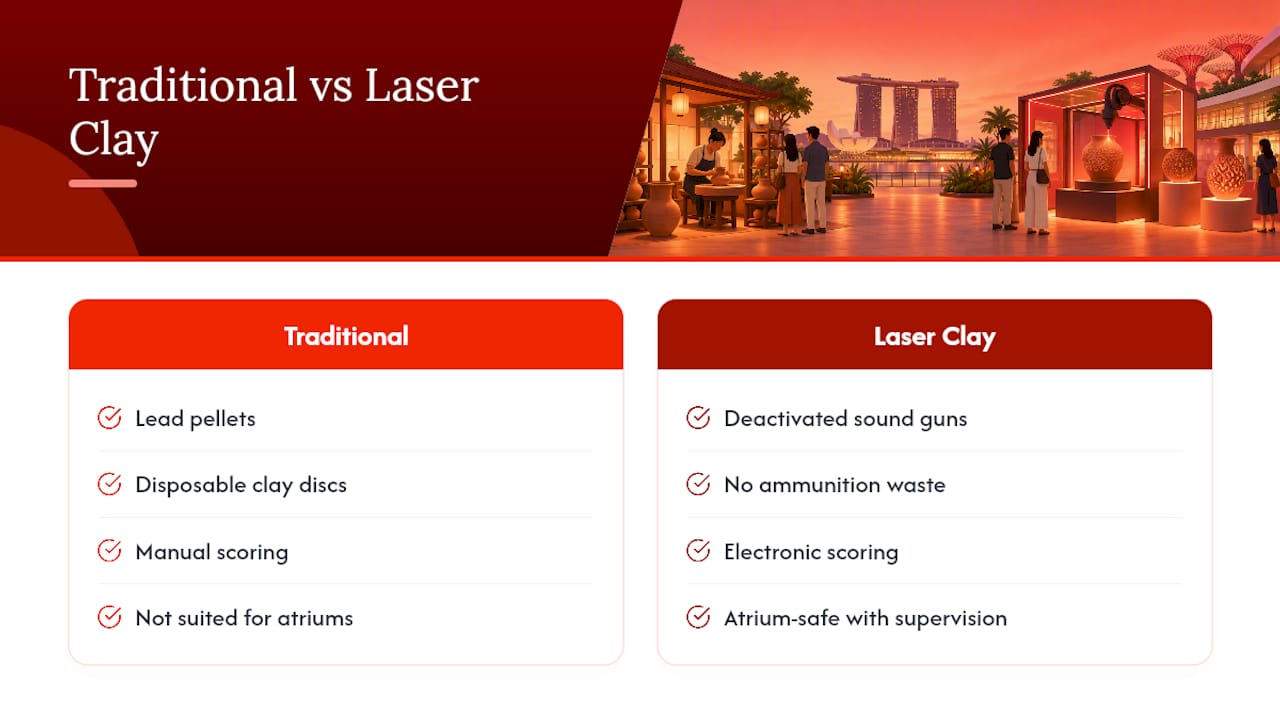
The scoring side solves a different problem: proving the activation worked. Electronic scoreboards log every shot, every participant, and every session length automatically, which gives you clean numbers for a client report without a facilitator manually tallying hits on a clipboard. That’s a meaningful upgrade over generic bounce-house or photo-booth activations, where “engagement” often means guessing from foot traffic alone.
Safety is the third leg. A facilitated laser clay shooting event runs under supervision from start to finish, with a briefed operator managing firing direction, queue flow, and equipment checks throughout the session. For a mall environment where you might have toddlers wandering past a firing line ten metres away, that oversight isn’t optional. It’s the difference between an activation your centre manager approves in one meeting and one that gets rejected outright.
Pitchable Laser Clay Concepts You Can Run for 3 to 10 Days
Most successful mall activations aren’t one format stretched thin. They’re a handful of concepts, each built for a specific commercial outcome, that you can mix and match depending on what the mall or brand actually needs. Here are five that translate well to a short-run laser clay shooting event.
-
Leaderboard challenge. A straightforward competitive format where shoppers shoot for score across the day, with results displayed live on a digital board. This works best when your objective is raw awareness and dwell time rather than direct sales. Footprint sits around 4×6 metres for a single-lane rig, and throughput averages six to eight shooters per hour depending on session length. KPI: participation count against a daily target, plus how often people photograph the leaderboard and post it themselves.
-
Family trial zone. A softer, child-friendly version aimed at getting whole families to linger rather than one competitive shooter at a time. Age minimums typically sit around 10 and up, with shorter sessions and simplified scoring for younger participants. KPI here is dwell time and voucher redemption rather than raw scores, since the commercial goal is footfall into surrounding tenants, not shooting accuracy.
-
Brand-integrated mission. This is where a sponsor’s product gets folded into the game itself, branded targets, product-trial stations built into the mission path, and a QR code that unlocks a reward on completion. It’s the format most likely to convert a shopper into a lead or a sale on the spot, because the game mechanic and the commercial ask are the same motion. KPI: voucher redemption rate or app sign-ups per session.
-
Mini-championship touring unit. Rather than a single mall run, this format tours two or three malls over a season, building a running leaderboard that carries between locations. It rewards repeat visits and gives you a story to pitch to press, “the championship comes to your mall this week.” KPI: cumulative app points or redemption codes tied to the touring leaderboard.
-
Pop-up team games. A corporate-facing variant scheduled for weekday lunch hours or weekend slots, positioned less as retail entertainment and more as a live demonstration of the team-building product itself, useful if a mall wants to attract corporate bookings from nearby office towers. KPI: leads converted into actual corporate bookings.
Staffing needs vary by concept but rarely drop below two people on site, one facilitator running the firing line and one managing queue flow, signage, and rewards redemption. Accessibility matters too: keep at least one lane at a lower firing height or provide a seated option, and make sure queue paths don’t force wheelchair users to double back. Merchandising opportunities are easiest to build into the brand-integrated mission format, since the mission path can route participants past specific tenant storefronts on the way to their next target.
Short-run windows of three to ten days tend to strike the right balance for these formats. Long enough to build word of mouth and let you iterate on the offer mid-run, short enough to preserve the urgency that gets people to try it now rather than next time they’re in.
How Do You Choose the Right Laser Clay Format?
The format you pick should follow directly from the KPI your client actually cares about, not from which concept looks best in a deck. A leaderboard challenge photographs beautifully but tells you little about sales lift. A brand-integrated mission converts well but needs more lead time to build the branded assets.
| Objective | Best-fit format | Primary measurement |
|---|---|---|
| Awareness / dwell | Leaderboard challenge | Participation count, social shares |
| Family footfall / trial | Family trial zone | Dwell time, voucher redemption |
| Data capture / conversion | Brand-integrated mission | QR sign-ups, redemption rate |
| Repeat visits / PR | Touring championship unit | App points, cumulative redemptions |
| Corporate lead generation | Pop-up team games | Booking conversion rate |
Before you scope a supplier, run through a short evaluation checklist:
- Footprint and throughput: does the available space support your target shooters-per-hour, or will queuing kill the experience?
- Audience fit: is the mall’s typical shopper base aligned with the format (families vs. young professionals vs. luxury shoppers)?
- Accessibility: can the layout accommodate wheelchairs, prams, and lower firing heights without a redesign?
- Noise and sightline impact: does the sound-simulated firing mechanism sit within acceptable ambient noise for the location, and can spectators see the action without crossing the firing line?
Pro Tip: Draft your brief before you call any supplier, not after. A one-page brief with objective, target audience, KPI, tentative dates, footprint, and budget band turns a vague enquiry into a quote you can actually compare against alternatives.
A workable starter brief reads something like: “Objective: drive trial of new snack range. Audience: families, weekday afternoons. Dates: first week of March. Footprint: 5x8m atrium space. Budget band: medium.”
Choosing the Right Mall Typology and Space
Not every mall suits every concept, and the mismatch usually shows up as either an empty activation or a queue nobody wants to join. Family-oriented heartland malls tend to reward the family trial zone and leaderboard challenge, where shoppers already expect to linger with kids in tow. Youth-skewed malls near schools or universities respond better to competitive leaderboard formats and touring championship concepts, where bragging rights carry real social currency. Luxury malls need more restraint: a brand-integrated mission tied to a premium product launch works, but a loud competitive leaderboard usually clashes with the tone tenants expect, a point worth weighing against the broader case for events driving luxury retail sales.
Space requirements are non-negotiable regardless of typology:
- Minimum footprint: around 4×6 metres for a single-lane setup, scaling to 8×10 metres or more for multi-lane leaderboard formats.
- Queuing and spectator zones: budget at least 2 to 3 metres of buffer beyond the firing line for queue management and a further zone for spectators to watch without crossing into the firing path.
- Sightlines: position the rig so mall security and facilitators can see the entire firing line and queue from a single vantage point.
Inline kiosk spaces suit small-footprint brand missions but rarely have room for spectator zones. Atrium staging gives you the best sightlines and photo opportunities but usually needs earlier booking due to demand. Corridor placements work for narrow leaderboard formats but need tighter queue discipline since foot traffic flows past on both sides. Outdoor forecourt staging offers the most flexible footprint but introduces power and weather contingencies that indoor venues don’t need to plan for.
How Long Should It Run, and What Does It Cost?
Most successful mall activations run for three to ten days, a window long enough to build repeat visits and word of mouth, short enough to preserve urgency without the format going stale. Within that window, session lengths of 10 to 15 minutes per shooter keep throughput reasonable, typically six to eight participants per hour per lane during peak weekend traffic.
Budget bands vary by how much technology and staffing you layer on:
- Low band: a basic single-lane unit with minimal staffing, suited to a straightforward leaderboard challenge with no branded integration.
- Medium band: adds a digital scoreboard, branded signage, and a rewards mechanism, the sweet spot for most brand-integrated missions.
- High band: full phygital integration with app tie-ins, AR elements, and potentially a touring unit moving between locations, priced accordingly for the added logistics.
For planners renting equipment directly rather than booking a full-service package, system rental runs 500 to 800 SGD per hour, which gives you a rough anchor for scoping the medium band above a raw equipment cost.
Core KPIs to track and how to measure them without overcomplicating your reporting:
- Participation count: logged automatically through the electronic scoring system.
- Dwell time: tracked via simple observational counts or mall foot-traffic heat maps if the venue provides them.
- Lead capture rate: the percentage of participants who scan a QR code, straightforward to calculate from redemption data.
- Social reach: hashtag or geotag tracking across the run.
- Conversion proxy: voucher redemption rate at partner tenants, the cleanest signal of commercial impact.
Short-run activations in this three-to-ten-day window are specifically recommended in experiential marketing guidance because they balance the urgency that drives immediate participation against enough time to test and adjust the offer mid-run.
What Permits and Safety Rules Apply?
Regulatory compliance is where most first-time mall activation briefs fall apart, usually because someone assumed a mall’s own tenancy approval covers everything. It rarely does.
If any part of your activation spills onto Orchard Road frontage, a public plaza, or other state land rather than staying entirely within a mall’s private lease area, you’ll likely need a Non-Renewable Temporary Occupation Licence from the Singapore Tourism Board, and applications typically take about a month to process. Build that lead time into your planning calendar from day one, not after the mall confirms your dates.
Outdoor or tented setups, forecourts, car park activations, anything beyond an indoor atrium, trigger fire-safety conditions under SCDF’s Temporary Change of Use guidance, which sets limits on tent size, minimum passageway widths, and mandatory fire extinguisher provisioning. A qualified person typically needs to sign off on the layout before SCDF approval.
Because the equipment simulates firing with laser components, entertainment-laser regulations apply: proper labelling, visible warning signage, a responsible operator present throughout, and in some cases pre-submission of layout and emission measurement data to the authority before the show goes live.
On-site operational discipline matters just as much as the paperwork:
- Define and mark a fixed firing direction that never points toward pedestrian flow.
- Keep a briefed facilitator supervising the firing line at all times, detailed here.
- Physically separate the queue from the firing zone with barriers or floor markings.
- Log documented equipment checks before every session block, not just once at load-in.
- Rehearse emergency procedures with mall security before doors open.
If your activation captures participant names, phone numbers, or emails for a giveaway or rewards programme, PDPC guidance requires clear consent at the point of collection and sensible retention limits, don’t hold data longer than the campaign needs it.
Sustainability and Your Pre-Build Checklist
Reusable clay targets are the quiet advantage of a laser clay format over anything using disposable materials. There’s no clay disc debris to sweep, no ammunition disposal to arrange, and no single-use signage that gets binned the moment the run ends if you plan reusable branding instead. Retail activations built around sustainability messaging tend to land particularly well with ESG-conscious shoppers, who increasingly notice when a brand activation leaves visible waste behind.
A pre-build checklist keeps setup day from turning into a scramble:
- Site survey confirming floor loading, ceiling height, and column obstructions.
- Power plan mapping outlet locations against the rig’s draw and any digital scoreboard needs.
- Noise mitigation check against the mall’s ambient sound levels and any tenant proximity concerns.
- Signage placement for safety warnings, queue direction, and branding.
- Facilitator briefing covering firing protocols and participant positioning.
- Spare parts kit for common wear items, so a single fault doesn’t shut the whole session down.
- Waste management plan for the minimal packaging and signage materials that do get used.
Pro Tip: Run a full setup checklist walkthrough with your supplier the day before doors open, not the morning of. Anything you missed on power or floor loading is far easier to fix with 24 hours of buffer than 20 minutes.
Contingency planning rounds this out: have a covered fallback plan for sudden rain if any part of the setup sits outdoors, keep a backup generator on standby for outdoor power runs, and pre-arrange additional crowd controllers for weekend peaks when queue volume tends to spike without warning.
How Do You Amplify Reach with Phygital Mechanics?
The physical activation is only half the campaign. The digital layer is what turns a good day of foot traffic into a shareable story that outlasts the run itself. QR codes that unlock a voucher on completion, app points that stack across visits, and AR filters tied to the leaderboard are the standard toolkit, and shareable leaderboard graphics do a surprising amount of unpaid promotion once people start posting their own scores.
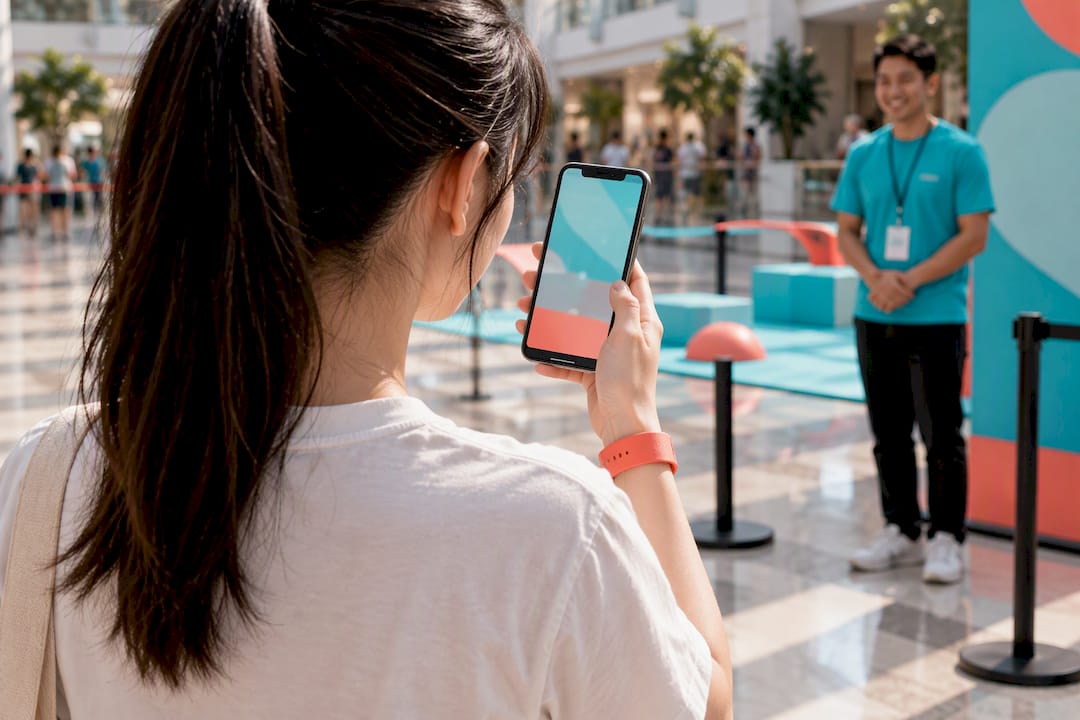
CapitaLand’s phygital storytelling approach is worth studying here: combining physical installations with digital amplification reportedly drove strong increases in participation and sales across several of its mall campaigns, including its Mofusand Holidays activation. The lesson generalises well beyond that specific case: a game mechanic only becomes commercial when the reward is visible and the redemption path is frictionless.
Practical tactics that make participation measurable and commercial:
- Tie voucher unlocks directly to tenant redemptions rather than generic discounts, so tenants can see their own uplift.
- Integrate with the mall’s existing loyalty app where possible, rather than building a standalone one for a short run.
- Build a leaderboard graphic specifically designed to be screenshotted and shared.
Campaign pacing typically follows a tease, soft launch, hero weekend, sustain pattern: build anticipation for a week beforehand, open quietly on a weekday to iron out operational kinks, push hard on the first weekend when foot traffic peaks, then sustain momentum with smaller mechanics (bonus point days, surprise leaderboard resets) through the remaining run before compiling your reporting window.
What Laser Clay Actually Provides for Mall Activations
Laser Clay’s format replaces lead ammunition and disposable clay discs with laser-based scoring and reusable targets, which is what makes an indoor mall setting workable in the first place. The sound-simulated deactivated shotguns recreate the physical feel of the sport without the noise, recoil, or environmental cost of live ammunition, and the electronic scoring runs in real time so your team gets a clean participation number without manual tallying.
The format is built to be accessible from age 10 upward, which matters for family trial zones, and flexes between competitive tournament formats and casual walk-up sessions depending on what the brief calls for. Every session runs facilitated, with an operator managing safety, queue flow, and equipment throughout, which is the operational backbone the permit and compliance sections above assume is already in place.
When Does Laser Clay Deliver, and When Should You Pass?
Laser clay earns its place in a mall activation when three things line up: high baseline footfall, a brand tie-in that gives the format a commercial reason to exist, and a KPI specific enough to report against afterwards. Skip it, or scale it right down, when the available footprint can’t support a safe firing line and clear sightlines, or when the venue can’t guarantee queue control during peak hours.
Before your first briefing call, get clear on four things: your actual objective, your realistic footprint, your KPI, and who on the mall side owns fire and crowd safety approvals. Get those four answers first and the rest of the scoping conversation moves fast.
— Joshua
Ready to Book Your Laser Clay Mall Activation?
If you’ve read this far, you already know the format works when it’s briefed properly. What Laserclay offers over piecing together your own rig and safety plan from scratch is simple: a facilitated, permit-aware setup that arrives ready to run, so your team spends its time on marketing and tenant coordination instead of sourcing equipment and writing risk assessments from a blank page.
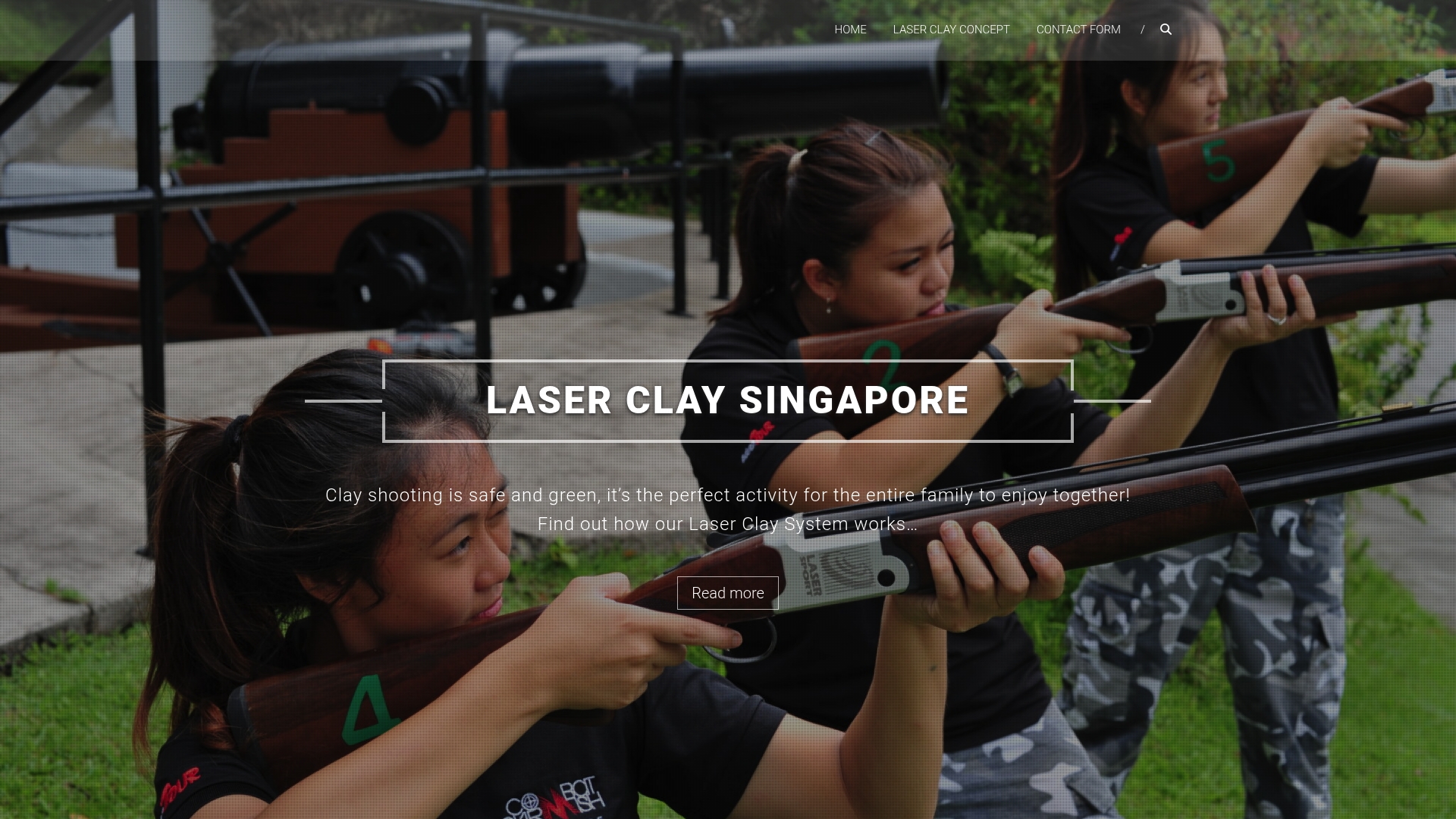
For a branded mission or a corporate-facing pop-up, the Corporate Laser Clay Package runs at 69 SGD per person and includes facilitation, equipment, and setup. Running something family-facing instead? The birthday party package starts from 49 SGD per person and adapts well to a family trial zone format. If your mall or agency already has staff and just needs the rig, system rental is priced at 500 to 800 SGD per hour.
Before you reach out, have your dates, footprint, target KPI, and expected daily throughput ready, it turns a vague enquiry into a quote we can turn around fast. Get in touch through our contact page to start scoping your activation.
Where to Check Permits and Safety Rules
- NRTOL applications and guidance (Singapore Tourism Board)
- SCDF outdoor event fire-safety conditions
- Entertainment-laser regulations (Singapore Statutes Online)
- Workplace Safety and Health event management guidelines
- PDPC guidance on data collection
Lead times vary, NRTOL applications alone take roughly a month, so start your permit conversations as early as your venue booking, and direct specific questions to each authority rather than relying on secondhand guidance.
Sources
- Non‑Renewable Temporary Occupation Licence | Singapore Tourism Board
- Outdoor event fire safety conditions (SCDF)
- Entertainment-laser regulations (Singapore Statutes Online / AGC)
- Personal Data Protection Commission (PDPC)
FAQ
What Is a Laser Clay Mall Activation?
It’s a short-run, facilitated shooting activity using laser-based scoring and reusable targets instead of live ammunition, designed to run safely in a mall atrium or forecourt. It typically pairs a game mechanic like a leaderboard or mission with a commercial goal such as trial, data capture, or tenant redemption.
Do I Need a Permit to Run a Laser Clay Event in a Mall?
If the activation stays entirely within the mall’s private tenancy area, mall management approval usually covers it. Any spillover onto state land or Orchard Road frontage typically requires a Non-Renewable Temporary Occupation Licence, which takes about a month to process.
How Long Should a Mall Activation Run For?
Most successful runs last between three and ten days, long enough to build word of mouth and iterate mid-run, short enough to preserve urgency. This window is widely recommended for touring pop-ups specifically because it balances measurability against novelty.
Is Laser Clay Safe for Family Audiences?
Yes, when run facilitated with proper queue separation and firing-line supervision. The format is generally suitable from age 10 upward, and every session runs under an operator managing safety and equipment checks throughout.