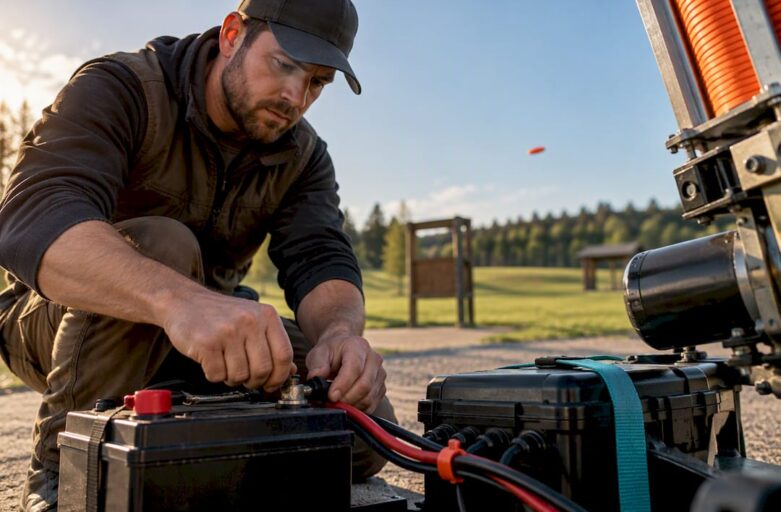
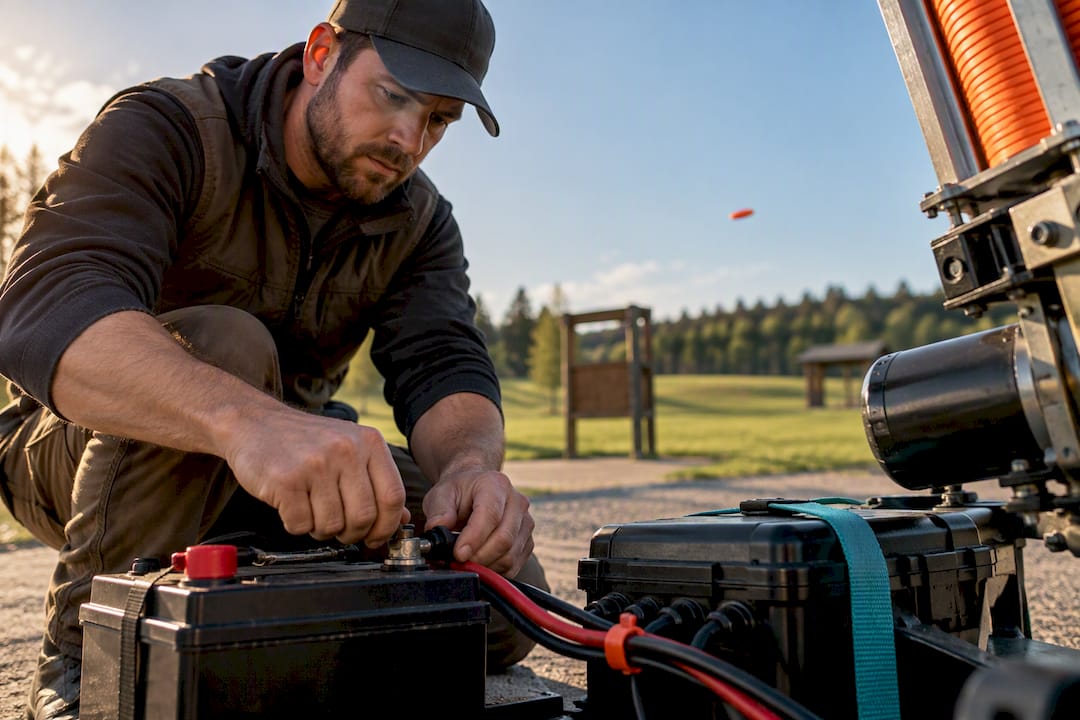
Most laser clay systems run on internal 12V DC batteries for the traps, guns and scoreboard, with mains reserved for charging and, on longer events, powering distribution boards. Before you sign off a venue, confirm four things: the rated voltage and feed arrangement for every component, earthing and RCD protection on any temporary supply, a battery and charging plan sized for your session length, and proof of an electrical certificate alongside public liability insurance. Reference SS 650 for temporary installation compliance and IEC 60825-1 for laser classification.
TL;DR:
- Mains power is mainly used for charging batteries, so plan site layout to minimize cable length and voltage drop, especially outdoors.
- Peak current for trap motors can be significantly higher than their rated wattage, requiring sizing batteries and breakers around stall or surge current figures.
- Compliance with SS 650 and IEC 60825-1 standards is essential, including RCD protection, proper earthing, and manufacturer classification documentation.
- Outdoor setups need weatherproof enclosures, sheltered batteries, and wind protections, while indoor venues require careful proximity of power sources to avoid voltage drops.
- Confirm venue power sources, socket capacities, and circuit protection early, and ensure all backup plans, safety, and operator protocols are in place before event day.
Table of Contents
- Site and space requirements: how footprint shapes your power layout
- Equipment power needs: adding up the real electrical load
- Electrical standards planners should reference before booking a venue
- Safety, insurance and operator duties around power equipment
- Staffing and session timing: how throughput drives your power plan
- Calibration and pre-event electrical checks
- Weather and environmental effects on outdoor power setups
- Network and connectivity needs for scoreboards and logging
- Storage, transport and maintenance of batteries and traps
- Quick-spec checklist for site managers
- How Laser Clay approaches power on a managed booking
- Booking a session: what to prepare and where to start
- Standards and manuals worth sharing with your electrician
- Sources
- FAQ
Site and space requirements: how footprint shapes your power layout
Outdoor and indoor laser clay setups demand different electrical thinking, mostly because of cable run length and access to charging points. Outdoors, you typically need a clear shooting lane of 15 to 20 metres, a landing zone behind the traps, and a safe perimeter that keeps spectators well back from the launch arc. The further your distribution board sits from the traps, the more voltage drop you introduce, and that drop is a genuine cause of motor stalls on longer cable runs.
Indoors, the constraints flip. You need enough wall or ceiling clearance for the trap’s throw arc, but the real electrical question is proximity: where do chargers and any mains-fed distribution sit relative to the shooting lane, and can that equipment stay clear of foot traffic?
A few practical points to brief into any venue walkthrough:
- Site chargers and spare batteries in a dedicated zone, away from public access and away from the shooting lane itself.
- Keep cable runs as short as practical. Long thin runs cause more voltage drop and failures than they save in flexibility.
- Ask the venue where its nearest 13A sockets and distribution boards actually are, not where they assume you’ll want them.
- Confirm the route cables will take before the day, including whether they cross walkways and need matting or covers.
Get this wrong and you’re not troubleshooting a laser fault on the day. You’re troubleshooting a cabling problem that could have been solved on a floor plan a week earlier.
Equipment power needs: adding up the real electrical load
A laser clay installation isn’t one device drawing one current. It’s several separate loads with different behaviours, and the way you budget for them determines whether mains or battery power is the right call.
The components that draw power on a typical setup are:
- Trap motor — the biggest and least predictable load, because it launches intermittently rather than drawing a steady current.
- Gun electronics — low, continuous draw for the infrared emitter and trigger sensor.
- Scoreboard — variable draw depending on whether it’s a simple LED display or a networked screen.
- Sound module — small continuous draw, spikes briefly on each shot or hit.
- Network gear — routers or switches feeding the scoreboard, usually the most overlooked line item in a power budget.
The number that trips up planners isn’t average draw, it’s peak draw. Trap motors pull a stall current well above their running current every time they launch a clay, and that spike is what protection circuits and battery capacity actually need to handle. Manufacturer guidance on clay trap electronics makes this point directly: duty cycle and motor stall current matter more than average wattage when you’re sizing a supply, because a battery or breaker rated only for continuous draw will fail the moment the trap fires in quick succession.
Pro Tip: Never size a battery or breaker off a component’s average current rating alone. Ask the supplier for the peak or stall current figure and size around that, not the number that looks tidier on the spec sheet.
For a worked example, a five-gun system with one trap, one scoreboard and basic sound typically sits comfortably within a single deep-cycle battery’s capacity for a half-day session. Scale that to a linked 10 or 15-gun setup with two or three traps and a networked scoreboard, and you’re now managing multiple batteries, a shared charging rota and, in most cases, a mains-fed distribution point rather than batteries alone.
When you read a supplier’s spec sheet, look specifically for rated voltage (usually 12V DC for traps), continuous current draw, and peak or stall current. If a sheet gives you only one of those figures, ask for the others before you commit to a site plan.
Electrical standards planners should reference before booking a venue
Singapore Standard SS 650 governs temporary electrical installations at events, and it’s the document to quote when you’re asking a venue or electrician whether their setup is compliant. The standard covers residual current device (RCD) protection, correct earthing, appropriate cable selection for the load and run length, and requirements for how temporary distribution boards are configured on site.
When you’re briefing a venue or hiring an electrician, ask for:
- Written confirmation that RCD protection covers every circuit feeding your equipment.
- Evidence of correct earthing at the distribution board, not just at the final socket.
- Cable sizing appropriate to your run length, since voltage drop over long cable runs is a common cause of in-event electrical failures that thicker cable or a closer distribution point solves more reliably than a spare battery ever will.
- A temporary installation certificate signed by a qualified electrician, dated for your event.
On the laser side, IEC 60825-1 is the standard that governs laser product classification internationally. Most entertainment-grade systems sit in the lowest hazard classes, but the only way to confirm that for the specific equipment you’re hiring is to request the manufacturer’s classification statement rather than assume it from the product name alone.
Safety, insurance and operator duties around power equipment
Three things are non-negotiable before any laser clay session goes live: a controlled landing zone behind the traps, a trained facilitator running the session, and proof of public liability insurance from the supplier.
Around the power side specifically, plan for:
- Ventilation and a spill containment tray wherever lead-acid batteries are charged or stored.
- Secure cable management, taped or matted across any walkway, never left loose across a floor.
- Written proof of the supplier’s public liability insurance, requested and filed before the event, not chased afterwards.
- A temporary installation certificate from the venue’s electrician covering the exact circuits your equipment will use.
Ask for this paperwork early. A supplier or venue that hesitates to produce it is telling you something worth hearing before the event, not during it.
Staffing and session timing: how throughput drives your power plan
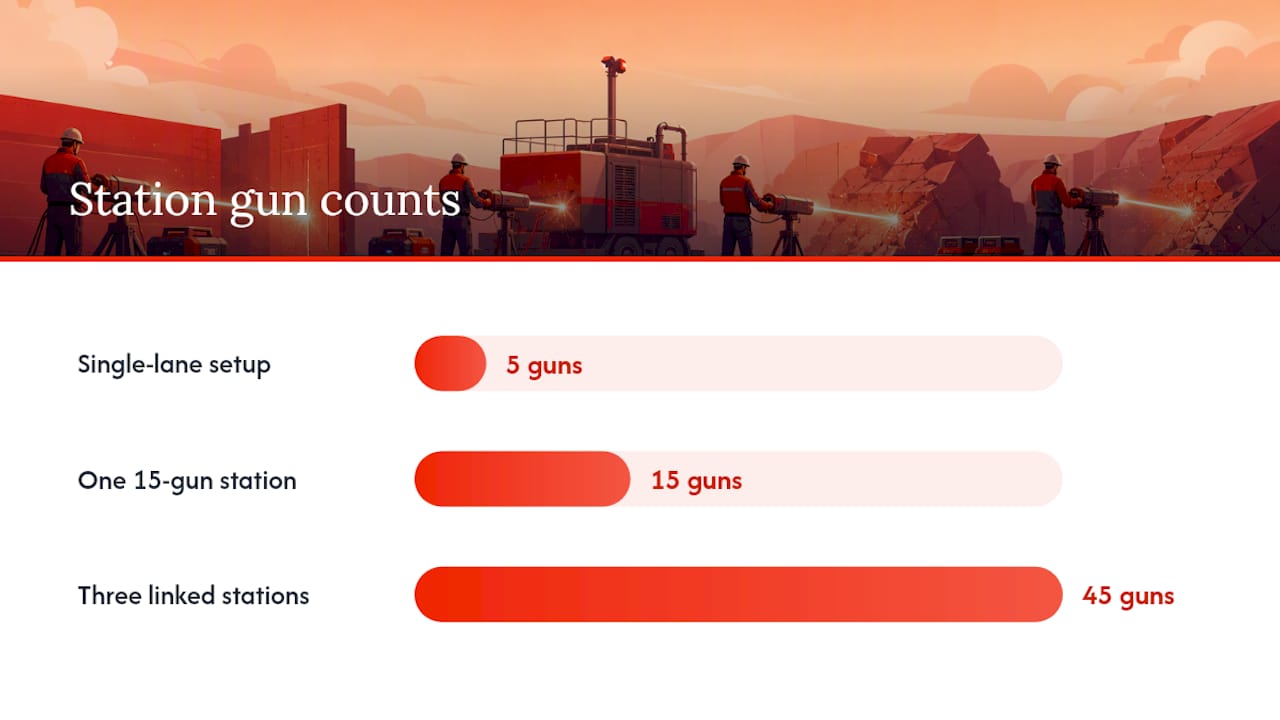
The number of shooters running simultaneously, and the number of guns and traps deployed, sets your peak power demand and how fast batteries drain. A single-lane five-gun setup drains far slower than three linked 15-gun stations running back-to-back sessions all afternoon.
Three practical points shape most staffing and timing decisions:
- Match operator numbers to gun count, with at least one facilitator monitoring battery charge state and swap timing per active station.
- Build a battery swap and charging window into your session schedule rather than running units until they fail mid-round.
- For back-to-back corporate sessions, plan charging capacity for at least double the batteries in active use, so a full rotation is always ready.
Get the swap window wrong and you’ll see it as a stalling trap motor mid-session, which is a far worse look than a two-minute scheduled pause between rounds.
Calibration and pre-event electrical checks
Run a full dry-run the day before, or at minimum several hours before doors open. Check that every battery holds a full charge, load-test each trap under a simulated duty cycle rather than a single test shot, test every RCD, and inspect cables and connectors for wear or loose terminals.
- Confirm full charge on every battery, not just the ones scheduled for first use.
- Load test each trap through several rapid launches, since that’s where stall current shows up.
- Test RCD trip function on every circuit feeding the setup.
- Inspect connectors and cable runs for damage or loose fittings before power goes live.
| Check | What to look for | Action if it fails |
|---|---|---|
| Battery charge | Full voltage reading on load | Swap for charged spare before session |
| RCD test | Clean trip on test button | Do not proceed until fixed |
| Cable/connector inspection | No fraying, loose pins, or heat damage | Replace before use |
| Voltage drop under load | Stable voltage during trap firing | Shorten run or use thicker cable |
Run this warm-up for at least 20 to 30 minutes, long enough to fire each trap repeatedly and log any voltage sag under real load.
Weather and environmental effects on outdoor power setups
Outdoor sessions add variables mains-only indoor setups never face. Sockets and control boxes need an appropriate IP rating for damp conditions, since a splash of rain into an unprotected junction box is a fast way to end an event early.
- Use IP-rated enclosures for any mains socket or control box exposed to weather.
- Keep batteries within their manufacturer’s recommended temperature range and shelter them from direct sun or cold overnight storage.
- Anchor and protect cables against wind, and postpone outdoor sessions if wind risks toppling traps or exposing cabling.
Cold reduces usable battery capacity, and heat accelerates degradation, so a shaded, ventilated equipment tent earns its keep on most outdoor bookings.
Network and connectivity needs for scoreboards and logging
Confirm whether your scoreboard operates fully offline or needs live network access before you build your power budget, because that answer changes what else you need to plug in. Many systems, including entertainment-grade laser setups, bundle their own internal power supplies for scoreboards and receivers, but configurations vary enough that you should verify it with your specific supplier rather than assume it.
- Ask the supplier directly whether the scoreboard needs a live network connection or runs standalone.
- Include routers, switches or PoE equipment in your power budget if connectivity is required.
- Build in redundancy for anything critical: local USB logging as a backup to networked scoring, and a battery-backed router if a live leaderboard matters to the event format.
A scoreboard that drops mid-session because a router lost power is an easy fix in planning and an awkward one to explain on the day.
Storage, transport and maintenance of batteries and traps
Batteries need secure, upright mounting in transport, with terminals protected against short circuits from loose metal objects rattling around a van. On site, store them in a ventilated area with a spill tray beneath, well clear of crowd flow.
- Mount batteries securely and upright during transport; never let them roll loose.
- Store on site in a ventilated area with spill containment beneath.
- Clean terminals and check charger calibration between events, not just when something stops working.
- Mark the charging area clearly and keep it a safe distance from spectators.
Set an inspection interval, monthly is reasonable for active-use equipment, and keep a simple log of terminal condition and charger performance over time.
Quick-spec checklist for site managers
Copy this into any venue brief before confirming a booking.
| Item | Minimum requirement |
|---|---|
| Footprint (outdoor) | 15 to 20 metre clear lane, landing zone, safe perimeter |
| Per-system power budget | Peak trap stall current plus continuous draw for guns, scoreboard, sound |
| Battery spec | 12V DC deep-cycle, spare per active trap |
| Certification | Signed temporary installation certificate under SS 650, current public liability insurance |
Ask the venue directly: where are the nearest sockets, what’s the distribution board’s spare capacity, is every circuit RCD-protected, and is there a safe, ventilated area for charging away from guests?
How Laser Clay approaches power on a managed booking
Typically, trained facilitators manage battery rotation and charging as part of the booking, rather than leaving planners to work it out on site. For corporate and multi-station events, this often includes liaising with venue electricians on SS 650 considerations before the day, so the electrical brief is settled ahead of setup rather than negotiated in the car park.
Planners get more value from a managed hire when the electrical groundwork is already handled by people who do it every week. Details on how sessions run in practice are covered in how laser clay works.
— Joshua
Booking a session: what to prepare and where to start
Laserclay is the alternative to sorting mains power, battery logistics and electrician sign-off yourself. For a corporate day, the Corporate Laser Clay Package at 69 SGD per person includes facilitation and battery management as part of the booking, not as an extra you have to arrange. For events where you’re supplying your own venue staff, the System Rental option, priced at 500 to 800 SGD per hour, gives you the equipment and operational support without handing over the whole event.

Before you enquire, have three things ready: participant numbers, photos of your site or venue floor plan, and any information the venue has already given you about available power. Send those through via the contact page, and the team can confirm whether your site needs mains, batteries, or a mix of both before you commit to a date.
Standards and manuals worth sharing with your electrician
- SS 650 temporary electrical installations — mandatory guidance for event temporary power in Singapore.
- IEC 60825-1:2014 — the international laser product classification standard.
- Promatic Kodiak clay target launcher manual — representative battery specification and safety guidance.
Sources
Batteries suit short, outdoor events where mains access is inconvenient or unavailable. Mains power, or at least mains-fed charging, becomes the sensible choice once you’re running a full day, a high-throughput corporate session, or several linked stations simultaneously.
Representative clay trap manuals recommend a 12V deep-cycle leisure battery with a capacity suitable for several hours of operation as the standard specification for trap operation. That capacity maps to several hours of intermittent trap use under typical event duty cycles, though lead-acid batteries lose usable capacity faster under the high, intermittent draw a trap motor creates than their nominal Ah rating suggests. Budget conservatively rather than trusting the number on the label.
Good charging practice on site includes:
- SS 650 temporary electrical installations (preview)
- IEC 60825-1:2014 Safety of laser products – equipment classification and requirements
- Promatic Kodiak clay target launcher user manual (representative example)
The one rule that overrides everything else: never wire a DC trap directly into mains AC without the correct transformer or an approved power supply unit. Manufacturer instructions are explicit that connecting a trap directly to mains without the correct PSU risks damaging the unit and creating a genuine safety hazard.
FAQ
Is a 1000 MW laser legal to use at events?
Entertainment-grade laser clay systems use low-power infrared sources, nowhere near the output of high-powered industrial or military lasers, and typically fall into the lowest hazard classes under IEC 60825-1. Always ask your supplier for the manufacturer’s classification statement rather than assuming based on the product name.
How does laser clay shooting work?
A shooter aims a sound-simulated gun fitted with an infrared emitter at a clay launched by an electric trap, and a sensor on the target registers a hit for scoring. The trap, gun electronics and scoreboard each draw power differently, which is why planning the electrical setup matters as much as the game format itself.
What shot size is best for clays, and does that affect laser clay setups?
Shot size is a traditional shotgun consideration and doesn’t apply to laser clay, since there’s no ammunition involved at all. That’s part of the appeal for event planners: no shot pattern, no lead, and no ballistic safety zone to manage beyond the standard perimeter around the shooting lane.
Do laser clay systems need mains power or can they run on batteries alone?
Most systems run on 12V DC batteries for traps, guns and scoreboards, with mains reserved mainly for charging. Longer or higher-throughput events, especially multi-station corporate days, generally need a mains-fed charging setup or distribution board rather than batteries alone.
What should I ask a venue about before booking laser clay?
Confirm the location and capacity of nearby power sockets, whether RCD protection covers the circuits you’ll use, and whether there’s a ventilated area suitable for battery charging away from guests. Request written confirmation from the venue’s electrician against SS 650 before signing off the site.