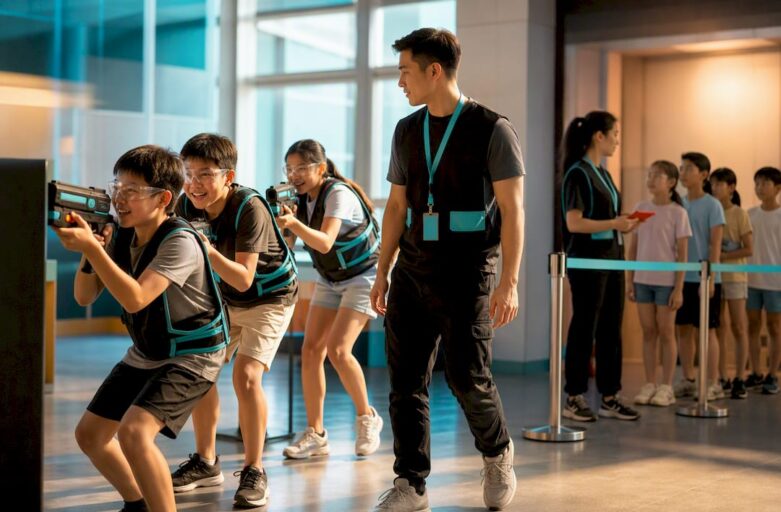
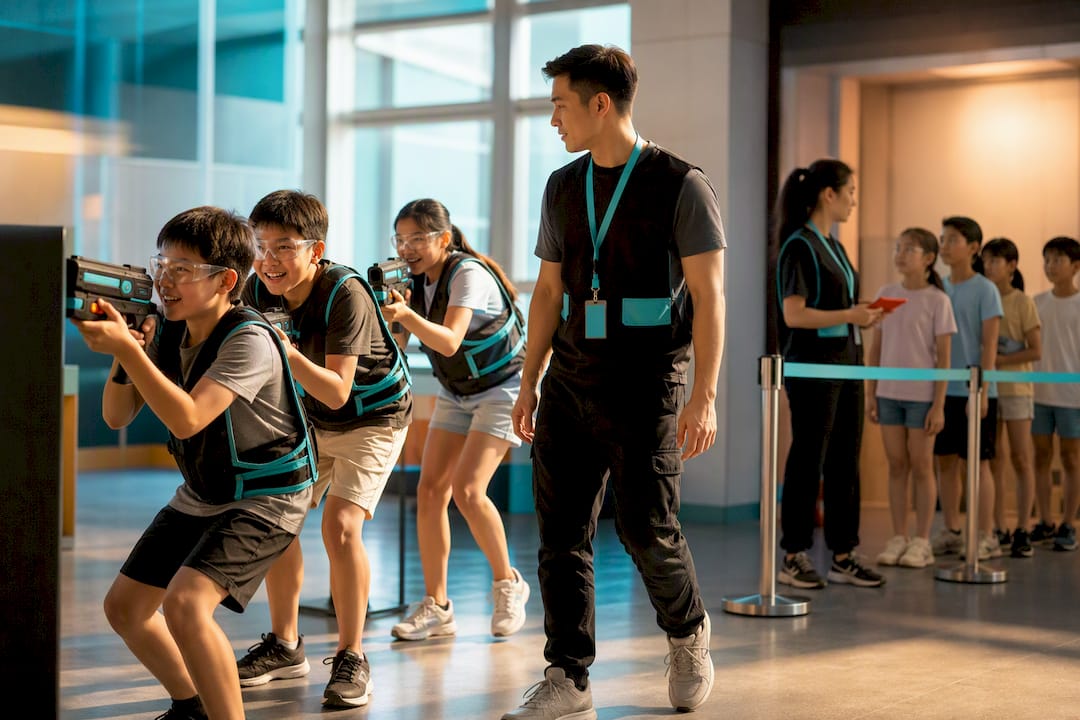
For a safe laser clay session, plan on 1 trained operator plus 1 assistant marshal for every 10 players, alongside a designated first aider and an event manager overseeing the whole activity. Larger events need setup technicians, scorekeepers and crowd controllers layered on top. Organisers who don’t want to source and train this crew themselves can book Laser Clay’s staffed packages, which arrive with facilitators already in place.
TL;DR:
- For events with up to 50 participants, one operator and one marshal generally suffice, but larger events require additional staff for multiple stations and crowd control.
- Staff must hold current first aid certification, receive specific equipment training, and be assigned clearly to roles like safety monitor and emergency shut-off operator.
- Setup and testing should be scheduled for at least 45 to 90 minutes before the event, with a focus on power, interlocks, and equipment placement to prevent delays.
- Each active shooting station needs a dedicated operator, as Singapore regulations prohibit one person from supervising more than 10 players or multiple stations simultaneously.
- Wireless staffing solutions like Laser Clay’s staffed packages can provide fully trained facilitators, saving time and ensuring safety compliance.
Table of Contents
- Role-by-role breakdown and staffing by event size
- Shift patterns, timings and staff-hour estimates
- Which safety duties must staff own?
- Equipment and venue support tasks staff must cover
- What to require when hiring or booking staff
- How many staff should watch each shooting station?
- What happens when staff don’t show up?
- Staff attire and PPE requirements
- Common staffing mistakes and how to fix them
- Let Laser Clay handle your staffing needs
- Sources
- FAQ
Role-by-role breakdown and staffing by event size
Every laser clay session needs the same core functions, whether it’s ten colleagues in a meeting room or 150 kids at a school carnival. The roles just multiply as headcount grows.
- Session lead / laser operator — runs the equipment, briefs players, watches the beam path and audience continuously, and calls stops.
- Range marshal / assistant — manages the queue, keeps non-shooters behind the cordon, and backs up the operator on rule enforcement.
- Setup technician — handles launcher placement, power, and pre-session equipment testing (can double as an operator on smaller events).
- Scorekeeper / MC — runs the electronic scoreboard, announces results, and keeps the energy up between rounds.
- Crowd controller — directs foot traffic around the shooting area, particularly important at festivals or open carnivals with passers-by.
- Dedicated first aider — a named person with current certification, not a shared duty tacked onto someone else’s role.
- Event manager — the single point of contact who owns the schedule, supplier coordination, and any incident escalation.
For events with up to 20 participants, one operator and one marshal usually covers it, with the event manager doubling as first aider if certified. Between 21 and 50 participants, add a second marshal and a dedicated scorekeeper. Most laser clay systems support a limited number of concurrent shooters per station, so events in this bracket typically run two stations side by side rather than one long queue.
Beyond 51 participants, up to roughly 150, you’re looking at multiple stations, a full crowd control presence, and a first aider who isn’t juggling any other job. School camps and festivals push throughput hard, so build in an extra setup technician for rapid target resets between groups. Birthday parties and other child-focused bookings benefit from a dedicated child supervision assistant per station, since younger players need more frequent redirection and closer safeguarding attention than adult corporate groups.
Shift patterns, timings and staff-hour estimates
Getting the schedule right matters as much as getting the headcount right. Rushed setup and under briefed operators cause more delays than staffing shortages ever do.
- Setup and testing: allow 45-minute to 90-minute periods before doors open, covering launcher placement, power checks and interlock tests, based on typical hire timelines for staffed laser clay activities.
- Briefing: 10 to 15 minutes per group, covering safety rules, scoring, and the emergency stop signal.
- Live session blocks: 20 to 30 minute rounds work best, keeping engagement high without operator fatigue setting in.
- Operator rotation: swap operators every 90 to 120 minutes to preserve the concentration needed for continuous beam-path monitoring.
- Takedown: budget 30 to 45 minutes for equipment collection, battery removal and site clearance.
For a 50-participant event, plan for a moderate number of total staff hours across setup, live running and takedown. Running parallel stations, rather than one long single-file queue, is the simplest way to avoid downtime between back-to-back bookings.
Which safety duties must staff own?
Regulatory guidance in Singapore is specific about who does what, not just what equipment is used. Operators must be positioned so they can view the audience and the full beam path at all times, and every setup needs a working interlock plus an emergency shut-off, according to Singapore’s laser regulations. That’s not a suggestion. Assign one named staff member, not a vague “someone on site,” who can trigger that shut-off immediately if something goes wrong.
Pro Tip: Write the shut-off person’s name on the safety plan itself, not just in a briefing note. If they step away, someone else needs to know exactly who to find.
Before the event, organisers should hold:
- A written risk assessment covering the specific venue and group size.
- A safety and security plan with sketches of beam paths and cordon layouts.
- Equipment test records, including interlock and radio checks.
- Proof of current first aid certification for the named first aider.
Police guidance on event safety plans calls for documented evacuation procedures, personnel screening and nominated authorised staff with defined access controls, which means your event manager needs this paperwork ready before the first player picks up a controller. First aid and incident reporting sit with the dedicated first aider, who should log any incident, however minor, immediately rather than at the end of the day.
For louder events with amplified scoring announcements or music, PUB’s hearing protection guidance recommends cordoning high-noise zones, adding clear signage, and having earplugs on hand. Staff need to actually enforce these cordons, not just set them up and hope people stay behind them.
Equipment and venue support tasks staff must cover
Setup technicians carry most of the pre-event workload: site layout, launcher placement, power checks, scoreboard and audio setup, and test firings to confirm interlocks are working before anyone steps up to shoot. This is the stage where problems get caught cheaply, before a queue of players is standing around waiting.
Venue checks matter just as much as equipment checks. Assign a staff member to confirm power access, flat ground for launcher stability, weather shelter for outdoor bookings, and vehicle access for equipment delivery. Missing any one of these on the day turns a 45 minute setup into a two-hour scramble.
- Power access confirmed and tested before load-in.
- Ground surface checked for stability and drainage.
- Weather contingency (tent, marquee, indoor backup) arranged for outdoor events.
- Vehicle access route confirmed for equipment delivery and takedown.
Pro Tip: Send a one-page venue checklist to the client a week before the event. Half of all setup delays come from a locked gate or a missing power point nobody flagged in advance.
Speaker placement affects both audio quality and hearing safety, so position PA systems away from where players queue, and keep earplugs available near the cordon. On the day, one staff member should be responsible for battery swaps, target collection between rounds, and keeping spare parts within reach, so a flat battery never stalls a whole session.
What to require when hiring or booking staff
A clear brief prevents the single biggest staffing failure: people showing up unsure what they’re actually responsible for.
- Set minimum requirements: current first aid certification, prior experience supervising groups, and basic equipment handling competence.
- Run an on-site training pass: safety briefing, emergency shut-down drill, scoring system walkthrough, and child supervision rules if the event includes younger players.
- Collect documentation: photo ID, first aid certificates, and a short practical equipment test before the event starts.
- Issue a written brief: something as simple as “You are the range marshal. Your job is queue management and cordon enforcement. Report any incident to [name] immediately” removes ambiguity on the day.
This kind of structure lines up with WSH event management guidelines, which recommend clear role assignment, supervision and documented training records for anyone running organised activities.
How many staff should watch each shooting station?
The operator-to-player ratio is the number organisers fixate on, and rightly so, but it’s only half the picture. One operator should never supervise more than 10 active players on a single station, because continuous beam-path monitoring becomes unreliable beyond that. The marshal isn’t a spare pair of hands. They’re the person managing everyone waiting their turn, which frees the operator to focus entirely on the shooters currently at the line.
Multi-station events change the maths. Two stations running in parallel need two operators, not one operator splitting attention between both, since the sight-line requirement means an operator genuinely cannot watch two separate beam paths at once. This is where a lot of smaller operators try to cut corners and it’s exactly where near-misses happen.
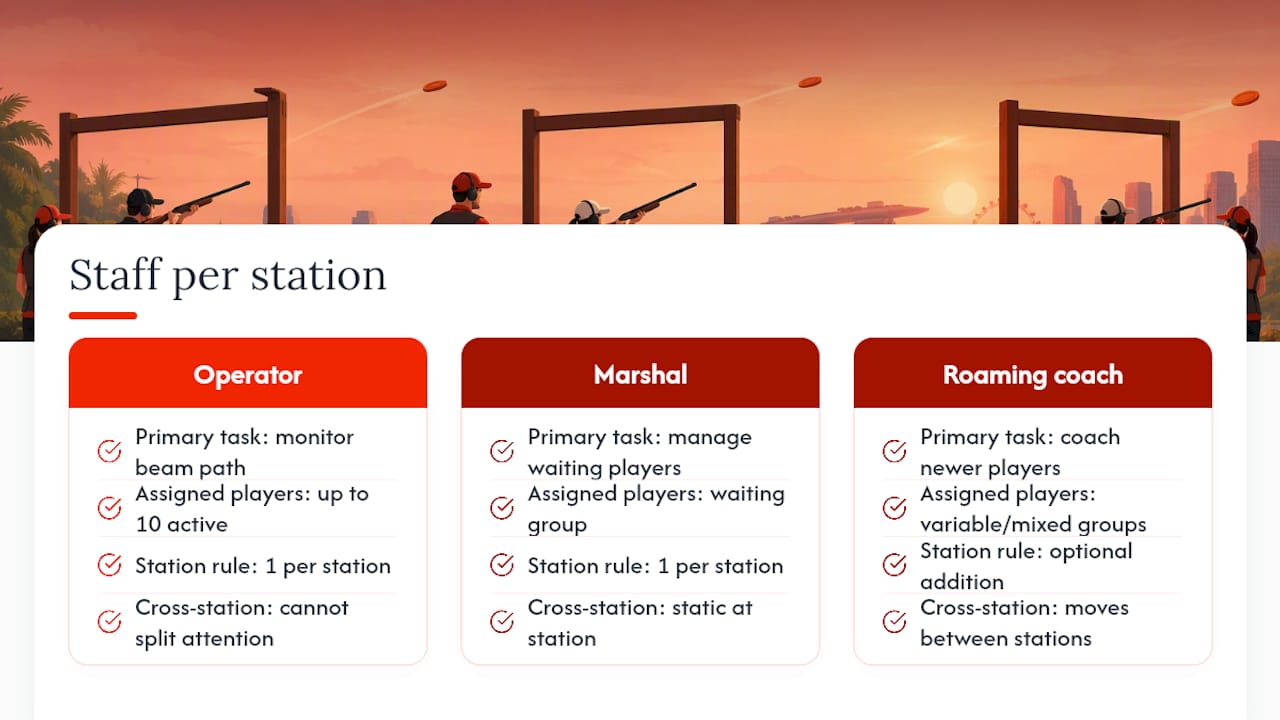
Corporate bookings with mixed skill levels sometimes benefit from a roaming coach who moves between stations helping newer players with technique, on top of the fixed operator and marshal. Schools and large festivals should treat the operator ratio as a hard ceiling, not a target, and add a second operator the moment participant numbers push past what one person can genuinely track. External event-security perspectives, such as the workforce planning approach used by range safety officer services in organised shooting events, reinforce the same principle: dedicated supervision per active lane beats one supervisor stretched across several.
What happens when staff don’t show up?
Every event plan needs a backup for the day someone calls in sick or the queue runs longer than expected. The gap between a smooth recovery and a scrapped session is usually one phone call made early enough.
Build a simple contingency layer into every roster: one on-call reserve staff member per every three to four booked roles, briefed in advance and reachable by phone on the day. For corporate and school bookings where a full session is riding on the activity, agree a fallback with your supplier ahead of time rather than scrambling on the morning.
Cross-train wherever possible. A scorekeeper who’s also had the operator briefing can step into that role in a pinch, and a marshal who understands the shut-off procedure can cover for the first aider’s administrative tasks if the medical response itself is handled elsewhere. Keep one laminated card at the event manager’s station listing every role, who’s covering it, and who the backup is. It sounds basic, but it’s the single fastest way to answer “who’s doing first aid now?” in a moment of actual pressure, rather than working it out from memory.
Staff attire and PPE requirements
Laser clay doesn’t carry the ballistic risks of live ammunition, but that doesn’t mean PPE is optional. Hearing protection should be available for staff working near amplified scoring announcements or music, in line with the same noise exposure guidance that applies to attendees.
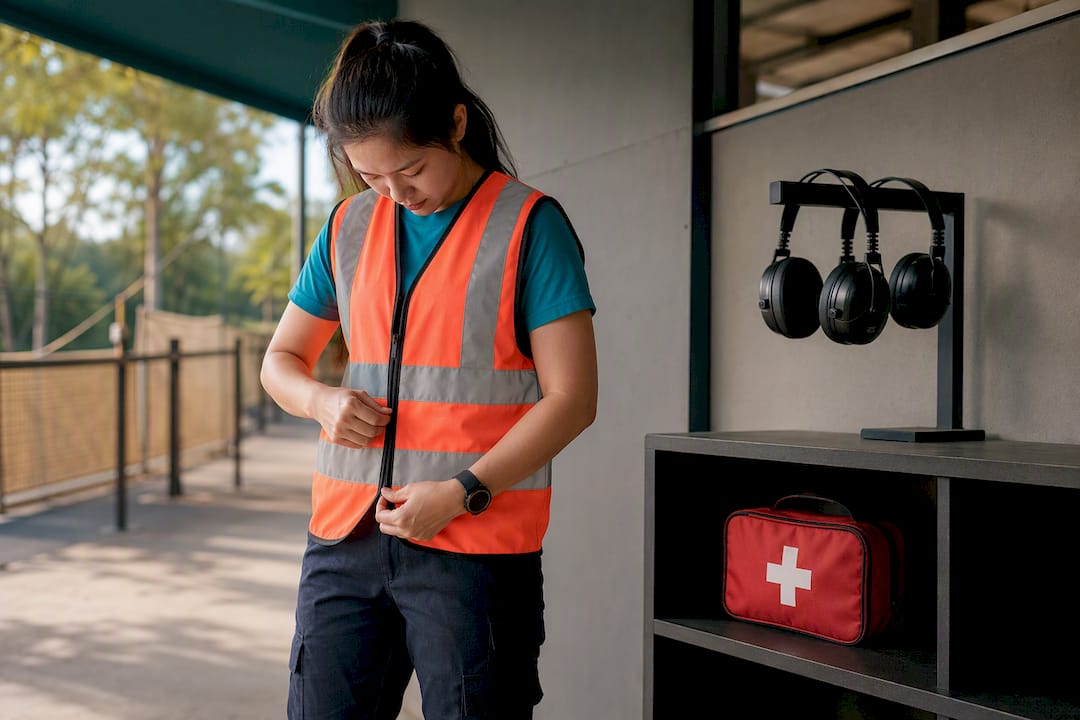
High-visibility vests or branded shirts for marshals and crowd controllers make it instantly obvious who’s staff, which matters more than it sounds at a crowded festival where players and passers-by mix freely. Closed footwear is a sensible baseline for anyone moving equipment or working near launcher stands, and outdoor events should have wet-weather gear on standby for staff who can’t simply step under cover when it rains.
First aiders need their kit visibly accessible, not buried in a bag under a table, and should wear something that marks them out immediately if a player needs help mid-session. None of this is complicated, but it’s the sort of detail that gets skipped when a team is assembled in a hurry.
Common staffing mistakes and how to fix them
The most common mistake isn’t understaffing the shooting line. It’s under resourcing queue management, briefing time, and the named safety contact, three things organisers assume will “sort themselves out” on the day. They rarely do.
The fix is straightforward: assign a marshal before you assign anything else, budget real minutes for briefings rather than squeezing them in, and put one name, not a role title, against emergency responsibility on your safety plan.
— Joshua
Let Laser Clay handle your staffing needs
Sourcing, training and rostering safety-qualified staff eats hours most organisers don’t have spare, on top of everything else on an event checklist. Laser Clay’s staffed packages solve that by supplying trained facilitators, full setup and takedown, and first-aid-trained personnel as part of the booking itself, so you’re not assembling a crew from scratch.
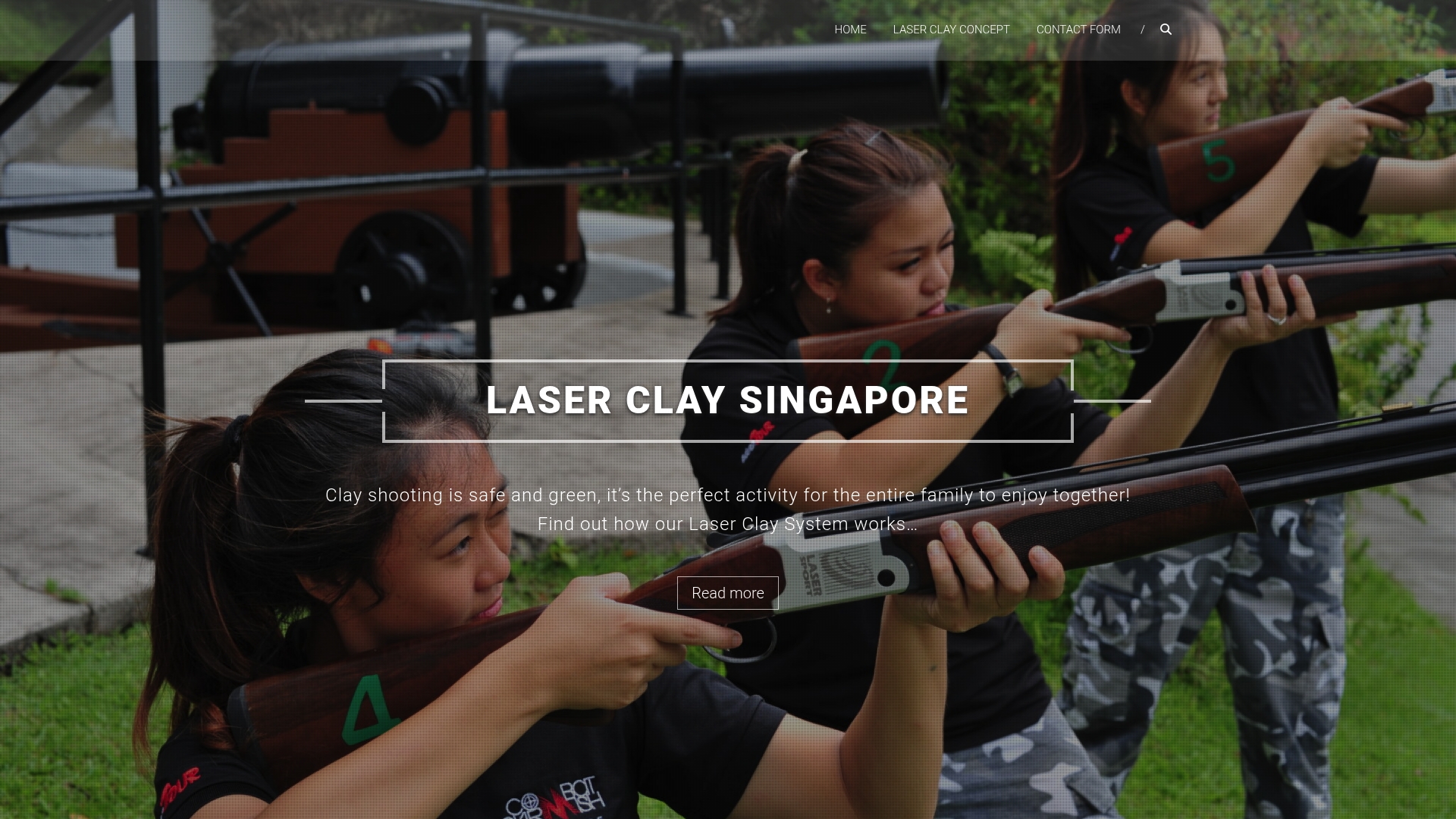
For corporate bookings, the Corporate Laser Clay Package runs at $69 SGD per person and includes facilitated staffing throughout the session. Planning a birthday party instead? The birthday party package starts from $49 SGD per person, with staff briefed specifically on child supervision. If you’d rather run the activity with your own crew, System Rental is available at $500 to $800 SGD per hour, with facilitator support available on request.
Whichever route fits your event, get in touch through Laser Clay’s contact page to check dates and confirm exactly which staffing level your session needs.
Sources
- Guideline on preparing safety and security plans (Singapore Police Force)
- Singapore laser regulations (statutory provisions excerpt)
- Protection of hearing at recreational or community events (PUB guidance)
FAQ
How many staff do I need for a laser clay event?
For up to 20 players, one operator and one marshal typically suffices, alongside a named first aider. Larger events, 51 to 150 participants, need multiple stations, dedicated crowd control and a first aider free of other duties.
What qualifications should laser clay staff have?
Operators and marshals need current first aid certification, prior experience supervising groups, and hands-on training with the specific equipment, in line with WSH event management guidance. Laser Clay’s staffed packages include facilitators who already meet these requirements.
How long does setup take before a session can start?
Setup and equipment testing typically take between 45 and 90 minutes, covering launcher placement, power checks and interlock testing. Takedown afterwards usually runs 30 to 45 minutes.
Can one operator supervise multiple shooting stations?
No. Singapore’s laser regulations require operators to view the beam path and audience continuously, which means each active station needs its own dedicated operator.