The best community event games in Singapore are the ones a six-year-old and a sixty-year-old can both join within two minutes of arriving. In practice that means a mix: a few low-tech heritage games for the whole crowd, one or two relay or team formats for groups, and one headline activity that gives people something to talk about afterwards. This guide shows which games suit which crowd, how to pick them, what to check on safety and permits, and how to fit it all into your time and budget.
TL;DR
- Build the programme in layers: a free-flow heritage or booth game for drop-in guests, a structured relay or team game for groups, and one headline activity.
- Choose by headcount, age range, venue and run time before you choose by theme. A game that needs a queue of 40 people will fail in a 90-minute slot.
- Check fire safety, sound and sport-safety guidance early. They shape your layout more than the games do.
- Laser clay is a low-noise, no-lead headline option for ages 10 and above: S$69 per person for corporate groups, birthday parties from S$49 per person, or system rental at S$500-800 per hour.
- Leave a buffer for setup, briefing and rotation. Most overruns come from those, not from the games.
Table of Contents
- What counts as a community event game
- Heritage games: the safe starting layer
- Relays and telematch formats for groups
- Which games suit which crowd
- How to choose: headcount, venue, purpose, time
- Safety checks that shape your layout
- Time and budget: how to plan them
- A sample three-hour community programme
- Our perspective: make one thing the centrepiece
- Bringing laser clay to your event
- A planning checklist
- FAQ
- Sources
What counts as a community event game
A community event can be a residents’ day, a school carnival, a company family day, a charity fun run village or a block party. What they share is a mixed crowd that did not arrive as a team. That changes the brief. Corporate team-building can assume a captive group of working-age adults who signed up. A community event cannot: people wander in, leave, bring toddlers and grandparents, and judge in thirty seconds whether a game is for them.
So good community games have four traits:
- Instant rules. One sentence of explanation, a demonstration if needed.
- Short rounds. Two to five minutes, so queues move.
- Mixed-ability scoring. Results that do not simply reward the fittest or the youngest.
- Something to show. A score, a photo, a stamp or a prize token that people carry around the venue.
Heritage games: the safe starting layer
Singapore has a ready-made library of games that cross generations. GetActive! Singapore’s 57 Kampung Games guide lists heritage-inspired formats such as hopscotch, chapteh, congkak, bola relays, tin-can soccer, treasure hunts, quizzes, Singapore-themed races and intergenerational games for preschool children, parents and educators. The guide frames these adaptations as a way to encourage physical activity, preserve Singapore heritage and create interaction and bonding among children, parents and friends.
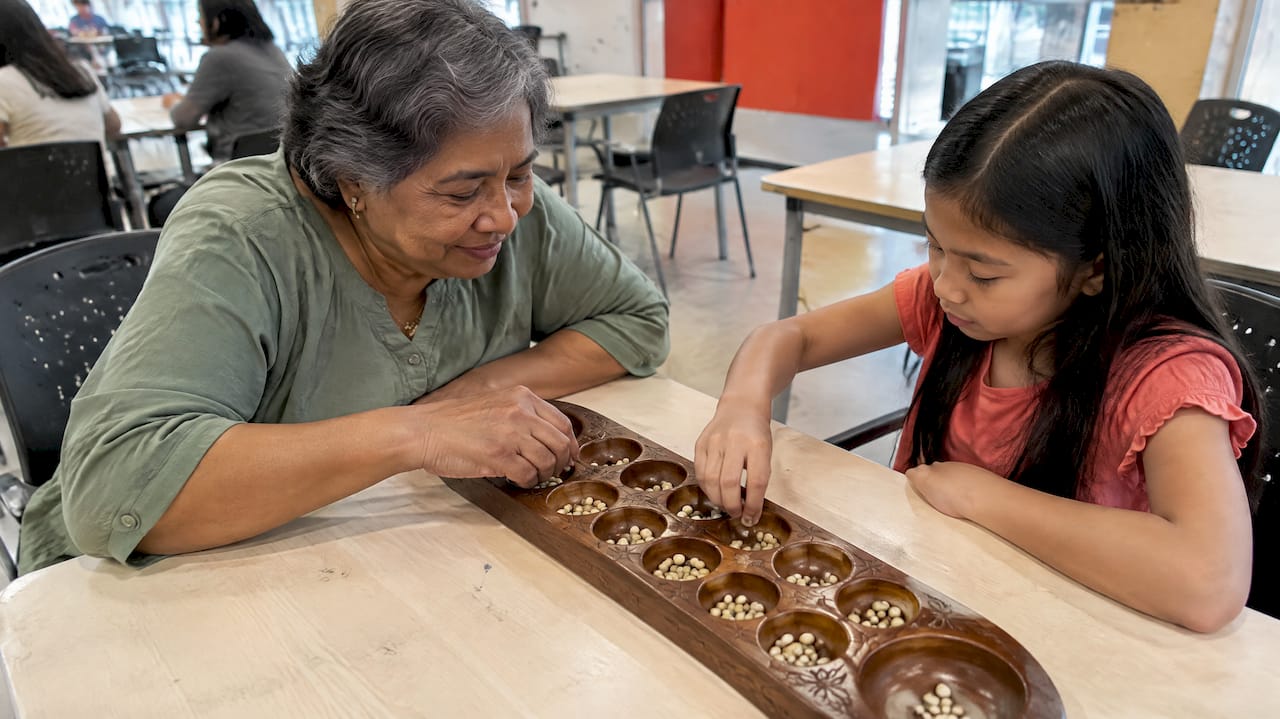
That framing is useful for organisers. Heritage games do three jobs at once: they need almost no equipment, grandparents often know the rules and can teach them, and they give a community event a local identity that a generic inflatable does not.
Practical ways to use them:
- Run them as a drop-in corner. Set out chapteh, congkak boards and hopscotch grids with a volunteer or two. No sign-up, no timing.
- Pair generations. Make a rule that every team of three includes at least one adult and one child, or one senior and one younger participant.
- Turn them into a stamp trail. Five stations, one stamp each, a small prize at the end. This spreads the crowd around the venue instead of piling it at one booth.
Relays and telematch formats for groups
When you have family groups or neighbourhood teams, relays are the workhorse. Singapore Children’s Society’s Family Day Telematch, according to the organisation’s own account of the event, combined yoga, team games and relay matches, including Egg and Spoon Race and Run, Waiter, Run, with a photo booth and an art-and-craft booth alongside. More than 25 families took part.
The lesson is in the mix, not just the relays. The calmer stations (yoga, craft) gave less energetic guests a place to be involved, and the photo booth gave everyone a keepsake. If you only schedule high-energy games, you lose part of your audience by the second hour.
A simple relay menu that works for 20 to 100 people:
| Format | Best for | Space | Watch out for |
|---|---|---|---|
| Egg and spoon, waiter-style relays | Families, mixed ages | Open lane, 10-15 m | Wet or polished floors at indoor halls |
| Tin-can or bola relays | Children and parents | Field or hall | Flying objects near spectators |
| Singapore-themed trivia races | Adults, teens, schools | Any space with stations | Needs a clear answer sheet and a marshal |
| Treasure or stamp hunts | Large, spread-out sites | Whole venue | Give a map and a time limit |
| Craft or art booth | Toddlers, seniors, quieter guests | Table seating, shade | Needs tables and cleaning supplies |
Which games suit which crowd
The right mix depends on who is actually coming. These are working suggestions from our own event experience, not rules.
Corporate family days
Staff bring partners, children and sometimes parents. You need a spread: one high-energy team game, one calm table activity, one activity that adults take seriously and children can still join. Our guides to corporate family day games and family engagement activities for HR teams go through formats that suit this crowd, and the office party games page covers lighter ideas for indoor settings.
Schools and enrichment days
The priorities here are supervision ratios, clear age limits and activities that give every pupil a turn. Rotations in groups of ten or so work well. For more, see our notes on school enrichment ideas. For overnight programmes, our night camp plan covers games and park permits.
Residents’ and neighbourhood events
These are the widest age range. Lean on heritage games, a stamp trail and one stage-style activity that people can watch even if they do not play. Spectator value matters: a game where onlookers can see a live scoreboard keeps the crowd engaged.
Large groups
At 100 to 500 people the problem is throughput, not variety. Run several identical stations in parallel rather than one elaborate game. We have set out run sheets for large-group team games for 20 to 500 people.
Inclusive play
Check that at least half your programme can be played seated or with limited mobility, and that scoring does not depend on speed alone. Our page on inclusive office-friendly games has formats that adapt well beyond the office.
How to choose: headcount, venue, purpose, time
Before you pick a single game, write down four numbers and one sentence.
- Headcount at peak, not total registrations. Drop-in crowds peak for a short window.
- Age range, youngest to oldest.
- Venue type: indoor hall, covered court, open field, void deck, park.
- Total run time, and how much of it is active play.
- One sentence of purpose: bonding, fundraising, heritage, fitness, or simply a good day out.
Then apply a simple filter. Each game should list how many people it serves per hour. Divide your peak headcount by that number to see how many stations you need. If a game serves 12 people an hour and 150 people want to play, you need either more stations or a shorter queue rule, such as one attempt per person.
Indoor versus outdoor
Indoors you control weather and noise but lose space; outdoors you gain space but need a wet-weather plan. A covered area or an indoor fallback is cheaper to arrange early than to improvise at 2 pm under a thunderstorm. Laser clay is one of the few headline activities that runs in both settings, because it uses no live ammunition and no range; you can see how it works on our how to play page.
Safety checks that shape your layout
Safety is not a closing paragraph in your plan. It decides where booths go.
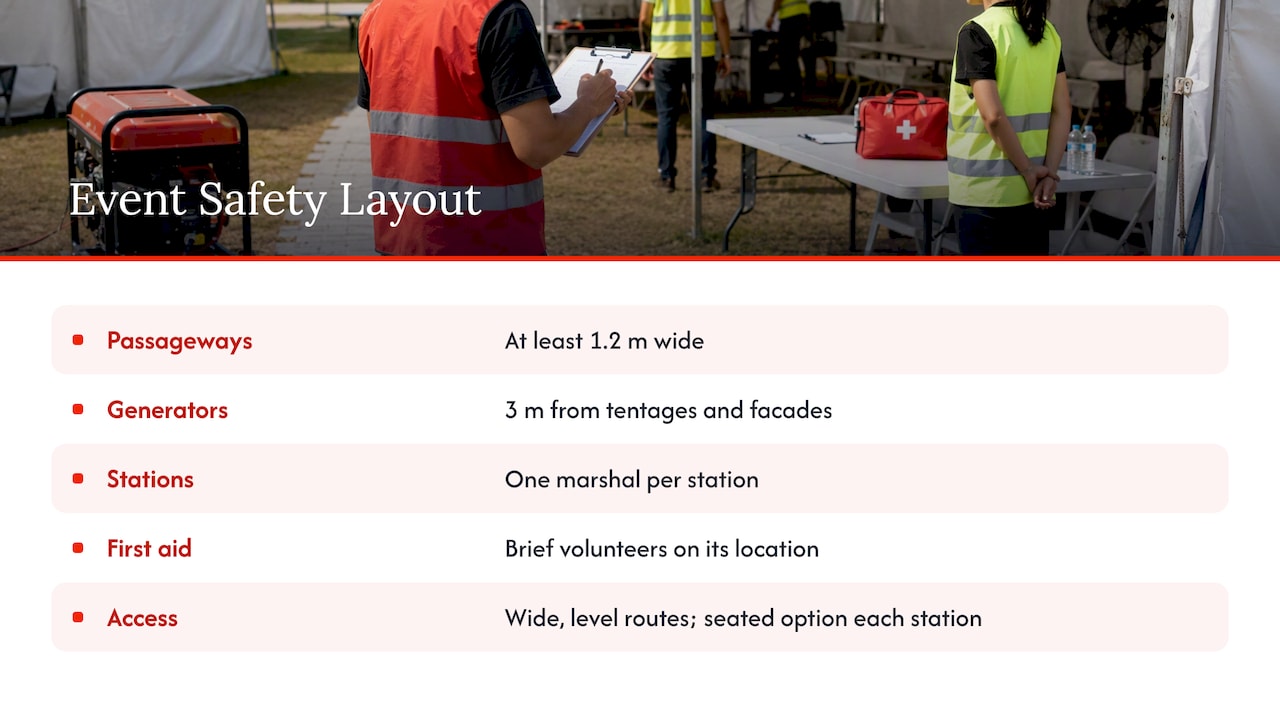
Fire safety and layout. SCDF’s outdoor event fire safety conditions require clear passageways of at least 1.2 metres between booth rows, and generators at least 3 metres from tentages and building facades. Mark these on your floor plan before you assign game stations, particularly if you plan a row of stalls.
Sport safety. Sport Singapore explains that Singapore Standard SS 681:2022 gives requirements and recommendations for sport safety, advocating a proactive risk-management approach. For a community event, that translates into a short written risk assessment: what can go wrong at each station, who watches it, and what you do if it does.
Sound. URA encourages event organisers to use appropriate measures to promote safe listening at events with high sound levels. Keep loudspeakers off the children’s zone and give quiet corners to guests who need them. Low-noise games make this easier.
Approvals. If your event runs as a temporary fair, the operator must obtain approvals from the relevant authorities before it starts. The relevant government agencies list includes SCDF and LTA, and URA approval applies if the site is used temporarily for more than 90 days. Most one-day community events are far shorter, but ask your venue manager which approvals apply to your case, and confirm with the agencies directly, as requirements depend on the venue and activity.
Children and different abilities. Assign one marshal per station, state age limits clearly, and brief every volunteer on where the first-aid point is. For people with limited mobility, make sure paths between stations are wide and level, and offer a seated alternative at every station.
Time and budget: how to plan them
Published prices for community games vary too much by format and provider to quote an average honestly, so plan from your own constraints instead.
Time.
- Allow setup before doors open, plus a briefing for volunteers.
- Keep each active round to five minutes or less for drop-in guests.
- Build a 10-15 minute buffer between blocks for changeovers, toilet breaks and drinks.
- For a three-hour event, three to four activity blocks is realistic; more usually means rushed rounds.
Budget. Split it into four lines: headline activity, consumables and prizes, safety and staffing, and contingency. Heritage games and stamp trails cost little because they use reusable simple items. Your largest single line is usually the headline activity, so decide that first and fill the rest around it.
Staffing. One marshal per station is a sensible baseline for children’s games. For equipment-based activities, the provider’s ratio governs. Ours is one operator plus one marshal per ten players, set out in our staffing guide.
A sample three-hour community programme
This layout is a template for roughly 100 to 150 mixed-age guests. Adjust it to your venue.
| Time | Block | Purpose |
|---|---|---|
| 0:00-0:20 | Arrival, stamp card, photo booth | Spread the crowd, give a keepsake |
| 0:20-1:00 | Heritage corner and craft booth open; relay heats begin | Drop-in play for all ages |
| 1:00-1:15 | Water break, announcements | Reset energy, shade |
| 1:15-2:15 | Headline activity in rotating groups | Main attraction, live scoreboard |
| 2:15-2:45 | Relay finals and family challenge | Team spirit, spectator moments |
| 2:45-3:00 | Prizes, group photo | Close on a high |
Our perspective: make one thing the centrepiece
We have seen community events fail by trying to offer ten things at once. Staff are stretched, queues form everywhere and nothing feels special. The events people remember have one centrepiece, supported by simple games around it.
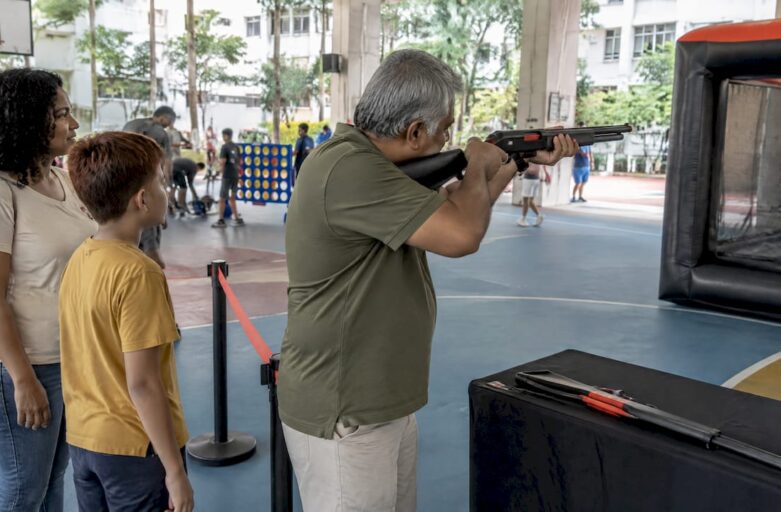
That is why we built Laser Clay. It uses sound-simulated deactivated shotguns, reusable clay targets and real-time electronic scoreboards, so there is no lead, no live ammunition and none of the noise pollution of a traditional range. It is fully facilitated and suitable from age 10, so a parent can shoot beside a child, and the scoring can be set to be competitive or casual. Indoors or outdoors, it gives a crowd something to watch as well as play, which matters when most of your guests are not on the firing line at any moment.
It is not for everyone: children under 10 need other stations, which is why we always recommend pairing it with heritage games or a craft booth. A good community event is a mix, and we would rather help you build that mix than push you to fill the day with our equipment.
— Joshua
Bringing laser clay to your event
If you want a headline activity, here is how our offers map to common community events:
- Corporate groups and family days: the Corporate Laser Clay Package is S$69 per person, with facilitators, setup and customisation included.
- Birthday parties and children’s gatherings: the birthday party package starts from S$49 per person. Our guide to planning a laser clay birthday party for kids walks through it.
- Carnivals, school camps and residents’ events: system rental is S$500-800 per hour, for organisers who want to run the activity within a larger programme.
Before booking, read the practical pages that prevent overruns: setup time and run sheets (we plan for 60-90 minutes of setup), power requirements and setup requirements. Our compliance guide for planners covers the permit side. To discuss your date and headcount, contact us.
A planning checklist
- Peak headcount, age range and venue confirmed in writing.
- Floor plan showing 1.2 m passageways and generator placement.
- One-page risk assessment per station, with a named marshal.
- Wet-weather or heat plan for outdoor events.
- Seated or low-mobility option at each station.
- Sound plan: where speakers go, where quiet zones are.
- Approvals checked with the venue manager and relevant agencies.
- Buffer built into every block of the programme.
- Prizes and keepsakes sorted before the day.
FAQ
What are good community event games for mixed ages in Singapore?
Heritage games such as chapteh, congkak and hopscotch work well because many generations know them. Add relays with simple rules and a craft or photo booth for guests who prefer quieter activities. Use one headline activity for spectacle.
How many games should a three-hour community event have?
Three to four activity blocks is realistic for most events, with a few drop-in stations running throughout. More than that tends to produce rushed rounds and thin staffing. Fewer, better-run games usually leave people happier.
Do I need permits for a community event game day?
It depends on the venue, the size and what you set up. Temporary fairs need approvals from the relevant agencies, and outdoor events have SCDF fire safety conditions. Ask your venue manager first, then confirm with the agencies named in the sources below.
Is laser clay suitable for children?
Our sessions suit participants from age 10 and are fully facilitated. There is no live ammunition or lead, and the equipment uses simulated sound. For younger children, pair it with age-appropriate stations such as heritage games or crafts.
Can laser clay run indoors?
Yes. It can be set up indoors or outdoors, and the main requirements are space, power and a setup window. See our setup and power pages for the checks, and contact us with your venue details.
Sources
- 57 Kampung Games, GetActive! Singapore
- Telematch Fun for Families, Singapore Children’s Society
- Outdoor event fire safety conditions, SCDF
- About sport safety, Sport Singapore
- Event application, URA
- Approval by relevant government agencies, SFA