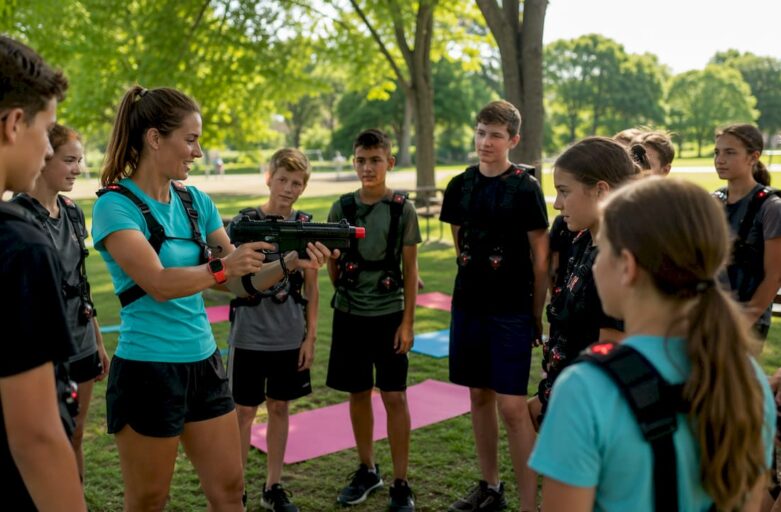
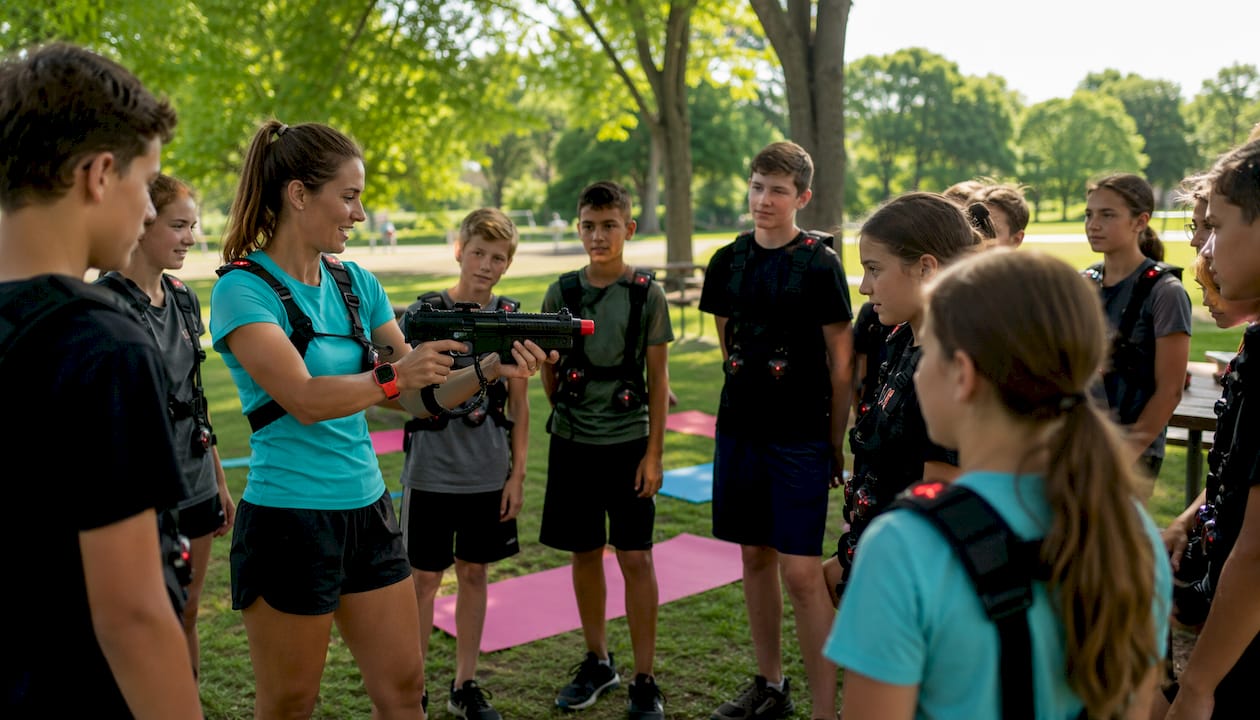
Laser clay shooting is simulated clay pigeon shooting using low-power lasers instead of live ammunition. Replica or decommissioned 12-bore shotguns are fitted with laser modules, and participants fire at electronic disc targets rather than anything airborne or destructive. The result is a projectile-free shooting activity that schools can run on-site or at activity centres, with no noise, no lead, and no safety compromise. Laserclay has built its offer around exactly this model, making the technology accessible for school groups, youth clubs, and programme coordinators across the UK.
Key features at a glance:
- No live ammunition or projectiles; uses infra-red or visible low-power lasers
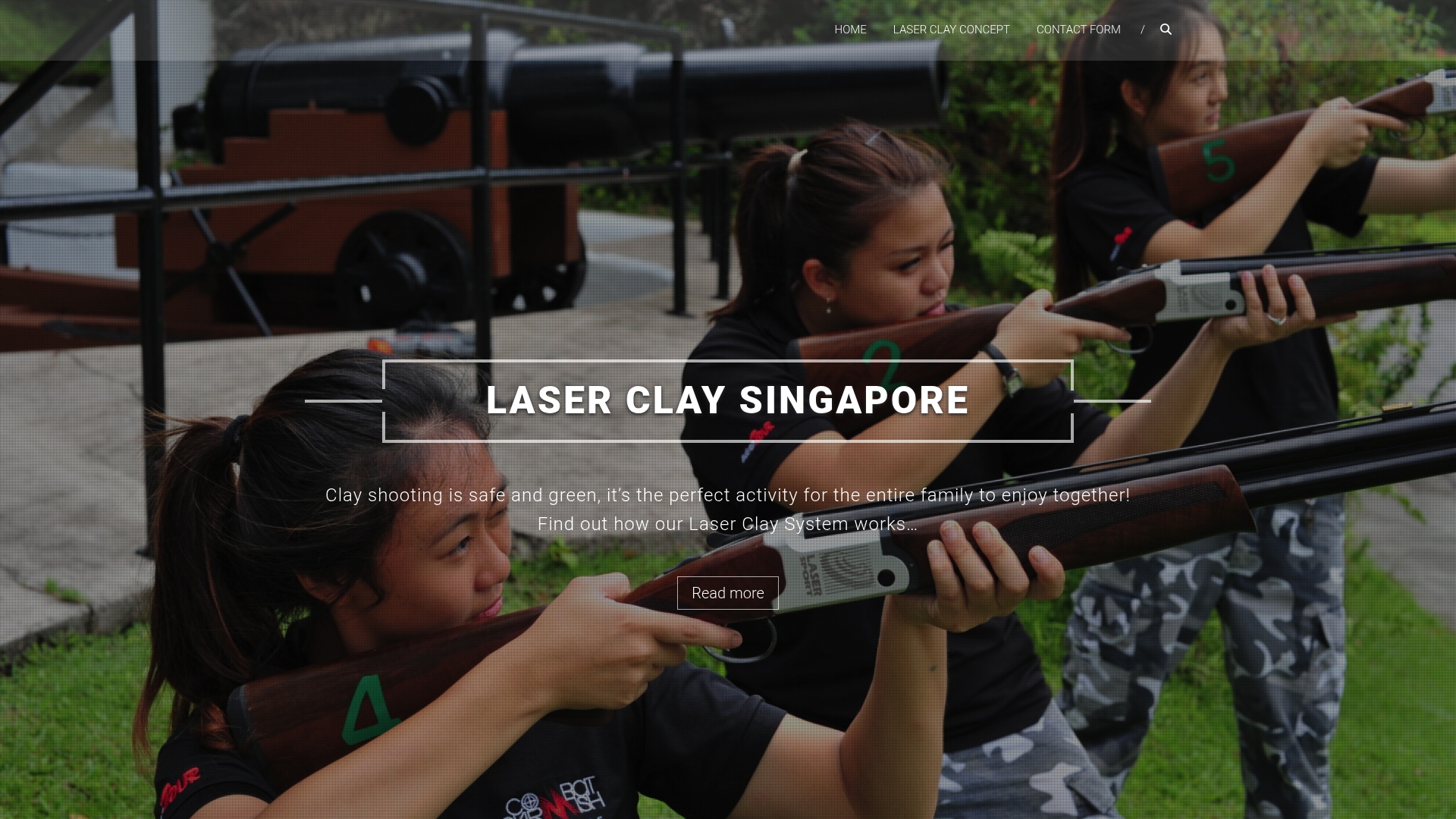
- Equipment consists of decommissioned 12-bore shotgun replicas fitted with laser modules
- Electronic targets provide immediate hit feedback via RGB LEDs and real-time scoring
- Recommended for participants at an appropriate age for equipment handling
- Groups of multiple students can take part per session
- No specialist facility required; suitable for indoor and outdoor settings
- No environmental impact from lead shot or clay debris
How does laser clay shooting work in a school setting?
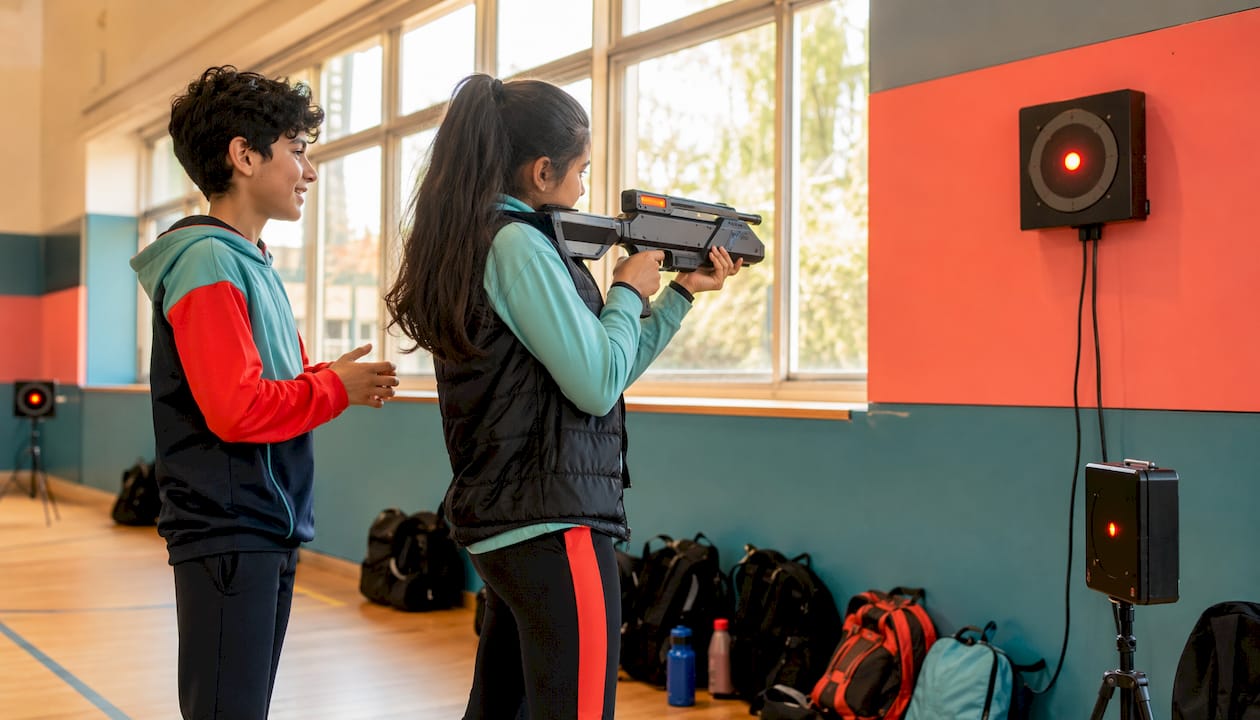
The system has three components working together: a laser-gun module, a physical electronic target, and a web-based scoring display. When a student pulls the trigger, the gun emits a brief laser pulse lasting a few milliseconds. The target detects that pulse through an illuminance sensor paired with a Fresnel lens, then fires its RGB LEDs to confirm a hit instantly. Scores are logged and visualised in real time through a browser on a smartphone or tablet, so instructors can track individual performance without any dedicated app.
This dual-structure architecture means students get two layers of feedback: the physical flash on the target and the digital score on screen. That combination keeps engagement high and gives teachers usable data on accuracy and improvement over a session.
| Component | Function | Notes |
|---|---|---|
| Laser-gun module | Emits pulse-controlled laser on trigger pull | 10 ms pulse per shot |
| Physical electronic target | Detects hit via illuminance sensor; gives LED feedback | Fresnel lens improves sensitivity |
| Web-based scoring module | Records and visualises scores via smartphone camera | No dedicated app required |
| Decommissioned shotgun replica | Houses laser module; realistic handling weight | Suitable for ages 14 and above |
At UK activity centres, sessions accommodate up to 15 students with qualified supervision, and pricing for school and youth groups is highly competitive and affordable at regional venues such as Lower Grange Farm in Kent.
What skills do students develop through laser clay shooting?
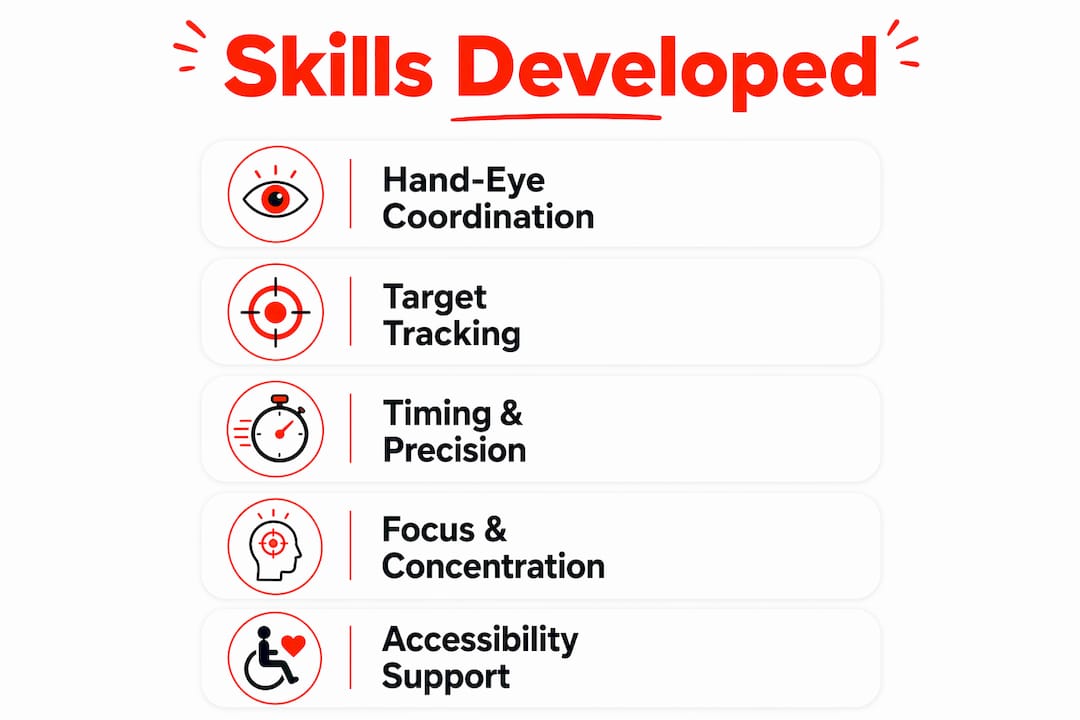
Hand-eye coordination is the most obvious gain, but it is far from the only one. Tracking a moving target, timing a trigger pull, and adjusting stance all demand spatial awareness and fine motor control simultaneously. Students also develop focus and concentration under mild competitive pressure, which transfers directly to classroom attention tasks.
The activity fits naturally into both physical education and STEM curricula. The electronic target system introduces students to sensor technology, real-time data capture, and feedback loops — concepts that sit squarely in the technology and engineering strands of the national curriculum. Group formats build communication and teamwork, particularly when students rotate roles between shooter and scorer.
Benefits for students:
- Improved hand-eye coordination and fine motor control
- Stronger focus and sustained concentration
- Spatial awareness developed through target tracking
- Teamwork and communication in group or relay formats
- Introduction to sensor technology and data feedback as part of STEM learning
- Discipline around safe equipment handling
- Inclusive participation regardless of prior sporting experience
Students with physical disabilities or sensory processing differences often engage well with laser clay precisely because the activity is low-impact and adjustable. The absence of noise, recoil, and projectiles removes barriers that traditional shooting sports create for many young people.
Safety guidelines every school coordinator should know
Laser clay equipment operates under IEC 60825-1:2014, the international standard governing optical radiation safety. The pulse-limited laser emission of approximately 10 milliseconds per trigger pull is specifically designed to prevent ocular hazard, keeping the system well within safe exposure thresholds. That engineering choice is not incidental; it is the foundation on which the whole school-use case rests.
Age guidance sets the minimum at 14 years, driven by the weight and handling demands of the decommissioned 12-bore replicas rather than any concern about the laser itself. Younger students simply find the equipment physically difficult to manage safely over a full session.
Key safety practices:
- Confirm equipment complies with IEC 60825-1:2014 before booking or purchasing
- Enforce the minimum age of 14 for all participants using standard replica shotguns
- Brief students on safe gun-handling before each session, even with laser equipment
- Never point the laser gun at faces or eyes at close range
- Ensure a qualified instructor or supervisor is present throughout
- Conduct a site risk assessment in line with HSE guidance for adventure and activity providers
- Store equipment securely after use
Pro Tip: When evaluating providers or equipment suppliers, ask specifically whether the laser module is pulse-limited and IEC 60825-1:2014 compliant. Any reputable supplier will confirm this immediately; hesitation is a red flag.
Practical steps for setting up a laser clay programme at your school
Space requirements are modest. A clear outdoor area of roughly 20–30 metres works well for standard target distances, but the system also runs indoors in a sports hall with targets positioned at shorter range. The portability of the equipment means you are not tied to a fixed venue.
- Decide between hiring an external provider or purchasing equipment outright; provider hire suits occasional use, while ownership makes sense for regular PE or enrichment sessions
- Book sessions for groups of up to 15 to maintain safe supervision ratios
- Allow 45–60 minutes per session, including a safety briefing and rotation time
- Adapt target height and distance for participants with mobility considerations
- Confirm instructor training and certification before the first session
Instructor training covers safe equipment handling, session structure, and basic troubleshooting of the electronic target system. Providers such as Laserclay typically include this as part of their setup support. For schools running the activity independently, structured youth shooting programmes offer useful frameworks for safe, age-appropriate delivery.
Pro Tip: Run a short demonstration round with staff before the student session. Instructors who have fired the equipment themselves give clearer, more confident briefings, and students respond to that.
What does the research say about laser shooting systems in schools?
Academic work on low-cost laser shooting systems confirms what practitioners already observe: the combination of immediate physical feedback and digital scoring creates a learning loop that conventional PE equipment rarely matches. A published study on educational laser systems found that expert validators in physical education, educational technology, and sports technology rated the system highly across safety, cost efficiency, functional completeness, and field applicability.
The proposed system represents a practical and scalable alternative for school physical education classes, after-school activities, and recreational programmes where conventional shooting equipment is difficult to deploy.
The synchronisation between the laser pulse and the illuminance sensor is what makes reliable hit detection possible at low optical power. That precision is also what keeps the system safe; the sensor responds to the brief pulse without requiring the laser to operate at a level that could cause harm. General-purpose components and web standards keep costs down, which matters for schools working within tight budgets.
| Research finding | Practical implication |
|---|---|
| Pulse-limited 10 ms emission prevents ocular hazard | Safe for school use under IEC 60825-1:2014 |
| Illuminance sensor with Fresnel lens detects hits at low power | Reliable scoring without high-power lasers |
| Browser-based scoring requires no dedicated app | Low IT overhead for schools |
| Expert validation: high marks for safety and field applicability | Confidence for programme coordinators |
Laserclay applies these principles across its school and youth programmes, combining safe laser technology with structured session formats that give coordinators confidence from the first booking.
Laser clay shooting gives schools a physically active, technology-rich activity that is genuinely safe, measurably educational, and easy to run. Explore how to play and see how Laserclay can support your next school or youth programme.
Key takeaways
Laser clay shooting is the most practical way to bring a shooting sport into UK schools safely, combining IEC 60825-1:2014-compliant laser technology with real-time electronic scoring and no projectiles.
| Point | Details |
|---|---|
| Age and group size | Recommended for ages 14 and above, with sessions accommodating up to 15 students. |
| Safety standard | Equipment uses pulse-limited 10 ms laser emission, compliant with IEC 60825-1:2014. |
| Skills developed | Hand-eye coordination, focus, spatial awareness, teamwork, and STEM literacy. |
| Setup flexibility | Runs indoors or outdoors with no specialist facility; scoring via smartphone browser. |
| Cost at UK venues | Regional activity centres charge £15 per person for school and youth group sessions. |