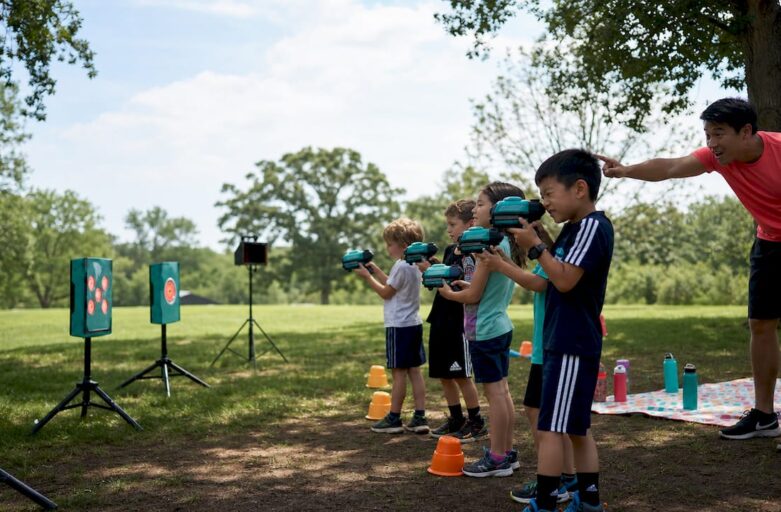
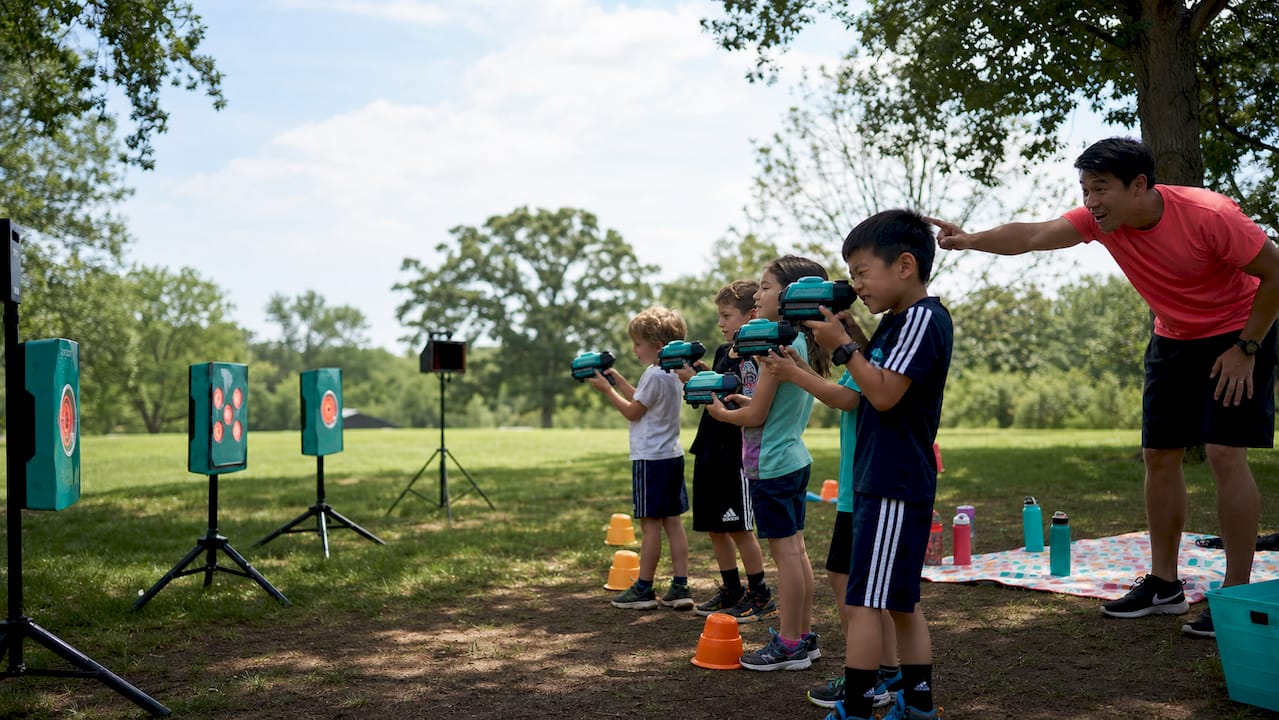
Run a safe, inclusive school sports day by organising a station-based carousel format with a mix of accuracy, movement, and cooperative activities that require no physical tagging or contact. The Youth Sport Trust’s annual report consistently highlights participation and inclusion as the primary drivers of long-term physical literacy in school sport, and that principle should sit at the heart of every planning decision you make. Tools like PE Mastery’s editable activity packs and Laserclay’s facilitated laser shooting station give you ready-made, non-contact options that work across a wide range of abilities.
Day-of essentials: first-aid kit at each zone, sun cream station at entry, water points every 30 metres, lanyard roles assigned, rotation whistle confirmed. Sample run order: 8:30 AM arrival and registration, 9:00 AM warm-up, 9:15 AM–11:45 AM station rotations of several minutes per station, 11:45 AM break, 12:00 PM team finale, 12:30 PM close, and certificates.
Key takeaways
A station-based carousel with 5–7 non-contact activities, one adult per station, and a written volunteer briefing sent three days before the event is the most reliable format for an inclusive school sports day in Singapore.
| Point | Details |
|---|---|
| Station format reduces waiting | Half-day events work best with 5–7 stations running 6–8 minutes each, keeping all pupils active simultaneously. |
| Inclusion needs roles, not removal | Assign scorers, media leads, and equipment managers so every pupil has a meaningful job, not just a spectator seat. |
| Singapore heat is a real hazard | Monitor WBGT and pause outdoor activity at 31°C or above; schedule rotations before 10:30 AM where possible. |
| Written briefings outperform verbal ones | Send volunteers a written brief three days before the event; verbal instructions on the morning create confusion. |
| Laserclay as a facilitated station | Laserclay’s school package includes facilitators, kit, and scoring, fitting directly into a carousel rotation with no prep from your team. |
Table of Contents
- How do you organise a non-contact school sports day step by step?
- What non-contact activities work best for a school sports day?
- How does a station carousel format work, and what does a run-sheet look like?
- How do you make a school sports day inclusive for all pupils?
- What safety checks does a non-contact sports day require?
- How should you recruit and deploy volunteers on the day?
- Where do you source equipment for a school sports day in Singapore?
- Why Laserclay works as a non-contact station for school sports days
- An organiser’s perspective on what actually works
- What does a Laserclay school package include, and how do you book?
- Sources
How do you organise a non-contact school sports day step by step?
A reliable sports day comes down to five decisions made in the right order. Rush any of them and you spend the morning firefighting instead of running activities.
-
Lock in the date and reserve a contingency day. Choose your primary date at least six weeks out and immediately reserve a fallback date one week later. Singapore’s weather makes this non-negotiable: a sudden downpour can end an outdoor event in minutes. Decide your weather cut-off the evening before (check the Meteorological Service Singapore forecast by 6:00 PM) and communicate it to parents that night. The PE Hub’s sports day planning checklist lists this as the first critical task for good reason.
-
Choose your format and activities. A station-based carousel suits non-contact days best. Aim for 5–7 stations for a half-day event. Assign each station a clear activity type: one accuracy game, one movement relay, one cooperative challenge, one dance or rhythm activity, and one low-sensory option. Write a one-line description of each station so volunteers can brief pupils in under 30 seconds.
-
Recruit volunteers and assign roles. You need at least one adult per station plus a roving first-aider and a timekeeper. Student leaders aged 10 and above can manage scoring and equipment at simpler stations. Brief every volunteer in writing at least three days before the event, not on the morning itself.
-
Complete equipment and safety checks. Walk every station the afternoon before the event. Check that equipment is undamaged, that target distances are marked, and that there are no trip hazards. Confirm your first-aid kit is stocked and that your designated first-aider holds a current certificate. PlanBee’s organiser guide recommends preparing an indoor alternative rota in case of rain, even if you expect sunshine.
-
Send your communications pack. Parents need: the date, the format, what to wear (closed-toe shoes, sun hat, water bottle), the non-contact rules in plain language, and the contingency plan. Staff need: the run-sheet, their station assignment, the rotation signal, and the stop-activity protocol. Send both at least five days before the event.
Run-sheet stub you can copy:
| Time | Activity |
|---|---|
| 8:30 AM | Arrival, registration, sun cream station |
| 9:00 AM | Whole-school warm-up (5 minutes) |
| 9:10 AM | Station rotations begin (6–8 min per station, whistle signal) |
| 11:30 AM | Final rotation ends, pupils return to base |
| 11:45 AM | Break and hydration |
| 12:00 PM | Team finale or showcase activity |
| 12:30 PM | Certificates, close, pack-down begins |
What non-contact activities work best for a school sports day?
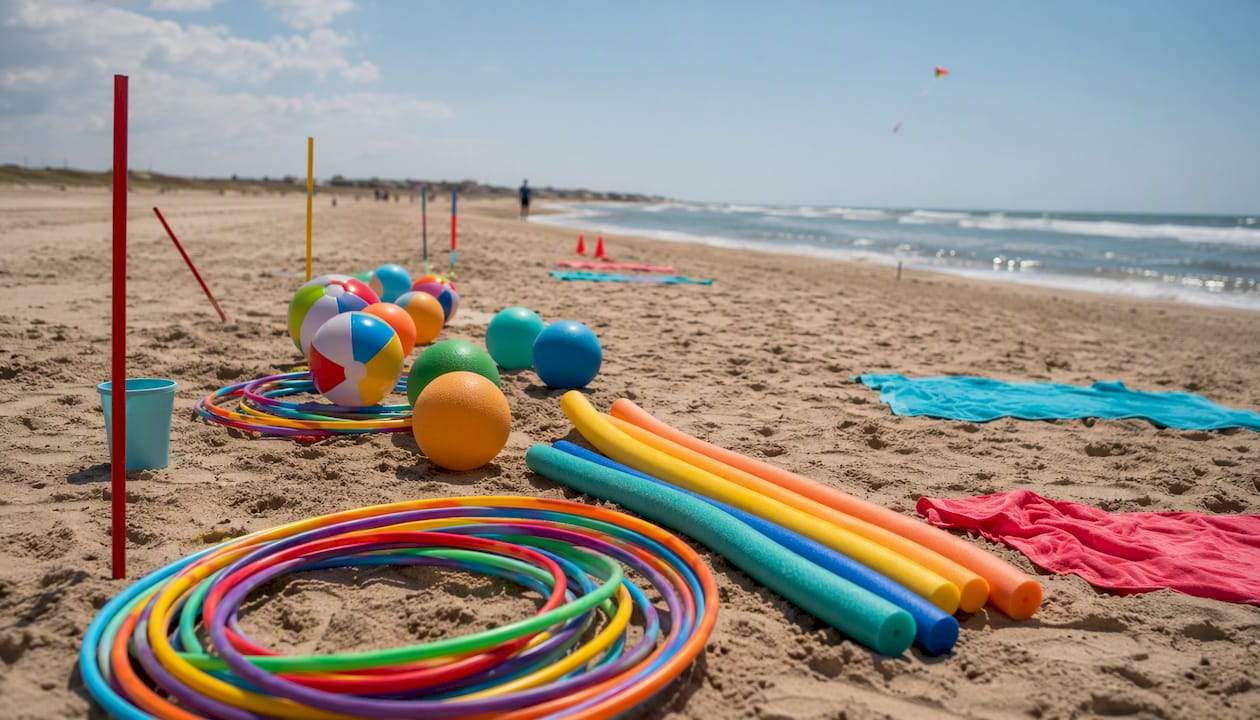
The activities below are grouped by type. Each card gives you the essentials to run the station without further preparation. Age tags use KS1 (Primary 1–2), KS2 (Primary 3–6), and Secondary. Space tags are: S = small hall or classroom bay, M = playground, L = field.
| Activity | Age | Space | Equipment | Time | Scoring | Easier mod | Harder mod |
|---|---|---|---|---|---|---|---|
| Bean-bag target toss | KS1, KS2 | S, M | Hula hoops (3), bean bags (10) | 6 min | 1 pt per hoop landed | Move thrower 1 m closer | Add a moving hoop |
| Laser clay shooting | KS2, Secondary | M, L | Laserclay kit (facilitator-supplied) | 8 min | Electronic scoreboard | Larger target, slower clay | Faster clay, smaller target |
| Hula hoop pass relay | KS1, KS2 | S, M | 1 hoop per team of 6 | 6 min | Fastest team wins | Smaller team (3) | Two hoops simultaneously |
| Scavenger hunt | KS1, KS2 | M, L | Laminated clue cards, collection bags | 8 min | Most items found | Paired search | Timed solo challenge |
| Parachute activities | KS1 | S, M | 1 parachute, foam balls | 6 min | Balls kept aloft | Slower ripple pace | Add more balls |
| Rhythm and dance freeze | KS1, KS2 | S, M | Bluetooth speaker, playlist | 6 min | Participation stamp | Seated version available | Choreography challenge |
| Obstacle course (no-touch) | KS2, Secondary | M, L | Cones, hoops, balance beams | 8 min | Fastest time | Walk the course | Blindfolded with a guide |
| Cooperative ball balance | KS2, Secondary | S, M | Tennis balls, flat boards | 6 min | Distance covered | Shorter distance | Eyes closed |
| Simon Says | KS1 | S | None | 5 min | Last person standing | Slower commands | Compound commands |
| Hopscotch challenge | KS1, KS2 | M | Chalk or tape | 6 min | Fastest clean run | Wider squares | One-footed only |
Equipment master list across all stations: hula hoops (×6), bean bags (×20), foam balls (×10), parachute (×1), tennis balls (×10), flat balance boards (×4), cones (×20), laminated clue cards (×30), collection bags (×15), chalk or floor tape (×2 rolls), Bluetooth speaker (×1), playlist prepared on device, Laserclay kit (booked separately with facilitator).
Many of these items can be sourced from your school’s PE cupboard or borrowed from neighbouring schools. School Fitness Ireland’s activity list recommends modified pitches and simplified rules to keep the focus on teamwork rather than physical dominance, which translates directly to the no-touch obstacle course and cooperative ball balance above.
For movement-based family and group activities that translate well to school settings, Lunix’s family fitness guide offers a useful reference for inclusive, low-equipment games.
How does a station carousel format work, and what does a run-sheet look like?
A carousel keeps every pupil active simultaneously. Instead of one race with 30 spectators, you have 6 stations running in parallel with 5 pupils at each. Waiting time drops to near zero, variety increases, and inclusion becomes structurally easier because you can place the most accessible activities at the stations where pupils who need more support are scheduled to start.
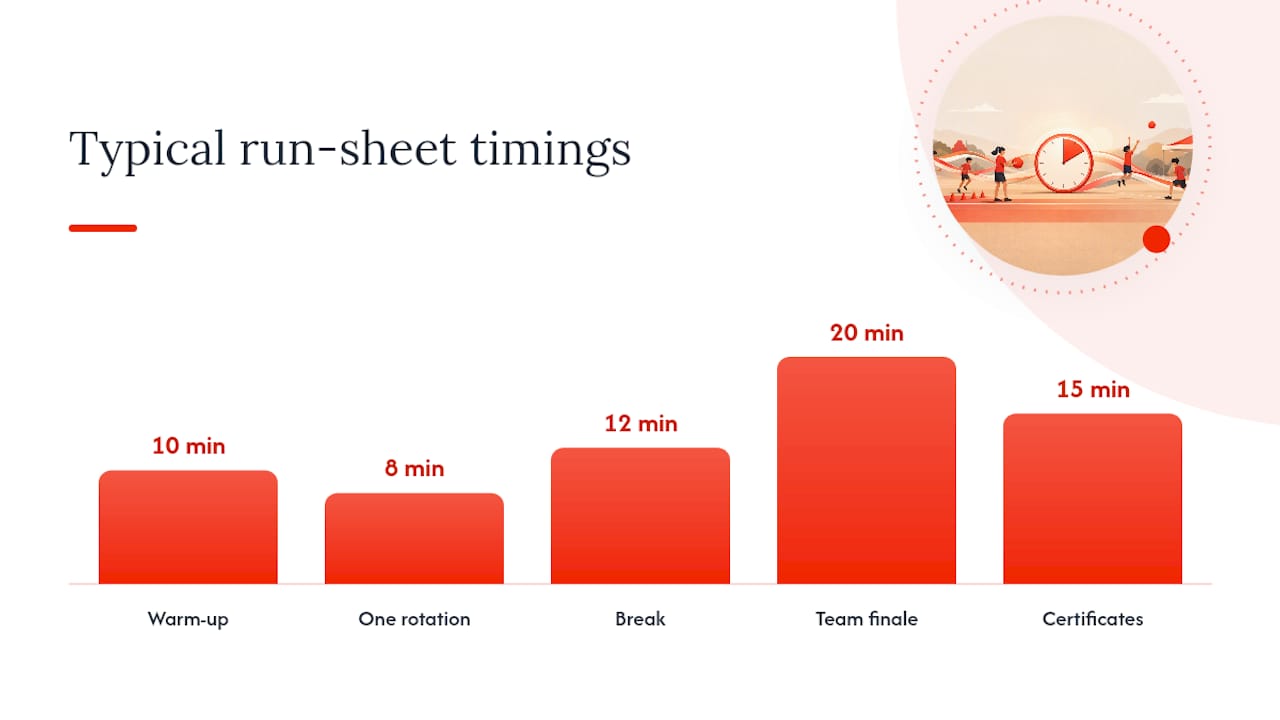
According to the School Specialty field day guide, station rotations typically run 6–8 minutes each, with full-day events using 16–20 stations and half-day events commonly using 5–7 activities. That rhythm gives you a natural planning anchor.
Sample half-day timed run-sheet with multiple stations and pupils:
| Time slot | Activity |
|---|---|
| 9:00–9:10 AM | Whole-school warm-up, rules briefing |
| 9:10–9:18 AM | Rotation 1 |
| 9:18–9:26 AM | Rotation 2 |
| 9:26–9:34 AM | Rotation 3 |
| 9:34–9:42 AM | Rotation 4 |
| 9:42–9:50 AM | Rotation 5 |
| 9:50–9:58 AM | Rotation 6 |
| 9:58–10:10 AM | Break, hydration, toilet stop |
| 10:10–10:30 AM | Team finale or showcase station |
| 10:30–10:45 AM | Certificates, group photo, pack-down |
Rotation flow: use a single whistle blast to signal the end of each rotation. Pupils move clockwise to the next station. A second volunteer stands at the midpoint between stations to guide flow and prevent bunching. Post a laminated station map at each entry point so groups can navigate independently.
Three scoring models to choose from:
- Participation focus: every pupil who completes a station earns a stamp on their card. No points, no ranking. Works well for KS1 and mixed-ability groups.
- Points per station: each station awards up to 5 points. Teams accumulate a total. Displayed on a central scoreboard at the end. Suits KS2 and secondary groups who respond well to friendly competition.
- Mixed badge system: pupils earn coloured badges for participation (green), personal best (silver), and top score (gold). Recognises effort and achievement simultaneously, which aligns with the Youth Sport Trust’s emphasis on inclusive participation metrics.
Schools often combine a morning of station rotations with an afternoon team finale, balancing broad participation with a moment of spectacle that pupils remember.
How do you make a school sports day inclusive for all pupils?
Inclusion is not about removing challenge. It is about designing the day so that every pupil has a meaningful role and a genuine chance of success. PE Mastery’s KS2 sports day planning pack frames this clearly: role assignments, equipment adaptations, and alternative scoring are the three levers that make the difference, not a watered-down programme.
Non-performer roles that matter
Not every pupil will want to compete at every station. Give them a job that carries genuine responsibility:
- Media team: photograph or film each station. Produces the event slideshow shown at the close.
- Equipment manager: sets up and packs down each station between rotations. Wears a hi-vis vest.
- Scorer: records points on a clipboard and reports to the central scoreboard keeper.
- Cheer captain: leads team chants and manages team spirit. Wears a coloured sash.
- Water station attendant: manages the hydration point, hands out cups, tracks refills.
Sample lanyard text for a scorer: “My job today: record each team’s score at this station and hand the sheet to the timekeeper at the whistle. Ask me if you have a question about points.”
Equipment and rule adaptations for common SEND needs
Small adjustments preserve the activity’s intent while opening it to more pupils. For target-based activities, reducing the throwing distance by 1–2 metres or increasing the target size often preserves the challenge while making success achievable. For movement activities, a seated or wheelchair-accessible version of the same task (parachute ripple from a chair, bean-bag toss from a seated position) keeps the pupil at the same station as their peers rather than in a separate adapted event.
For pupils with sensory sensitivities, the rhythm and dance freeze station can be run with visual cues (a raised flag) instead of a loud whistle. Simon Says works well as a quieter, low-sensory option with no equipment.
Adaptive fitness training principles suggest that the most effective modifications maintain the core movement pattern while adjusting load, distance, or complexity, rather than substituting an entirely different task.
Briefing staff and parents
Brief staff on SEND adaptations in writing before the day, not verbally on the morning. Keep the briefing factual and task-focused: “Pupil X may need the throwing distance reduced at the bean-bag station. The scorer at that station has been informed.” Avoid sharing diagnostic labels in a group briefing. For parents, a short paragraph in the pre-event letter explaining that all activities have adapted versions available is usually sufficient.
Pro Tip: Create a one-page “adaptation card” for each station and laminate it. The station leader can refer to it instantly without needing to remember verbal instructions from a briefing three days earlier.
Optional participation should always be available. A pupil who does not want to take part in a specific station should have a non-competitive role ready, not a gap in their schedule.
What safety checks does a non-contact sports day require?
Non-contact does not mean no-risk. Equipment can still cause trips, Singapore’s heat creates genuine physiological risk, and crowd flow at rotation points needs managing. Cover these before the day, not during it.
Key safety principle for Singapore schools: the National Environment Agency advises that outdoor physical activity for children should be paused or moved indoors when the Wet Bulb Globe Temperature (WBGT) reading reaches 31°C or above. Check the NEA’s real-time WBGT data on the morning of the event and assign a staff member to monitor it throughout the day. Build a 10-minute indoor contingency rotation into your run-sheet so you can act immediately without disrupting the programme.
Sun safety and hydration in Singapore conditions
Singapore’s equatorial climate means UV index readings above 11 (extreme) are common between 10:00 AM and 2:00 PM. Schedule outdoor rotations before 10:30 AM where possible, or provide shaded canopies at each station. Every pupil should apply SPF 30+ sun cream before the first rotation. Sun safety activities for children can be built into the pre-event briefing as a short, engaging routine rather than a lecture.
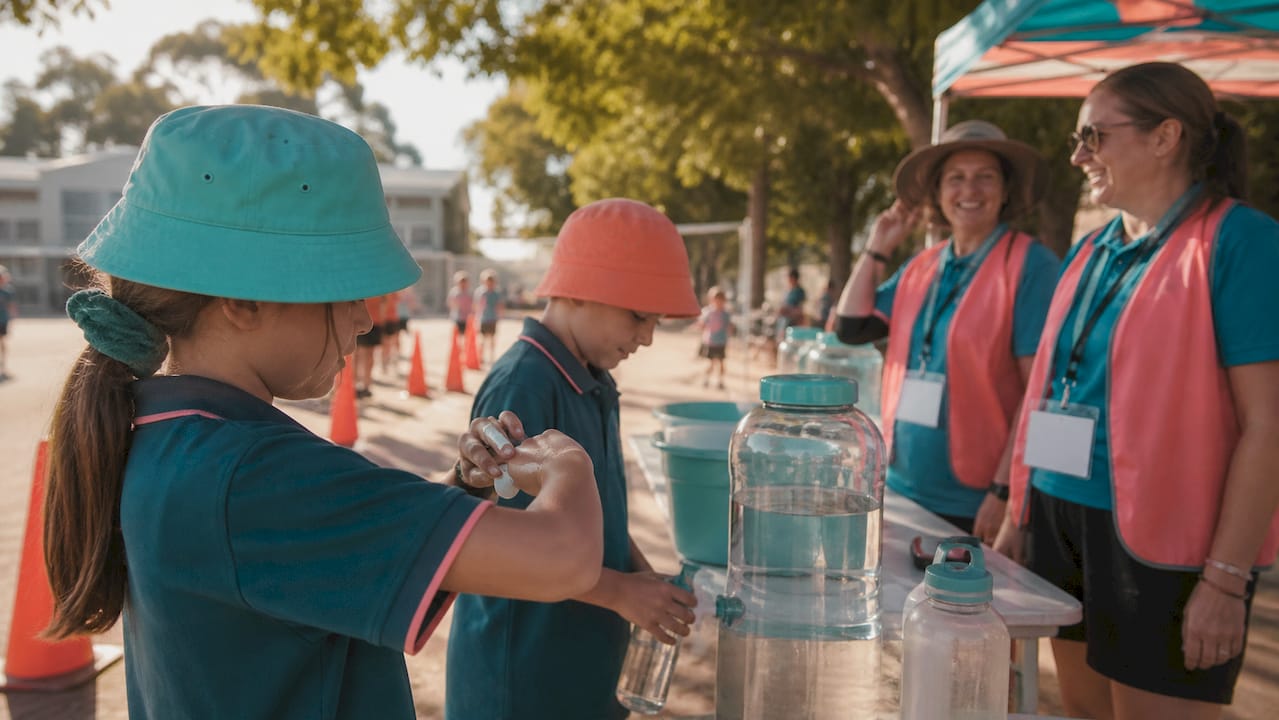
Water points should be placed no more than 30 metres from any station. Pupils should drink at every rotation break, not just when they feel thirsty. Assign a water station attendant (see staffing section) to track consumption and flag any pupil who appears flushed or lethargic.
Risk-assessment checklist
| Hazard | Mitigation |
|---|---|
| Trip hazard from equipment | Walk every station the afternoon before; remove or tape down loose items |
| Collision at rotation points | Designate one-way flow paths with cones; station a volunteer at each junction |
| Heat exhaustion | Monitor WBGT; schedule breaks; water points every 30 m; shaded rest area available |
| Equipment failure (e.g. broken hoop) | Spare equipment box at central point; station leader empowered to swap immediately |
| Pupil injury at station | First-aider within 60 seconds of every station; stop-activity whistle protocol known to all staff |
| Sunburn | Mandatory sun cream at entry; hats required; canopies at exposed stations |
| Unauthorised visitor access | Perimeter check before opening; sign-in table for parents and volunteers |
Stop-the-activity triggers: any pupil who loses consciousness, vomits, or shows signs of heat exhaustion triggers an immediate station pause. The station leader blows three short whistle blasts (distinct from the rotation signal), all pupils sit down, and the first-aider responds. Every staff member and volunteer must know this protocol before the event starts.
How should you recruit and deploy volunteers on the day?
Volunteers perform well when they know exactly what they are doing before they arrive. A volunteer who turns up and receives their instructions verbally at 8:45 AM is a liability; one who received a written brief three days earlier and confirmed receipt is an asset.
Recruitment sources
School parent-teacher associations are the most reliable source for Singapore schools. Student leaders from upper primary or secondary can manage simpler stations under adult supervision. Teachers from partner schools or PE specialists can cover technical stations. Aim for a minimum ratio of one adult per station, plus one roving first-aider and one event coordinator who does not run a station.
Sample job descriptions
- Station leader: runs one activity for the full event. Briefs each group as they arrive (30-second script provided), manages scoring, and signals the timekeeper if an issue arises. Stays at the station throughout.
- Scorer: collects score sheets from each station after every rotation, updates the central scoreboard, and hands blank sheets to station leaders for the next group.
- Setup and pack-down crew: arrives 45 minutes before the event, sets up all stations to the layout diagram, and packs down within 30 minutes of close.
- Water station attendant: manages the hydration point, hands out cups, refills containers, and monitors pupils for signs of heat stress.
- First-aid watcher: roving role. Carries the first-aid kit, maintains line of sight to at least two stations at all times, and responds to the three-whistle stop signal.
- Media lead: photographs and films each station, collects consent-compliant images, and prepares a short slideshow for the closing ceremony.
Staffing ratios
For a half-day event with 6 stations and up to 30 pupils, you need a minimum of 6 station leaders, 1 first-aider, 1 scorer, 1 water attendant, and 1 event coordinator. That is 10 adults for 30 pupils, a ratio of 1:3. For larger events (60–90 pupils), scale station leaders proportionally and add a second roving first-aider.
Quick supervision check: before rotations begin, each station leader should confirm they have a clear sightline to every pupil at their station. If any pupil is out of direct sight, adjust the station layout before the whistle blows.
Where do you source equipment for a school sports day in Singapore?
Most of the equipment in the activity catalogue above is already in your school’s PE store. Do a stock check six weeks before the event and identify gaps early, because rental lead times in Singapore can run 5–7 business days for specialist items.
Equipment checklist by station type
- Target and accuracy stations: hula hoops, bean bags, cones, chalk or floor tape, laminated scoring sheets.
- Movement and relay stations: cones, flat balance boards, tennis balls, stopwatch or timer app.
- Cooperative stations: parachute, foam balls, rope (for boundary marking only, not contact).
- Dance and rhythm stations: Bluetooth speaker, fully charged device with playlist, laminated freeze-pose cards.
- Low-sensory stations: laminated clue cards, collection bags, visual signal flags.
- Facilitated stations (Laserclay): booked as a complete package including deactivated shotguns, electronic scoreboard, reusable clay targets, and a trained facilitator.
Buy versus rent
Buy consumables (chalk, laminated cards, bean bags) outright; they are cheap and reusable across future events. Rent specialist equipment (parachutes, balance boards, Laserclay kit) where the per-event cost is lower than storage and maintenance. When speaking to a rental provider, ask: Does the price include delivery and collection? Is the equipment covered by the provider’s insurance during the event? Does a facilitator come with the kit, or is that separate? What is the minimum booking notice?
For Laserclay specifically, the event rental options include facilitator support, setup, and pack-down as part of the school package, which removes the equipment management burden from your team entirely. Sourcing advice for school shooting sport programmes is also covered in detail at Laserclay’s equipment sourcing guide.
For general PE supplies in Singapore, school supply vendors such as those listed on the Ministry of Education’s approved supplier register are a practical starting point. Online marketplaces (Lazada, Shopee) carry most consumables at competitive prices with next-day delivery options.
Why Laserclay works as a non-contact station for school sports days
Laser clay shooting replaces the traditional clay pigeon format with a system that uses sound-simulated, deactivated shotguns and electronic targets. There is no ammunition, no physical contact, and no specialist outdoor range required. The school-focused rationale on Laserclay’s site explains the safety and inclusion case clearly: any pupil who can hold a lightweight prop and aim at a screen can participate, regardless of athletic ability.
In a school sports day context, the station typically runs as follows. A group of 5–6 pupils rotates in. The facilitator gives a 60-second briefing. Each pupil takes 3–5 shots at moving electronic clay targets. The real-time scoreboard displays individual scores immediately, which creates a moment of genuine excitement without any physical competition between pupils. The group rotates out. Total station time: 6–8 minutes, matching the carousel format exactly.
Logistics checklist for booking Laserclay
- Space footprint: approximately 10 m × 6 m for a standard school setup; suitable for a covered basketball court, school hall, or open field with canopy.
- Power: standard 13A socket required; the facilitator brings extension leads.
- Group size: 5–6 pupils per rotation; the system accommodates up to 30 pupils per hour in a carousel format.
- Facilitator: included in the school package; handles briefing, scoring, and pack-down.
- Setup time: approximately 30 minutes before the event; pack-down 20 minutes after.
- Eco credentials: reusable electronic targets, no lead or chemical waste, no noise pollution beyond the sound-simulated effect.
The benefits of laser games in school programmes cover the educational rationale in more depth, including suggested age groups and how the scoring system can be adapted to reward improvement rather than raw score, which aligns directly with the Youth Sport Trust’s participation-first framework.
An organiser’s perspective on what actually works
The conventional wisdom about school sports days is that the activities are the hard part. They are not. The hard part is the 20 minutes before the first whistle, when three volunteers have not arrived, a station is missing its equipment, and a parent is asking why their child is not in the opening photo.
Every smooth sports day I have seen comes down to one thing: the briefing pack sent three days before the event. Not the activities, not the budget, not the venue. The briefing pack. When every volunteer knows their station, their script, and the stop-activity signal before they walk through the gate, the event runs itself. When they do not, you spend the morning managing people instead of managing the programme.
The other thing worth saying: measure success differently. Participation rate matters more than podium results. A simple staff feedback form with three questions (Did every pupil have a role? Were there any safety concerns? What would you change?) takes five minutes to complete and gives you a genuine improvement loop for next year. Smiles and energy at the closing ceremony are real data too, even if they do not fit a spreadsheet.
What does a Laserclay school package include, and how do you book?
For school sports days that need a facilitator-led, zero-contact station with no equipment prep on your side, Laserclay’s school package covers everything from delivery to pack-down.
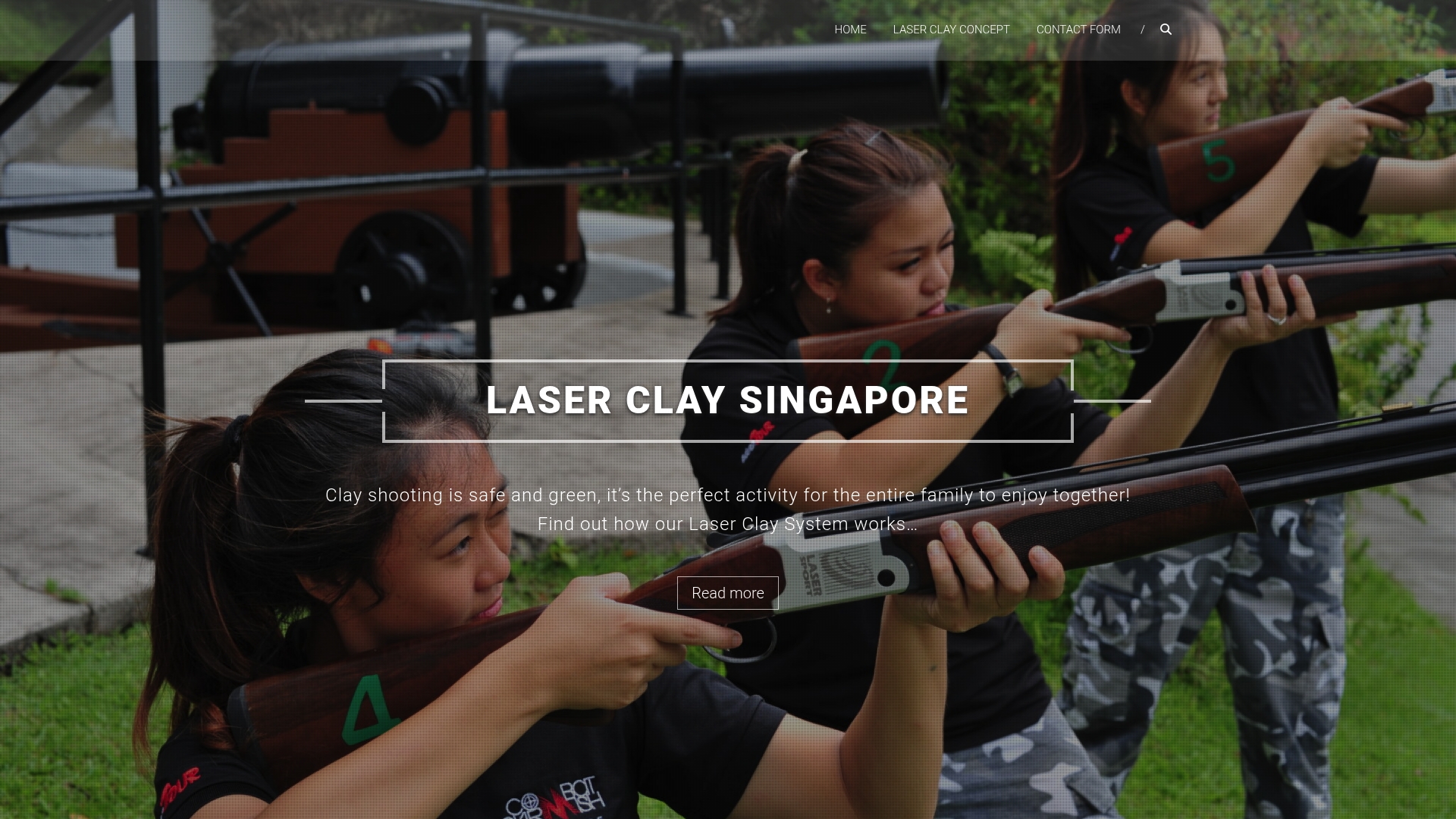
A standard school booking includes: trained facilitators who run the station and brief each group, the full Laserclay kit (deactivated shotguns, electronic targets, real-time scoreboard), setup and pack-down, and a customisable scoring format so you can choose participation stamps, individual scores, or team totals. The event rentals page lists current package options and what each includes.
To request a quote, prepare: your event date (and contingency date), the number of pupils, your venue address and available space dimensions, and whether you need a morning or afternoon slot. Laserclay’s team can advise on how many facilitators you need and how to fit the station into your carousel run-sheet. Contact them directly via Laserclay to check availability and get a school-specific quote.
Sources
The following resources support the planning, inclusion, and activity guidance in this article. All are freely accessible.
- Sports day planning checklist
- Top 5 creative sports day ideas for primary schools
- PE, school sport: the annual report 2025
School policies on outdoor activity, heat management, and media consent vary by institution. Always cross-reference your event plan with your school’s own risk-management policy and consult the National Environment Agency’s WBGT guidelines for Singapore-specific heat thresholds before finalising your outdoor schedule.
Recommended
- School sports day alternative activity ideas: 2026 guide | Laser Clay Singapore
- Why schools adopt non-contact shooting sports | Laser Clay Singapore
- Inclusive outdoor school sports: 10 examples for educators | Laser Clay Singapore
- How to source equipment for a school shooting sport programme | Laser Clay Singapore