
The strongest company picnic games mix three things: casual drop-in stations people can join without signing up, one or two scheduled team challenges that create a shared story for the day, and family-friendly options if guests are bringing children. Mixing energy levels this way keeps introverts and extroverts both engaged, prevents the day peaking too early or dragging in the afternoon, and gives you a natural rhythm to schedule around. The checklist and sample timetables below turn that mix into a runnable plan.
TL;DR:
- Casual lawn and tabletop games like corncake, giant Jenga, and bocce provide low-pressure options for guests to relax and chat without commitment.
- Large groups over 150 guests require multiple zones, staff per activity, and a headline attraction capable of handling high attendance efficiently.
- Facilitated games such as laser clay shooting offer a safe, inclusive, and weather-proof headline activity suitable for mixed-ability groups.
- Prioritizing optional participation and testing logistics beforehand prevents crowding and ensures smooth event flow.
- Prizes should be instant, humorous, and awarded for participation to motivate engagement without creating long queues or favoritism.
Table of Contents
- Ten quick picks for company picnic games
- Company picnic activities grouped by energy and effort
- How to choose games for your event’s vibe, guest mix and budget
- Sample schedules and zoning that stop the day turning into chaos
- A copy-ready checklist for supplies, signage and safety
- When to DIY and when to rent the headline attraction
- Why a facilitated activity like laser clay shooting works as a headline game
- Prizes and rewards that actually motivate participation
- Getting every employee involved, not just the usual few
- Considerations for virtual or hybrid company picnic games
- Three heuristics I’d use before booking a single game
- Book a headline game your whole team can actually join
- Sources
- FAQ
Ten quick picks for company picnic games
If you need to build a shortlist in the next ten minutes, start here. These cover the main energy levels you need at any staff picnic, and each one tells you roughly what it costs in time and kit.
Active team games get people moving and generate the loud, competitive energy that photographs well and gets talked about on Monday.
- Tug of war: two ropes, a marked centre line, five minutes per heat. Needs open grass and at least eight players per side.
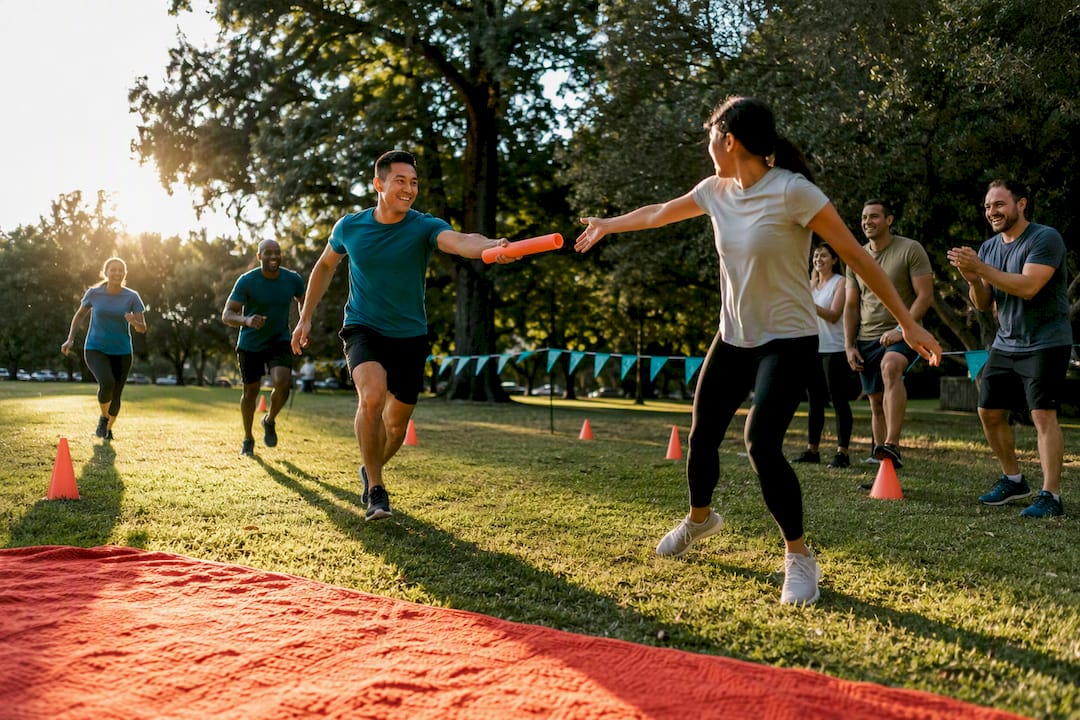
- Relay race: batons or beanbags, cones, a stopwatch. Scales from four teams to twenty; runs in ten minutes flat.
- Three-legged race: fabric strips or old ties, a 20 metre stretch of lawn. Cheap, chaotic, and always a crowd favourite.
- Tug-of-war variant, the “trust pull”: same rope, but pairs face each other rather than lines, good for smaller headcounts.
Casual lawn games are the drop-in stations people wander to between conversations, no commitment required.
- Cornhole: a couple of boards and bean bags, runs all day unattended once set up.
- Giant Jenga: one set covers a table’s worth of players at a time; low supervision needed.
- Giant connect four or noughts and crosses: quiet, sociable, works for mixed ages.
Carnival and novelty attractions give the picnic a headline moment, the thing people mention when asked how the day went.
- Ring toss or bean bag boards: cheap to rent or DIY, runs continuously.
- Photo booth with props: near-zero staffing once the backdrop is up.
- **A dunk tank alternative, such as a splash-target game, works where a full dunk tank isn’t practical or budget allows.
Family and kids-friendly picks matter if the invite extends to children or partners.
- Face painting and bubble stations: minimal setup, keeps under-tens occupied for long stretches.
- A shared parent-child activity, like a simple obstacle course, lets families play together rather than being split into separate zones.
Company picnic activities grouped by energy and effort
Once you’ve picked your headline pieces, it helps to see the fuller catalogue, grouped by how much energy and supervision each one demands. This is where outdoor team building activities earn their keep, because the right group challenge does more for workplace relationships than an afternoon of small talk ever will.
Active and team challenges
These are the outdoor company picnic games that need space, a bit of noise tolerance, and usually a facilitator to keep score.
- Tug of war, scaled by adding weight classes or a best-of-three format for larger groups.
- Sack race, using real potato sacks or pillowcases; slow it down for mixed-ability groups by allowing a walking pace.
- Egg-and-spoon race, swapped to a golf ball and plastic spoon for windy conditions.
- Water balloon toss, which works well as a partner game and needs almost no rules explanation.
- Tag-team obstacle course, built from cones, hula hoops and a rope crawl; the most flexible format for scaling difficulty up or down.
Safety note: anything involving running on grass needs a quick check for sprinkler heads, tree roots or uneven ground beforehand, and any relay involving young children or older guests should offer a walking-pace lane.
Casual lawn and tabletop games
These are the low-pressure picnic activities for adults who’d rather chat than compete. Zoning casual games away from the high-traffic active area keeps queues short and lets people linger without feeling in the way of a relay race.
- Cornhole, played straight or with team scoring for a light competitive edge.
- Giant Jenga, self-policing once the group understands the “one hand” rule.
- Bocce or French boules, a genuinely inclusive option since pace and physical exertion are both low.
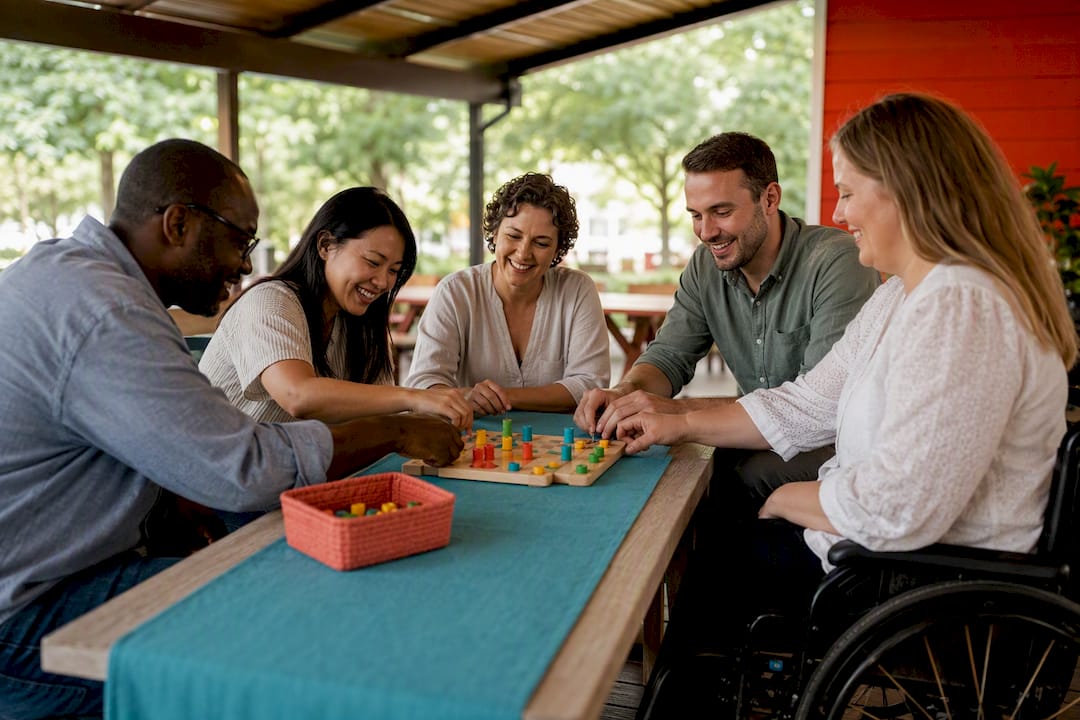
- Card and board game tables, useful for shaded areas and older guests who’d rather sit.
Carnival, novelty and creative low-cost options
This is where fun games for companies get memorable without needing a big budget.
- Ring toss and bean bag boards: rules take thirty seconds to explain, which matters when you’ve got a constant flow of new players.
- Trivia stations, themed around company history or pop culture, run well as a rolling activity rather than a single scheduled event.
- Minute-to-win-it challenges, such as stacking cups or balancing objects, need almost no equipment and generate strong crowd energy around a single table.
- Scavenger hunts, built around the venue itself, work particularly well for larger sites and can be run as team challenges or solo.
Pro Tip: Run your scavenger hunt as a QR-code trail rather than a paper list. It cuts printing costs, lets you track completion times automatically, and works just as well if the event later shifts to a hybrid format.
Accessibility adaptations matter across every category. Swap running relays for wheelchair-friendly walking versions, provide seated variants of tabletop games, and make sure at least one zone is entirely low-noise for guests who find carnival games overstimulating. A low-impact outdoor activity option such as a quiet nature walk or fishing-adjacent station gives you somewhere to point guests who want to opt out of organised games without feeling excluded from the day.
How to choose games for your event’s vibe, guest mix and budget
Pick the vibe before you pick the games. Event professionals consistently flag this as the single decision that determines whether a picnic feels energising or exhausting: decide whether the day is a celebration, a thank-you, or a team-building exercise first, because that choice dictates everything downstream.
A celebration vibe (a product launch, an anniversary) leans towards carnival attractions and a headline moment. A thank-you vibe (end of a hard quarter, appreciation day) leans towards low-pressure, drop-in stations with no mandatory participation. A team-building vibe leans towards structured challenges with team scoring, because the goal is shared effort rather than pure relaxation.
Guest count and venue change the maths fast:
- Under 50 guests: one active zone, one casual zone, and a single scheduled team event is plenty. More than that and you’ll have idle staff running empty stations.
- 50 to 150 guests: run two parallel active stations to avoid queues, and stagger your scheduled team event into heats rather than one mass event.
- Over 150 guests: you need a proper zoning plan (covered next), multiple staff per station, and at least one headline attraction that can absorb a crowd without a bottleneck.
Blended formats that combine team challenges with individual, low-pressure activities consistently outperform single-format days, because not every guest wants to compete and not every guest wants to sit still.
Your inclusion checklist should cover physical ability (seated and walking-pace alternatives for every active game), sensory needs (a quiet zone away from carnival noise), age range (something for children if partners and families are invited), and language or cultural comfort with physical contact games.
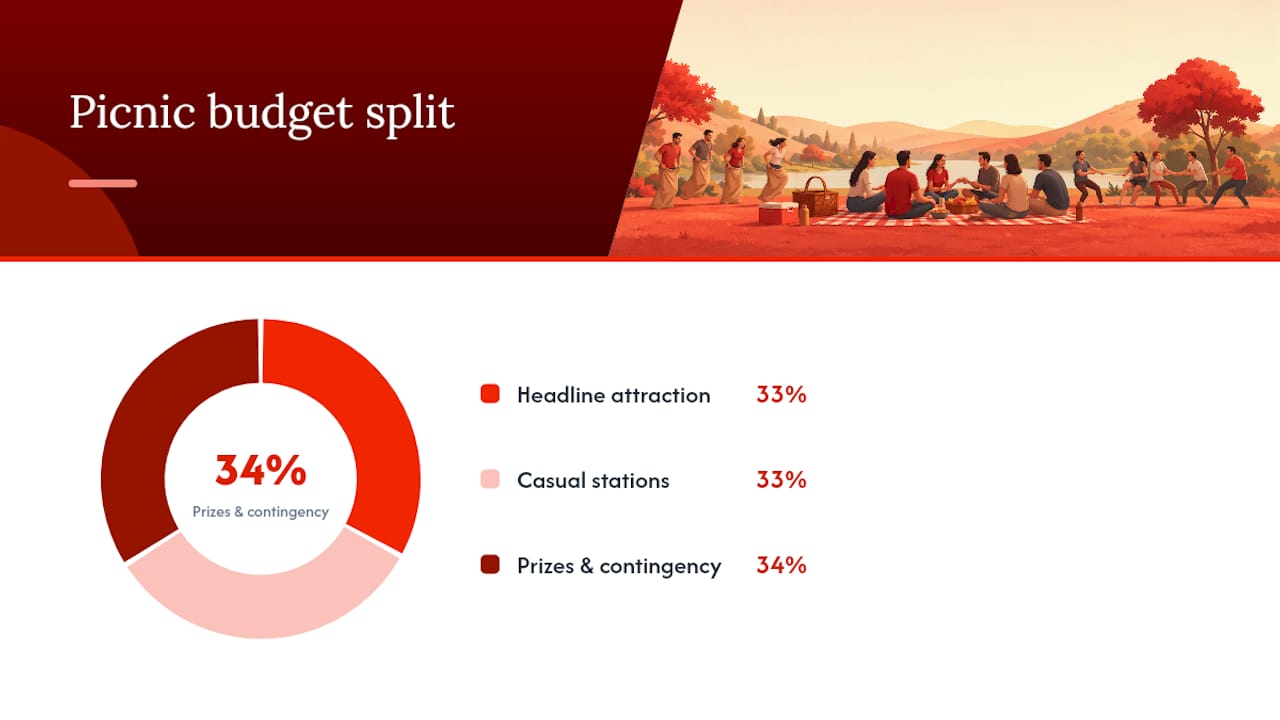
On budget, a rough rule of thumb: allocate roughly a third to a headline attraction, a third to casual station supplies, and the rest to prizes, signage and contingency. DIY works fine for lawn games and relays; renting makes sense the moment an attraction needs specialist equipment, insurance, or trained staff, which the DIY-versus-rentals section below covers properly.
Sample schedules and zoning that stop the day turning into chaos
Successful picnic layouts separate zones for active games, casual lawn games, food and family areas, opening the casual stations the moment guests arrive and holding the scheduled team events for the middle of the day when energy and attendance both peak, according to event-planning guidance from Party Pros East Coast.
Small picnic (under 50 guests), half-day format:
- 11:00, arrival: casual lawn games open (cornhole, giant Jenga), food stations open.
- 12:00, one scheduled team event: relay race or tug of war, run as a single heat.
- 13:00, lunch, with tabletop games available for anyone finishing early.
- 14:00, carnival stations open (ring toss, photo booth) until close.
Mid-size picnic (50 to 150 guests), full-day format:
- 10:00, arrival: two casual zones open in parallel to avoid queues.
- 11:30, first scheduled team event, run in heats by department.
- 13:00, lunch with a quiet zone and seated games running throughout.
- 14:30, second scheduled team event or headline attraction slot.
- 16:00, carnival and novelty stations stay open until wind-down.
Large picnic (over 150 guests), full-day format with parallel programming:
- 10:00, arrival across three casual zones plus a dedicated kids zone.
- 11:00 to 15:00, rolling team heats running continuously in one zone while casual stations run unbroken elsewhere.
- 13:00, a headline attraction slot (a facilitated activity like laser clay shooting works well here since it absorbs a crowd without a long queue).
- 16:00, prize presentation and wind-down.
Staffing roles worth locking down regardless of size: one emcee to keep energy and announcements moving, a station leader per activity, and at least one first-aider on site. As a working guide, budget one staff member per 25 to 30 guests across active stations.
Weather planning matters more than most planners expect. Outdoor events carry real wellbeing benefits from sunlight and fresh air, but that same sun means shade structures, visible hydration points, and shorter activity windows in the hottest part of the day aren’t optional extras, they’re what keeps people participating past 1pm rather than retreating indoors.
A copy-ready checklist for supplies, signage and safety
Paste this into your event brief and adjust quantities to guest count.
Game supplies (for roughly 100 guests):
- Cornhole boards and bean bags (2 sets), giant Jenga (1 to 2 sets)
- Relay batons or beanbags, 20 cones, 2 stopwatches
- Ring toss or bean bag board sets (2)
- Face paint kit and bubble machine for the kids zone
Safety, shade and hydration:
- Two to three shade structures or gazebos per 100 guests
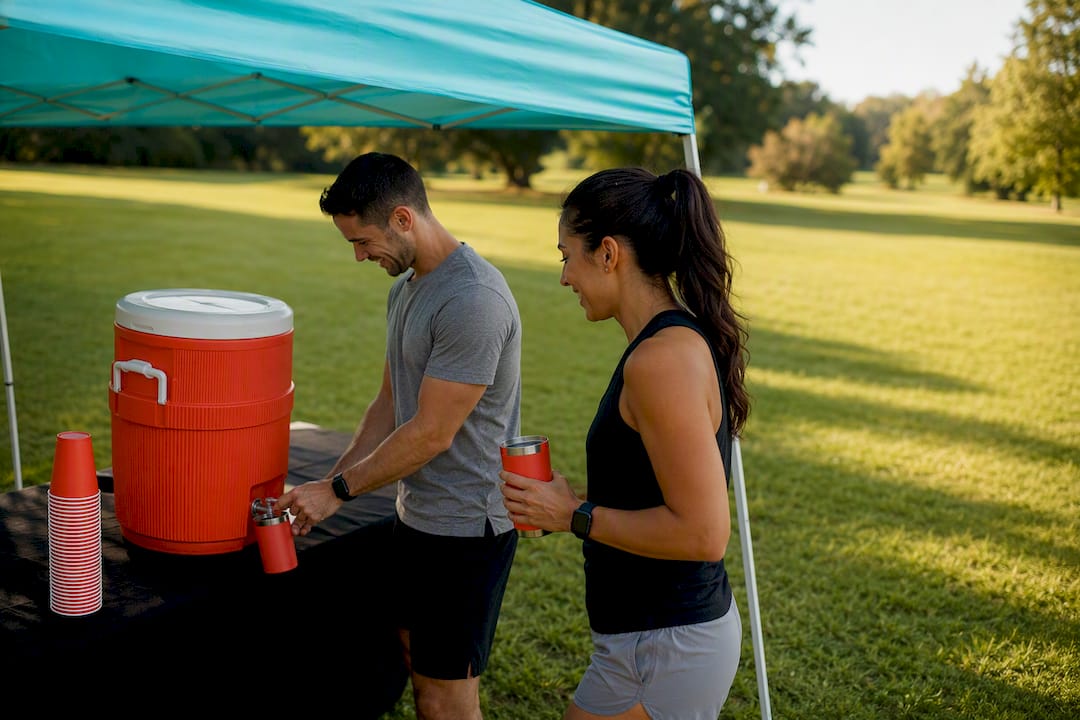
- Water station visible from every zone, with cups or reusable bottles
- A stocked first-aid kit and a designated first-aider, badge or hi-vis vest
- Sunscreen available at the welcome table
Admin to confirm before the day:
- Venue rules on amplified sound, alcohol and open flame
- Public liability insurance, either your own or the supplier’s
- Permits if the venue is a public park rather than private grounds
Onsite troubleshooting: keep a spare set of batteries, a backup speaker, and duct tape in one labelled box. Most on-the-day failures are small and fixable in under two minutes if you know where the spares are.
When to DIY and when to rent the headline attraction
DIY suits anything you can set up in under fifteen minutes with kit you already own or can borrow cheaply: cornhole, relays, tug of war, tabletop games. The trade-off is time, not money. Someone on your team needs to source, transport, and pack down every item, and that adds up once you’re running six or more stations.
Renting makes sense the moment an attraction needs specialist equipment, trained supervision, or carries real liability if something goes wrong. Inflatables, dunk tanks and anything involving projectiles or moving mechanical parts fall into this bracket. Providers running high-energy or high-liability attractions generally recommend short run slots and qualified supervision rather than leaving guests to operate equipment unsupervised, which is exactly the gap a facilitated attraction fills.
Before booking, brief any supplier on:
- Power requirements and where the nearest outlet or generator sits
- Footprint, meaning the flat, clear area the attraction actually needs
- Staffing, so you know whether they bring their own facilitator or expect yours
- Insurance, confirmed in writing before the contract is signed
Pro Tip: Ask any rental supplier what happens if it rains. A supplier with a genuine wet-weather contingency, rather than a shrug, is the one worth booking again next year.
A portable, facilitated activity removes most of this liability question entirely, because the supplier owns both the equipment risk and the supervision.
Why a facilitated activity like laser clay shooting works as a headline game
Laser clay shooting uses sound-simulated, deactivated shotguns and reusable electronic targets rather than live ammunition, which removes the two biggest objections event planners raise about traditional clay shooting: safety risk and environmental impact from spent lead shot. It runs on real-time electronic scoreboards, so results are visible and competitive without a referee manually tracking scores.
For a company picnic, that combination solves a specific scheduling problem. A headline attraction needs to absorb a rotating crowd without a long queue or extensive safety briefing, and a facilitated format with built-in scoring does exactly that.
- Group size: typically runs well for groups from small teams up to large corporate headcounts, rotating participants through in short sessions.
- Space: works both outdoors on open grass and indoors, giving planners a genuine weather backup rather than a cancelled slot.
- Format: usually run as short, timed rounds with live scoring, which fits neatly into the “one or two scheduled team events” slot in the sample schedules above.
- Supervision: comes with trained facilitators, removing the equipment liability question that DIY carnival attractions can’t answer.
Planners researching interactive shooting formats for group events will find the format sits closer to a facilitated carnival attraction than a traditional shooting range, which is precisely why it fits a picnic’s mixed-ability, mixed-confidence guest list better than the sport’s traditional version ever could.
Prizes and rewards that actually motivate participation
Cash bonuses aren’t the answer here, and most planners overthink this. The prizes that work best at a picnic are visible, immediate, and slightly silly rather than valuable.
A traveling trophy that moves between departments each year builds more long-term engagement than any one-off prize, because it gives teams something to defend the following year. Small, instant prizes, think branded caps, a decent bottle of something, or an extra hour of leave, work better than one large prize because more people go home with something.
Consider a tiered structure: a genuine top prize for the scheduled team events, plus small “most enthusiastic,” “best team spirit” or “best costume” awards that reward participation rather than pure skill. This matters because skill-based prizes alone tend to reward the same competitive employees every year, which quietly discourages everyone else from trying.
For carnival and novelty stations, instant tickets or stamps that build towards a small raffle prize keep casual stations busy all day without needing a formal scoring system.
Getting every employee involved, not just the usual few
Fixing that starts with making every scheduled game genuinely optional. Ambient, drop-in entertainment drives more social mixing than mandatory competitions, because people who feel forced into a game tend to disengage from the whole day, not just that activity.
Mixed teams help enormously. Randomly assigning people across departments for team challenges rather than letting cliques form naturally forces new conversations and is usually the actual point of a team-building picnic in the first place.
Give quieter employees a role rather than a spectator seat. Scorekeeping, photography, or running a casual station gives introverts a legitimate reason to be involved without needing to perform in front of a crowd. And build in visible momentum: an emcee calling out scores, a leaderboard near the food area, or a running photo slideshow all pull passive guests towards the action without anyone feeling pressured.
Considerations for virtual or hybrid company picnic games
Fully remote teams and hybrid workplaces still want a shared picnic moment, even if half the guest list can’t attend in person. The trick is designing games that don’t leave remote participants watching a screen while everyone else plays.
Trivia and quiz formats translate almost perfectly to hybrid, since remote participants can join via video call and answer through a shared app just as easily as someone standing on the lawn. Photo and video challenges, such as a scavenger hunt where remote staff submit clips from home while onsite staff do the same at the venue, keep both groups genuinely competing rather than one group performing for the other.
Live-streamed scoreboards work well for scheduled team events, giving remote employees something to watch in real time rather than a summary afterwards. Where possible, split prizes evenly between onsite and remote winners; nothing kills hybrid engagement faster than every prize going to whoever happened to be in the room.
The honest limitation is physical, active games. Relays and carnival attractions don’t translate to a screen, so hybrid picnics work best when they lean harder on the trivia, quiz and creative-challenge categories rather than trying to force a tug of war onto a video call.
Three heuristics I’d use before booking a single game
Keep every game optional, always. The moment a scheduled activity feels compulsory, you’ve turned a picnic into a performance review, and attendance for the rest of the day drops off a cliff. This single rule prevents more picnic disasters than any amount of careful scheduling.
Balance one headline attraction against several casual stations, never the reverse. A day built entirely around one big-ticket activity leaves guests standing in a queue for most of the afternoon; a day with nothing but casual stations never generates a shared story people talk about afterwards. The mix in this article’s opening line exists because both extremes fail in predictable, avoidable ways.
Test your logistics before the day, not during it. Walk the actual site, time how long your scheduled events genuinely take with real people rather than an estimate, and check where your shade and water points sit relative to the sun’s path at 2pm. Most picnic problems are logistics failures dressed up as game problems.
For measuring success afterwards, three numbers tell you almost everything: participation rate across scheduled events (not just headcount at the venue), how many candid photos get shared afterwards without prompting, and a short post-event survey asking whether people felt included rather than just whether they had fun. The third question catches problems the other two miss entirely.
— Joshua
Book a headline game your whole team can actually join
If you’ve read this far, you already know the mix that works: casual stations, one or two scheduled events, and a headline attraction that doesn’t leave half the guest list queuing or watching from the sidelines. Laser Clay solves that last piece specifically. It runs indoors or outdoors, fits mixed-confidence groups without a steep learning curve, and uses sound-simulated, deactivated shotguns and reusable eco-friendly targets instead of live ammunition, so there’s no lead shot to manage and no firearms licence to worry about.
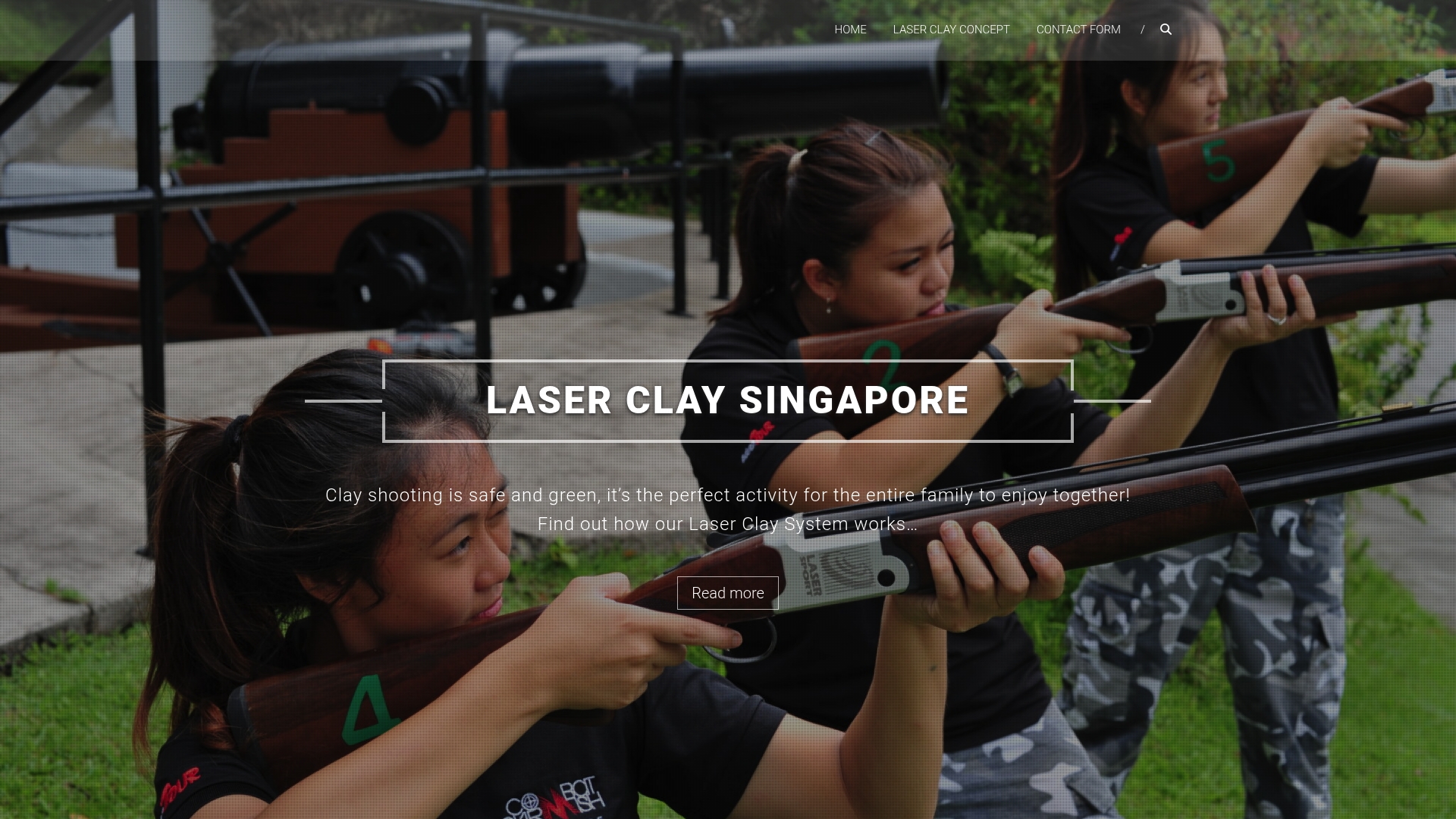
For a corporate picnic, that translates into a rotating, short-session format with live electronic scoring, run by trained facilitators who own the safety and setup end entirely. If you’re weighing it against a rental inflatable or a DIY relay circuit, the corporate team-building programme page breaks down group sizes and formats, while the gameplay guide walks through exactly how a session runs from arrival to scoreboard. Check dates and get a quote before you lock in your picnic timetable.
Sources
- Company picnic ideas that actually build team spirit | GigSalad
- Company picnic games | Party Pros East Coast
- Naboo
FAQ
What are some fun games to play at an office picnic?
Cornhole, tug of war, relay races and a photo booth cover most guest preferences, and adding one facilitated headline attraction gives the day a shared talking point.
What games can you play on a picnic?
Lawn games like cornhole and giant Jenga work as drop-in stations, while relays, sack races and tug of war work better as one or two scheduled team events.
What are the fun games for a work team?
Team relay races, tug of war and mixed-department trivia build genuine team bonding games because they force new conversations across departments rather than letting cliques stick together.
What are some fun games for a group?
Scavenger hunts, minute-to-win-it challenges and ring toss scale easily from a dozen people to a few hundred, making them reliable interactive games for work groups of almost any size.
How many games should a company picnic actually include?
Most events run well with three to five activities: one or two casual drop-in stations, one scheduled team challenge, and one headline attraction, rather than trying to fill the day with a long list.