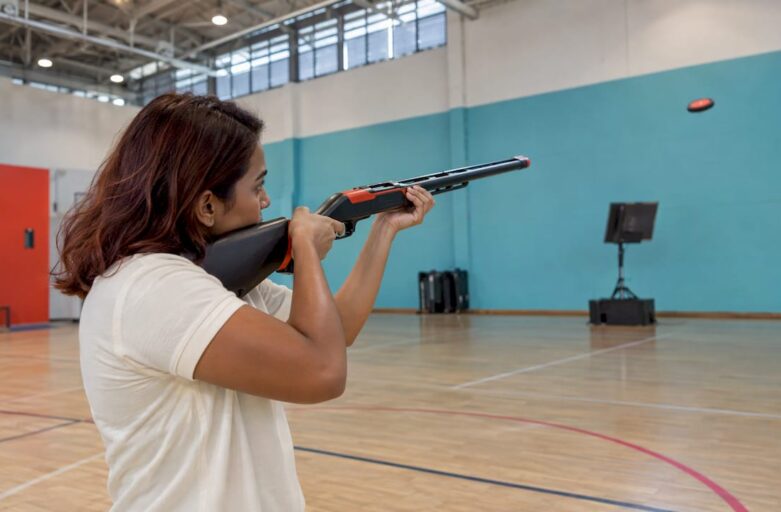
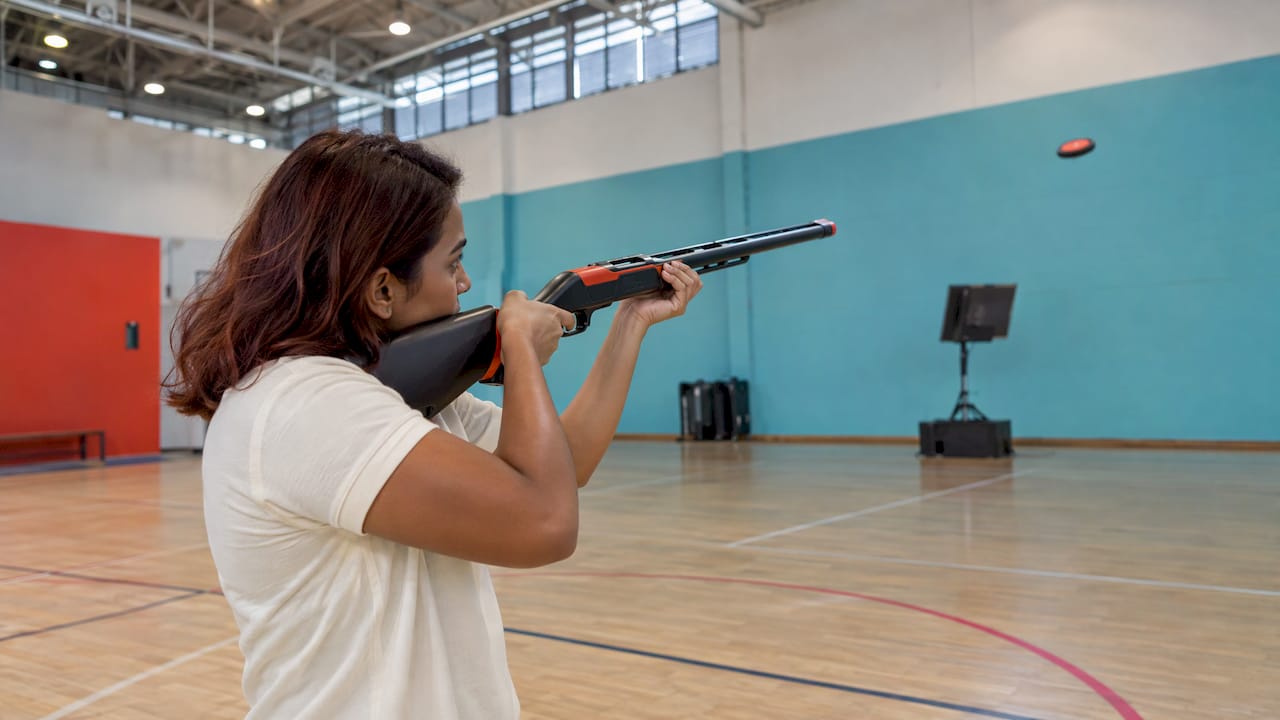
A laser clay system registers a hit when a pulse of invisible infrared light, sent from a deactivated shotgun at the moment of the trigger pull, is matched against the position of the flying clay and the result is sent to a scoreboard. Nobody judges by eye and nothing is fired. The system decides, shows the result in seconds and gives every player the same standard. That is why we run our events on a real-time electronic scoreboard: your guests get a fair score, and you get an activity that runs without arguments.
This guide explains the process in plain terms, for the people who book these sessions: HR and event teams, school staff, parents and anyone who wants a clay shooting experience without lead, noise or risk.
TL;DR
- Each shot sends an invisible infrared pulse from a deactivated shotgun. The system compares where the pulse lands with where the clay was at that instant.
- A hit or a miss is decided by the system, not by a referee, so scoring is consistent across players, ages and skill levels.
- Scores appear on an electronic scoreboard, which keeps teams, rounds and leaderboards moving.
- Nothing is fired, there is no lead, and the gun sound is simulated, which makes the activity suitable for offices, schools and parties.
- Our packages start at S$49 per person for birthdays and S$69 per person for corporate groups, and include facilitators and setup.
Table of Contents
- What happens in the moment you pull the trigger
- How the system knows it was your shot
- What the system looks at: lead, timing and the moving clay
- What affects accuracy and fairness on the day
- How hits and misses are shown to players
- A worked example: a 24-person team session
- Why hit detection makes laser clay safe and eco-friendly
- What to ask when you book
- Our approach to hit detection
- Book a session that scores itself
- FAQ
- Sources
What happens in the moment you pull the trigger
In real clay shooting, a hit means a cloud of pellets reached the clay and broke it. A laser clay system has no pellets, so it has to answer the same question in another way: if this had been a live shot, would it have hit?
The sequence is easy to follow:
- A clay is launched or displayed. In a laser setup the clay is a reusable target, so nothing shatters and nothing needs sweeping up.
- You mount the gun and call for the target. The gun looks and handles like a shotgun, but it is deactivated and carries no ammunition.
- You pull the trigger. The gun gives off a short pulse of light. This is infrared, which sits just beyond what the human eye can see, the same kind of light a TV remote uses, as NASA explains for infrared waves.
- The system checks the pulse against the clay. It looks for the return of that pulse from the target at the moment of the shot.
- The result is registered. A hit or a miss is recorded and credited to the right player.
- The score is shown. The scoreboard updates and the shotgun sound plays, so the feedback feels immediate.
The whole chain takes a fraction of a second. For the player, what is noticeable is not the technology but the fact that the result feels fair.
How the system knows it was your shot
A group event usually has several guns in play, so the system has to tell shooters apart. Laser clay systems of this type generally give each gun its own signature, a distinct pattern in the light it sends. When a hit is detected, the pattern identifies which gun produced it, so the point goes to the right player.
This is what makes team formats workable. Four colleagues can shoot in rotation, or two teams can compete side by side, and every hit lands on the correct name without anyone keeping a paper tally.
For you as an organiser, the practical gain is simple: the person running the event does not need to referee, and players do not need to take each other’s word for a score.
What the system looks at: lead, timing and the moving clay
A clay moves fast. A hit detection system that only looked at where you pointed would reward the wrong thing, because real clay shooting is about aiming ahead of the target and timing the shot. A well-designed system therefore treats the clay’s position and speed at the instant of the trigger pull as the reference for the result.
In practice that means three things matter to your result:
- Timing. The shot counts at the moment you pull, not at the moment the computer finishes thinking.
- Lead. You aim at the place the clay will be, as you would with a real shotgun, not at where it is now.
- Steady swing. A smooth follow-through helps, because the gun is judged at the instant of firing.
This is why beginners often miss badly on the first few targets and then improve fast. The skill being measured is the real one. If you want to see how closely it tracks the real sport, our page on how laser clay compares to real clay accuracy goes into it, and precision in laser clay sport covers how players sharpen their scores.
What affects accuracy and fairness on the day
Hit detection is only as good as the conditions it runs in. These are the factors that matter most when you plan a session, and each is something a facilitator should handle for you.
Setup and positioning
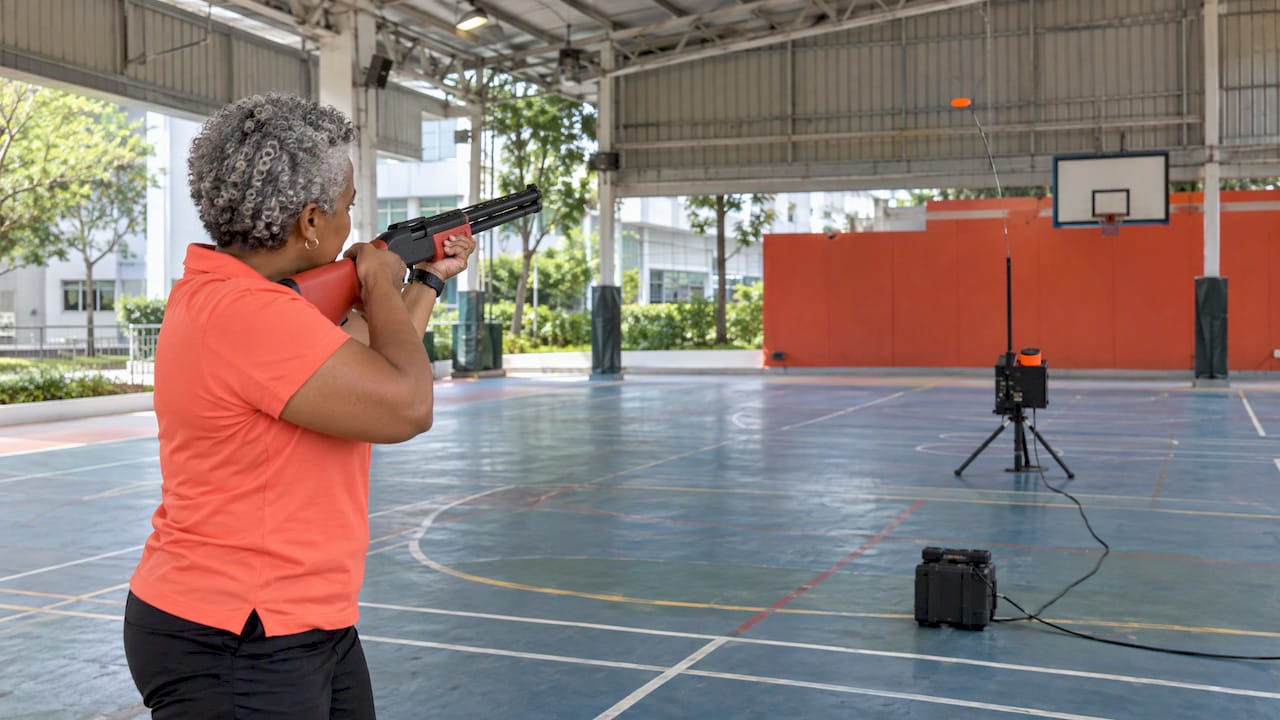
The gun, the target and the detection equipment need to be positioned and aligned correctly before the first player steps up. A system that is set up in a rush gives uneven results. A facilitator who sets up, tests and adjusts before guests arrive removes that risk. Our packages include venue setup and facilitators, so the alignment is done by people who do it for every event.
Space
Laser clay does not need a range. Systems of this kind can run indoors in a fairly small area or outdoors in an open space, and the clay needs room to fly and land when you play outside. Our outdoor laser clay page covers sessions for 15 to 30 guests, and team building venues in Singapore helps you match the activity to your space.
Lighting
Because detection relies on infrared light, very strong direct light can interfere with any light-based system. A facilitator who knows the venue will position the lanes with the lighting in mind. For indoor offices and function rooms this is rarely a problem, and for outdoor events a shaded or evening setup keeps results steady.
Player behaviour
Players who rush the shot, hold the gun inconsistently or aim at the clay instead of ahead of it will see misses. That is the scoring working as intended, and the facilitator’s briefing at the start of the session usually fixes it within a few rounds.
How hits and misses are shown to players
Detection is only half of the experience. Players need to see the result straight away, otherwise the energy of the activity drops.
Our sessions use sound-simulated deactivated shotguns, so each shot gives the realistic bang of a shotgun, and real-time electronic scoreboards show the score as the round goes on. The sound tells the player the shot has gone, and the scoreboard confirms the result.
For a corporate event this solves a practical problem. Teams can see the leaderboard shift between rounds, and the host does not have to stop the game to count. We cover this in detail in our piece on laser clay scoreboards for planners.
Scoring formats can also be customised. Depending on the group, a session can be:
- Competitive: individual or team scores with a final leaderboard, suited to departmental challenges.
- Casual: shorter rounds where everyone shoots, suited to birthdays and family days.
- Mixed: a warm-up round followed by a scored final, which suits groups with a wide range of experience.
A worked example: a 24-person team session
Take a team of 24 colleagues from a Singapore company, booked for a team-building afternoon.
The facilitator arrives early, sets up the lanes and the scoreboard and tests each gun. The group is split into six teams of four. In the briefing, players learn how to mount the gun, how to lead the clay and how the scoreboard works.
A practice round follows, in which scores do not count. Then comes a scored round, where each player takes a set number of shots in rotation. Because each gun is recognised individually, the scoreboard records who hit what. After two rounds, the leaderboard shows the standings for each team, and the final round decides the winners.
The host’s job during all this is to take part. No one counts hits, no one argues over a disputed clay, and no one has to wear ear protection or protective gear. For a closer look at that last point, see how laser clay works without protective gear.
Why hit detection makes laser clay safe and eco-friendly
The detection method is the reason the activity can be offered so widely. Because the guns are deactivated and send out light rather than pellets, there is no lead, no live ammunition and no loud discharge. The clays are reusable, so there is no debris to collect afterwards.
That opens the activity to people who would not go near a shooting range:
- Schools: our sessions are suitable for ages 10 and above, and fit school camps and activity days. Our guide on laser clay in education explains what schools should know.
- Parents: a birthday party for children can run with the same equipment, with a facilitator in charge. See how to plan a laser clay birthday party for kids.
- Offices: teams can play on site. Our laser shooting safety guide for offices covers the practical points.
- Eco-conscious organisers: with reusable targets and zero lead, the activity suits companies with sustainability goals.
One safety rule applies to any light-based equipment: never look into a laser or point it at another person. The facilitator’s briefing covers this at the start of every session, and the guns are handled only under their supervision.
What to ask when you book
Whatever format you choose, these are the questions that tell you whether a session will run smoothly:
- How many players can shoot at once, and how will scores be kept? You want a live scoreboard, not a clipboard.
- Who sets up and tests the equipment? It should be a facilitator, before guests arrive.
- Can the scoring format be adapted to my group? Competitive teams and children’s parties need different formats.
- What space and power does the setup need? Indoor and outdoor venues have different requirements.
- What is the age range? Ours starts at 10.
If you want a fuller introduction before you decide, read what laser clay shooting is or our beginner’s guide.
Our approach to hit detection
Joshua here. When people ask us about hit detection, they are usually really asking whether the game will feel fair. Fair is what makes a team event work. If a colleague thinks a point was stolen, the mood changes. If a child thinks the game is rigged, the party changes.
That is why we build our sessions around authentic deactivated shotguns with simulated sound, reusable clays and a real-time electronic scoreboard. The system makes the call, and the facilitator keeps the game moving. Nobody has to referee, and everyone sees the same result at the same time.
We also think the best technology is the kind you stop noticing. Guests should be talking about the last clay, not about the equipment. Because there is no lead and no noise pollution, we can bring the activity to offices, schools, function rooms and open spaces, and tailor it for a competitive team day or a relaxed family afternoon.
Joshua
Book a session that scores itself
If you are planning an event in Singapore, our packages cover the equipment, the facilitator and the setup. The Corporate Laser Clay Package is S$69 per person. The birthday party package starts from S$49 per person. If you run your own event and only need the equipment, the system rental is S$500 to S$800 per hour.
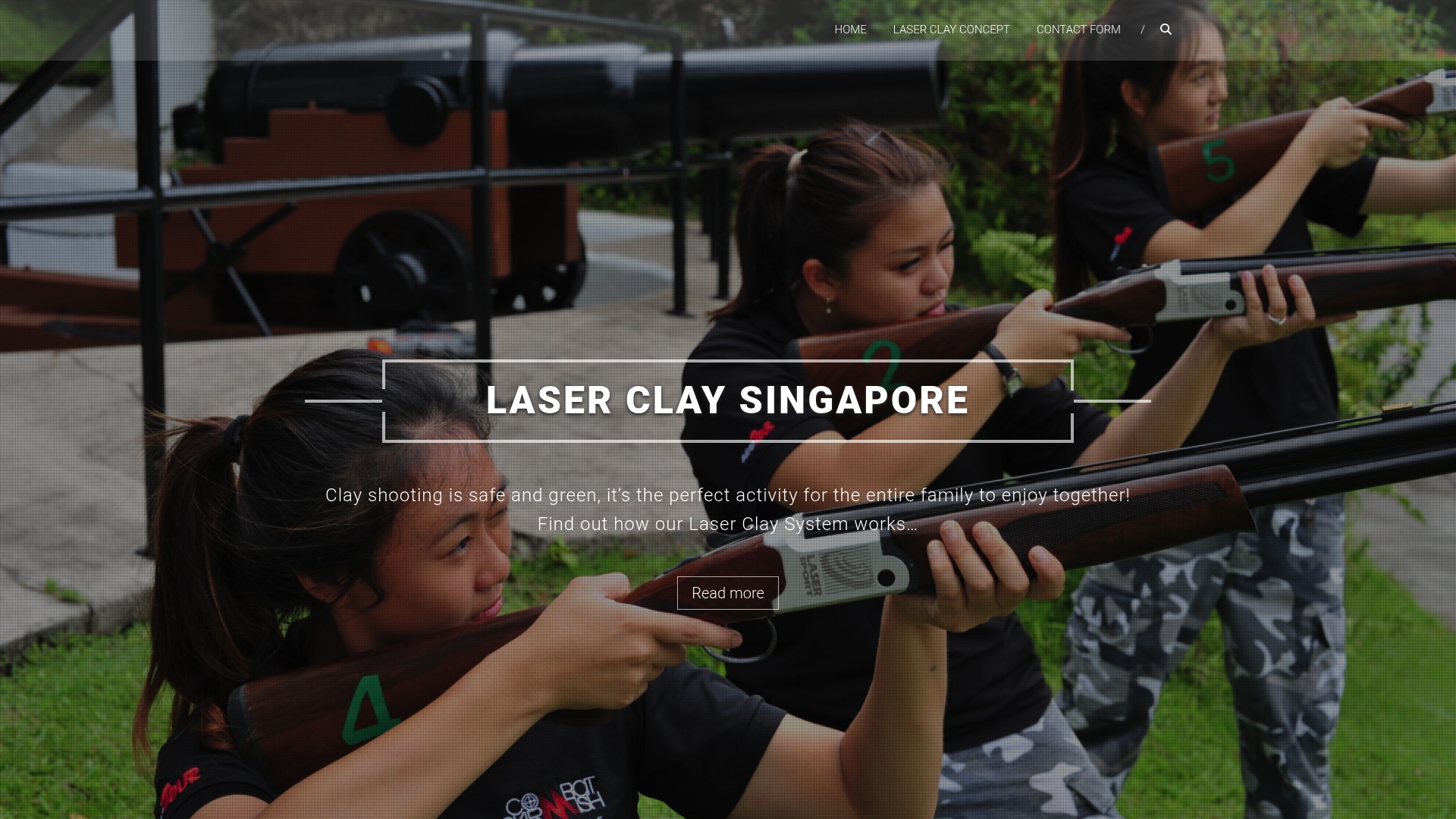
Tell us your group size, venue and the kind of day you want, and we will recommend a format. You can reach us through our contact page or start from the Laser Clay Singapore homepage.
FAQ
Is laser clay hit detection accurate?
The system decides each result by comparing the shot with the position of the clay at the instant of the trigger pull, so the outcome depends on your aim and timing. Setup matters too, which is why a facilitator aligns and tests the equipment before the first player shoots. For the comparison with real clay shooting, see our page on how laser clay compares to real clay accuracy.
Can the system tell which player hit the clay?
Yes. Laser clay guns of this type each carry their own signature, so a hit is credited to the right shooter. That is what allows team rounds, rotations and leaderboards to run on the scoreboard without manual counting.
Is the infrared light safe?
Infrared light is invisible to the eye, and it is the same kind used in TV remote controls, as NASA describes. As with any light-based equipment, players should never look into a laser or point it at anyone, and our facilitators brief every group on this before play begins.
Does it work indoors?
Yes. Laser clay can run indoors or outdoors, with no live ammunition and no loud discharge, which is why it suits offices, function rooms and school halls. Our guide to training clay shooting indoors safely explains how indoor sessions are set up.
What age can take part?
Our sessions are suitable for all ages starting from 10, fully facilitated, and can be tailored for competitive or casual play. That makes the same system work for school camps, family parties and corporate days.