The three formats that move fastest for Singapore product launches are physical skill challenges, phygital product demos and mobile scavenger hunts, because each converts a passer-by into a tracked lead or a sale within minutes. If you are briefing a supplier this week, start by mapping your product story to one of these formats and send a short brief before you compare quotes.
TL;DR:
- Matching the right game format to your product story enhances engagement, with skill challenges suited for tactile products and phygital demos ideal for electronics and beauty.
- Brief suppliers thoroughly on your objectives, attendee profile, technical constraints, and data requirements to ensure accurate quotes and compliance.
- Secure necessary permits like TCOUP for activities under 60 days and verify safety and venue regulations early to avoid late compliance issues.
- Measure success through engagement, dwell time, lead capture, and redemption rates, ensuring data exports are captured for ROI analysis.
- Use proven local examples like reward-based challenges or puzzle trails, and focus on a single measurable interaction that highlights your product message.
Table of Contents
- 1. Curated interactive game ideas for product launches
- 2. How to choose a game format and brief suppliers
- 3. Operational checklist and Singapore permit essentials
- 4. How to measure success and attribute value to gameplay
- 5. Local examples that worked and the lessons to copy
- 6. Why laser clay-style activations suit product launches
- 7. A planner’s honest view on what actually works
- 8. Laser Clay services for product launches and how to book
- FAQ
- Sources
1. Curated interactive game ideas for product launches
Not every format suits every product. A skincare launch calls for a different mechanic than a fintech app or a car reveal, so the menu below groups ideas by format and tells you where each one earns its keep in Singapore venues.
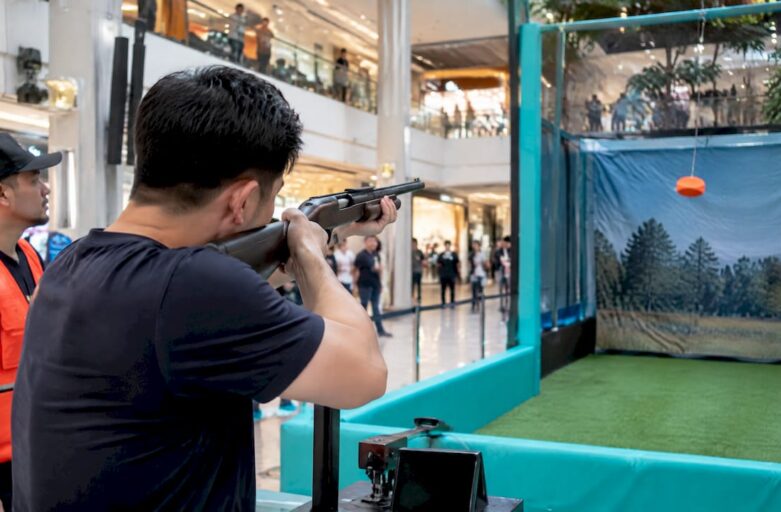
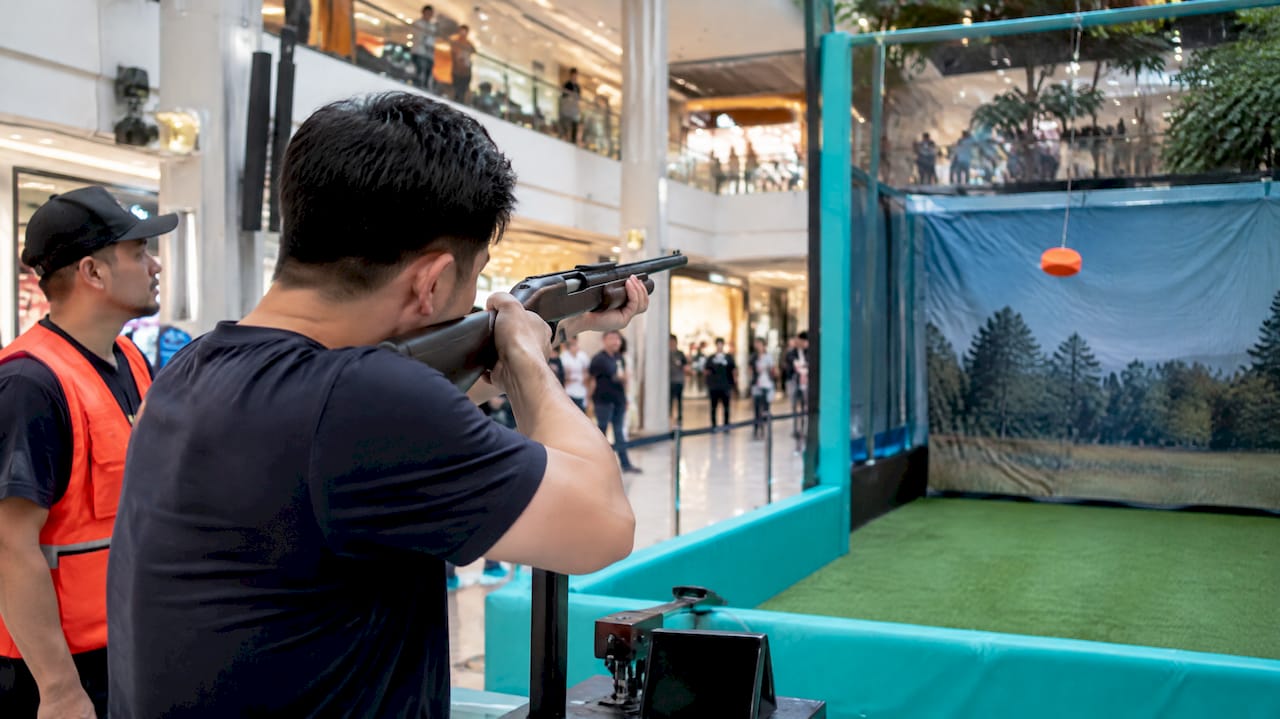
Physical skill and challenge games work well when your product has a tactile story to tell, with many adaptable golf challenge ideas for fun and skill-building with friends showcasing precision and control mechanics. Laser clay-style target challenges and precision putting games give guests a short, satisfying task that ties naturally to a branded leaderboard. They need a clear lane of 3 to 5 metres, basic safety briefing and one facilitator per station, and they comfortably run 40 to 60 players an hour at a mall atrium or hotel ballroom.
Phygital product demos blend a physical action with instant digital feedback. Motion-controlled interactions, where a gesture or movement triggers an on-screen product reveal, work particularly well for electronics and beauty launches. AR try-ons suit fashion, eyewear and cosmetics brands that want guests to see the product on themselves before they buy. These need a tablet or kiosk, stable Wi-Fi or a local network, and roughly 2 square metres per station, with throughput of around 80 to 100 guests an hour per unit.
Arcade and leaderboard experiences borrow familiar mechanics that need almost no instruction. Local suppliers commonly offer prize wheels, claw machines, racing simulators, trivia screens and escape-room micro-experiences as reliable crowd draws for trade shows and launches in Singapore. A leaderboard adds a competitive layer that keeps guests returning throughout the event, which extends average dwell time without extra staffing.
App-led scavenger hunts and location-based trails suit launches spread across a mall, a business district or a multi-precinct venue. Guests follow clues on their phones, unlock product facts at each checkpoint and finish at a branded redemption counter. Real-world exploration formats in Singapore commonly run about 90 minutes and work best when the trail length matches that window rather than stretching guests thin.
Instant-win mechanics, such as spin reels or digital joypots, are fast and cheap to deploy, and they pair naturally with a purchase-to-play gate: a guest scans a receipt or shows a sample voucher to earn a spin. This is also where experiential sampling integrations belong, because the product sample becomes the entry ticket rather than a free handout.
Here is a quick-reference list of the formats and what they need:
- Skill challenges (laser clay-style targets, putting games): a cordoned lane, one facilitator, strong fit for product stories built on precision or control.
- Phygital demos (motion-controlled interactions, AR try-ons): a tablet or kiosk, stable connectivity, strong fit for beauty, fashion and electronics.
- Arcade and leaderboard games (prize wheels, racing sims, claw machines): minimal briefing needed, strong fit for high-footfall mall concourses.
- App-led scavenger hunts: a web or native app, strong fit for multi-precinct or campus-style launches.
- Instant-win mechanics: a spin reel or digital joypot, strong fit for quick sampling counters and queue management.
Pro Tip: Gate every game behind a single action, a scan, a sample voucher or an email opt-in, so the fun moment doubles as a tracked conversion event.
2. How to choose a game format and brief suppliers
Picking the right format matters less than briefing it properly. A strong brief turns a vague idea into a quote you can actually compare.
Weigh each option against the same criteria before you shortlist anyone:
- Audience fit: does the mechanic suit the age range, mobility and attention span of your expected crowd?
- KPI clarity: can the supplier tell you, before you sign, exactly what data the game produces?
- Data capture: does the format naturally generate a unique player ID, a timestamp and an opt-in record?
- Throughput: how many guests can play per hour, and does that match your expected footfall?
- Set-up time and staffing: how long does the rig take to build, test and strike, and how many facilitators does it need?
- Price structure: is the supplier charging per-play, per-hour or as a flat package, and does that match your budget shape?
- Insurance and safety obligations: does the supplier carry public liability cover and understand venue-specific safety rules?
Once you have a shortlist, send each supplier a short brief rather than a loose phone call. Include:
- Your objective in one sentence (lead capture, footfall, product trial, social shares).
- The attendee profile (expected numbers, age range, dwell pattern).
- The guest flow through your space, including entry and exit points.
- Technical constraints (power points, Wi-Fi strength, floor load, ceiling height).
- The KPIs you need reported back.
- Reporting deliverables and the format you expect them in.
- A contingency and wet-weather plan for outdoor or semi-outdoor venues.
Ask every shortlisted supplier the same set of questions: what format do they export data in, what devices do they provide versus expect you to supply, what is their facilitator-to-guest ratio, do they carry insurance, have they run a contingency test before, and have they delivered a comparable activation in Singapore before. A supplier who cannot answer the last two clearly is a risk.
Treat these as hard red flags: no on-site testing before go-live, vague answers about how data will be reported, or no awareness of Singapore-specific compliance such as fire-safety clearances or permit timing. Any one of these should move a supplier off your shortlist, not just lower their ranking.
3. Operational checklist and Singapore permit essentials
Compliance problems surface late if you leave them late, so check these before you lock a venue.
Most short-term promotional activities and product launches in Singapore fall under a Temporary Change of Use Permit (TCOUP), which the Singapore Civil Defence Force confirms covers promotional activities, exhibitions and trade fairs for up to 60 days, subject to fire-safety conditions. If your activation involves structural changes or exceeds that scope, a full plan submission through CORENET may be required, so raise this with your venue early rather than after signage is printed.
SCDF’s indoor-event fire-safety conditions set out clearance and safety requirements that planners routinely miss, including distance from sprinkler heads and unobstructed access to fire equipment. Confirm these layout rules with your venue and, where a waiver is needed, check the conditions directly with SCDF rather than assuming your supplier has it covered.
If you are activating in a public domain such as Marina Bay, check with the Urban Redevelopment Authority early, since not every event type is approved for every public space and lead times vary by precinct.
Before go-live, run through this checklist:
- Power and data: confirm outlet count, cable runs and backup Wi-Fi.
- Device hygiene: plan a wipe-down schedule for shared tablets and controllers.
- Queueing and throughput: map expected peak load against your stations per hour.
- Prize fulfilment: decide whether redemptions are cashless or physical, and brief staff accordingly.
- Wet-weather backup: have an indoor fallback plan for any outdoor component.
TCOUPs in Singapore typically cover promotional activities for up to 60 days, which gives most single-event launches comfortable headroom, but any multi-phase campaign spanning several venues should check this timing against each site separately.
4. How to measure success and attribute value to gameplay
A game that delights guests but produces no data is a missed opportunity. Build your measurement plan before the event, not after.
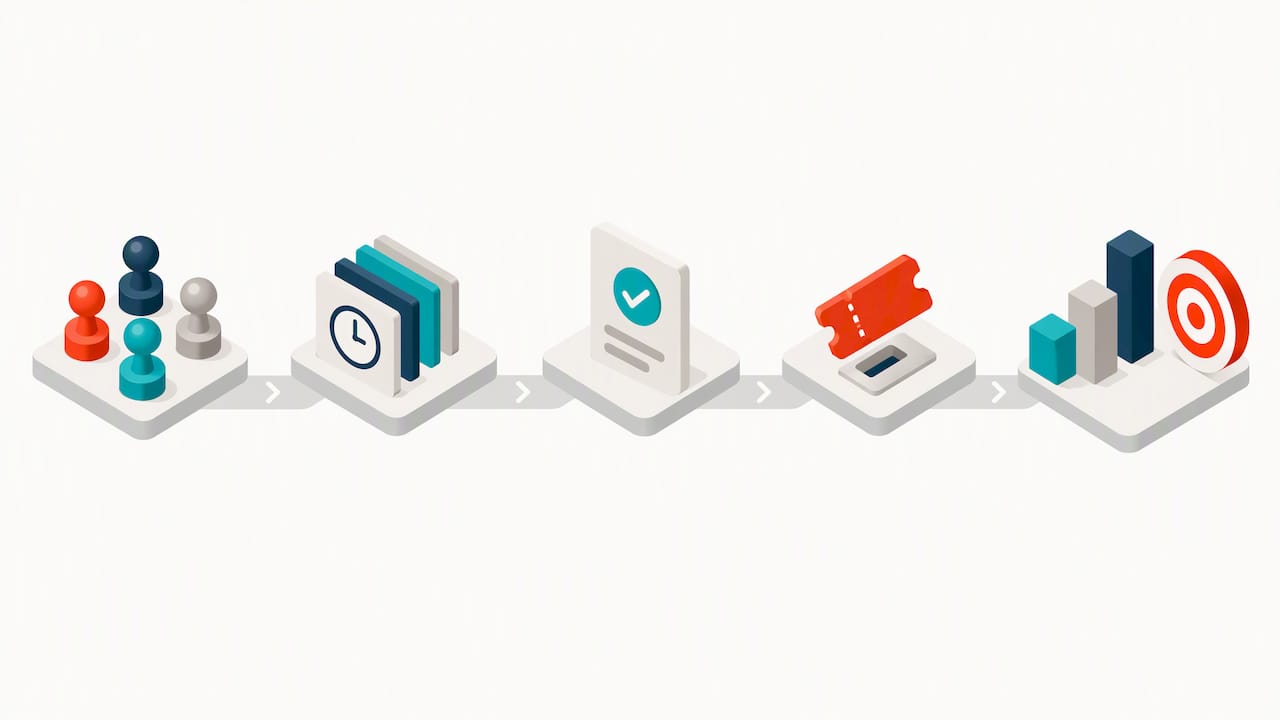
Track these core metrics:
- Engagement rate: players as a share of total attendees.
- Average dwell time per player and per station.
- Repeat plays, which signal strong product-message resonance.
- Lead capture rate, the share of players who opt in.
- Redemption-to-purchase conversion, the share of issued codes actually redeemed.
Common tracking methods include QR-gated rewards, single-use promo codes tied to point-of-sale systems, loyalty-card redemptions, in-app analytics for scavenger hunts, and straightforward CSV exports from your games supplier.
Request a minimum dataset from any supplier: unique player identifiers, play timestamps, opt-in email or contact details, and a record of redemption codes issued against codes redeemed. With that dataset, you can build a simple ROI narrative for stakeholders: total plays, conversion to leads, conversion to purchase, and a rough cost-per-acquisition against your activation spend.
5. Local examples that worked and the lessons to copy
A week-long Watsons activation across a Singapore mall used reward-driven challenges and skill-based games to increase shopper exploration and product discovery. The replicable mechanic: gate higher-tier prizes behind a purchase or a social share, which turns casual browsing into a measurable action.
A food-hub takeover tied product purchase to game-pass rewards, creating a measurable bridge from live play to take-home purchase. The lesson: link game-pass issuance to a receipt or QR scan at the point of sale, since manual ticketing makes conversion figures unreliable.
A 90-minute real-world puzzle trail guided players across multiple precincts using a web app, with completion rate as the headline metric. The caveat: a multi-precinct trail needs clear signage and a tight time window, or completion rates drop sharply.
6. Why laser clay-style activations suit product launches
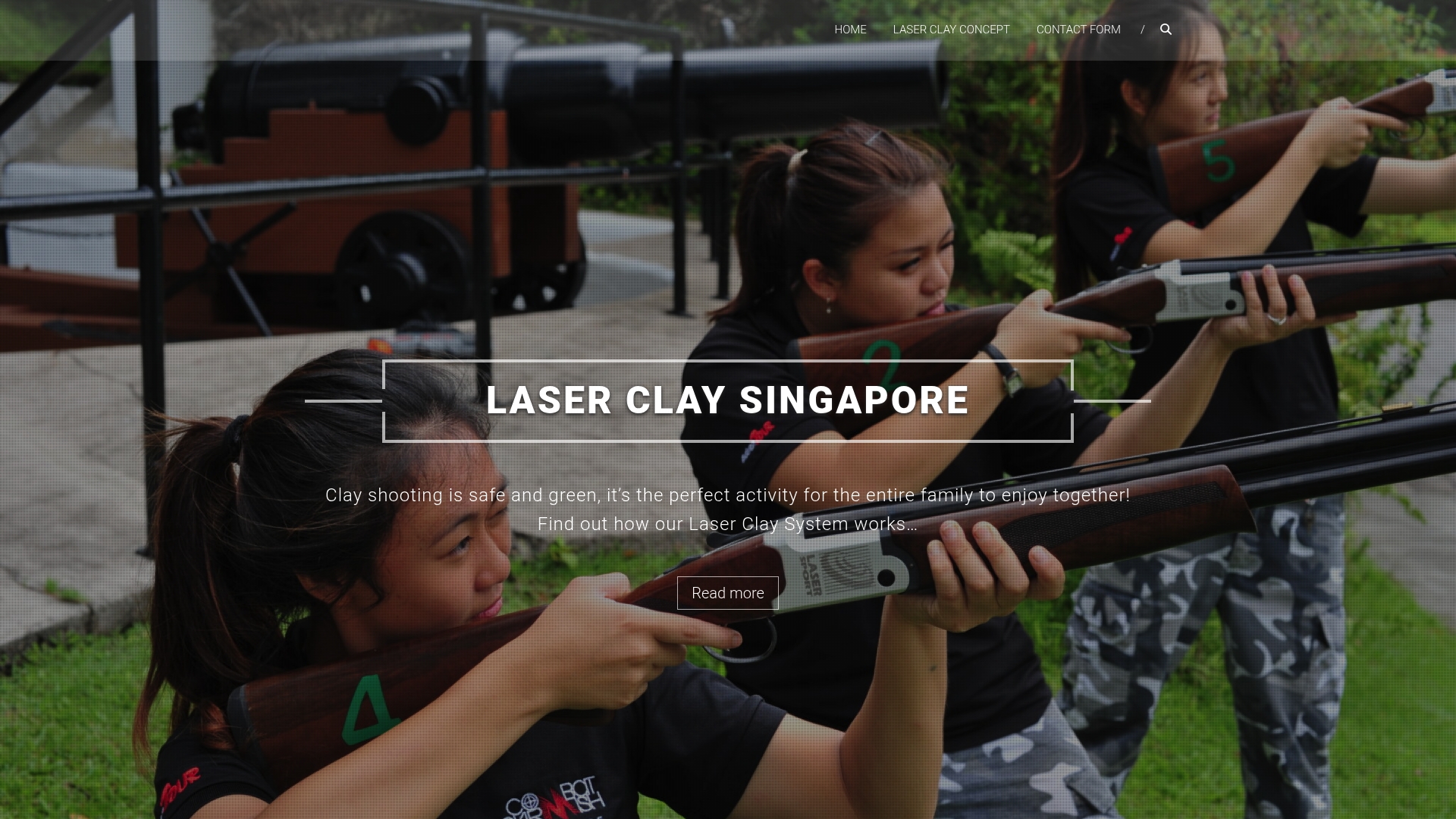
A facilitated, skill-based format gives product launches a safe, measurable centrepiece without the risks of traditional shooting activities. Our laser clay sessions use authentic equipment with reusable, eco-friendly clays and no lead or noise pollution, suitable for guests aged 10 and up, indoors or outdoors. Sessions typically run with one facilitator per lane and fit naturally into a 30 to 45 minute activation window within a larger launch programme, with a run sheet planned around your guest flow.
7. A planner’s honest view on what actually works
The product launches that convert aren’t the ones with the flashiest rig, they’re the ones built around a single measurable interaction that echoes the product’s core message. Brief suppliers early, insist on two rehearsal runs before doors open, and never accept a supplier who can’t hand you a data export.
— Joshua
8. Laser Clay services for product launches and how to book
A facilitated activation takes the operational worry off your plate: we handle setup, safety briefing and run sheets, so your team can focus on the product story. Our Corporate Laser Clay Package suits product launches that want a staffed, measurable skill activation at 69 SGD per person, and our System Rental option, from 500 to 800 SGD per hour, suits planners who want the equipment and facilitator guidance while managing the rest of delivery themselves.
Every booking includes facilitator staffing, safety oversight and a run sheet you can share with your venue ahead of time. If you want a decision-ready brief or a sample run sheet before you commit, get in touch and we will put one together around your guest flow and launch date.
FAQ
Does a product launch in Singapore need a TCOUP?
Most short-term promotional activities, exhibitions and product launches fall under a Temporary Change of Use Permit, which covers events of up to 60 days alongside required fire-safety conditions. Confirm the exact scope with your venue and SCDF before finalising your date.
What game format works best for a mall atrium launch?
Arcade and leaderboard formats, such as prize wheels or racing simulators, suit high-footfall mall concourses because they need little instruction and keep throughput high. Phygital demos also work well where you have a dedicated kiosk and stable connectivity.
How much does a laser clay activation cost for a launch event?
Our Corporate Laser Clay Package is priced at 69 SGD per person, while System Rental ranges from 500 to 800 SGD per hour depending on setup. Both options include facilitator support and a run sheet for your venue.
What data should I request from an interactive games supplier?
Ask for unique player identifiers, play timestamps, opt-in contact details, and a record of redemption codes issued against those redeemed. This minimum dataset lets you calculate engagement rate, dwell time and redemption-to-purchase conversion after the event.
How long should a scavenger hunt or puzzle trail run?
Real-world exploration and puzzle trail formats in Singapore commonly run around 90 minutes, which matches typical attention spans across multi-precinct venues. Shorter trails risk feeling rushed, while longer ones see completion rates drop.
Sources
- Temporary change of use — SCDF
- Watsons gamifies beauty retail with experiential festival | Marketing‑Interactive
- Transforming a food hub into a high-converting participation zone — Makai Inc.