Curriculum-integrated outdoor learning, delivered regularly rather than as an occasional treat, raises attainment, sharpens wellbeing and builds transferable skills that stay with pupils long after the lesson ends. The evidence base is now large enough that school leaders no longer need to treat outdoor learning as a nice extra bolted onto PE or a wet-weather contingency.
The gains show up in several places at once:
- Academic attainment: measurable improvements in higher-order thinking and subject-specific test performance
- Social-emotional skills: better collaboration, communication and resilience
- Motivation and engagement: pupils who are more switched on in class, not just outdoors
- Teacher professional benefits: improved job satisfaction and stronger pedagogical range
Three bodies of evidence back this up. The Natural Connections Demonstration Project tracked outcomes across 125 schools over four years. A 2022 narrative synthesis of 147 studies confirmed the pattern held across contexts. A 2021 controlled experiment involving 304 primary pupils found a cross-curricular maths and science model outperformed traditional teaching on higher-order TIMSS-style tasks.
Key Takeaways
Curriculum-integrated, regular outdoor cross-curricular activity delivers measurable gains in attainment, wellbeing and social-emotional skills that ad-hoc outdoor trips consistently fail to produce.
| Point | Details |
|---|---|
| Regularity beats novelty | Consistent, curriculum-linked outdoor sessions outperform one-off trips on both attainment and behaviour measures. |
| Map to assessment | Design outdoor activities backwards from the specific assessment evidence you need, not the other way round. |
| Teacher preparation drives success | Subject-specific CPD matters more than access to green space alone for consistent outcomes. |
| Inclusion needs upfront design | Build accessibility checks into planning from the start rather than adjusting on the day. |
| Measure with mixed methods | Combine attendance, test comparators and pupil voice over a 6 to 12 week pilot before scaling. |
| External support can add capacity | Providers like Laserclay offer structured, safety-checked formats with built-in scoring to reduce planning load while keeping curriculum links intact. |
Table of Contents
- What the research says about why cross-curricular outdoor activities benefit schools
- How does outdoor learning improve academic attainment?
- What wellbeing and social benefits come from outdoor learning?
- Designing outdoor lessons that map to curriculum aims
- Making outdoor learning accessible for all pupils
- What barriers stop schools running outdoor programmes, and how do you fix them?
- How do you measure the impact of an outdoor learning programme?
- How can schools roll out cross-curricular outdoor learning?
- A practitioner’s view on why schools stick with this approach
- Where an external provider fits into your outdoor programme
- Sources
- FAQ
What the research says about why cross-curricular outdoor activities benefit schools
Three studies carry most of the weight in this field, and each answers a slightly different question.
The Natural Connections Demonstration Project ran for four years across 125 schools and is the most cited multi-school project in this space. It didn’t just ask whether pupils enjoyed being outside. It tracked attainment, engagement, behaviour, wellbeing and teacher practice together, and found improvements across all five when outdoor learning was woven into regular curriculum delivery rather than treated as a one-off excursion. Teachers reported higher job satisfaction too, a detail school leaders often overlook when pitching outdoor programmes purely as a pupil benefit.
The 2022 Frontiers narrative synthesis pulled together 147 individual studies on nature-specific outdoor learning. Its headline finding: consistent, measurable gains in social-emotional development, engagement and self-concept, plus some academic benefit, though study quality varied considerably across the sample. That caveat matters. Not every outdoor learning trial is well designed, and school leaders should weight larger, better-controlled studies more heavily than small pilot reports.
The 2021 primary-school experiment is the most rigorous of the three from a methods standpoint. Researchers split 304 pupils into an experimental group taught through a cross-curricular, experiential maths-science model and a control group taught conventionally. The experimental cohort of 149 pupils outperformed the 155-pupil control group specifically on the second and third TIMSS cognitive domains, the ones that test application and reasoning rather than recall.
“Regular, curriculum-based outdoor learning, backed by strong teacher preparation, is what separates programmes that deliver consistent results from those that don’t.” This is the consistent thread running through the expert commentary on implementation.
Three limitations are worth flagging honestly:
- Study quality is uneven across the wider evidence base, so headline effect sizes should be read as directional, not definitive
- Outcomes depend heavily on context: a well-resourced school with trained staff will see different results to one running an ad-hoc trip
- Teacher preparation and subject-specific training consistently predict success more reliably than access to green space alone
How does outdoor learning improve academic attainment?
Outdoor lessons work academically because they change how pupils encode information, not just where they sit while learning it. Multi-sensory experience, physical movement and real-world context create richer memory traces than a whiteboard diagram ever will, and that shows up in test performance when the outdoor activity is deliberately mapped to what’s being assessed.
The 2021 TIMSS-aligned study is the clearest illustration. Pupils who collected real field data and then analysed it outperformed peers on questions requiring application and reasoning rather than pure recall. That’s not a coincidence. Field data collection forces pupils to notice variability, anomalies and patterns in a way a pre-printed dataset never does.
Separate meta-analytic work on integrated curricula finds similar gains in critical thinking and creativity under cross-curricular models generally, outdoors or not. Combine the two bodies of evidence and the case for outdoor, cross-curricular design becomes hard to dismiss as anecdotal enthusiasm.
Practical examples that map cleanly to assessment domains:
- Stream or pond sampling that feeds directly into a data-handling or statistics unit
- Estimating and measuring tree height or playground area to reinforce ratio and scale in maths
- Habitat observation logs that double as evidence for a science write-up on adaptation
- Weather-station readings tracked over a term, then graphed and interpreted in a numeracy lesson
Pro Tip: Before taking a lesson outside, write the exact assessment question or success criterion you’ll use back in the classroom. If the outdoor activity doesn’t generate evidence that answers that question, redesign the activity rather than the assessment.
The mechanism holds because integration, not novelty, drives the gain. A one-off nature walk with no follow-up rarely shows up in test scores. A lesson sequence where outdoor data collection feeds directly into classroom analysis almost always does.
What wellbeing and social benefits come from outdoor learning?
Regular outdoor, nature-specific activity reduces classroom behaviour incidents and lifts pupil wellbeing, and the effect strengthens with consistency rather than one-off exposure. This isn’t a soft, unmeasurable claim. The 147-study synthesis found repeated, measurable improvement in engagement and self-concept specifically tied to frequency of outdoor participation.
The social-emotional gains cluster around a few recurring themes:
- Resilience: pupils navigating uneven terrain, changeable weather or an unexpected setback (a lost data sheet, a broken measuring tape) build tolerance for minor frustration that transfers back to classroom persistence
- Communication: small-group outdoor tasks force verbal coordination in a way a quiet indoor worksheet never demands
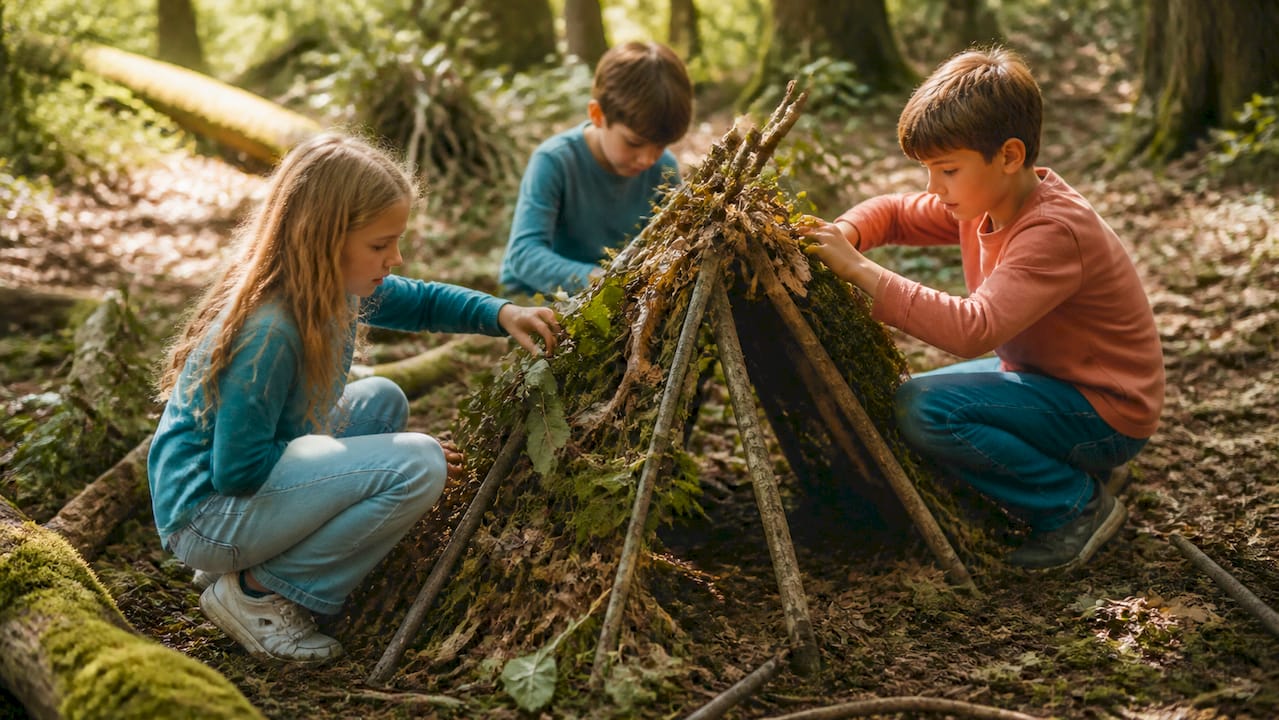
- Teamwork: shared physical tasks, like carrying equipment or building a shelter, distribute responsibility naturally
- Reduced stress: unstructured time outdoors before a demanding lesson has been linked to improved focus once pupils return inside
Engagement is the standout metric across the wider research base. The Natural Connections project linked sustained outdoor participation to improved behaviour and attainment together, not as separate outcomes, which suggests the two reinforce each other rather than trading off.
Three SEL activities that pair naturally with curriculum goals: a paired “shelter build” that doubles as a design and technology brief on structural stability; a role-rotation nature trail where each pupil takes a job (navigator, recorder, timekeeper) that maps to a literacy or maths outcome; and a reflective outdoor journal used across a term to track both personal growth and subject content.
Designing outdoor lessons that map to curriculum aims
Outdoor sessions need explicit planning against curriculum standards from the outset. Ad-hoc outdoor time, however enjoyable, rarely produces evidence a school can point to at inspection or governor review. Treat outdoor learning as an “add-in” to existing schemes of work, not a separate enrichment track running in parallel.
A simple mini-unit sequence illustrates the principle:
- Lesson 1 (indoor): introduce the concept (e.g. ratio, or habitat adaptation) with worked examples
- Lesson 2 (outdoor): pupils collect real data or specimens directly tied to that concept
- Lesson 3 (indoor): pupils analyse their own data against the taught method
- Assessment: a written task or short test using the pupil’s own collected evidence as the source material
Ready-to-use activity ideas across subjects:
- Science: minibeast surveys feeding into a classification or food-web lesson
- Maths: estimating and measuring playground or field dimensions for area and perimeter work
- Literacy: descriptive writing drafted on-site, using direct sensory observation rather than imagination alone
- Arts: natural-material sculpture or land-art projects linked to a design brief on texture and form
- PE: team orienteering or relay challenges that build in explicit communication roles
| Activity | Curriculum Aim | Assessment Evidence |
|---|---|---|
| Stream sampling | Data handling, statistics | Pupil-produced graph and written interpretation |
| Playground measurement | Ratio, area, scale | Worked calculation booklet |
| On-site descriptive writing | Sensory vocabulary, structure | Draft and edited final piece |
| Natural-material sculpture | Design, texture, form | Photographed piece with design rationale |
| Team orienteering | Communication, problem-solving | Peer and teacher observation checklist |
Materials stay simple for most of these: clipboards, tape measures, sample pots and a first-aid kit cover the bulk of them. Safety notes should be activity-specific rather than generic: check ground conditions before any measurement task involving movement, confirm allergy information before any natural-material handling, and always run a headcount at transition points between outdoor zones.
Making outdoor learning accessible for all pupils
Outdoor learning becomes more accessible, not less, when it’s deliberately designed with a wider range of needs in mind from the planning stage rather than retrofitted afterwards. A flat, well-marked route with clear sightlines works better for a pupil with a visual impairment than an improvised route decided on the day.
An inclusive planning checklist worth running through before every session:
- Confirm transport and drop-off points are step-free where required
- Check ground surface and gradient against known mobility needs in the group
- Identify sensory triggers (loud group activities, strong smells from certain plants) in advance
- Prepare simplified instruction cards or visual schedules for pupils who need reduced verbal load
- Assign peer-support roles so no pupil is left without a clear task
Differentiation strategies that work well outdoors mirror good classroom practice: scaffolded task cards for pupils needing more structure, tiered outcomes (some pupils collect data, others also analyse it on-site), and defined peer-support roles that give every pupil a job matched to their strengths.
Pro Tip: Run a five-minute “access and participation” check before every outdoor session, the same way you’d do a fire drill headcount. Ask: can every pupil see, hear, reach and move through this space as planned? If not, adjust before you leave the building, not once you’re outside.
What barriers stop schools running outdoor programmes, and how do you fix them?
Three barriers come up in almost every staffroom conversation about outdoor learning, and each has a workable fix.
- Safety concerns: standardise a risk assessment template across the school so staff aren’t rebuilding one from scratch for every trip. A reusable safe planning framework cuts the administrative load dramatically after the first term.
- Timetabling pressure: use block scheduling and rotating cohorts rather than trying to move a whole year group outside at once. Smaller rotating groups also make supervision ratios easier to manage.
- Curriculum pressure and teacher confidence: build outdoor sessions directly into existing lesson plans rather than treating them as extra content, and invest in CPD focused on subject-specific delivery outdoors rather than generic outdoor-education training.
A minimal risk assessment template needs only: hazard identified, likelihood and severity rating, control measure, named responsible staff member, and a review date. Logistics checklists should cover weather contingency, first-aid kit location, emergency contact list and a headcount protocol at every transition.
A realistic CPD plan for staff new to outdoor delivery runs across a term: one INSET session on risk and logistics, one subject-specific planning session per department, and a paired observation where a confident colleague co-delivers the first outdoor lesson.
How do you measure the impact of an outdoor learning programme?
Measurement needs to combine hard numbers with pupil and staff voice, and every metric should trace back to a specific learning objective rather than a vague sense that “pupils seemed more engaged.” Mixed methods beat a single test score every time governors ask for evidence.
Feasible metrics for most schools:
- Attendance on outdoor learning days versus the school average
- Structured engagement observations against a simple rubric
- Standardised test comparators, pre- and post-programme
- Pupil voice surveys asking specific, not generic, questions
- Staff wellbeing and confidence self-assessments
| Metric | What It Captures | When To Collect |
|---|---|---|
| Attendance comparison | Pupil buy-in and enjoyment | Every session |
| Engagement rubric | On-task behaviour outdoors | Weekly sample |
| Test comparator | Attainment against learning objective | Pre- and post-pilot |
| Pupil voice survey | Perceived value and confidence | End of pilot |
A 6 to 12 week pilot works well as a first evaluation window: weeks 1 to 2 for baseline data, weeks 3 to 10 for delivery and weekly observation, weeks 11 to 12 for comparator testing and pupil voice collection, with a short report back to governors before scaling further.
How can schools roll out cross-curricular outdoor learning?
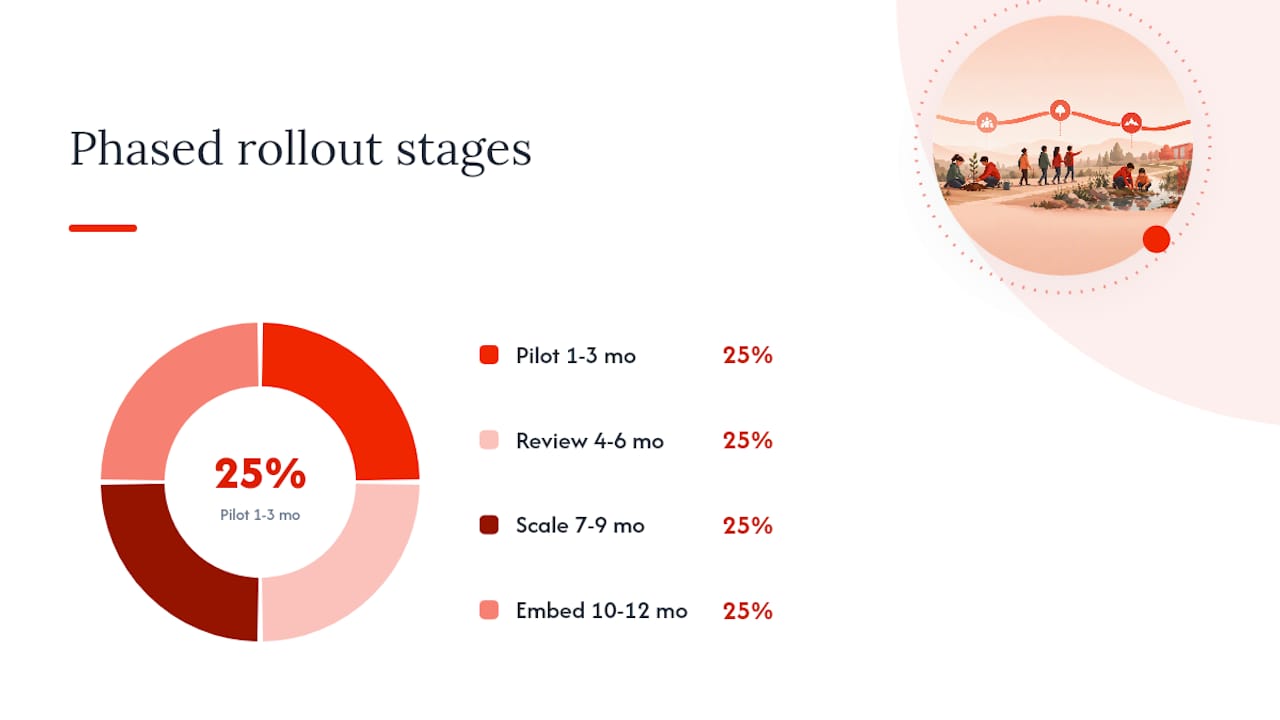
A phased rollout protects against the two most common failure modes: trying to do too much in year one, or losing momentum after a single successful pilot.
- Months 1 to 3: run a small pilot with one year group and one or two subjects, using the risk template and measurement framework already outlined
- Months 4 to 6: review pilot data, gather staff and pupil feedback, adjust logistics
- Months 7 to 9: scale to two or three year groups, bringing in additional subject leads
- Months 10 to 12: embed into the standard scheme of work and formalise CPD for all relevant staff
Roles matter here. Senior leaders own the timetable and budget decisions. Subject leads adapt schemes of work to include outdoor sessions. Site staff manage space, equipment storage and grounds access. External providers, where used, supply specialist equipment or facilitation capacity the school doesn’t hold internally.
| Phase | Focus | Key Measure |
|---|---|---|
| Pilot (1 to 3 months) | Single cohort, single subject | Baseline engagement and attainment |
| Review (4 to 6 months) | Feedback and adjustment | Staff and pupil survey results |
| Scale (7 to 9 months) | Additional cohorts and subjects | Comparator test scores |
| Embed (10 to 12 months) | Whole-school integration | CPD completion and sustained uptake |
Resource costs stay modest for most subjects: basic fieldwork equipment, CPD time and cover, and possibly a facilitation service for larger whole-school events. None of these require a major capital outlay to start.
A practitioner’s view on why schools stick with this approach
A head of science I’ve spoken with about this decided to shift a Year 6 data-handling unit outdoors after watching pupils disengage from a spreadsheet exercise for the third year running. The following term, pupils who’d collected their own pond data outdoors produced noticeably stronger written interpretations than any previous cohort, without extra teaching time added.
The tip that mattered most: don’t wait for the “perfect” outdoor unit. Take one existing lesson, move the data collection outside, and keep everything else the same. Small, contained changes get staff buy-in faster than a full curriculum overhaul ever will.
Where an external provider fits into your outdoor programme
Running a full cross-curricular outdoor programme well takes time most departments don’t have spare, particularly around risk paperwork, equipment maintenance and keeping activities genuinely mapped to learning objectives rather than just “fun.” This is where a specialist external provider earns its place, not as a replacement for teacher-led planning, but as extra capacity for the parts that eat staff hours without adding classroom value.

A good external partner typically handles facilitation on the day, supplies lesson plans already mapped to outcomes so your staff aren’t starting from a blank page, brings and maintains equipment, and can run scoring or assessment aids that make pupil evidence easy to collect on-site. Laserclay works this way for schools looking at team challenge formats: structured, safety-checked equipment with real-time scoring that gives teachers a controllable, repeatable session rather than an improvised one, echoing the case for structured, repeatable outdoor formats that hold up to scrutiny from governors and safeguarding leads alike.
Before commissioning any external session, brief the provider clearly: state your year group, your specific learning objective, the assessment evidence you need back, and any accessibility requirements in the group. If you’re weighing this route for a whole-school event, a carnival, camp or event rental package is worth a look, and you can check formats and pricing directly to see what fits your timetable and budget.
Sources
- The Natural Connections Demonstration Project — guide chunks
- The effect of cross‑curricular integration on pupils’ knowledge gained through experiential learning
- Getting out of the classroom and into nature: a systematic review of nature‑specific outdoor learning
- PMC article on outdoor learning implementation and teacher preparation
- MDPI study on structured outdoor programme design
FAQ
What are the main benefits of outdoor recreation for pupils?
Improved attainment on higher-order thinking tasks, stronger social-emotional skills, better classroom behaviour, increased physical activity and improved teacher job satisfaction all feature consistently across multi-school evidence.
What are the benefits of learning outside the classroom?
Outdoor lessons deepen conceptual understanding through multi-sensory encoding, improve engagement and self-concept, and produce measurable gains on reasoning-based assessment tasks when mapped explicitly to curriculum aims.
What are the benefits of playing outdoor games at school?
Structured outdoor games build teamwork, communication and resilience while offering natural opportunities for physical activity; formats like team challenges also reinforce sportsmanship and fair-play skills that transfer back into classroom collaboration.
How often should outdoor cross-curricular activities happen for real impact?
Evidence points to regular, ongoing participation rather than occasional trips. Weekly or fortnightly integration into existing schemes of work produces stronger, more consistent results than termly one-off events.
Do outdoor activities work for pupils with SEN or additional needs?
Yes, when planning includes accessibility checks from the outset: route conditions, sensory triggers and peer-support roles all need consideration before the session, not adjustment on the day.
How do schools measure whether an outdoor programme is working?
Combine attendance data, structured engagement observations, pre- and post-programme test comparators and pupil voice surveys, ideally across a 6 to 12 week pilot before deciding to scale.
Recommended
- Inclusive outdoor school sports: 10 examples for educators | Laser Clay Singapore
- Low-risk outdoor school activities: a guide for school leaders | Laser Clay Singapore
- How to plan safe outdoor activities for school groups | Laser Clay Singapore
- Benefits of laser games in school programmes | Laser Clay Singapore