Pick from interactive stage games, team relays, casino-style tabletop rounds, immersive mystery formats and tech-driven quizzes, all of which suit typical Singapore ballrooms and mixed age groups. Slot two or three short segments into your run of show, then finish with a grand prize draw so guests stay until close.
TL;DR:
- During an evening lasting four hours, place games between courses, group awards early, and reserve 60–75 minutes for dancing to preserve momentum.
- For mixed age groups, seated table puzzles, phone quizzes, and team photo hunts avoid putting guests on stage; test wireless access before mobile games.
- A ballroom marketed for 500 standing guests may seat about 300 after staging and game areas take space; request a marked floor plan before signing.
- Use the venue package as a base, then budget 40–60% more for entertainment, staging, and extras; treat this as a guide and confirm vendor quotes.
- Choose the $69 per person package for a defined group, or $500–$800 per hour rental when guests will drop in and out.
Table of Contents
- 1. Which dinner and dance games actually work in a ballroom?
- 2. How do you schedule games into a four-hour run of show?
- 3. What venue and space checks should you run in Singapore?
- 4. What should you ask vendors and budget for game segments?
- 5. How can Laser Clay be customised to suit your theme and team size?
- 6. What safety protocols apply to Laser Clay at a dinner and dance?
- 7. What do Laser Clay packages cost at a dinner and dance in Singapore?
- 8. Why choose Laser Clay over traditional dinner and dance games?
- 9. What do past events show about Laser Clay at corporate gatherings?
- 10. Planner perspective: pacing, inclusion and booking windows in Singapore
- 11. Add a facilitated game segment or event booth to your dinner and dance
- FAQ
- Sources
1. Which dinner and dance games actually work in a ballroom?
Group your options by format, then choose one or two formats rather than five. Each category below states what you need, how long it runs and a gentler variant for mixed-age or family-friendly rooms.
- Interactive stage staples: lip-sync battles, quick talent rounds and themed runways. Run them as a short segment with a host and a simple applause vote. You need a stage, a microphone and a playlist. The inclusive variant is a “table talent” round where each table nominates a group performance, so nobody performs alone.
- Team challenges and department relays: short rounds such as trivia sprints, balloon relays or object-passing races. They are easy to judge and encourage bonding across departments. Keep each round brief. The inclusive variant is a seated challenge, such as a table puzzle race, for guests who prefer not to run.
- Casino-style tabletop games: blackjack, roulette and poker tables adapted for corporate crowds, played for tokens rather than money. They take little floor space and work at tables during dinner. The inclusive variant is a card-matching game that needs no gambling knowledge.
- Immersive formats: murder mystery, photo-mystery hunts and themed role-play. Release clues in segments between courses so the story builds without stopping the programme. The inclusive variant is a team-based photo hunt that guests can complete seated.
- Tech-driven options: live quiz apps, polling and mobile scavenger hunts. Everyone plays from their phone, so no one is put on the spot. You need reliable Wi-Fi and a screen visible from every table. Test connectivity in the room before the event, not on the night.
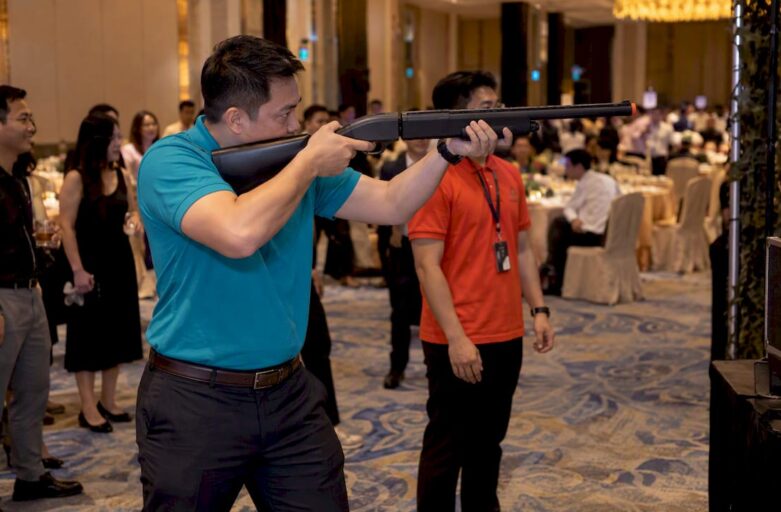
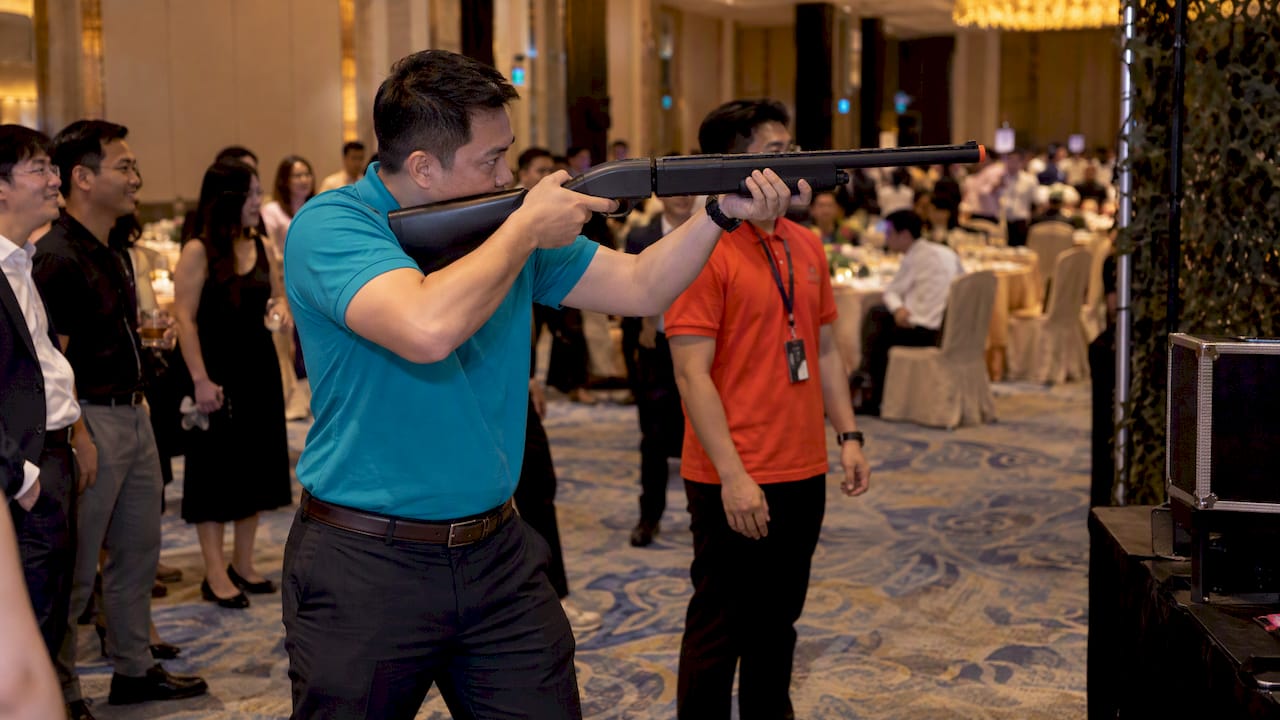
- Skill-based shooting experiences: a facilitated, scoreboarded activity such as laser clay gives a competitive highlight that guests can watch and cheer. Later sections explain how we run it at dinner and dance events.
Pro Tip: Brief every game clearly and concisely. If the host cannot explain the rules in one breath, the game is too complicated for a room that is also eating and chatting.
2. How do you schedule games into a four-hour run of show?
Treat the evening like a conference programme. Singapore event-planning guidance describes a four-hour dinner and dance with a reception, dinner, grouped awards, entertainment during courses and a grand prize draw at the end. Here is a template built on that structure.
- Reception and arrivals: welcome drinks, photo wall and a light icebreaker, such as a tech quiz that guests join from their phones as they mingle.
- Opening and leadership speech (early): speeches land best while guests are fresh and before the room settles into dinner conversations.
- Starter and first game burst: a quick team challenge or quiz round between the starter and main course.
- Main course with a mid-course interactive burst: a tabletop game or photo-hunt clue that keeps tables busy while they eat.
- Awards and entertainment block: group the awards into one tight block rather than spreading them across the night, which avoids a long, slow stretch that drains energy. Follow with a stage game such as a lip-sync battle.
- Dancing (about 60–75 minutes): open the floor, with a short game segment halfway to pull people back in.
- Grand prize draw and close: hold the biggest prize until last. It gives guests a reason to stay until the final minutes.
3. What venue and space checks should you run in Singapore?
Never rely on a published capacity figure alone. Practical venue advice notes that a ballroom quoted as 500 standing may seat only around 300 once the stage, AV, dance floor and game setups are accounted for. Ask for a marked floor plan showing the stage, dance floor and game areas before you sign.
Run through this checklist with the venue:
- Usable seated capacity with your stage, dance floor and game zones in place
- AV, power points and Wi-Fi capacity for tech games and scoreboards
- Whether the venue’s licence covers your entertainment and your planned closing hour
- Load-in access and the time window for setup and teardown
- Sightlines to the stage and screens from the furthest tables
For smaller hotel ballrooms, which are common in Singapore, shrink the footprint: choose tabletop games and phone-based quizzes, use one compact stage game rather than a floor-wide relay, and keep any equipment-based activity in a corner zone.
Planning rule: marketed capacity can overstate real seated capacity, so always ask for the marked floor plan before contracting.
4. What should you ask vendors and budget for game segments?
Start with a budgeting method planners in Singapore commonly use: price the venue package, then add 40–60% for entertainment, staging and extras. Treat that as a planning guide, not a quote, and adjust it to your headcount and the scale of your programme.
Ask every vendor these questions before you commit:
- How long do setup and teardown take, and can they happen outside dinner service?
- What is the staff-to-player ratio, and who acts as host or marshal?
- What display or scoreboard needs do they have, and who supplies the screen?
- Do they carry public liability insurance, and what is the contingency plan if equipment fails?
- How are prizes handled: supplied by the vendor or procured by you?
For staffing, assign one person to each segment as the timekeeper so games never run over. Buy prizes early, label them by category and keep the grand prize in a visible spot to build anticipation.
Pro Tip: Ask each vendor for a one-page run sheet with exact minutes. A vendor who cannot give you one is a risk to your timetable.
5. How can Laser Clay be customised to suit your theme and team size?
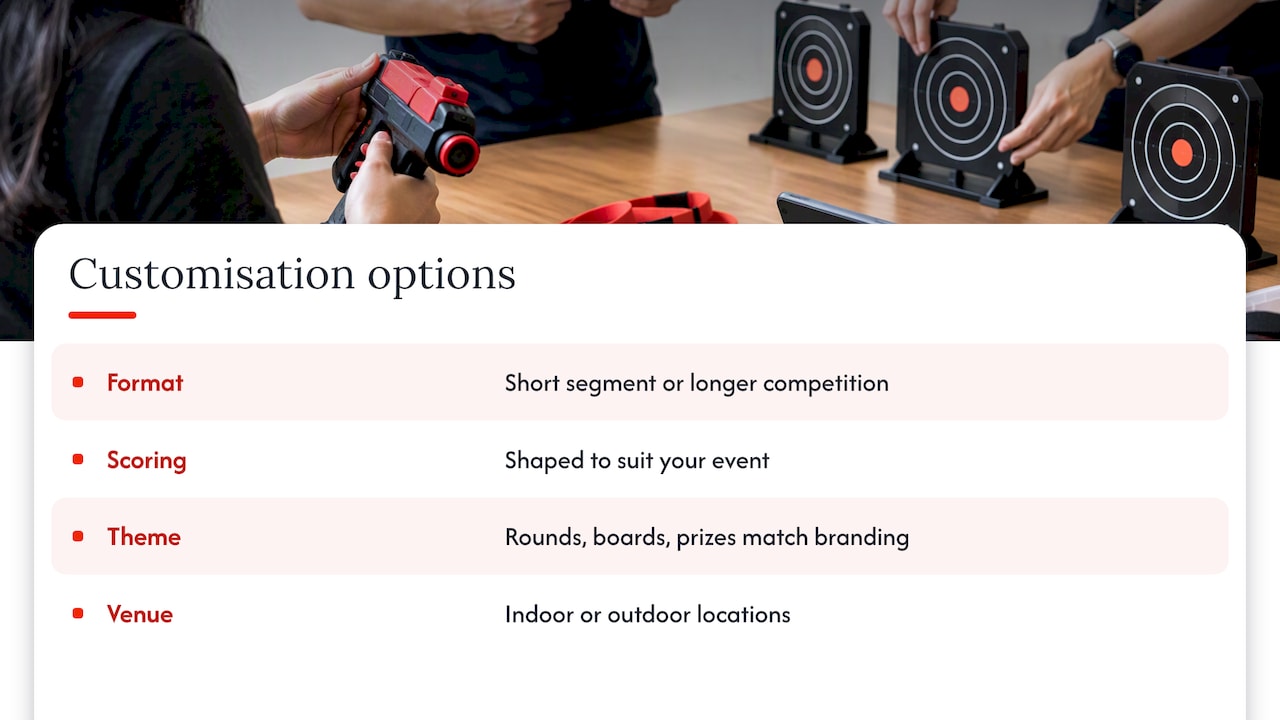
We build the activity around your programme rather than the other way around. The facilitated format can run as a short, high-energy segment or a longer competition, and the scoring system can be shaped to suit your event. Our game formats and scoring systems are customisable, so a themed evening can use scoring rounds, team scoreboards and prize categories that match your branding.
Team size is simple to adjust. Smaller groups can rotate through the system quickly, while larger corporate crowds can be split into teams that compete for a leaderboard, with the rest of the room watching the real-time electronic scoreboard. This keeps the audience engaged even when they are not shooting.
Our setup suits both indoor and outdoor venues, so a ballroom corner, a foyer or a hotel terrace can all host it. Our competition ideas for Singapore planners page shows quick formats and prize ideas you can borrow, and our how to play page explains the format, timings and setup needs.
6. What safety protocols apply to Laser Clay at a dinner and dance?
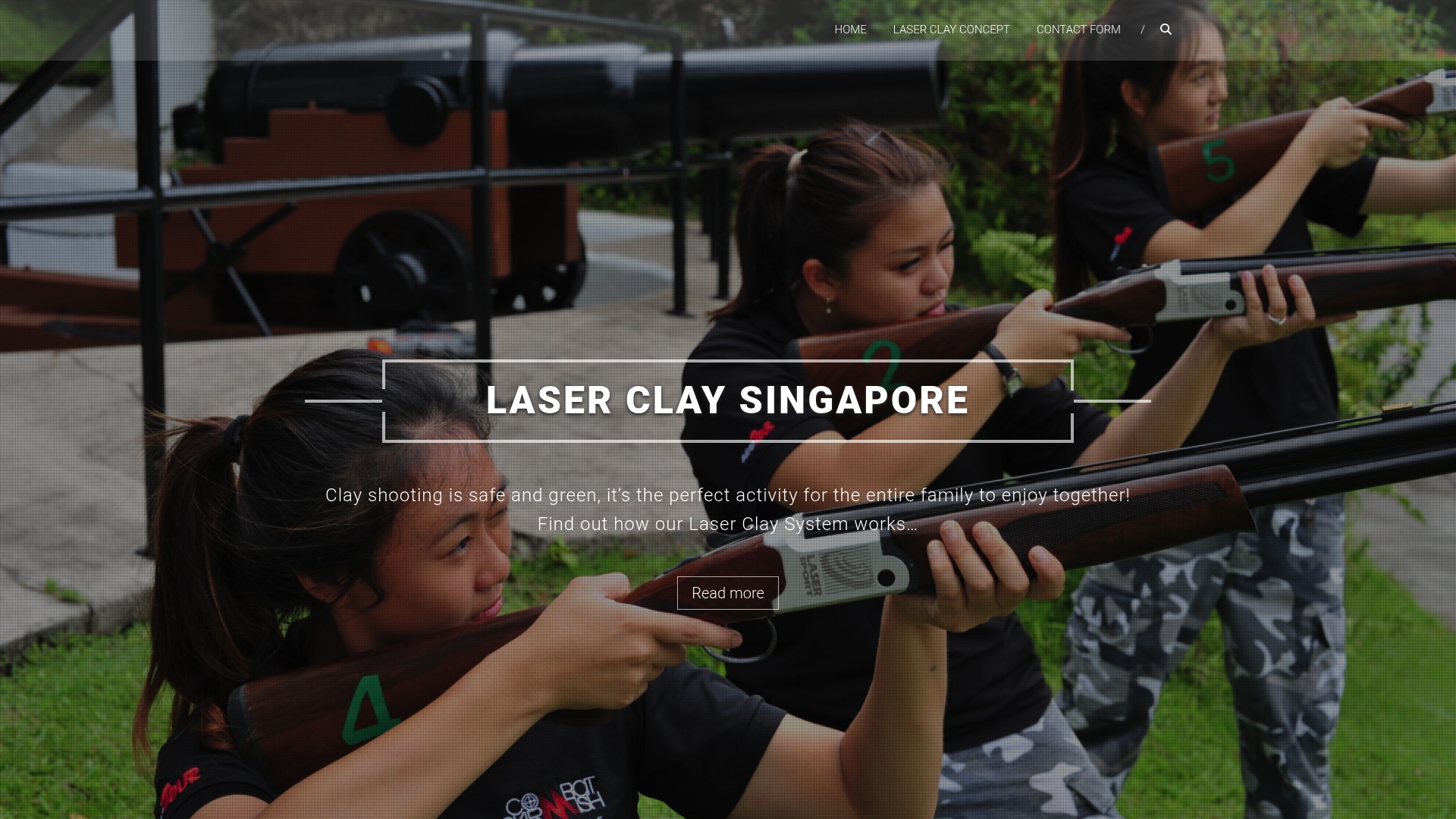
Safety is built into the format. Laser Clay uses laser technology instead of lead ammunition, so there is no live fire, no lead and no environmental concern from spent shot. The equipment includes sound-simulated, deactivated shotguns, which give an authentic feel without any live ammunition.
Every session is fully facilitated. Our team briefs participants before they begin, controls the shooting area and manages the queue. That structure matters at a dinner and dance, where guests may be dressed formally and have been socialising.
A few practical points for your event:
- Keep the activity zone clear of dining tables and dance traffic
- Brief players on where to stand and when to stop
- Hold the activity before the dancing block, so the zone is not shared with a busy floor
- Run the setup checks listed on our setup requirements page with your venue ahead of time
The activity suits participants from age 10, which makes it workable for family-friendly corporate events.
7. What do Laser Clay packages cost at a dinner and dance in Singapore?
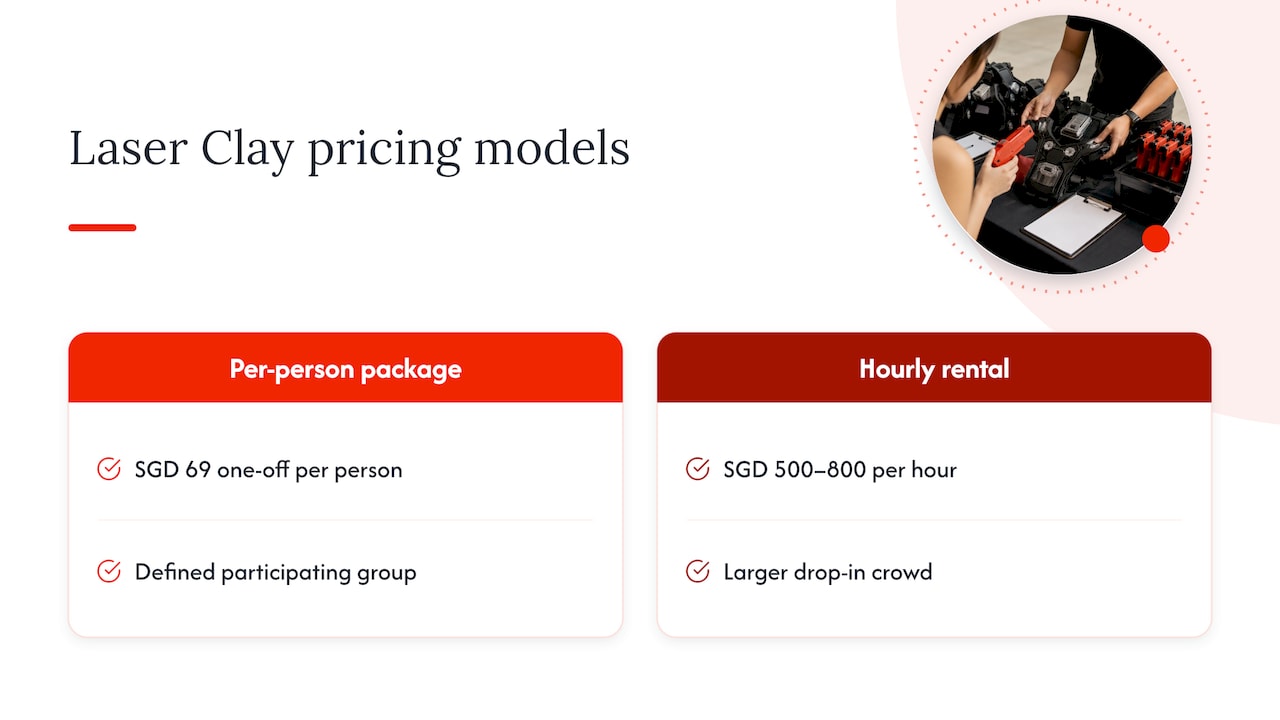
Our listed pricing is straightforward. The Corporate Laser Clay Package is 69 SGD one-off per person. If you would rather run it as a booth that your own team or event company manages, System Rental is 500-800 SGD per hour.
The choice depends on your format. A per-person package suits a defined group who will all take part, such as a department team. Hourly rental suits a larger crowd where guests drop in and out through the evening, because you pay for time rather than headcount.
For wider benchmarks, our Laser Clay cost page sets out pricing ranges and how to get in touch for a quote. Final pricing for your date and venue is confirmed when you enquire.
8. Why choose Laser Clay over traditional dinner and dance games?
Traditional games such as trivia, charades and relays are easy to run, but they often depend on the loudest guests. A scoreboarded, skill-based activity gives everyone a fair chance to compete, whatever their confidence on stage.
Here is what sets our format apart:
- Facilitated and scored: our team runs the activity and the real-time electronic scoreboard keeps the competition visible to the whole room.
- Inclusive for mixed levels: no prior experience is needed, and the activity is accessible regardless of skill level.
- Eco-friendly: reusable clay targets and no lead ammunition, a good fit for companies with sustainability goals.
- Adaptable: it works indoors or outdoors and can be tailored for competitive or casual crowds.
- Low mess: no clean-up of props, paper or confetti on a ballroom floor.
It also complements the other formats in this list rather than replacing them. Use a quiz to open the evening, a stage game for the awards block and a shooting segment as a competitive highlight.
9. What do past events show about Laser Clay at corporate gatherings?
We do not publish named client testimonials or case studies for dinner and dance events, so we will not invent any here. What we can describe is how our corporate packages are typically structured and used.
Our corporate events run as facilitated sessions with a clear start and finish, team scoring and a leaderboard. Planners use them for team-building days, awards evenings and social gatherings, and the format fits naturally into a segment of a larger programme because setup and run sheets are planned in advance. Our setup time guide covers setup and run sheets that help keep an evening on schedule.
If you want to see how the activity could fit your run of show, our team-building explainer for event planners walks through facilitation, scoring and suitability. For venue-specific questions, our team building venues page explains how the activity fits different venue types.
10. Planner perspective: pacing, inclusion and booking windows in Singapore
Keep awards short and early. A long awards block is where a room loses its energy, and a well-timed game is the cheapest way to win it back between courses. Book popular dates well ahead, or choose a quieter period for better availability and value. And choose games that a host can brief in half a minute and that work across ages and job levels. The best segment is the one the quietest person at table twelve can enjoy.
— Joshua
11. Add a facilitated game segment or event booth to your dinner and dance
Laser Clay is a facilitated, scoreboarded option for planners who want a competitive highlight that is eco-friendly and suits a corporate dinner. It is one practical choice among many, adaptable to indoor and outdoor spaces.
- Corporate package: our Corporate Laser Clay Package is for defined groups.
- Rental: System Rental is for booths you manage yourself.
To fit it into your run of show, contact our team with your date and venue.
FAQ
How many game segments should a dinner and dance have?
A few short segments can keep energy high without crowding out speeches, awards and dancing. That keeps energy high without crowding out speeches, awards and dancing in a four-hour programme.
What games work for a mixed-age corporate dinner and dance?
Phone-based quizzes, table puzzle races and photo hunts work well because guests play seated and no one is forced on stage. Skill-based activities with a scoreboard also suit mixed levels, since no prior experience is needed.
How much should I budget for dinner and dance entertainment?
A common planning method is to price the venue package, then add 40–60% for entertainment, staging and extras. Treat it as a starting guide and confirm quotes from your vendors.
What should I check with the venue before booking games?
Ask for a marked floor plan showing the stage, dance floor and game areas, plus power, AV and Wi-Fi details. Confirm that the venue’s licence covers your entertainment and closing hour, and check usable seated capacity rather than the marketed figure.
Sources
- The company dinner and dance in Singapore, planned like an event – We are C4E
- From Dinner to Dancing: Planning a Memorable Annual Dinner in Singapore – The Random Singaporean