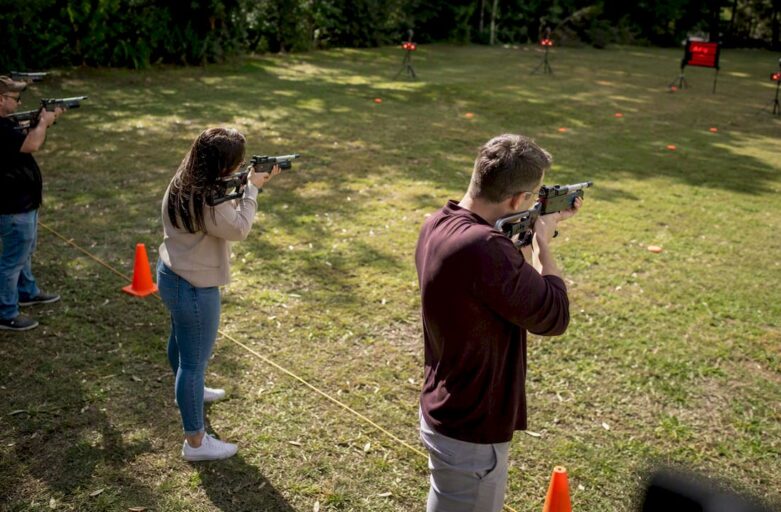
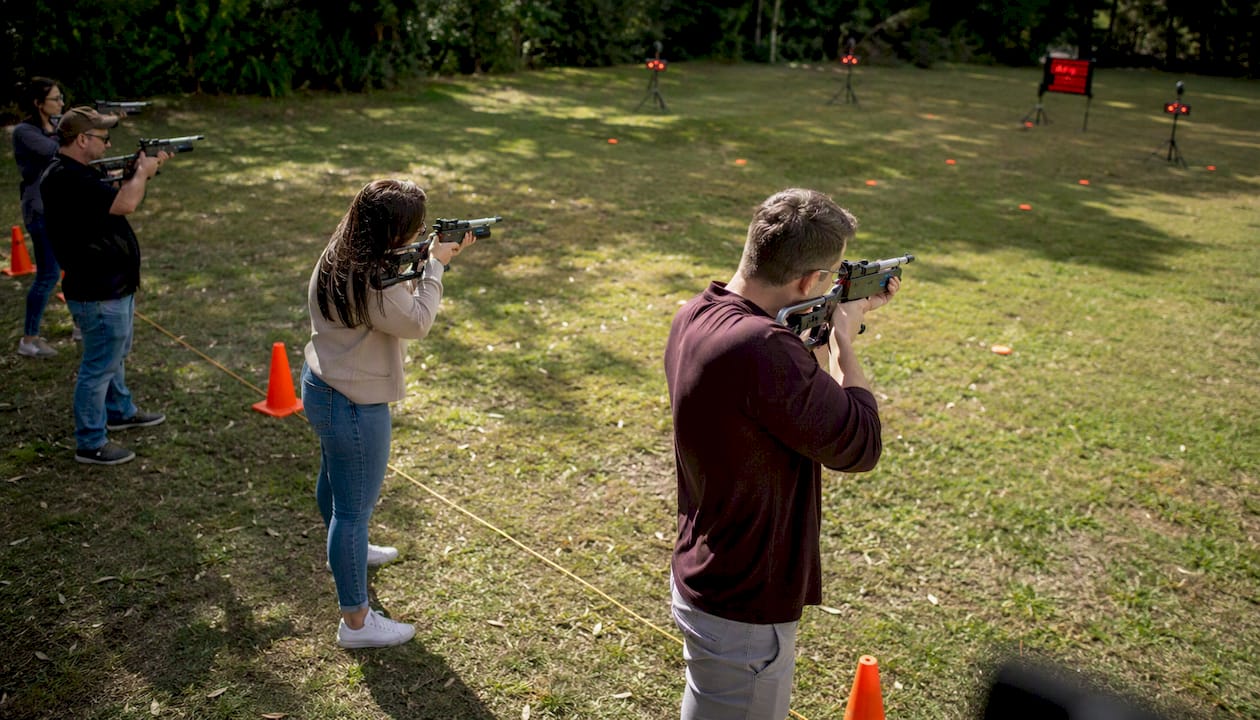
Laser clay shooting is the best team building activity for remote employees meeting up in person, and it works for three reasons: nobody needs prior experience, the electronic scoreboard gives instant feedback everyone can see, and the whole rig packs down small enough to run indoors or outdoors.
For distributed teams that only gather a few times a year, that combination matters more than novelty. You get a shared skill everyone starts on equal footing, a live scoring feed that turns performance into conversation, and a setup flexible enough to fit a car park, a function room, or a rooftop.
- Inclusive by design — no shooting background needed, so a graduate and a director start level.
- Measurable learning — every shot registers on the scoreboard instantly, giving real-time feedback rather than a vague “good session”.
- Logistically light — indoor and outdoor formats mean venue choice rarely rules it out.
The rest of this guide covers the exact space you need, group sizes, safety checks, game formats, a booking checklist, and a sample run sheet you can lift straight into your event plan.
Key Takeaways
Laser clay shooting succeeds as a remote team-building activity because it needs no prior skill, gives instant scoreboard feedback, and adapts to almost any indoor or outdoor venue.
| Point | Details |
|---|---|
| Confirm your footprint early | Test for roughly 30m × 10m outdoors or 30ft × 20ft indoors before booking a venue. |
| Match format to goal | Use timed accuracy rounds for composure under pressure, relays for trust and hand-offs. |
| Lock safety documentation | Get facilitator qualifications and insurance confirmed in writing during contracting. |
| Budget travel separately | Activity pricing is usually fixed; travel for distributed staff is the variable cost. |
| Laserclay handles the full package | Facilitators, equipment, scoreboard, set-up and takedown come included, indoors or outdoors. |
Where to go next
- Start with the corporate team building package page for pricing structure and inclusions.
- Review venue suitability across Singapore before confirming your space.
Copy the booking checklist from this guide into your next vendor email. It’s the fastest way to get a consistent, comparable quote.
Table of Contents
- Why laser clay shooting works so well for distributed teams
- How much space and staffing does a session need?
- What safety and accessibility checks should you run?
- Which game formats teach which behaviours?
- What should you ask suppliers before booking?
- A ready-to-use 90 to 120 minute run sheet
- Which virtual platforms fit remote team-building if some staff can’t attend in person?
- How do you keep remote employees engaged before the day itself?
- What does a remote team-building day actually cost?
- What’s a realistic timeline for organising the day?
- How do you schedule around multiple time zones fairly?
- How Laserclay delivers this for your next team day
- FAQ
Why laser clay shooting works so well for distributed teams
Remote employees who only see each other a handful of times a year need an activity that builds trust fast, without relying on shared history or inside jokes. Laser clay shooting does this because the learning curve is shallow and the feedback loop is immediate.
- Sharper focus and situational awareness — participants track a moving target and their own stance simultaneously, which mirrors the kind of split attention needed in fast-moving projects.
- Healthy competition without friction — scoring is individual and team-based, so rivalry stays light rather than personal.
- A level playing field across seniority — nobody has an advantage from tenure or job title, which levels behaviour across a mixed-ability group.
- Performance you can actually measure — the electronic scoreboard displays instant visual and audio feedback, so improvement across rounds is visible to the whole group, not just felt.
Each of these maps onto a workplace behaviour. Rapid feedback on the range echoes a test-and-learn culture back at the desk. Watching a colleague coach a teammate through their stance is peer mentoring in miniature. A shared scoreboard, updated shot by shot, is the closest thing to a live dashboard most teams will stand in front of together all year.
Pro Tip: Screenshot the final scoreboard and use it as the opening slide in your next debrief. Ask the team what helped their score improve round to round, then ask where that same pattern shows up in how they solve problems at work.
How much space and staffing does a session need?
Booking a venue for laser clay shooting comes down to three questions: how much floor space, how many facilitators, and how long. The system is battery powered and self-contained, so it can run wherever there is a flat, clear line of sight rather than wherever there happens to be a power socket.
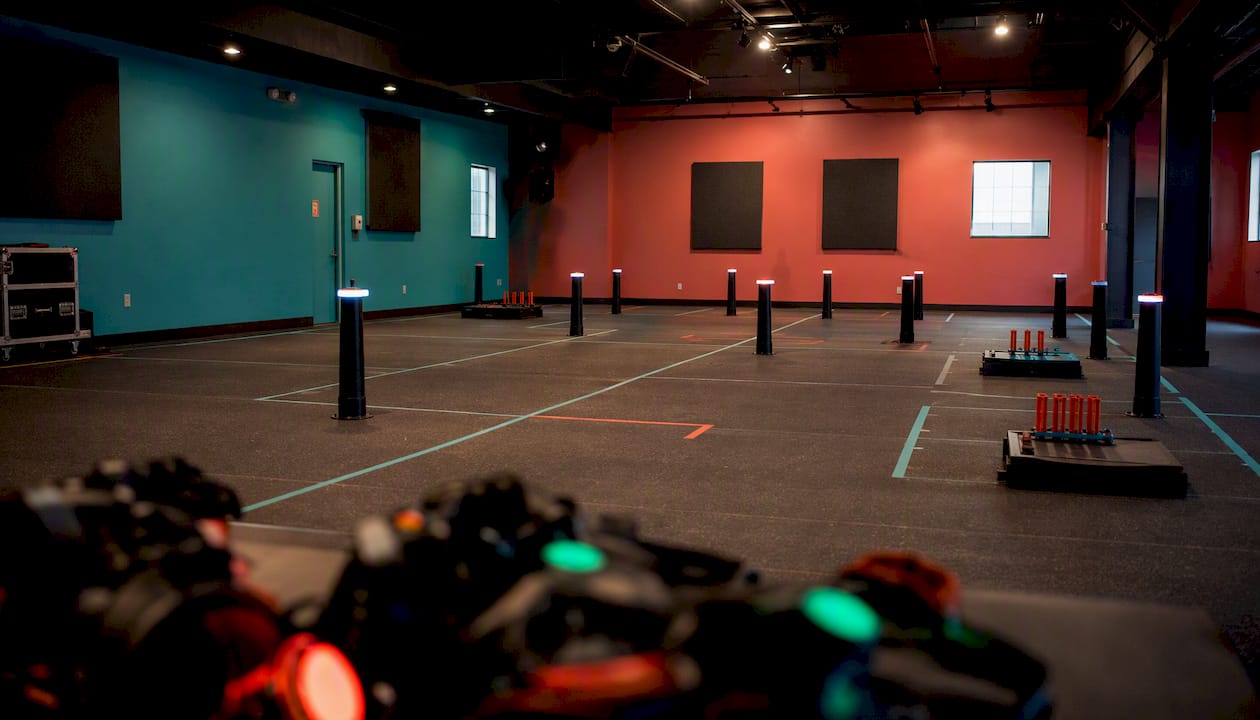
Outdoors, plan for a footprint of roughly 30 metres by 10 metres to give a firing line proper clearance. Indoors, a compact configuration around 30 feet by 20 feet works for function rooms, warehouses, or larger meeting spaces, though you should always confirm ceiling height and sightlines with your venue before booking.
| Setup factor | Typical guidance |
|---|---|
| Outdoor footprint | Approximately 30m × 10m for a comfortable firing line |
| Indoor footprint | Approximately 30ft × 20ft for compact venues |
| Lanes per session | Five lanes is the common configuration for group play |
| Session length | 60 to 150 minutes depending on group size and rounds |
Groups scale by adding lanes rather than by cramming more people onto one. A standard five-lane setup suits groups of 20 to 40 comfortably, with facilitators rotating people through in relay format; larger headcounts usually mean linking multiple systems and adding facilitators rather than stretching one team thin.
Before you sign off a venue, walk through this checklist with the site manager:
- Confirm there’s a genuinely clear sightline with no pedestrian crossing behind the firing line.
- Check for shelter or shade if running outdoors in the middle of the day.
- Ask about surface type. Grass, tarmac and indoor flooring all behave differently underfoot.
- Flag any noise sensitivity with neighbouring tenants or residential blocks nearby.
- Confirm loading access for equipment vans and a realistic set-up window.
What safety and accessibility checks should you run?
Every laser clay session should use deactivated shotguns firing infra-red beams at reusable clays, never live ammunition, and the vendor should confirm this in writing before you sign anything.
- Ask for proof of public liability insurance and a written incident procedure.
- Confirm facilitators are trained to run safety briefings and supervise the firing line throughout, not just at the start.
- Check the reusable clays are part of an eco-friendly, non-contaminating setup, useful if your procurement team screens for sustainability.
- Ask how the firing line adapts for participants using a wheelchair or with limited mobility, and whether standing and seated positions are both supported.
- Offer alternative roles such as scorekeeper or team captain so anyone who prefers not to shoot still takes part fully.
Get facilitator qualifications and safety documentation in writing during contracting, not verbally on the day.
Which game formats teach which behaviours?
Different formats push different behaviours, so pick the format to match what you actually want the day to achieve.
- Head-to-head relays — two lines racing to complete rounds fastest. High energy, low complexity, and it rewards clean hand-offs between teammates under mild time pressure.
- Team aggregate score — every shot from every team member adds to one running total. This rewards consistency over showmanship and works well for larger, mixed-ability groups.
- Timed accuracy rounds — a fixed window to hit as many targets as possible. This builds composure under pressure, since rushing costs more than it gains.
- Knock-out ladder — a bracket format where the top scorers advance. High energy, moderate complexity, and it surfaces natural competitors within the group.
Scoring runs through the same electronic scoreboard across every format, giving immediate visual and audio confirmation of each hit. That immediacy is what makes formats like timed accuracy rounds work as a teaching tool rather than just a game. If you want more format variations to mix into a longer day, the best laser shooting team building activities guide runs through several worth trying.
What should you ask suppliers before booking?
A good proposal answers these before you have to ask twice.
- What’s the facilitator-to-participant ratio, and are facilitators included in the quoted price?
- Is the equipment self-powered, or does it need mains access at the venue?
- What happens if the weather turns on an outdoor booking, and is there an indoor fallback?
- Is there spare equipment on-site in case of a technical fault mid-session?
- Are quotes per-head or flat rate, and what triggers a travel surcharge?
Once you have answers, lock down these contract checkpoints:
- Confirm the cancellation window and any deposit terms in writing.
- Ask for the exact arrival and set-up time, plus the takedown window afterwards.
- Confirm parking, loading access and who’s responsible for coordinating this on-site.
- Check whether facilitators handle both set-up and safety briefing, or whether that’s split across roles.
- Get invoicing milestones agreed before the event date, not after.
A reliable corporate package includes facilitators, equipment, set-up and takedown as standard, so any vendor quoting these as costly extras is worth questioning. Confirming a weather contingency plan and a clear arrival window in the contract avoids the most common day-of hiccup: a truck stuck outside a venue with nowhere to unload.
A ready-to-use 90 to 120 minute run sheet
This slots straight into a company day without needing a rewrite.
- 0 to 15 minutes — arrival, equipment set-up, facilitator safety brief.
- 15 to 30 minutes — warm-up rounds with light coaching, no scoring yet.
- 30 to 75 minutes — competitive rounds using your chosen format (relay, aggregate, or knock-out).
- 75 to 90 minutes — finals and scoreboard reveal, awards handed out.
- 90 to 105 minutes — takedown and wrap-up.
Build in a 10 to 15 minute buffer for mixed-ability groups, since coaching pace varies more than people expect. Close with three quick debrief questions: What helped your score improve across rounds? Where did you rely on a teammate? What would you do differently next time? Those three answers usually surface more about how the team actually works than a formal survey ever will.
Which virtual platforms fit remote team-building if some staff can’t attend in person?
Even when the core event is in-person, distributed teams often have a handful of people who genuinely cannot travel. Platforms like Zoom, Microsoft Teams, and Google Meet let those employees dial in for the briefing, awards, and debrief segments, even if they can’t take a physical turn on the range.
Live-streaming the scoreboard feed through a shared screen share means remote participants watch scores update in real time rather than getting a summary afterwards. Some planners run a parallel light-touch virtual quiz or prediction game for remote attendees, tied to the same live scores, so nobody feels like a spectator watching a closed event. It’s a workaround, not a replacement. The core value of the activity, shared physical space and hands-on coaching, only lands for people actually on-site, so treat virtual inclusion as a bridge for the odd absentee rather than the main event format.
How do you keep remote employees engaged before the day itself?
Engagement starts weeks before anyone picks up a laser gun. Send a short teaser video or photo set from a past session so people know what to expect. Uncertainty about a new activity is the biggest reason attendance dips, especially among employees who’ve never done anything like it.
Create small pre-event chat groups, split by the lanes or teams they’ll compete in on the day, so people arrive already knowing a couple of faces. A short async poll asking people to pick their team name or choose a format preference gives remote staff a sense of input before they’ve even travelled to the venue.
For teams spread across regions, consider running the debrief as a hybrid session afterwards, recorded and shared asynchronously, so people in different time zones who missed the live wrap-up still get the key takeaways and see the final scoreboard. Momentum matters here: engagement built before the event carries through to how much people actually participate once they’re on-site.
What does a remote team-building day actually cost?
Budgeting for an in-person day with remote employees has two cost layers: the activity itself, and getting people to the same room.
Activity pricing usually runs as either a flat session fee or a per-head rate, depending on group size and session length, and typically covers facilitators, equipment, set-up and takedown as a package rather than as line-item extras. The bigger, more variable cost for distributed teams is usually travel and accommodation for staff flying or driving in from other offices or home locations, which can dwarf the activity fee itself for a genuinely spread-out team.
Ask your vendor directly whether facilitators, equipment transport and takedown are bundled into their number or billed separately. A cheaper hourly rate that excludes set-up time often costs more once everything is added back in.
What’s a realistic timeline for organising the day?
Distributed teams need more lead time than co-located ones simply because travel has to be coordinated around everyone’s calendar, not just the venue’s availability.
Start six to eight weeks out by settling on a date and confirming who genuinely can travel. This is also when you should approach vendors for quotes, since good facilitators and popular venues book up faster than planners expect. Four weeks out, lock the venue, confirm numbers, and send travel details to attendees who need to book flights or trains. Two weeks out, finalise the run sheet, confirm facilitator numbers with your vendor, and send a reminder with what to wear and what to expect. In the final week, confirm weather contingencies for outdoor bookings and reconfirm arrival times with both the venue and the vendor.
Treat the four-week mark as your real deadline for irreversible decisions. Past that point, changing venues or vendors gets expensive and complicated fast.
How do you schedule around multiple time zones fairly?
Coordinating a single in-person date across a distributed team is a scheduling problem long before it’s a logistics one. The trick is separating decisions that need real-time input from ones that don’t.
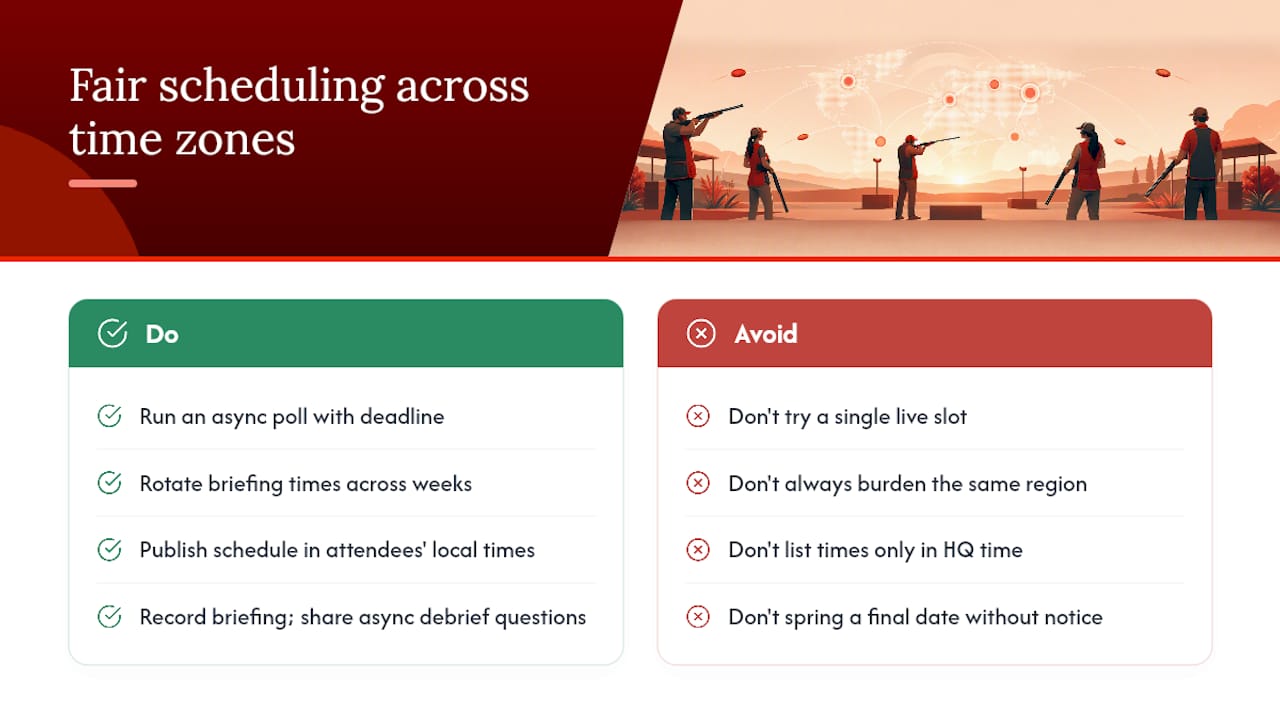
Use an async poll with a firm deadline to gather date preferences, rather than trying to find a live meeting slot that works for everyone across time zones. For the pre-event briefing or any planning calls, rotate the meeting time across weeks so the same region isn’t always stuck with an inconvenient hour. Publish the final schedule with times shown in each attending region’s local zone, not just headquarters time, since a “10am” invite is meaningless to someone reading it from six hours away.
If part of the team genuinely cannot make the chosen date due to time zone spread, record the safety briefing and key moments so they can watch asynchronously, and loop them into the async debrief questions afterwards. Fairness here isn’t about finding a slot that suits everyone equally. It’s about being upfront early enough that nobody’s surprised by the final date.
What planners tell us after booking
The mixes that work best combine people who’ve never met with a few familiar faces, so nobody feels completely adrift. Keeping momentum through the whole session matters more than any single game format. The most common last-minute fix we see is switching an outdoor booking indoors when rain threatens, which the mobile setup handles without disrupting the schedule.
We typically track participation rate and average improvement in hit rate across rounds, both of which tend to climb steadily once people get past the first few nervous shots.
How Laserclay delivers this for your next team day
If your team is scattered across offices or home desks most of the year, the in-person day you do book needs to earn its place, not just fill an afternoon. Laserclay’s laser clay shooting sessions are built around that: no live ammunition, no shooting experience required, and a setup that runs indoors or outdoors depending on what your venue actually offers.
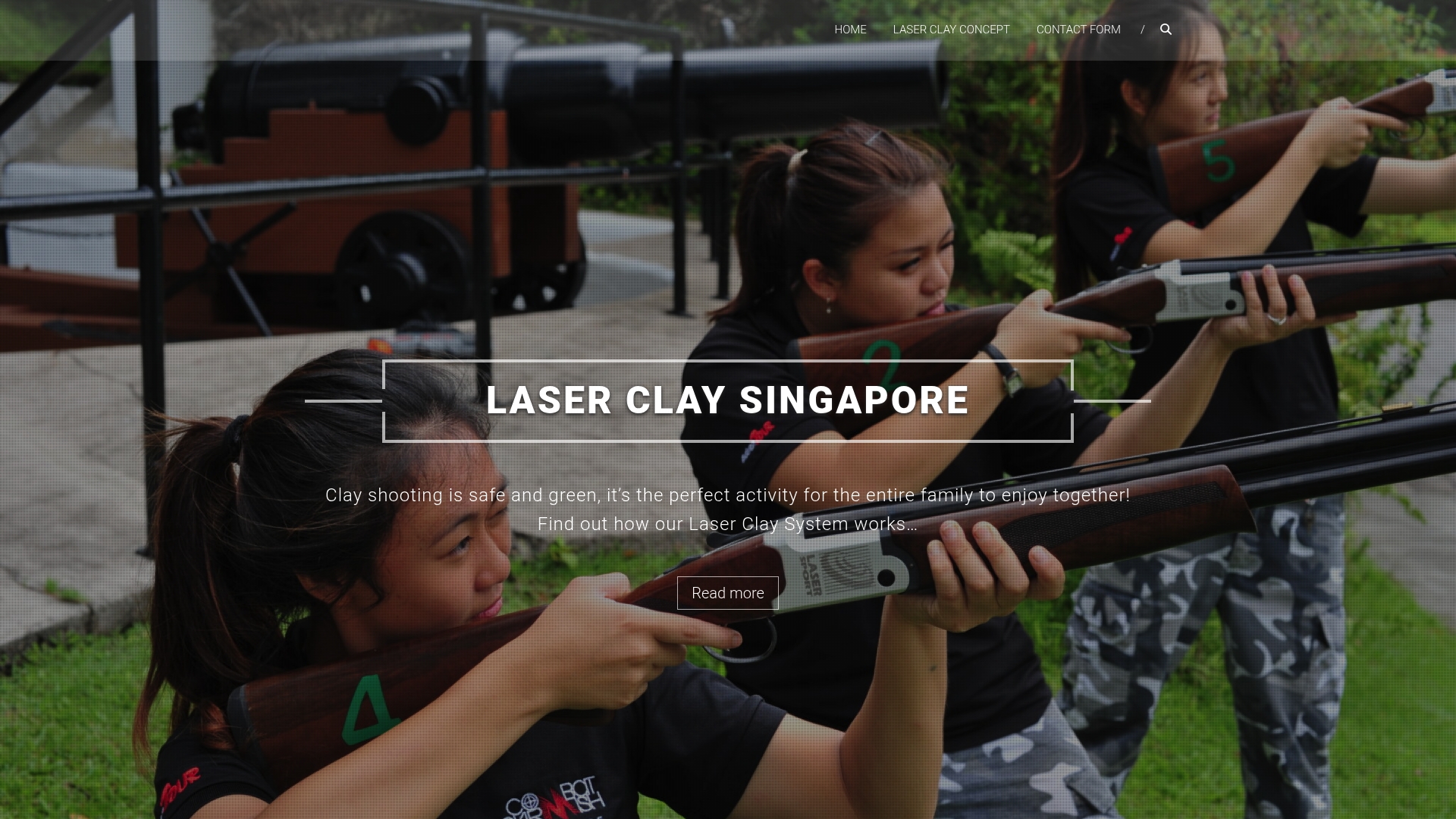
A typical corporate package includes:
- Trained facilitators who run the safety briefing and coach technique throughout.
- Full equipment, including the electronic scoreboard for live, round-by-round feedback.
- Set-up and takedown handled by the team, not yours.
- Flexible indoor or outdoor delivery, so venue choice doesn’t rule the day out.
Planners often add custom scoring formats for larger groups, branded scoreboards for company events, or extra facilitators to run multiple lanes simultaneously. If you’re coordinating recognition gifts for the day, Say Hey Gifting’s employee reward ideas pair well with a scoreboard-driven awards moment.
To check dates, get a quote, or ask about indoor options for your venue, visit the Laserclay Singapore booking page and send through your group size and preferred date.
FAQ
Is laser clay shooting suitable for employees with no shooting experience?
Yes. The activity is designed for mixed-ability groups with no prior experience needed, and facilitators coach technique from the first round.
Can laser clay shooting run indoors if the weather is bad?
Yes. The system runs on rechargeable internal batteries and needs no fixed power source, so sessions can move indoors to a compact space of around 30 feet by 20 feet.
How many people can take part in one session?
A standard five-lane setup comfortably handles 20 to 40 people, with larger groups accommodated by linking multiple systems and adding facilitators.
How long does a typical corporate session last?
Sessions usually run 60 to 150 minutes depending on group size, number of rounds, and whether a debrief is included.
Does laser clay shooting use real ammunition?
No. It uses deactivated shotguns that fire infra-red beams at reusable clays, with no live rounds involved at any point.
Recommended
- Benefits of laser shooting team events explained | Laser Clay Singapore
- Best laser shooting team building activities: UK guide | Laser Clay Singapore
- Laser clay team building explained for event planners | Laser Clay Singapore
- Laser clay vs archery programmes: which suits you? | Laser Clay Singapore