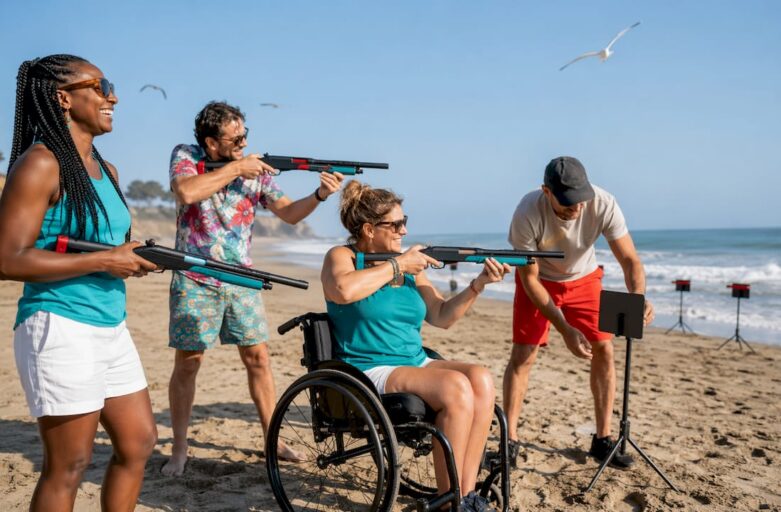
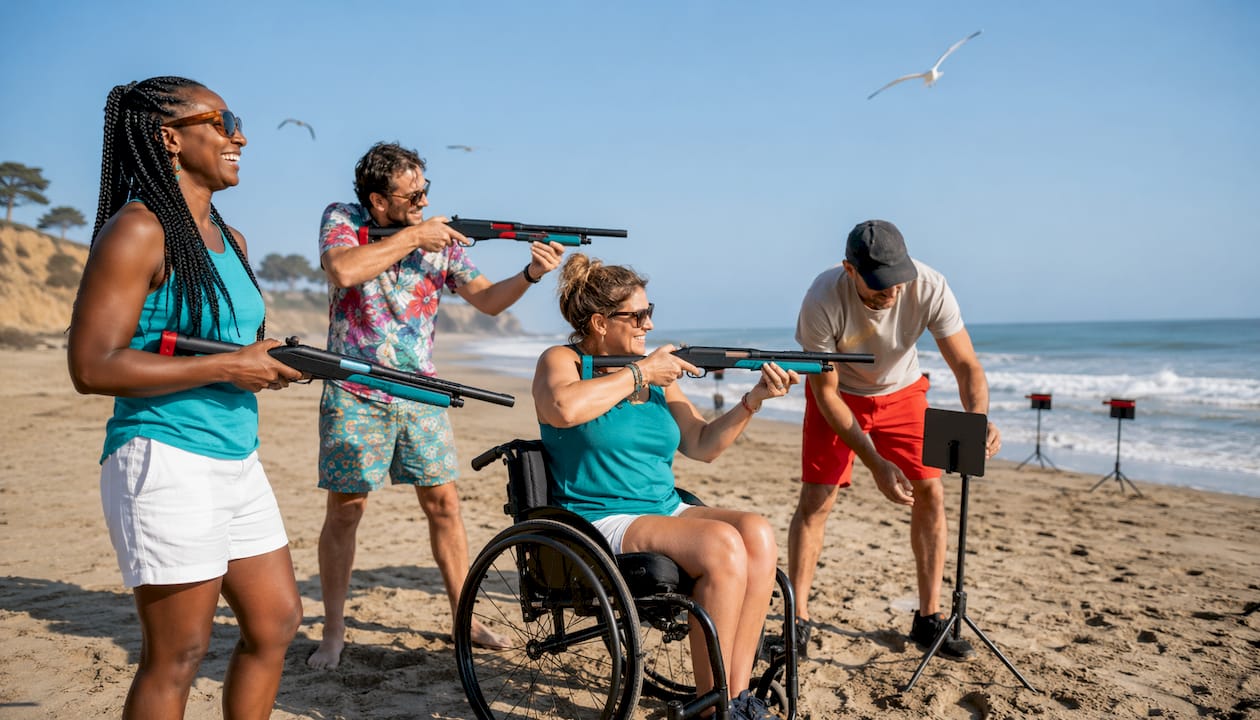
Laser clay accommodates varying fitness levels by removing the two biggest physical barriers in traditional clay shooting: recoil and loud reports. Because the shotguns fire infrared signals rather than live ammunition, there is no kickback, no heavy cartridge weight and no noise that rattles participants with sensory sensitivities. Sessions can be shortened, paced with rest breaks, and adapted with seated rigs or mounting stands so that participants who cannot stand for extended periods still take part fully. Multiple shooters can fire at the same clay simultaneously.
This means a less mobile participant can join a team shot rather than wait on the sidelines.
A few baseline requirements do apply. Participants generally need to hold a lightweight simulated shotgun for a brief duration, follow a short safety briefing and have basic head-eye coordination. Age guidance varies by operator, often setting a minimum age in childhood depending on whether a child can safely hold the equipment. Beyond those minimums, recreational laser clay removes the technical postural demands of competitive shooting and focuses on instant digital feedback and enjoyment instead.
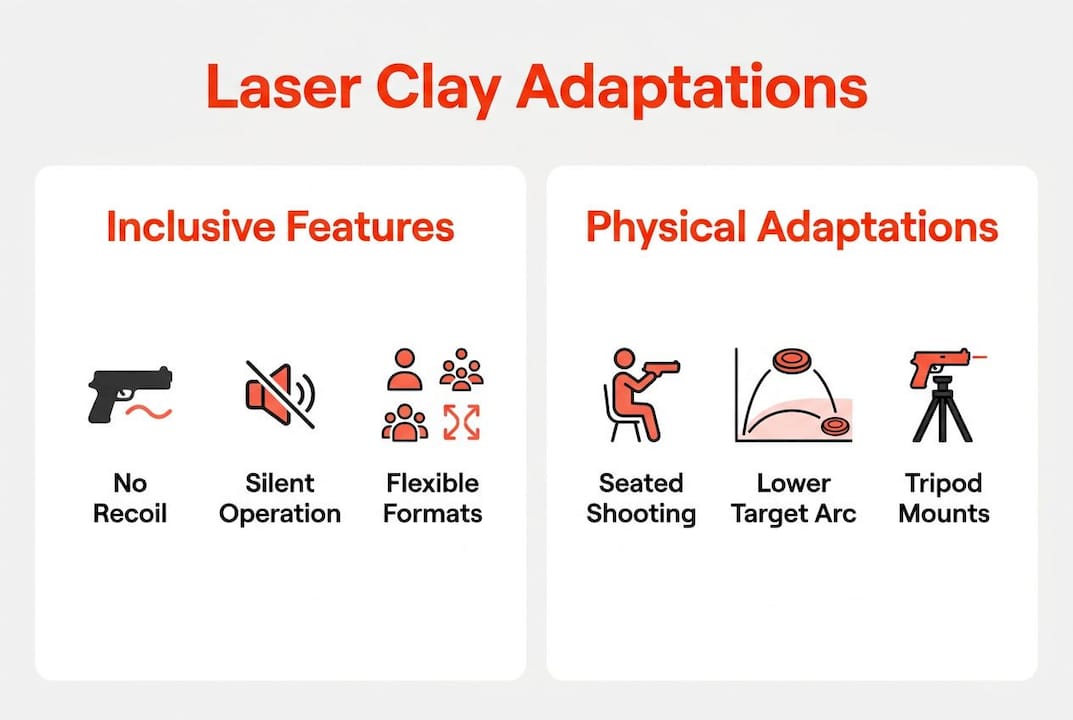
Table of Contents
- What does a typical laser clay session look like?
- How do instructors match the challenge to each participant?
- What physical demands does laser clay actually place on you?
- What are the safety rules and participant requirements?
- How to plan an inclusive session as an organiser
- How does a professional provider deliver genuine inclusivity?
- Warm-up and cooldown routines for mixed fitness levels
- Matching session intensity to individual health and fitness
- Key takeaways
- Why inclusivity in laser clay is more than a selling point
- Book an inclusive laser clay session with Laserclay
- Where to read more
What does a typical laser clay session look like?
Sessions generally run in one of three formats: a short taster lasting a short duration, a standard group slot roughly between half an hour and one hour, or a longer competitive format for parties that want a scored finale. The right length depends on group size and how many rest breaks the organiser builds in, not on any fixed rule.
Equipment consists of simulated shotguns converted to emit an infrared or laser signal, paired with electronic target-detection systems that register hits instantly. There is no protective ballistic gear, ear defenders or eye protection required, which removes a significant logistical and psychological barrier for mixed-ability groups. Every session opens with an instructor-led safety briefing and a supervised practice round before scoring begins.
| Format | Typical duration | Group size | Simultaneous shooters |
|---|---|---|---|
| Taster | A short duration | A small to medium group | Multiple shooters can fire simultaneously |
| Standard group | Between half an hour and one hour | Medium group | Multiple shooters simultaneously |
| Competitive event | Over an hour | Large group | Multiple shooters simultaneously |
Outdoor sessions need a grassy area of roughly 40 by 70 metres; indoor variants use a compressed range with closer targets and adjusted arc heights. Weather affects outdoor sessions, so operators typically offer a contingency plan or covered area. The absence of recoil means neither format places cardiovascular demands on participants — the physical ask is closer to a gentle arm raise than a sporting exertion.
How do instructors match the challenge to each participant?
This is where laser clay fitness adaptation becomes genuinely practical. Instructors have several levers they can pull without disrupting the session for everyone else.
Target adjustments:
- Lower the arc of the clay’s flight path to reduce the upward tracking demand on participants with limited shoulder mobility.
- Slow the clay’s release speed for beginners or participants with slower reaction times.
- Shorten the target distance so participants with limited vision or reduced upper-body control have a wider window to fire.
- Sequence easier targets first to build confidence before introducing crossers or high incomers.
Session pacing:
- Rotate participants through shorter rounds of three to five shots rather than long continuous sequences.
- Build in seated rest periods between rounds without marking them as “breaks for those who need it” — frame them as standard rotation.
- Allow repeat shots without penalty for participants who are still developing their timing.
Scoring and team formats: Relaxed scoring thresholds and relay-style team formats let less mobile participants contribute without needing to match the output of more active teammates. Research on laser-run and related shooting disciplines confirms that cardiovascular fitness does not directly determine shooting accuracy — core stability and consistent rhythm matter far more. That finding gives instructors permission to prioritise balance-friendly coaching over any endurance-based progression.
Pro Tip: Lower the clay’s release arc by 10–15 degrees and place a lightweight tripod mount at the shooting station before the session starts. Most participants will not notice the adjustment, but it reduces the shoulder elevation required by roughly half and keeps the game feeling authentic.
What physical demands does laser clay actually place on you?
The honest answer is: not many. The core physical requirements are brief standing periods (typically a few seconds per shot), the ability to lift and aim a lightweight simulated shotgun, and basic head-eye coordination. Cardiovascular fitness is not a prerequisite — the activity sits closer to a coordination exercise than a fitness test.
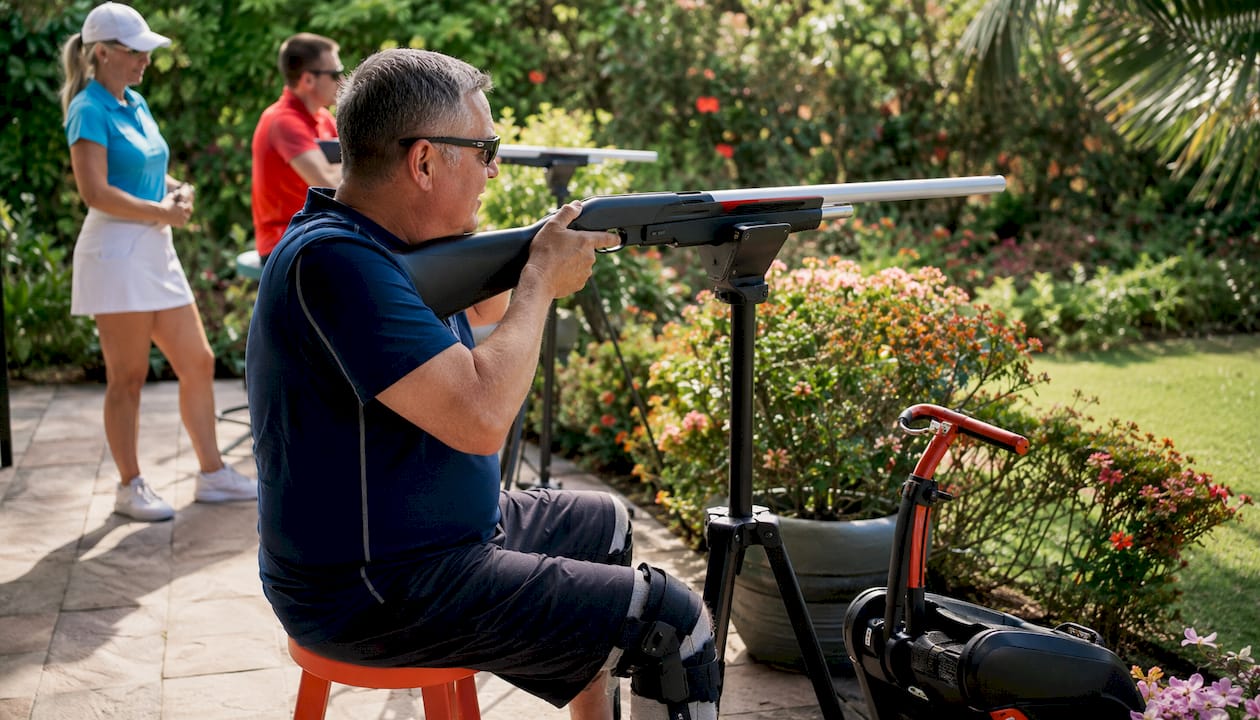
For participants who cannot stand or have limited upper-body strength, seated shooting and mounting stands are standard reasonable adjustments at most UK operators. A bipod or monopod support takes the weight of the gun entirely, so the participant focuses only on aiming and timing.
| Adaptation | Who it suits | Typical operator lead time |
|---|---|---|
| Seated shooting position | Wheelchair users, limited standing ability | Confirm at booking |
| Bipod / monopod gun mount | Limited arm strength or grip | Confirm at booking |
| Adjustable stock / shoulder rest | Shorter reach, prosthetic limb users | Confirm at booking |
| Ramped / paved range access | Wheelchair or mobility aid users | Confirm at booking |
| Visual start cue (flag/light) | Hearing sensitivity or hearing loss | Confirm at booking |
| Closer target distance | Limited vision, slower reaction time | Day-of adjustment |
Sensory considerations are worth raising before the day. Participants with hearing sensitivity benefit from visual start cues (a raised flag or LED signal) rather than a verbal “pull” call. For participants with limited vision, moving the target closer and using a wider electronic detection zone gives a larger effective hit area. None of these adjustments require specialist equipment — they are configuration choices the instructor makes at setup.
Pro Tip: Before the session, ask the operator for the gun’s unloaded weight and grip circumference. If a participant has limited hand strength, a foam grip wrap (available at most sports shops) can be fitted in minutes and makes a significant difference to comfort and control.
What are the safety rules and participant requirements?
Safety in laser clay is straightforward, and the absence of live ammunition removes most of the risk profile associated with traditional shooting sports. That said, operators follow a consistent set of protocols.
Standard safety steps every session includes:
- Instructor-led briefing covering range rules, gun-handling basics and emergency stop procedure.
- Demonstration by the instructor before any participant handles equipment.
- Supervised practice round with the instructor present at the shooting station.
- Range officer oversight throughout scored rounds.
Common participant requirements:
- Ability to follow verbal or visual instructions.
- Basic grip and hold ability (or a declared need for a mounting support).
- Minimum age guidance: most UK operators set this at 8–12 years old; children at the lower end may need adult assistance to hold the equipment safely.
- Closed-toe footwear and no loose scarves or dangling jewellery near the muzzle.
Medical disclosure: Operators are accustomed to reasonable-adjustment requests. If a participant has a cardiac condition, mobility impairment or any other health consideration, flagging it at booking (not on the day) gives the operator time to configure the right setup. Disclosures are handled confidentially and typically result in a brief pre-session conversation rather than exclusion.
Organiser safety checklist before confirming attendees:
- Confirmed minimum age for each participant.
- Any mobility aids or seating requirements noted.
- Hearing or vision considerations flagged to the operator.
- Closed-toe footwear confirmed for all participants.
- Medical conditions disclosed to operator in advance.
How to plan an inclusive session as an organiser
The single most effective thing an organiser can do is ask the operator about accessibility options at the point of booking, not on the morning of the event. Most UK operators can configure seating, mounting supports and adjusted target arcs with a few days’ notice; arriving and asking on the day creates pressure and limits options.
Before booking: Confirm the operator’s minimum age, the gun’s weight, whether seated shooting is available and what the range surface is like for wheelchair or mobility-aid users. Ask for a session format that builds in rotation rather than continuous shooting — this naturally creates rest periods without singling anyone out.
Pre-event communication: Send attendees a short briefing note covering what to wear, what to expect and a simple line inviting them to flag any access needs. Framing it as standard practice (“we want everyone to get the most out of the session”) removes the awkwardness of individual disclosure.
Grouping strategies: Mix abilities within teams rather than separating by fitness level. Relay formats, where team members take turns rather than all shooting simultaneously, let less mobile participants contribute at their own pace. The multi-shooter format — where up to five people fire at the same clay — is particularly useful here: a participant who cannot move between stations can still join a team shot from a fixed position.
On the day: Set up a quiet area for the briefing away from ambient noise. Assign a buddy or assistant to any participant who has flagged a specific need, and schedule at least one additional rest break beyond the operator’s standard rotation. Skill development in laser clay follows a progressive curve, so even participants who start slowly tend to improve noticeably within a single session — worth mentioning in your pre-event note to manage expectations positively.
How does a professional provider deliver genuine inclusivity?
A well-run provider does not treat accessibility as an afterthought. Staff training in reasonable adjustments, a configurable equipment fleet and clear pre-event communication are the operational markers that separate a genuinely inclusive session from one that merely tolerates mixed abilities.
Practically, this means:
- Lightweight simulated shotguns with interchangeable stocks and grip options.
- Seating rigs and bipod mounts available as standard, not on special request.
- Ramped or paved access to shooting stations.
- Visual start cues as a default option for any participant who requests them.
- Eco-friendly operation with no lead shot, no cartridge waste and no noise pollution — which also makes outdoor sessions more comfortable for participants with sensory sensitivities.
Laser clay removes the intimidation factor that keeps many people away from traditional shooting sports. No recoil, no loud report, no heavy ammunition — the playing field genuinely levels out, and participants who would never consider live-fire shooting find themselves competing on equal terms within minutes.
When requesting an inclusive booking, give the operator your group size, the number of participants with specific access needs, your preferred session length and any medical disclosures. The more detail you provide at enquiry stage, the better the operator can configure the session before you arrive.
Warm-up and cooldown routines for mixed fitness levels
Because laser clay’s physical demand is low, warm-up routines are brief and focus on the joints and muscles actually used: shoulders, wrists and the stabilising muscles of the core and lower back.
A five-minute warm-up before shooting works well for most groups: gentle shoulder rolls (10 each direction), wrist circles, a slow torso rotation and a few seconds of standing balance on each foot. Participants who are seated can do all of these from their chair. The goal is not to raise heart rate but to bring awareness to the shoulder and wrist joints before they take the gun’s weight.
Cooldown is equally short. After the final round, two minutes of slow shoulder stretches and a gentle neck roll are sufficient. For participants who have been standing throughout, a brief seated rest and a glass of water is the practical priority. Instructors can fold both routines into the session’s natural transition points — warm-up during the safety briefing demonstration, cooldown during score tallying — so they feel like part of the activity rather than an interruption.
Matching session intensity to individual health and fitness
The most useful tool an organiser has is a simple pre-event health question, not a formal fitness assessment. Asking attendees whether they have any conditions that affect standing, holding, or sustained concentration gives the operator enough information to configure the right setup.
For participants with cardiac conditions or low endurance, the key adjustment is session duration and shot frequency. Shorter rounds of three to five shots, with seated rest between each, keep the activity well within a comfortable exertion range. Core stability rather than aerobic capacity drives shooting performance, so a participant with low cardiovascular fitness is not at a meaningful disadvantage.
For participants at higher fitness levels who want more challenge, instructors can increase target speed, introduce crossers and high incomers, and run timed competitive formats. The same session can therefore serve both ends of the fitness spectrum simultaneously, with the instructor managing the two groups through target configuration rather than separate sessions.
Key takeaways
Laser clay is genuinely inclusive across fitness levels because the technology removes recoil and noise, and because operators can adjust equipment, pacing and target configuration to suit almost any participant.
| Point | Details |
|---|---|
| No recoil removes the main barrier | Infrared systems eliminate kickback, making the activity safe for participants who cannot absorb physical impact. |
| Seated and supported shooting is standard | Bipod mounts, seating rigs and adjustable stocks are available at most UK operators with advance notice. |
| Cardiovascular fitness is not required | Core stability and consistent rhythm matter more than aerobic capacity in recreational shooting. |
| Multi-shooter format aids inclusion | Up to five participants can fire at the same clay, enabling team formats that keep less mobile players fully engaged. |
| Laserclay delivers configurable sessions | Laserclay’s adjustable equipment, paced formats and eco-friendly operation make it a practical choice for mixed-ability groups. |
Why inclusivity in laser clay is more than a selling point
Most activity providers describe themselves as “suitable for all abilities.” Laser clay is one of the few where the technology actually enforces that claim rather than just asserting it. The absence of recoil is not a minor feature — it is the reason a 70-year-old with osteoporosis and a 14-year-old with no sporting background can stand at adjacent stations and have a genuinely competitive game.
What organisers tend to underestimate is how much the multi-shooter format changes group dynamics. When five people can fire at the same clay, the less mobile participant is not waiting and watching — they are part of the shot. That shift from observer to participant is where the real inclusion happens, and it requires no special equipment or prior planning.
The one thing I would push back on is the assumption that accessibility adjustments need to be invisible to work. In my experience of planning mixed-ability sessions, naming the adjustments openly (“we’ve set up a seated station over here, and anyone can use it at any time”) removes the awkwardness far more effectively than trying to make them unnoticeable. Participants appreciate being told the option exists; they do not need to be protected from knowing it.
Book an inclusive laser clay session with Laserclay
If you are organising a session for a mixed-ability group, the practical next step is to get in touch with Laserclay before you confirm numbers. Tell them your group size, the number of participants with specific access needs, your preferred session length and any medical considerations. That information lets the team configure seating rigs, mounting supports and target settings before you arrive, rather than improvising on the day.
Laserclay runs sessions for corporate teams, school groups, birthday parties and community events, with equipment and formats that flex around your group rather than the other way round. No lead shot, no ear defenders, no heavy cartridges — just a well-run, genuinely accessible session that works for participants across the full range of ages and physical abilities. Check availability and book your session to get started.
Where to read more
Useful sources for organisers, practitioners and anyone assessing suitability for specific participants:
- Laser Clay Shooting — Hunter Adventure Centre: Covers age guidance (minimum 13 at this operator), group sizes of 5–50 and the simultaneous five-shooter format. Useful for understanding how session logistics scale with group size.
- Emerald Outdoors — Laser Clay Shooting in Kenmare: Detailed breakdown of age minimums (8 years old minimum, 12 recommended), fitness requirements (“you just need to be able to hold a gun”) and throughput rates. Good reference for organisers assessing suitability for younger or lower-fitness participants.
- Scouts UK — Laser Clay Pigeon Shooting: Authoritative guidance on running laser clay as a supervised youth activity, including safety protocols and leader responsibilities. Relevant for school and youth-group organisers.
- The relative importance of physical fitness parameters in Olympic clay target shooting: Peer-reviewed research confirming that elite postural and cardiovascular demands do not apply to recreational shooting contexts — useful for reassuring participants and commissioners who worry about fitness prerequisites.
- Factors Affecting Shooting Performance in Laser Run: Research showing that higher heart rate does not impair shooting accuracy, supporting the case that low cardiovascular fitness is not a barrier to participation.
- Laserclay — What is laser clay shooting? A complete guide: Technical and safety background for organisers who want a fuller picture of how the infrared system works and what to expect from a professional provider.