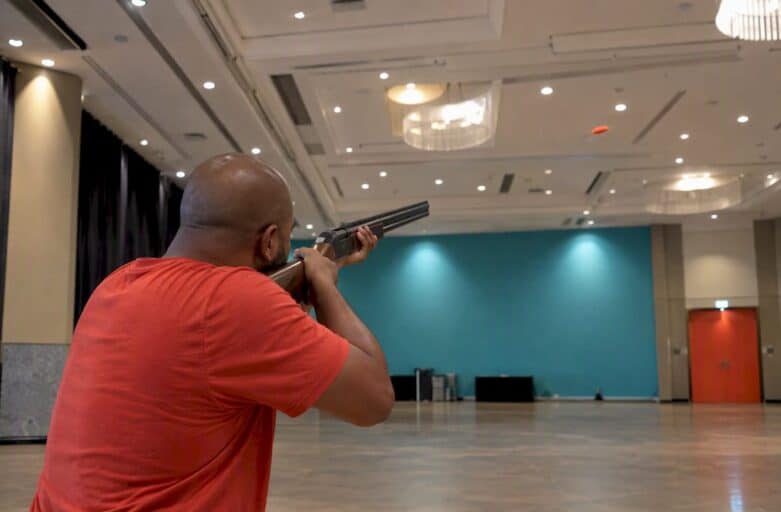
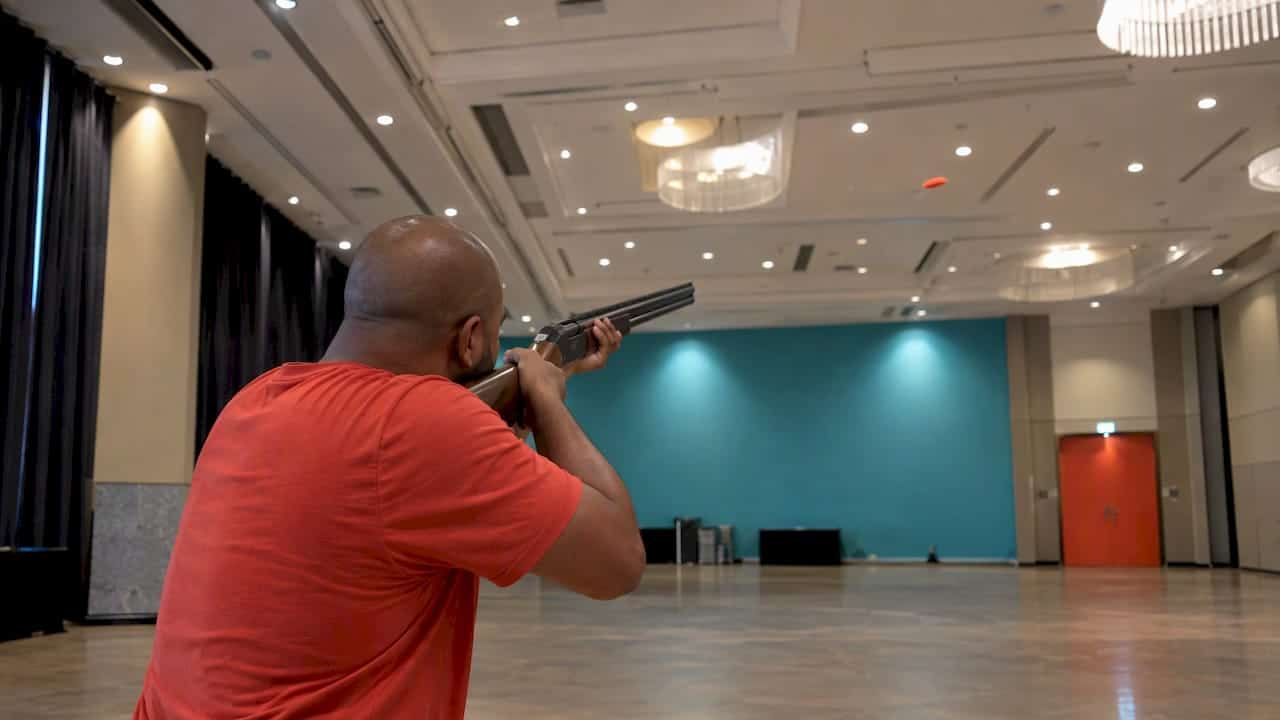
Indoor laser skeet is clay shooting with the lead, the noise and the weather taken out. Players hold deactivated 12-bore shotguns that fire infrared beams at reflective, reusable clays, and a scoring system records every hit. In Singapore, where a live clay range is a trip away and a licence matter, it is a practical way to put a group of mixed ages and abilities into a real shooting game in an ordinary function room, hall or covered space.
This guide explains how a session runs, how it differs from live-fire clay shooting, what skills it does and does not build, and which safety and compliance points a Singapore organiser should settle before booking.
TL;DR
- Indoor laser skeet uses deactivated shotguns, infrared beams and reusable clays, so there is no lead, no live ammunition and no range noise.
- It suits groups: corporate teams, birthday parties from age 10, school camps and social events, with real-time scoring.
- It trains parts of the shooting task, such as tracking and timing, but it is not a replacement for a licensed live-fire course.
- Singapore organisers should check venue space, power, staffing, risk assessment and laser-equipment compliance before the day.
- Our packages start at S$49 per person for parties and S$69 per person for corporate groups, with system rental at S$500 to S$800 per hour.
Table of Contents
- What indoor laser skeet actually is
- How a session runs
- Indoor laser skeet versus live-fire clay shooting
- Does it build real shooting skills?
- The environmental case, and its limits
- What Singapore organisers should check
- Our perspective
- Choosing the right format for your group
- Prices and booking
- FAQ
- Sources
What indoor laser skeet actually is
Traditional skeet and trap shooting launch a clay disc into the air. The shooter has to predict where the disc will be when the shot cloud reaches it, allowing for the speed of both the projectiles and the target. Shooters call this allowance the lead, and research on clay-pigeon shooting describes it in just those terms.
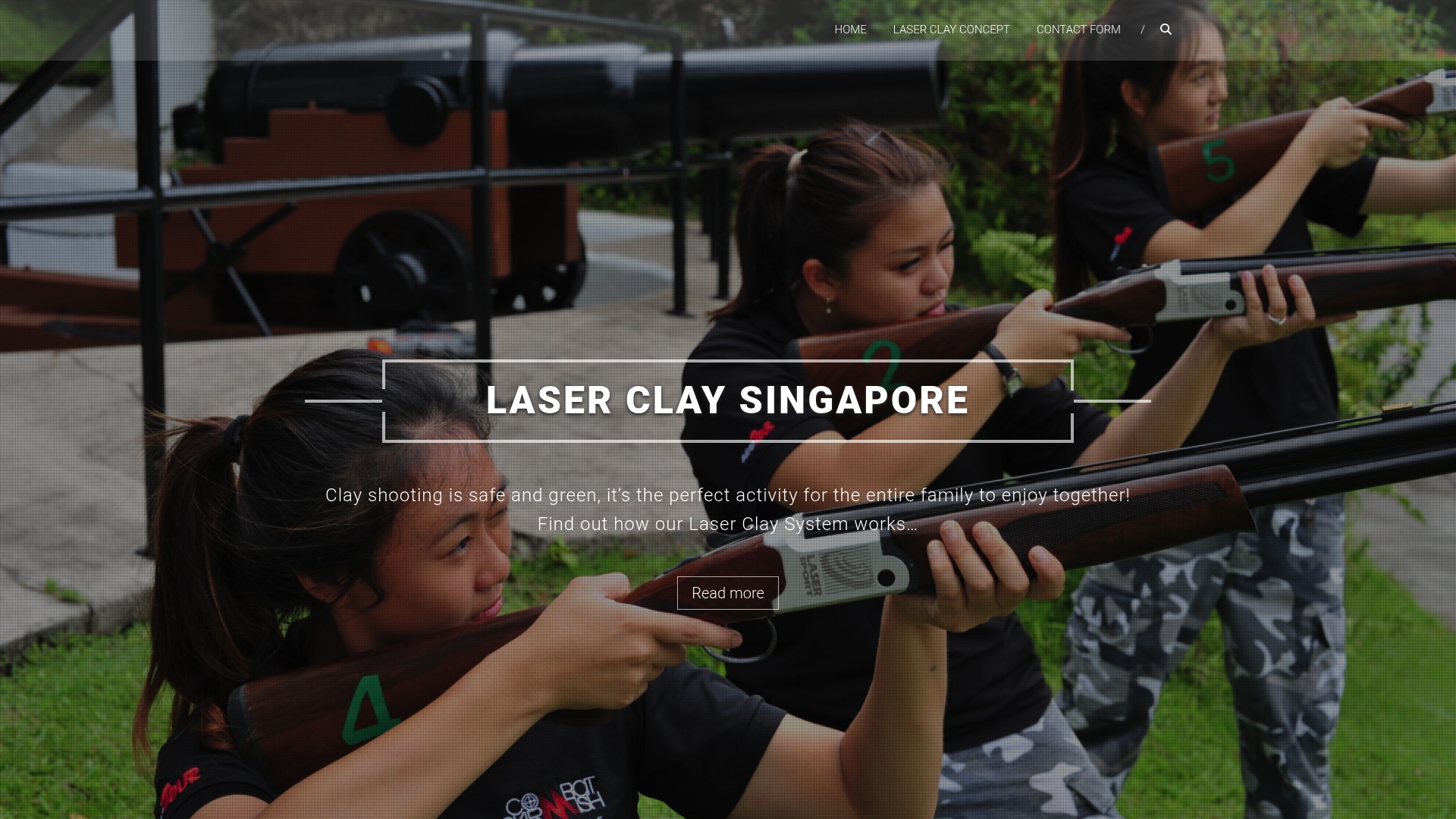
Laser versions keep that decision and remove the hazard. The gun is a deactivated 12-bore, so it looks and handles like the real thing, but what leaves the barrel is an infrared beam. The clay is a reflective, reusable target. When the beam meets the target, the system registers a hit. A sound module reproduces the bang so the shot feels right, and a scoring unit shows the result.
That is the format we run. You can read more on the laser clay shooting guide or see how the activity is described on our page about clay shooting the greener way.
Why “indoors” matters
No projectile means no downrange. There is no need for a shooting range, a backstop or hearing protection. The target can be launched or positioned in a hall, a ballroom, a school gym, a void deck function space or a covered carpark, as long as the layout and power work. That is the whole appeal in Singapore: heat, afternoon rain and limited land make a weatherproof activity genuinely useful.
How a session runs
A good indoor session is run, not just set up. Here is the typical flow of one of our events.
- Brief and handling. The facilitator explains how to hold and mount the gun, where the safe direction is and how scoring works. Even with deactivated guns, we treat the habits seriously, because they shape how people behave with the equipment.
- Practice rounds. Players take a few shots at the clays to find their timing. This is where beginners usually discover that aiming at the target and aiming ahead of it are not the same thing.
- Game rounds. Formats vary: individual scoring, team totals, knockout rounds, or timed challenges. The scoreboard updates as people shoot, so the room stays involved.
- Finals and results. Corporate groups often finish with a head-to-head final. Parties tend to end with a podium and photos.
Setup is part of the plan. Our guidance on setup time covers the 60 to 90 minutes organisers should allow, and the setup requirements page lists the checks that matter most.
Scoring and visibility
Scores are shown on real-time electronic scoreboards. That sounds like a detail, but it is what turns a novelty into a competition: people watch, cheer and recalculate who they need to beat. If you want to extend that into the room, see our leaderboard ideas for visible scores.
Indoor laser skeet versus live-fire clay shooting
The two share a target logic and little else. This table sets out the practical differences for an organiser, not a sports purist.
| Factor | Indoor laser skeet | Live-fire clay shooting |
|---|---|---|
| Projectile | Infrared beam | Lead or steel shot |
| Noise | Simulated sound, no range noise | Loud, hearing protection needed |
| Location | Halls, function rooms, outdoor spaces | Licensed shooting ranges |
| Group mix | Suits beginners and mixed abilities, from age 10 with us | Typically restricted by range rules and instruction |
| Environmental load | No lead pellets, reusable clays | Lead or shot fall-out, broken clay debris |
| Scoring | Instant, electronic | Manual or range-based |
| Travel | System comes to your venue | Group travels to the range |
The honest summary: laser skeet gives you the shooting decision, the competition and the social energy. It does not give you recoil, a live shot pattern or the full feel of a field. We say so plainly because planners should choose it for what it does best.
Does it build real shooting skills?
People often ask whether laser clay carries over to the real thing. The evidence is encouraging but limited, and it is worth being exact about it.
A study of virtual-reality clay-pigeon shooting found that training guidance affected performance in the simulation, and that the improvement persisted in repeated measures after the guidance was removed. The researchers’ view is that fidelity matters: clay shooting depends on depth perception, target prediction, lead and accurate timing, and a simulation can train parts of that motor task when the training is well designed.
That is a VR study, not a study of our system, so we do not claim the same results. What we do say is this: the decisions a laser player makes, reading the flight of a target and committing to a swing at the right moment, are the same decisions a live shooter makes. If you want to go deeper, our articles on how laser clay compares to real clay accuracy, skill development in laser clay and improving accuracy with laser training cover it.
Solo practice tricks, such as moving a laser dot across a wall, help with gun mounting and swing smoothness. A group session is a different thing: it is about participation and play, with skill as a side effect.
The environmental case, and its limits
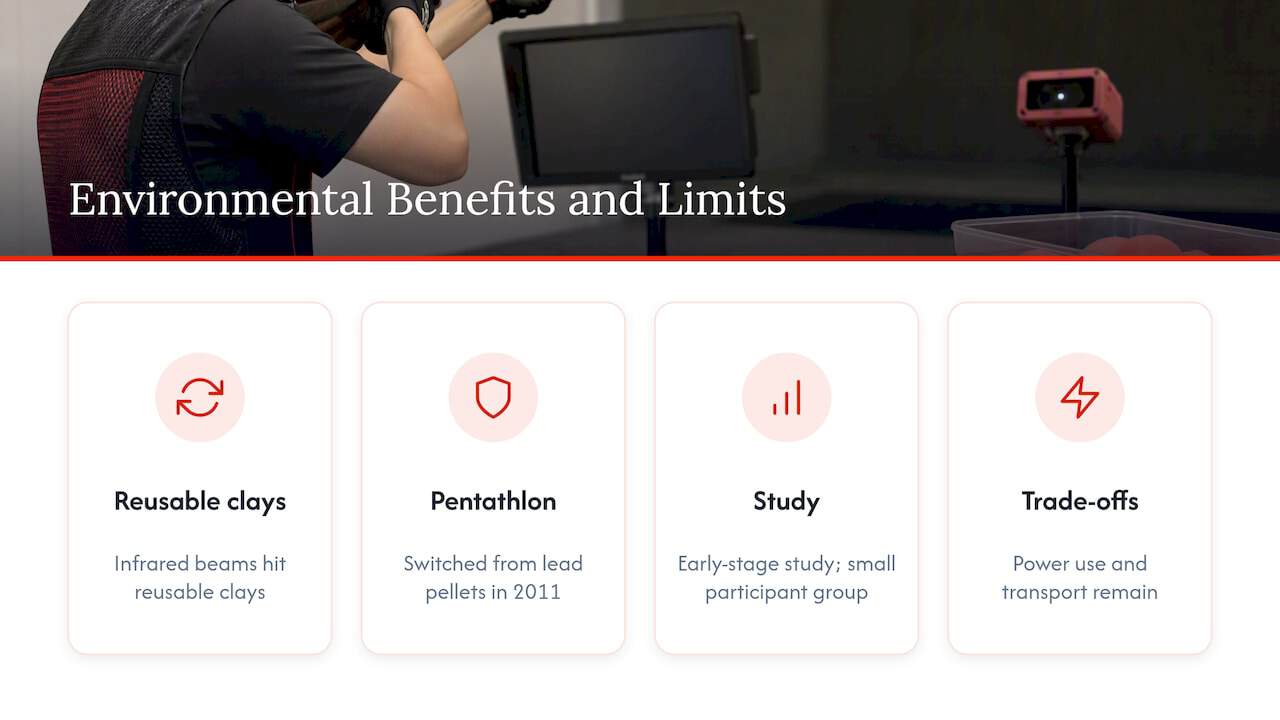
One reason organisers choose laser over live-fire is the environmental footprint. Our guns fire infrared beams at reusable clays, so there are no lead pellets to fall and no clay fragments to clear. Our guide to eco-friendly alternatives to traditional clay shooting goes through the detail.
A useful parallel comes from modern pentathlon. The International Olympic Committee’s sustainability case study records that the sport’s governing body switched from lead pellets to laser pistols in 2011, removing the lead-pellet risk and improving safety, security and accessibility. It also notes the challenges: compatible equipment had to be developed and standards set for approval. That is a pistol example, not a Singapore clay measurement, but the lesson transfers. Replacing lead with lasers widens where and who can take part, provided the equipment is reliable.
A separate academic study of electronic shotgun simulation, published in Engineering Reports, concluded that simulation can make shotgun training safer and less resource-intensive. Its authors are candid that it was an early-stage study with a small participant group and limited budget, so treat it as a promising direction rather than a final verdict.
The limits on our side are simple. The equipment runs on power, so a session still has an energy cost, and the system has to be transported. Our power requirements checklist helps organisers size batteries so a session does not stall mid-game.
What Singapore organisers should check
This is where a Singapore-specific guide earns its place. The questions below come up in almost every planning conversation.
Is a deactivated shotgun a weapon under Singapore law?
Singapore’s Guns, Explosives and Weapons Control Act defines a gun as an object capable, as designed or adapted, of causing hurt or injury by propelling a bullet, shot or other projectile, or by discharging a corrosive substance or poison using specified force. The version cited is the one in force from 1 July 2025. A laser system emits an infrared beam rather than a projectile, which is the reason this format is workable at ordinary venues. Legal classification is a matter for the authorities, though, so organisers with a specific concern should ask us for our compliance details and, if needed, confirm with the relevant agency. Our page for planners, Before You Book: Singapore Laser Clay Compliance, sets out the checks we walk clients through.
Imports are a separate matter. The Singapore Police Force states that toy and replica gun imports and exports are regulated and need approval from the Police Licensing and Regulatory Department. That matters to anyone thinking of buying and bringing in their own equipment, which is one reason many organisers rent instead.
Do laser permits apply?
Laser equipment rules depend on the class of laser. Documentation from a Singapore convention venue states that operators of Class 3B or Class 4 laser equipment need specific permits and must submit equipment and layout plans for approval, and that companies providing laser demonstrations must hold the appropriate licence (N1, N2 or N3) under the Radiation Protection Act for non-ionising radiation apparatus. Those requirements are aimed at higher-powered show lasers. Venue rules differ, so ask your venue manager what paperwork they expect for any laser-based activity, and ask your provider for the equipment specifications to hand over.
Risk assessment and supervision
Singapore’s sport safety standard, SS 681:2022, provides a framework that expects organisers to run risk assessments and prepare emergency response and medical support plans before an activity, particularly for schools and groups. In practice that means:
- A named person responsible for the activity on the day.
- A floor plan showing the firing line, queue area and spectator area.
- Clear instructions for how guns are handled, held and set down.
- Staffing proportional to the group. Our staffing guidance explains the operator and marshal ratio we use.
- A first-aid contact and an emergency route, as with any event.
For school groups, check the age limit. Our activity is suited to ages 10 and above, and our comparison of laser tag and paintball by age shows where it fits.
The space and power
You need a clear area, a safe backdrop for the targets and a dependable power source. A hall that looks big enough can still fail on ceiling height, glare or too few sockets. Walk the space with us, or send photos, and we will say honestly whether it works. See our write-up of team building venues in Singapore for ideas that planners have used.
Our perspective
We built our business around one belief: the best part of clay shooting is the moment you read a target and commit to the shot, and that moment should not need a range, a licence and a hearing protector.
When we talk to planners, we usually hear the same worry. They want something physical and competitive, but not so intimidating that half the team sits out. Indoor laser skeet solves that because the learning curve is fast. Within a few shots, a first-timer is aiming ahead of the clay and an experienced person is chasing precision. Everyone is in the same game, with the same scoreboard.
We are also direct about what it is. It is not live-fire training and we do not sell it as a shortcut to a shooting licence. It is a safe, fully facilitated, eco-friendlier way to enjoy the sport’s core challenge, in a room you already have. If that is what your event needs, we will make it run well. If you need something else, we would rather tell you than sell you the wrong thing.
— Joshua
Choosing the right format for your group
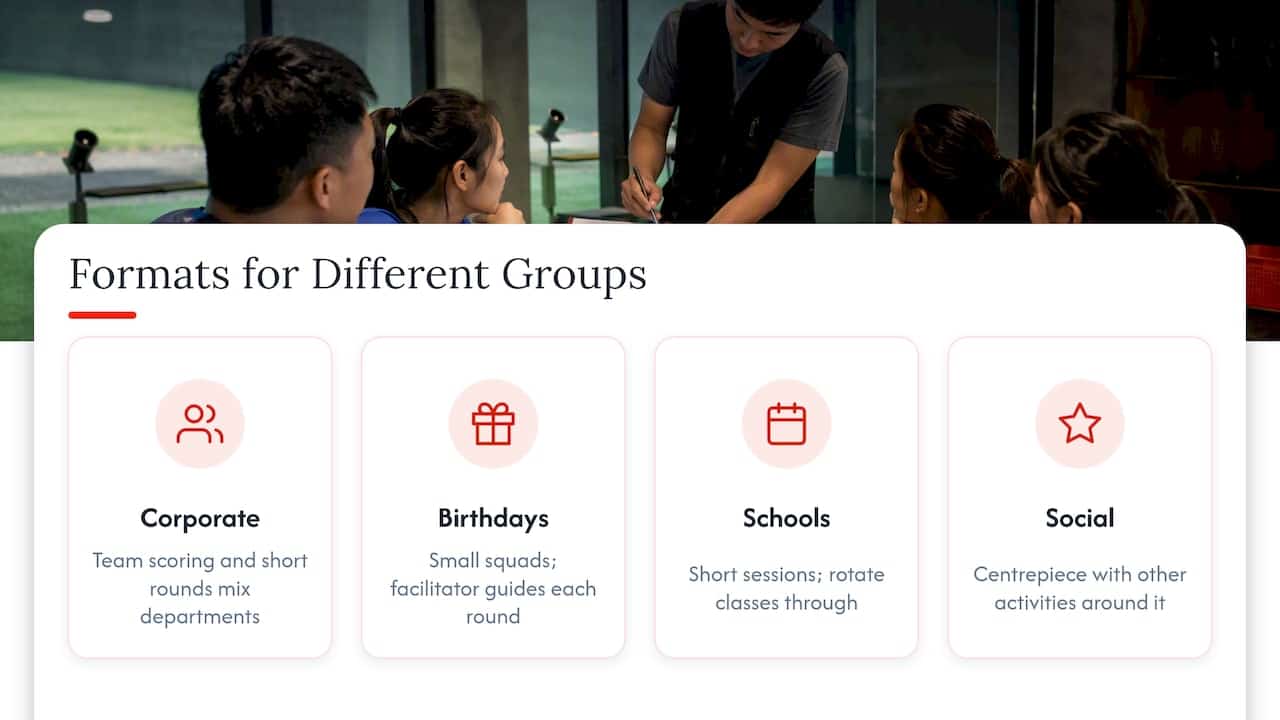
Corporate teams. Use team scoring and short rounds, so that people from different departments mix and nobody waits too long. Game formats can be customised, and our write-up on game show team building explains why the format fits a structured brief.
Birthday parties. Children from 10 usually do best in small squads with a facilitator guiding each round. Our guide to planning a laser clay birthday party for kids covers timing, group size and what to pair it with. If you are still comparing, the birthday party ideas for every age and budget is a good starting point.
Schools and camps. Keep sessions short and rotate classes through. A school gym is ideal, and the activity sits well beside other stations at a carnival or camp day.
Social events. For stag parties, family days or open houses, a laser system works as a centrepiece with other activities around it. Our bachelor party plan shows one way to build a programme, and the portable event activities shortlist sets out other options.
Prices and booking
Here is what our packages cost, as published on our site:
| Option | Price | Best for |
|---|---|---|
| Corporate Laser Clay Package | S$69 per person, one-off | Team-building, company days |
| Birthday party package | From S$49 per person, one-off | Children’s and family parties |
| System Rental | S$500 to S$800 per hour | Carnivals, camps, events with their own staff |
Packages include facilitators, venue setup, event customisation and equipment, indoors or outdoors. To check a date, a venue or a group size, get in touch with us and we will confirm what your space needs.
If you would like to see how the game plays before you book, how to play laser clay walks through a session, and our beginner’s guide answers first-timer questions. For a safety-first view of practice, see how to train clay shooting indoors safely.
FAQ
How much space does indoor laser skeet need?
It depends on the group size and format, but it needs a clear hall or room with a safe backdrop for the targets, enough power points and manageable lighting. Send us photos or the floor plan and we will confirm whether it works. Our setup requirements page lists the key checks.
Is it safe for children?
The guns are deactivated and fire infrared beams, with no projectiles, and every session is facilitated. Our activity is suited to ages 10 and above. Schools and group organisers should still run a risk assessment and emergency plan, as Singapore’s sport safety standard expects.
Will it improve my real clay shooting?
It trains the decisions behind the sport, such as reading a target and timing the swing, and research on simulated clay shooting suggests well-designed training can carry over in part. It does not replicate recoil or a live shot pattern, so treat it as a complement to licensed live-fire instruction, not a replacement.
Do I need a permit to host it?
Requirements depend on your venue and on the equipment class. Higher-powered laser equipment can need permits and licences in Singapore, so ask your venue manager what they require and ask us for equipment details. Our compliance page for planners covers the points to check.
Can we book it for a short event or just an hour?
Yes. If you already have staff and just need the equipment, System Rental is S$500 to S$800 per hour. If you want facilitators and full setup, our corporate and party packages are priced per person.
Sources
- A comparison between expert and beginner learning for motor skill in VR clay-pigeon shooting (Springer, 2019)
- From Lead to Laser Shooting, IOC sustainability case study (2017)
- Environmental impact and performance assessment of a new shotgun training approach (Engineering Reports, 2020)
- Guns, Explosives and Weapons Control Act 2021, Singapore Statutes Online
- Guide for Import Toy and Replica Gun, Singapore Police Force
- Laser equipment requirements for Singapore events (Sands Expo and Convention Centre, 2017)
- SS 681:2022 sport safety standard, Singapore Standards eShop